


If you hold a BCBA credential, the job market is working in your favor like almost never before. In 2025 there were 132,307 job postings for board certified behavior analyst jobs across the United States, according to a Lightcast analysis commissioned by the Behavior Analyst Certification Board (BACB). Set that against the roughly 74,000 BCBAs actually practicing nationwide, and the picture is clear: employers are competing for you, not the other way around.
This guide breaks down the 2026 demand data, explains why the gap keeps widening, shows where the jobs and the highest pay are, and lays out how to get hired fast in a market that heavily favors candidates.
How Many Board Certified Behavior Analyst Jobs Are There?
The headline number is striking. Behavior-analyst job postings reached 132,307 in 2025, a 28 percent jump over the prior year, per the BACB and Lightcast report US Employment Demand for Behavior Analysts: 2010-2025. That came on top of a 58 percent surge the year before. Even as the growth rate cools slightly, postings have climbed at a compound annual rate of 44.2 percent since 2017.
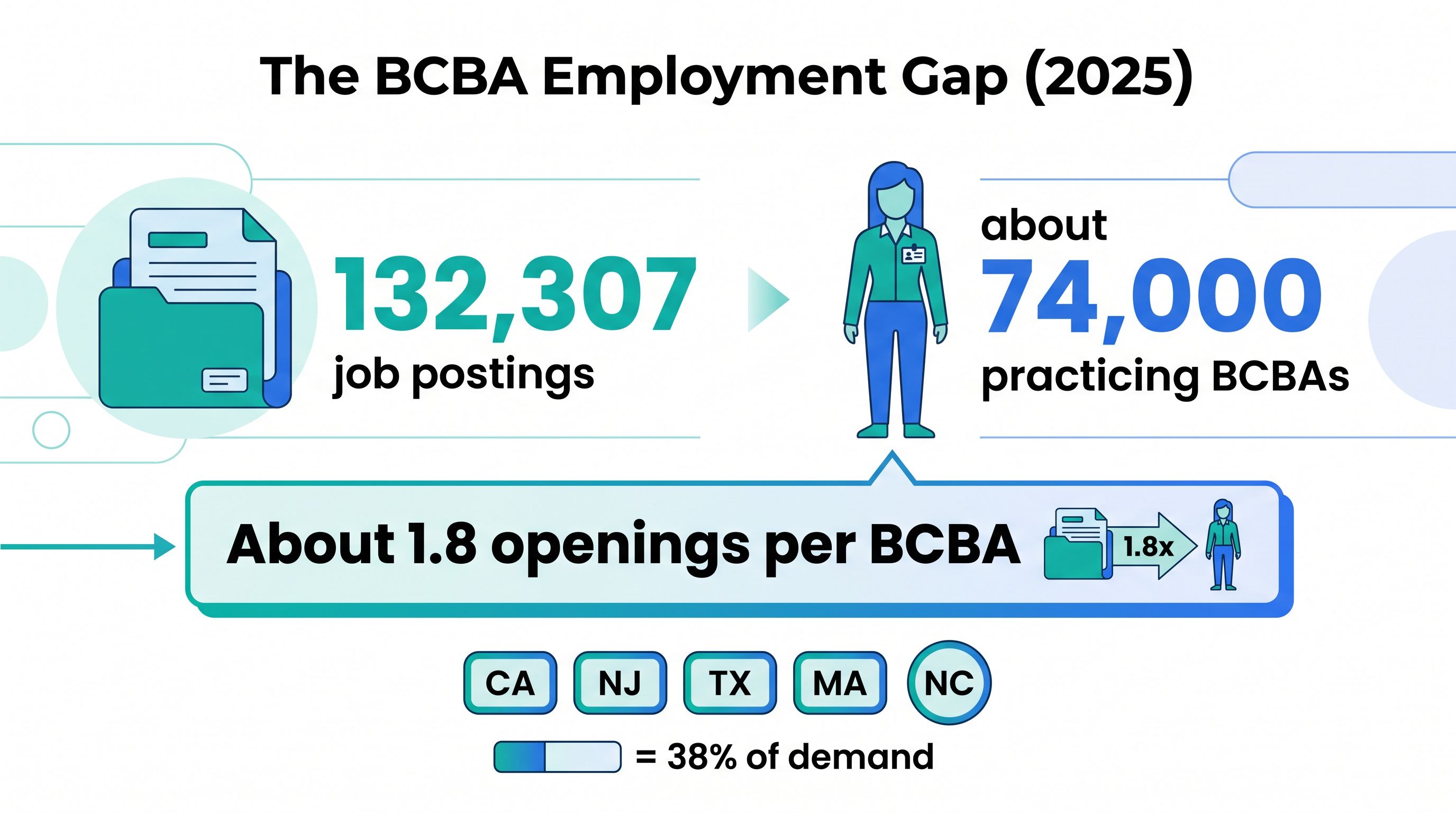
Now the supply side. The BACB certificant registry lists 85,587 BCBAs as of its January 2026 update. But not everyone on the registry is delivering services in the United States. BACB workforce figures from October 2025 count 71,371 BCBAs plus 2,915 doctoral-level BCBA-Ds actively practicing here, about 74,286 supervisor-level clinicians in total.
Divide the demand by the supply and you get roughly 1.8 open postings for every practicing BCBA in the country. And that ratio understates a job seeker's real advantage. The overwhelming majority of those 74,000 BCBAs are already employed and not looking to move. So if you are actively searching, you are not competing against the whole workforce for a scarce role; you are one of relatively few available candidates choosing among a mountain of openings. For a deeper count of what is out there, see our breakdown of BCBA job openings in 2026.
Roughly 1.8 job postings exist for every practicing BCBA; because most BCBAs are not job hunting, active candidates effectively pick from multiple offers.
Why the Employment Gap Keeps Widening
This is not a temporary blip. Several structural forces are pulling demand up faster than the profession can produce new analysts.
- ✓ Rising autism diagnoses. The CDC now identifies about 1 in 31 eight-year-old children with autism spectrum disorder, a steady climb that expands the population needing ABA services.
- ✓ Insurance mandates in all 50 states. Every state now requires some coverage of ABA therapy, converting clinical need into funded, billable demand.
- ✓ Expanding practice settings. Behavior analysis is moving well beyond autism clinics into schools, healthcare, organizational behavior management, and gerontology.
- ✓ A slow supply pipeline. Becoming a BCBA takes a master's degree, 1,500 to 2,000 supervised fieldwork hours, and a certification exam that only about 55 to 66 percent of first-time takers pass.
Geography makes the shortage sharper still. More than half of all U.S. counties have no practicing BCBA at all, which means demand in many communities goes completely unmet. We cover the numbers in detail in our analysis of the BCBA shortage in 2026 and the broader ABA employment gap.
Where the Jobs Are: Top States and Settings
Demand is national, but it concentrates. Five states accounted for 38 percent of all behavior-analyst demand in 2025: California, New Jersey, Texas, Massachusetts, and North Carolina. California alone represented about 15 percent of the country's demand. Massachusetts has the highest density of BCBAs, at 55.1 per 100,000 residents, while many other states remain far more underserved.
That underservice is an opportunity. Lower-density states and rural counties frequently offer sign-on bonuses and pay premiums to attract analysts. To scan openings in your area, start with our guide to finding BCBA jobs near me.
Board certified behavior analyst jobs also span a wide range of settings, each with a different day-to-day:
- Clinic and center-based: structured, team-heavy environments, often with strong supervision support.
- In-home: family-centered work with more autonomy and travel between clients.
- School-based: aligned to the academic calendar, with IEP and classroom collaboration.
- Telehealth: remote assessment and caregiver coaching, expanding fast as a way to reach unserved counties.
- Hospital and healthcare: interdisciplinary teams treating complex cases.
- Insurance and utilization review: non-clinical roles reviewing treatment plans and authorizations.
- Leadership: clinical director and program roles, which the shortage is opening up faster than usual.
Want the full landscape of roles and demand drivers? Our overview of behavior analyst jobs in 2026 maps them out.
What Board Certified Behavior Analyst Jobs Pay in 2026
Pay reflects the shortage. Nationally, most BCBA roles land in a range of about $70,000 to $95,000, with six-figure compensation common in leadership positions, high-demand metros, and contract or travel roles. Setting and geography drive much of the spread, and the tight labor market gives candidates genuine negotiating leverage.
For hard numbers, see how earnings break down in how much a BCBA makes in 2026 and compare local markets in our BCBA salary by state guide.
How to Get Hired Fast (and Choose the Right Employer)
When demand outstrips supply this heavily, the smart move is to change your mindset. The goal is not to land any job; it is to vet employers and pick the one that fits your career and your ethics. A few practical steps:
- 1. Lead with outcomes. Frame your resume around client progress, program results, and supervision impact rather than task lists. Our BCBA resume guide shows how.
- 2. Prepare for behavioral interviews. Expect scenario questions about caseload management and ethics. Practice with our list of BCBA interview questions for 2026.
- 3. Interview them back. Ask about caseload sizes, billable-hour expectations, supervision structure, and turnover. Our guide to questions to ask in an ABA interview flags the red flags to watch for.
- 4. Target the right cultures. Not every employer is equal on ethics, caseloads, or growth. See what to look for in the best ABA companies to work for in 2026.
There is also a smarter way to run the search itself: let employers come to you. Applying to postings one at a time puts the work on you and exposes your identity to your current employer. A reverse marketplace flips that. On CertifyndABA, you build an anonymous profile of your qualifications, and employers from that 132,307-posting pool send you interview requests. Your name and contact details stay private until you decide to accept.
Frequently Asked Questions
Are board certified behavior analysts in demand?
Yes, strongly. There were 132,307 behavior-analyst job postings in 2025 against roughly 74,000 practicing BCBAs, about 1.8 openings per analyst, and more than half of U.S. counties have no BCBA at all.
What is the job outlook for BCBAs?
Excellent. Postings have grown at a 44.2 percent compound annual rate since 2017, and federal labor projections point to far-above-average growth for behavioral-health occupations through 2034, several times the roughly 4 percent all-occupation average.
Can you make six figures as a BCBA?
Yes. While the typical range is about $70,000 to $95,000, six-figure pay is common in clinical director and leadership roles, high-demand metros, and contract or travel positions.
What can you do as a board certified behavior analyst?
Beyond autism therapy, BCBAs work in schools, hospitals and healthcare, organizational behavior management, gerontology, research, and clinical leadership. The credential is portable across a growing set of industries.
The Bottom Line for 2026
Board certified behavior analyst jobs sit at the center of one of the strongest candidate markets in healthcare. Demand is outpacing supply by a wide margin, the gap is widening, and that gives you real leverage over where you work, what you earn, and how you are treated. The winning strategy in 2026 is not to chase openings; it is to make employers compete for you.
Let employers come to you
Create a free, anonymous CertifyndABA profile and let qualified employers send you interview requests. Your identity stays private until you choose to respond.
Create Your Free Profile