


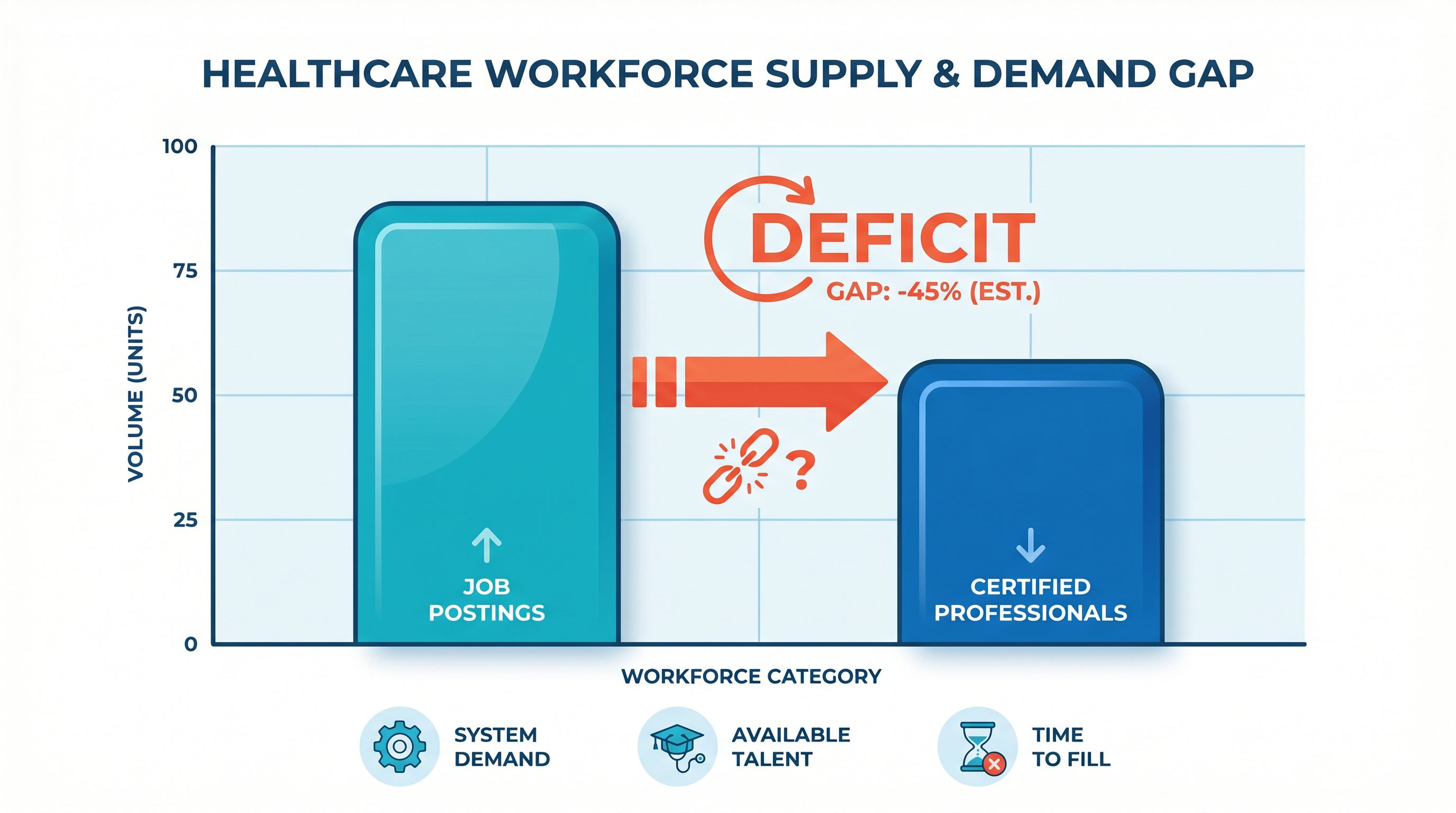
In 2025, employers posted 132,307 job openings for Board Certified Behavior Analysts. At the same time, only 81,566 BCBAs held active certifications. That means there were roughly 1.6 applied behavior analysis jobs for every qualified professional available to fill them. For ABA practitioners, this gap represents something rare in healthcare: a job market where the candidates hold the leverage.
This is not a temporary hiring surge. The ABA employment gap has been widening for over a decade, driven by rising autism diagnoses, expanding insurance mandates, and a certification pipeline that simply cannot keep pace with demand. Whether you are a newly certified BCBA, an experienced behavior analyst exploring new settings, or an RBT considering the path to certification, understanding this gap is essential to making smart career decisions in 2026.
Types of Applied Behavior Analysis Jobs
Applied behavior analysis jobs span three primary certification levels, each with distinct roles and responsibilities.
Board Certified Behavior Analysts (BCBAs) hold a master's degree and design treatment plans, conduct assessments, and supervise clinical teams. As of April 2026, 83,586 professionals hold this credential, according to the Behavior Analyst Certification Board (BACB). BCBAs represent the most in-demand tier of the ABA workforce.
Board Certified Assistant Behavior Analysts (BCaBAs) work at the bachelor's level under BCBA supervision, assisting with program implementation. There are currently 5,223 active BCaBAs. Demand for this credential has been relatively flat, with 10,717 job postings in 2025.
Registered Behavior Technicians (RBTs) are the largest segment of the ABA workforce at 253,397 certificants. RBTs work directly with clients, implementing the treatment plans that BCBAs design. They represent the front line of ABA service delivery.
These roles operate across a wide range of settings: ABA clinics, public and private schools, home-based programs, hospitals, and increasingly through telehealth platforms. Beyond the traditional focus on autism services, ABA professionals also work in organizational behavior management, elder care, substance abuse treatment, and sports performance.
The Applied Behavior Analysis Jobs Gap: Supply vs. Demand
The numbers tell a clear story. In 2025, the ABA field had approximately 50,000 more open positions than certified BCBAs to fill them. And because not every BCBA is actively job-seeking (many are already employed, semi-retired, or working in non-clinical roles), the effective ratio for available candidates is closer to two or three openings per person.
The growth trajectory makes this gap even more striking. Job postings for BCBAs grew from roughly 34,000 in 2020 to 132,307 in 2025, an increase of approximately 289% in five years. During the same period, the number of certified BCBAs grew from 44,025 to 81,566; a meaningful 85% increase, but nowhere near enough to match demand.
The year-over-year data reinforces the mismatch. From 2024 to 2025, BCBA job postings grew by 28%. BCBA certifications grew by 9.9%. The gap is not shrinking; it is accelerating.
"With roughly 50,000 fewer BCBAs than job openings, the gap between supply and demand limits access to care and extends already long waitlists."
Why the ABA Employment Gap Keeps Growing
Several structural forces are driving this widening gap, and none of them show signs of reversing.
Rising Autism Identification
The CDC's 2025 Community Report on Autism found that 1 in 31 children in the United States are now identified with autism spectrum disorder, up from 1 in 36 just two years earlier. For boys, the rate is 1 in 20. In California, it reaches 1 in 12.5. This is nearly five times higher than when the CDC began tracking autism prevalence in children born in 1992. While much of this increase reflects improved diagnosis and awareness rather than a true increase in occurrence, the effect on service demand is the same: more children identified means more families seeking ABA therapy.
Insurance Mandate Expansion
All 50 states now require some form of insurance coverage for ABA services. These mandates create a consistent, funded demand pipeline that did not exist 15 years ago. As state legislatures have expanded coverage requirements and government funding streams have broadened support for evidence-based behavioral treatments, the number of positions in clinics, schools, and private practices has grown accordingly.
The Certification Bottleneck
Becoming a BCBA is not a quick process. It requires completing a master's degree, accumulating 2,000 or more supervised fieldwork hours, and passing the BCBA certification exam. According to the BACB's annual report, approximately 8,000 new BCBAs are certified each year. That is not enough to close a gap that grows by tens of thousands of job postings annually.
High RBT Turnover
Turnover rates among Registered Behavior Technicians range from 45% to 75%, according to industry estimates. When RBTs leave, BCBAs absorb additional supervisory and training responsibilities. This increased workload contributes to BCBA burnout, which in turn drives more hiring demand as organizations try to manage sustainable caseloads.
Where Applied Behavior Analysis Jobs Are Most in Demand
Demand for ABA professionals varies significantly by state. The top five states for BCBA job postings in 2025, according to Lightcast data analyzed by the ABA Resource Center, were:
- California: 20,258 positions (+3% year-over-year)
- New Jersey: 8,139 positions (+58%)
- Texas: 7,792 positions (+32%)
- Massachusetts: 7,315 positions (+19%)
- North Carolina: 6,874 positions (+63%)
But some of the most dramatic growth is happening in states that historically had smaller ABA markets. South Carolina saw a 102% increase in BCBA job postings. Utah grew by 94%. Nebraska increased by 81%, and Missouri by 76%. These emerging markets often mean less competition for available positions and, in some cases, higher relative compensation as employers compete for a smaller local talent pool.
What the Employment Gap Means for Your ABA Career
If you are a certified behavior analyst or working toward certification, this employment gap translates directly into career leverage. Here is what that looks like in practice.
- ✓ Salary negotiation power. With multiple employers competing for the same candidates, you can negotiate from a position of strength. Research your local market data before accepting any offer.
- ✓ Flexibility in work arrangements. Part-time positions, telehealth roles, and contract work are increasingly available as employers adapt to attract talent. You can often find a structure that fits your life rather than the other way around.
- ✓ Signing bonuses and relocation support. Particularly in underserved areas and fast-growing states, organizations are offering signing bonuses and relocation packages to secure qualified BCBAs.
- ✓ Choice of setting and population. Whether you prefer a clinical environment, school-based work, home health, or telehealth, the demand exists across all settings. You can be selective about where and how you practice.
- ✓ Long-term career stability. The Bureau of Labor Statistics projects 17% growth for behavioral health counselors from 2024 to 2034, well above the 4% average for all occupations. The structural factors driving ABA demand are not cyclical; they are durable.
The bottom line: the ABA employment gap is not closing anytime soon. With only about 8,000 new BCBAs certified each year against tens of thousands of new job postings, this is a multi-year structural advantage for qualified professionals. The question is not whether you can find a job in applied behavior analysis; it is how to choose the right one.
Find the Right Applied Behavior Analysis Job for You
The data is clear: applied behavior analysis jobs are abundant, growing, and increasingly favorable for qualified professionals. With 132,307 job postings chasing 83,586 certified BCBAs, you are in a position to be selective about your next role. Know your market value, research your state's demand data, and do not hesitate to negotiate for the salary, benefits, and work arrangement you deserve.
In a market where demand outpaces supply by this margin, the traditional job search feels backwards. Instead of scrolling through hundreds of listings, consider letting employers compete for your attention.
Let Employers Come to You
CertifyndABA is a reverse job marketplace built for ABA professionals. Create an anonymous profile, set your preferences, and receive interview requests from employers who match what you are looking for. No resume blasting. No cold applications.
Create Your Free Profile