


With 83,586 active BCBAs in the United States and over 132,000 job postings competing for their attention, finding the best ABA companies to work for has never been more about what you want. The days of taking whatever position is available are over. The real question is: which employer deserves your expertise?
This guide skips the subjective company rankings that go stale in months. Instead, it gives you a data-backed framework for evaluating any ABA employer, so you can make confident career decisions no matter where you live or what setting you prefer.
The ABA Employment Gap: Why BCBAs Hold the Power
Before evaluating employers, understand just how much leverage you carry. The numbers tell a clear story.
According to the Behavior Analyst Certification Board (2026), the U.S. has 83,586 active BCBAs, 5,223 BCaBAs, and 253,397 RBTs. Workforce analyses estimate that only about 72% of BCBAs work in direct autism-related care, reducing the effective clinical workforce to roughly 53,000 against a need for over 100,000.
Demand grew 28% from 2024 to 2025, with job boards reporting a 58% increase in BCBA vacancies during that same period. The Bureau of Labor Statistics projects 19-22% job growth for behavior analysts through 2033, dwarfing the 3.1% overall economy growth rate. And with CDC autism prevalence now at 1 in 31 children (3.2%) and all 50 states mandating insurance coverage for ABA services, demand will only accelerate.
What does this mean for your job search? You have options. You can afford to be selective. And you should be.
7 Factors for Evaluating the Best ABA Companies to Work For
Rather than chasing company names, evaluate every potential employer against these seven criteria. Rate each factor on a 1-10 scale during your interview process to make systematic comparisons.
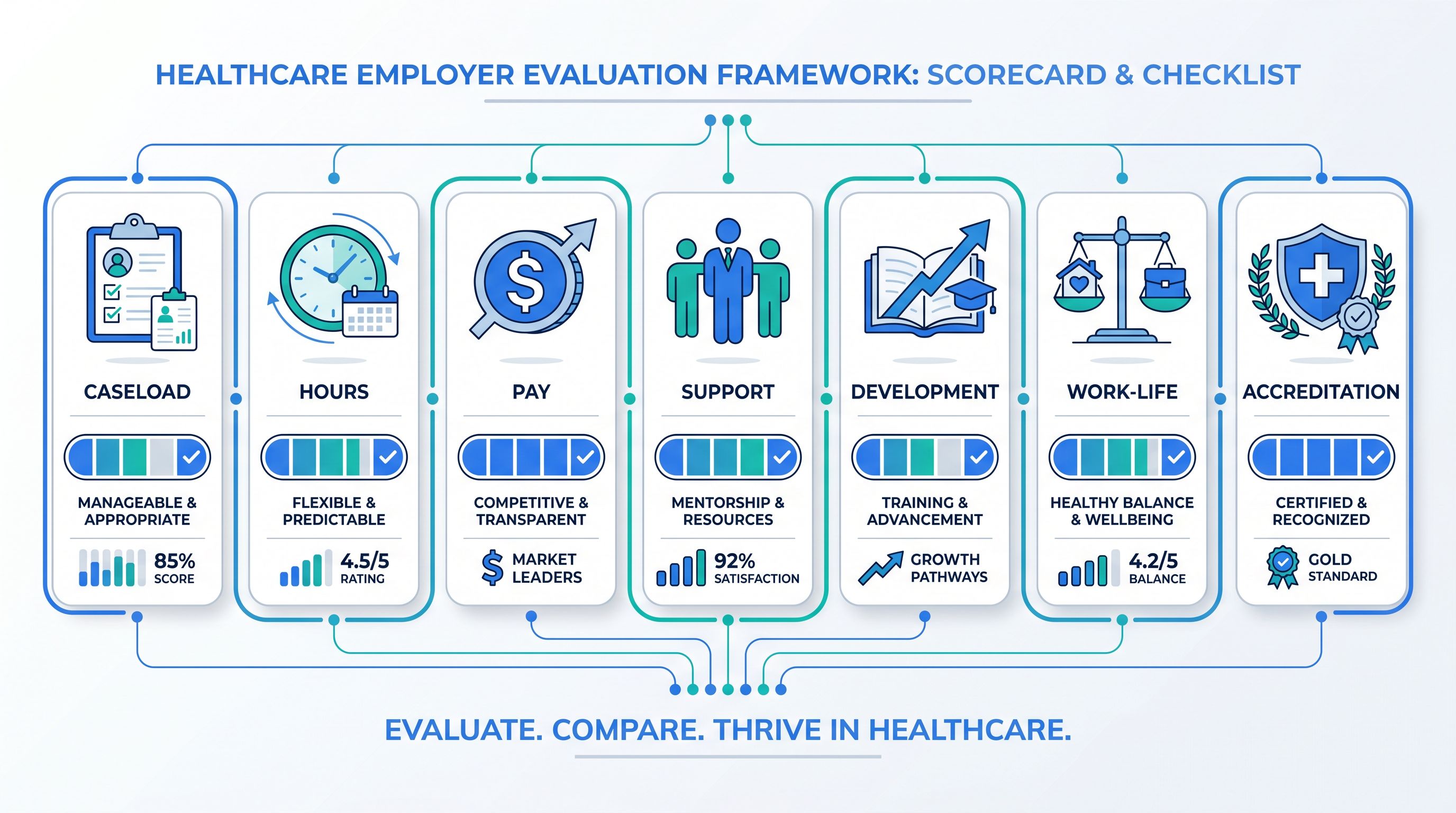
1. Caseload Sustainability
This is the single biggest predictor of whether you will burn out or thrive. Quality ABA companies start new BCBAs with 10-15 cases and gradually build to a maximum of 18-20. The optimal cap for sustained quality care is 8-10 clients.
Ask during interviews: "What is the typical caseload ramp-up timeline for new BCBAs?" If the answer is "you'll have a full caseload by week two," that is a red flag, not a compliment.
2. Billable Hour Expectations
Target a maximum of 25-27 billable hours per week. Companies that push for 30+ billable hours are effectively asking for 40-50 hours of actual work when you factor in documentation, treatment planning, parent training, and supervision.
Critically, ask about their cancellation policy. Companies that leave BCBAs unpaid when clients cancel or no-show are shifting business risk onto their clinicians.
3. Compensation Transparency
Salaried positions around $85,000 with full benefits often deliver $95,000-$100,000+ in total compensation when you factor in health insurance, 401(k) matching, PTO, CEU stipends, and paid holidays. An hourly rate of $55/hour may look higher on paper, but often yields less after accounting for cancellations, unpaid admin time, and missing benefits.
4. Clinical Support Structure
The best ABA companies provide regular supervision meetings, clear clinical escalation processes, and structured mentorship programs. You should never feel like you are navigating complex cases alone. Ask how often BCBAs meet with clinical directors and what happens when a case exceeds your current skill set.
5. Professional Development
Look for CEU stipends, paid time for conference attendance, and opportunities for specialization or research involvement. Companies that invest in your growth are investing in retention, and that investment signals long-term organizational health.
6. Work-Life Balance Policies
Evaluate PTO policies (do they credit your average hours during time off?), after-hours communication expectations, and scheduling flexibility. Companies that guilt or penalize clinicians for using PTO fuel the burnout cycle that drives over 70% of BCBAs to report burnout symptoms at some point in their careers.
7. Organizational Accreditation
Check whether the company holds BHCOE (Behavioral Health Center of Excellence) accreditation. This accreditation evaluates organizations across clinical quality, staff qualifications, and client satisfaction using over 100,000 data points. BHCOE-accredited organizations demonstrate lower staff turnover and higher employee retention; both concrete signals of a healthier workplace.
Red Flags That Signal a Bad ABA Employer
Knowing what to avoid is just as important as knowing what to seek. Watch for these warning signs during interviews and onboarding.
| Warning Sign | What It Really Means |
|---|---|
| Salary 15-20% above market | Expects proportionally more work or has retention problems |
| "Hit the ground running" | No structured onboarding process |
| Vague answers about support | No formalized clinical supervision systems |
| High staff turnover | Unsustainable environment that chews through clinicians |
| No paid admin time | Documentation and planning become unpaid overtime |
| PTO guilt culture | Views clinician wellbeing as expendable |
10 Questions to Ask Before Accepting a BCBA Position
Use these questions during interviews to systematically assess any ABA employer. The answers will reveal far more than a company's marketing materials.
- What is the typical caseload ramp-up timeline for new BCBAs?
- What is your billable hour expectation, and what happens when clients cancel?
- How often do BCBAs meet with clinical supervisors or directors?
- What is your staff retention rate over the past year?
- Do you provide CEU stipends and paid time for professional development?
- What does your onboarding process look like in the first 90 days?
- Are you BHCOE accredited?
- What is the average BCBA tenure at your company?
- How do you handle after-hours communication expectations?
- Can I speak with a current BCBA on your team?
If a company hesitates on questions 4 or 8, that tells you something. Healthy organizations are proud of their retention data and happy to connect you with current staff.
Comparing Work Settings: Where Do the Best ABA Opportunities Exist?
The "best" company also depends on which setting matches your career goals. Each has tradeoffs worth understanding.
| Setting | Strengths | Considerations |
|---|---|---|
| Clinic-Based | Collaborative teams, structured environment | Less autonomy, may feel corporate |
| In-Home | Direct family interaction, high autonomy | Driving time, variable environments |
| School-Based | Steady schedule, summers off | Lower pay than clinical roles |
| Telehealth | Flexible scheduling, geographic freedom | Requires strong self-management |
| Hospital / Insurance | Higher pay, non-traditional career path | Less direct client work |
| Private Practice | Highest autonomy and earning potential | Requires business skills, more risk |
Geographic location also matters significantly. According to TYGES Healthcare workforce data, Massachusetts leads with 55.1 BCBAs per 100,000 residents, while Wyoming has just 7.5. If you are willing to relocate to underserved areas, you will find employers competing even more aggressively for your skills.
Your Career, Your Terms
The ABA employment gap is not a temporary blip. With autism prevalence rising, insurance mandates expanding, and the BLS projecting sustained growth through 2033, BCBAs will remain in the driver's seat for years to come.
Use the seven-factor framework and ten interview questions from this guide to evaluate every opportunity systematically. You have earned your certification; now be just as rigorous about choosing the employer who deserves your skills.
"In a market with 1.6 open positions for every BCBA, the best companies do not just hire you. They earn you."
Let Qualified Employers Come to You
CertifyndABA's anonymous reverse marketplace lets you build a profile highlighting your skills and qualifications without revealing your identity. Employers send you interview requests; you decide who is worth your time.
Create Your Free Profile