


The BCBA job market has never been bigger, and your BCBA resume has never mattered more. Behavior Analyst Certification Board data shows job postings for BCBAs grew 58% year over year from 2023 to 2024, climbing from roughly 34,000 annual postings in 2020 to more than 103,000 in 2024. More openings also means more competition for the best ones: the remote roles, the clinical director tracks, the high-paying clinic positions where your clinical work actually has room to grow.
This guide walks certified and newly certified BCBAs through building a resume that survives applicant tracking systems, speaks the language clinical directors actually read for, and tailors itself to the setting you want to work in. You will find three copy-ready BCBA resume examples, the bullet formula that turns duties into outcomes, and one unconventional alternative to the resume game worth knowing about before you spend another Saturday tweaking your PDF.
The BCBA resume structure that works in 2026
Your resume has two audiences, in this order: an ATS parser, then a clinical director or recruiter who spends roughly seven seconds on the first pass. Over 98% of Fortune 500 employers and more than 75% of mid-sized organizations use an ATS to filter candidates before a human sees the file, and industry estimates suggest more than 75% of resumes get rejected at that stage (ResumeAdapter, 2026). Clinics, hospital systems, and school districts are no exception.
The safest structure for a BCBA resume in 2026 is a single-column, standard-typography document saved as .docx or a simple PDF.
- ✓Use standard section headings like Professional Summary, Core Competencies, Clinical Experience, Certifications & Licenses, Education, and (for early-career BCBAs) Supervised Fieldwork. Creative labels like “Career Journey” confuse parsers.
- ✓Stick to Arial or Calibri at 10 to 12 point. Avoid tables, text boxes, columns, icons, and headshots; ATS parsers routinely break on them.
- ✓Keep contact information in the body of the document, not a header or footer. Older ATS versions routinely miss header content.
- ✓Target one page if you have fewer than five years of post-certification experience. Two pages is appropriate for five or more years, leadership tracks, or clinical director roles.
Order matters. For experienced BCBAs, lead with Professional Summary, then Core Competencies, Clinical Experience, Certifications, and Education. For newly certified BCBAs coming out of RBT work, shift Certifications and Supervised Fieldwork ahead of your RBT experience so your BCBA credential shows up in the first ten seconds.
Credentials, certification, and how to list them (BACB-compliant)
How you represent your credential is not just style; it is an ethics matter. The Behavior Analyst Certification Board’s guidance on representing certification status is explicit about what language is acceptable and what is not.
Acceptable: “BCBA,” “Board Certified Behavior Analyst,” “BCBA certificant,” or “someone who has an RBT, BCBA, or BCBA-D certification.” You do not need to use the registered trademark symbol when referring to your own certification.
Not acceptable: “BCBA candidate,” “BCBA trained,” “BCBA eligible,” “pending BACB certification,” or “someone who has passed their competency assessment.” Any of these can constitute misrepresentation and expose you to an ethics complaint (BACB, 2024).
List your certification number where employers expect to see it. Most clinical directors verify through the BACB Certificant Registry, which is updated daily. Including your number speeds that verification by a day or two and shows transparency. A clean format looks like this:
- Board Certified Behavior Analyst (BCBA) | BACB Cert #1-24-567890 | Since June 2023
- Licensed Behavior Analyst (LBA-TX) | Texas DSHS License #123456 | Since July 2023
List state licensure separately when applicable (LBA, LABA, BCBA-D, and others vary by state). Keep your continuing education current; if you want a refresher on the cycle, see our guide to BCBA CEU requirements. Certified less than a year? Review our BCBA certification guide for context on how to frame a brand-new credential on a resume.
Writing a professional summary that gets past the clinical director
The summary is the one paragraph most clinical directors read carefully. Everything after it is a tiebreaker.
Use a summary (not an objective) unless you are a brand-new BCBA or a genuine career changer. Experienced BCBAs writing “Dedicated professional seeking a role where I can apply my passion” signal two things to hiring teams: you used a template, and you do not know what you bring. A strong summary answers five questions in three to four lines:
- What setting do you work in?
- What population and age range?
- What are your focus competencies (for example FBA, FCT, DTT, NET)?
- What is the scope of your supervision?
- What is one outcome you are known for?
BCBA with four years in clinic-based ABA serving ages 2 to 8 with ASD. Skilled in functional analysis, FCT, and DRA/DRO procedures. Supervise six RBTs across 22 active cases; reduced mean problem behavior 62% across caseload in the past year.
Notice what that summary does not do. It does not use the word “passionate.” It does not describe values. It names the setting, the population, the procedures, the team, and the outcome. A clinical director reading it can picture the candidate’s day by the end of the third sentence.
Quantifying your clinical impact (the numbers that matter)
This is the section where most BCBA resumes fall apart. Duty-based bullets (“worked with children with autism”) tell the reader what you were assigned. Outcome-based bullets tell them what you produced. Hiring teams care about the second.
Use this formula for every meaningful bullet (adapted from Operations Army, 2025):
Action verb + procedure or competency + population and setting + metric(s) + timeframe + supervision or system
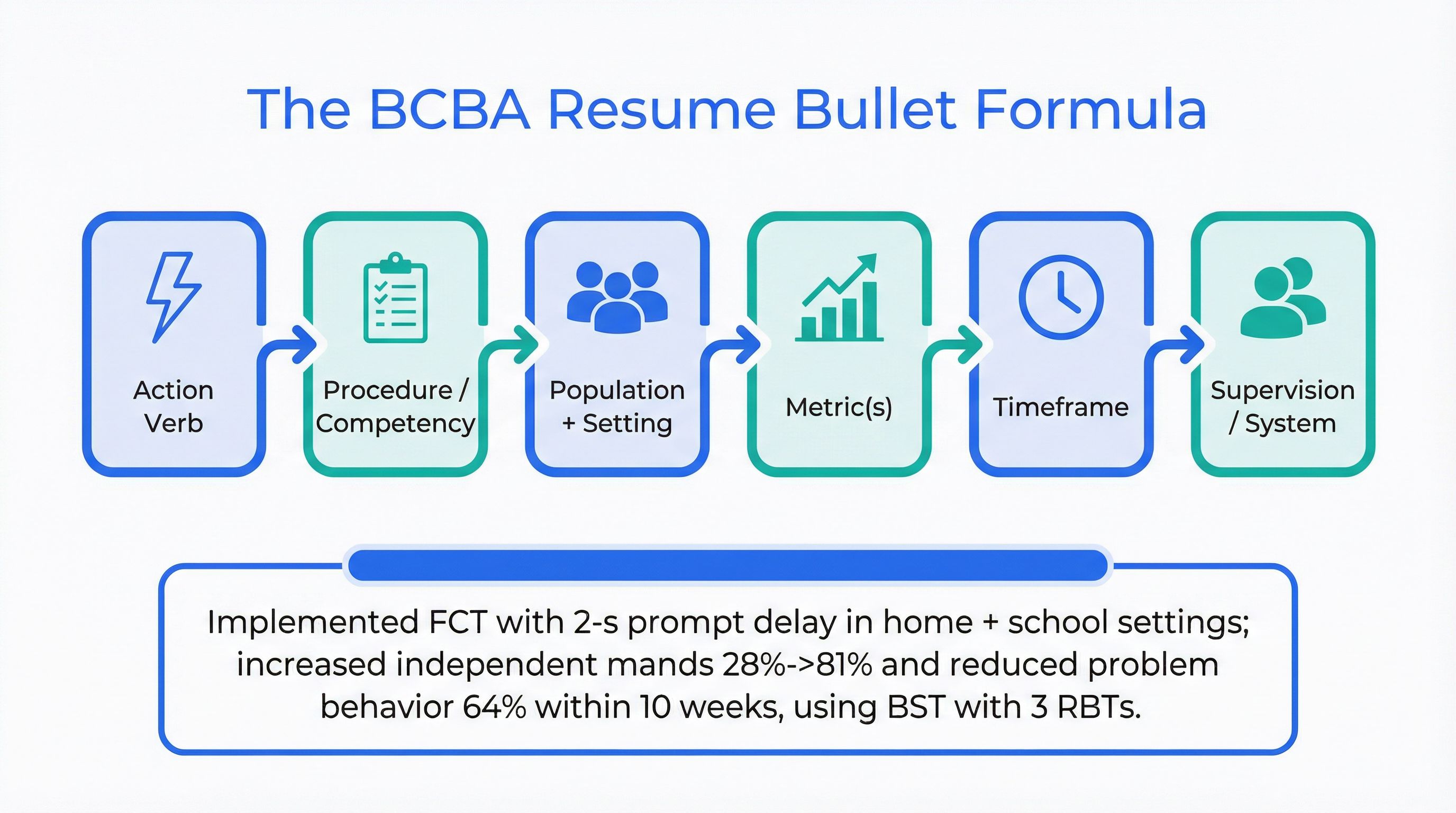
Four categories of metrics consistently matter to clinical directors:
- Client outcomes. Percentage of independent mands, rate of problem behavior reduction, percentage of generalization to new contexts, skill mastery rates, maintenance at 30, 60, and 90 days.
- Treatment integrity. Procedure fidelity percentage, inter-observer agreement, time to mastery, error-type frequency.
- Supervision and leadership. Number of RBTs and trainees supervised, integrity gains after Behavior Skills Training (BST), time-to-independence for new staff, rubric improvements across supervised cohort.
- Operations. Percentage of on-time documentation, audit pass rates, caregiver satisfaction scores, scheduling adherence, insurance authorization rates.
Here is the difference in practice:
| Weak (duty-based) | Strong (outcome-based) |
|---|---|
| Worked with children with autism to reduce challenging behaviors. | Implemented FCT with 2-second prompt delay across home and school settings; increased independent mands from 28% to 81% and reduced problem behavior 64% within 10 weeks, using a 10-item integrity checklist and weekly BST with 3 RBTs. |
| Supervised RBTs and provided training. | Supervised 6 RBTs across 18 cases; improved procedure integrity from 73% to 94% within 8 weeks post-BST, with monthly calibration sessions. |
| Wrote treatment plans. | Developed 22 individualized treatment plans (ages 3 to 9, ASD), achieving 85% goal-mastery rate over 6 months and 100% audit compliance across two payer audits. |
If you cannot remember your numbers, pull three months of session notes, your last BIP review, or your supervision logs and rebuild them. A single afternoon of reconstruction usually produces enough data for six strong bullets.
Core competencies: the ATS keywords BCBA jobs actually scan for
ATS systems look for exact-phrase matches between your resume and the job description. ResumeAdapter’s 2026 guidance is to mirror three to five of the most critical phrases from the posting; more than that reads like keyword-stuffing and can hurt you with a human reader.
Group your Core Competencies section into five clusters so the ATS hits the same keyword under multiple anchors without looking padded.
- Assessment. FBA, VB-MAPP, ABLLS-R, AFLS, PEAK, Vineland-3, preference assessments, functional analysis, skills assessment.
- Intervention. Discrete Trial Training (DTT), Natural Environment Teaching (NET), PECS, Functional Communication Training (FCT), Behavior Intervention Plan (BIP), DRA, DRO, DRI, DRL, errorless teaching, token economies.
- Supervision. Behavior Skills Training (BST), performance feedback, RBT supervision, fieldwork supervision, competency assessment, inter-observer agreement.
- Compliance and systems. BACB ethics code, HIPAA, CentralReach, Rethink, Catalyst, insurance authorization, goal mastery tracking, session documentation.
- Population and setting. ASD, ID, early intervention, school-age, clinic-based, in-home ABA, telehealth, school-based consultation.
Pull phrases directly from the job posting. If the role says “parent training,” use “parent training,” not “caregiver coaching.” If the posting lists “CentralReach,” do not write “EMR software.” This is the one place on your resume where being literal matters more than being elegant.
How to show supervision and fieldwork hours (for early-career BCBAs)
If you are within two years of certification, a dedicated Supervised Fieldwork section is worth the real estate. It signals to hiring teams that you did more than log hours; you led unrestricted clinical work.
BACB rules require at least 60% of accumulated fieldwork hours to be spent on unrestricted activities: assessment, treatment planning, data analysis, and supervision and training (BACB, 2024). Call that out on your resume so the reader does not have to do the math.
Supervised Fieldwork | 2,000 hours (1,820 unrestricted; 180 restricted)
Supervisor: Dr. Jane Patel, BCBA-D | Bright Path ABA | June 2022 to June 2023
• Conducted 14 FBAs and authored 11 BIPs for children ages 3 to 8 with ASD.
• Delivered caregiver training to 22 families; reached 80% implementation fidelity at the 6-week follow-up.
• Co-supervised 4 RBT trainees toward first-time certification (all 4 passed the RBT exam on first attempt).
Tie fieldwork to outcomes the same way you would a full-time role. Hiring clinical directors read this section to gauge whether you will ramp quickly or need six more months of hand-holding. For more on how the RBT-to-BCBA path compresses or stretches, see our RBT to BCBA timeline guide.
Tailoring your BCBA resume to the job setting
Clinic, school, in-home, telehealth, private practice, and clinical director roles reward different signals. One template will not optimize for all of them.
- •Clinic-based BCBA. Lead with caseload size, weekly intensity (hours per client), multi-disciplinary coordination (SLP, OT, psychology), and treatment integrity data. Clinics compete on outcomes and scheduling adherence.
- •School-based BCBA. Foreground IEP and 504 experience, classroom consultation, teacher coaching, functional assessment in educational settings, and familiarity with IDEA or ESSA. Districts want someone who can write measurable goals and survive an IEP meeting.
- •In-home BCBA. Emphasize caregiver-training hours, cultural humility, generalization across environments, and parent-as-mediator outcome data. In-home roles are won on buy-in, not on worksheet design.
- •Telehealth BCBA. Call out telepractice platforms (Zoom for Healthcare, Doxy, SimplePractice), remote observation protocols, HIPAA-compliant documentation, and outcome parity between telehealth and in-person caseloads. If you are exploring this path, our remote BCBA jobs guide covers what employers actually ask about.
- •Private practice or independent contractor. Business operations belong on the resume: insurance credentialing, NPI, 1099 versus W-2 experience, billing workflow. See independent contractor vs employee for the practical trade-offs.
- •Clinical director or leadership. Most clinical director postings require six or more years as a practicing BCBA and three or more years in a supervisory role (PsycTalent, 2025; Breakthrough ABA, 2026). Emphasize team size, program-level outcome metrics, compliance audits led, hiring and onboarding systems you built, and community training or outreach.
3 BCBA resume examples (copy-ready)
Three starter blocks you can adapt. Each one mirrors the structure above, uses the outcome-based bullet formula, and avoids ATS-breaking formatting.
Example 1: Newly certified BCBA (from RBT)
Maria L. Hernandez, BCBA
Austin, TX | maria.hernandez@email.com | (512) 555-0102 | linkedin.com/in/mlhernandez

PROFESSIONAL SUMMARY
BCBA (certified August 2025) with 3 years of RBT experience serving ages 3 to 7 with ASD
in clinic and in-home settings. Trained in functional analysis, DTT, NET, and FCT. Supervised
2 RBT trainees through initial certification and delivered 40+ hours of caregiver training
across 12 families during fieldwork.

CERTIFICATIONS & LICENSES
Board Certified Behavior Analyst (BCBA) | BACB Cert #1-25-789012 | August 2025
Registered Behavior Technician (RBT) | BACB Cert #2-22-345678 | March 2022 to July 2025

CORE COMPETENCIES
Assessment: FBA, VB-MAPP, ABLLS-R, preference assessments
Intervention: DTT, NET, FCT, DRA, token economies, errorless teaching
Supervision: BST, performance feedback, RBT competency assessment
Systems: CentralReach, HIPAA, insurance authorization

SUPERVISED FIELDWORK | 2,000 hours (1,820 unrestricted; 180 restricted)
Bright Path ABA, Austin, TX | Supervisor: Dr. Jane Patel, BCBA-D | 2023 to 2025
• Conducted 14 FBAs and authored 11 BIPs for ages 3 to 8; reduced mean problem behavior
  57% within 12 weeks across cohort.
• Delivered caregiver training to 22 families; reached 80% implementation fidelity at
  6-week follow-up, measured via in-home integrity checks.
• Co-supervised 4 RBT trainees to first-time certification (100% first-attempt exam pass rate).

CLINICAL EXPERIENCE
Lead RBT | Bright Path ABA | 2024 to 2025
• Managed 28-hour weekly caseload across 4 clients; sustained 95% on-time documentation.
• Led shadow-training for 3 new RBTs; reduced average ramp time from 6 to 4 weeks.

EDUCATION
M.S. Applied Behavior Analysis | Ball State University | 2023
B.A. Psychology | University of Texas at Austin | 2020
What makes it work: Certification shows up in the first six inches of the page. The fieldwork block reads like a clinical role, not a log. Every bullet has a number.
Example 2: Mid-career clinical BCBA
David T. Okafor, BCBA
Boston, MA | d.okafor@email.com | (617) 555-0199 | linkedin.com/in/dokafor

PROFESSIONAL SUMMARY
BCBA with 5 years of clinic-based ABA serving ages 2 to 9 with ASD and co-occurring
intellectual disabilities. Skilled in functional analysis, FCT, and DRA/DRO procedures.
Supervise 7 RBTs across 24 active cases; reduced mean problem behavior 62% and lifted
goal-mastery to 88% across caseload in the past year.

CERTIFICATIONS & LICENSES
Board Certified Behavior Analyst (BCBA) | BACB Cert #1-20-123456 | Since 2020
Licensed Applied Behavior Analyst (LABA) | Massachusetts | Since 2020

CORE COMPETENCIES
Assessment: Functional Analysis, VB-MAPP, AFLS, PEAK, Vineland-3
Intervention: FCT, DRA/DRO/DRI, DTT, NET, token economies, BIP design
Supervision: BST, RBT supervision (team of 7), IOA protocols, calibration routines
Systems: CentralReach, HIPAA, payer audit response, goal mastery tracking

CLINICAL EXPERIENCE
Lead BCBA | Harbor Point ABA, Boston, MA | 2022 to Present
• Manage 24-case clinic caseload (ages 2 to 9, ASD); achieve 88% goal-mastery rate and
  100% insurance authorization renewal over past 18 months.
• Supervise 7 RBTs; improved procedure integrity 73% to 94% within 8 weeks post-BST, with
  monthly calibration checks.
• Authored 31 BIPs over 3 years; passed 100% of payer audits (n=4) without correction.
• Implemented FCT with 2-s prompt delay across caseload; increased independent mands from
  28% to 81% and reduced problem behavior 64% within 10 weeks.

BCBA | North Star Pediatric ABA | 2020 to 2022
• Carried 15-case home-and-clinic caseload; reached 85% goal mastery across 6-month cycles.
• Delivered 120+ hours of caregiver training; families sustained 82% fidelity at 90 days.

EDUCATION
M.Ed. Applied Behavior Analysis | Simmons University | 2019
B.S. Psychology | Boston University | 2017
What makes it work: The summary opens with a number. Every role has a signature outcome bullet. Supervision scope is quantified, not vague.
Example 3: BCBA moving to clinical director
Priya S. Raman, BCBA-D
San Diego, CA | priya.raman@email.com | (619) 555-0177 | linkedin.com/in/priyaraman

PROFESSIONAL SUMMARY
BCBA-D with 8 years of clinical and leadership experience in multi-site ABA organizations.
Led clinical operations for a team of 14 BCBAs and 42 RBTs across 3 California clinics;
delivered program-level goal-mastery gains of 19 points over 2 years and 100% payer audit
pass rate across 6 audits. Known for building BST calibration systems that cut RBT
ramp-time from 9 weeks to 5.

CERTIFICATIONS & LICENSES
Board Certified Behavior Analyst - Doctoral (BCBA-D) | BACB Cert #1-17-654321 | Since 2017
Licensed Behavior Analyst (LBA) | California | Since 2018

CORE COMPETENCIES
Leadership: Clinical operations, multi-site oversight, hiring and onboarding systems,
program-level outcome measurement, payer audit response, community outreach.
Clinical: Functional analysis, FCT, BIP design, complex-case consultation.
Systems: CentralReach, Rethink, Catalyst, insurance credentialing, compliance audits.

CLINICAL EXPERIENCE
Associate Clinical Director | West Coast ABA Partners, San Diego, CA | 2022 to Present
• Lead 14 BCBAs and 42 RBTs across 3 clinics; grew program goal-mastery from 71% to 90%
  over 24 months through standardized BST and calibration protocols.
• Built a 6-week RBT onboarding and BST pipeline that cut ramp-time from 9 to 5 weeks and
  reduced first-year RBT attrition 38%.
• Own compliance and payer audit response; 100% pass rate across 6 audits with no
  corrective action plans issued.
• Delivered 14 community trainings to school districts and pediatric networks; contributed
  to 2 new insurance-in-network contracts.

Senior BCBA | West Coast ABA Partners | 2019 to 2022
• Managed 22-case clinic caseload; mentored 4 BCBAs through first-year certification.
• Co-authored organization-wide BIP template adopted across 3 clinics.

EDUCATION
Ph.D. Applied Behavior Analysis | University of North Texas | 2017
M.A. Psychology | San Diego State University | 2013
What makes it work: Leadership metrics sit above clinical metrics. Program-level outcomes and audit results prove executive readiness. Community outreach maps to what clinical director postings routinely require.
7 BCBA resume mistakes that cost you interviews
- Listing duties instead of outcomes. “Worked with clients” loses to “reduced problem behavior 64% in 10 weeks” every time.
- Misrepresenting certification status. “BCBA candidate” or “BCBA trained” violates BACB ethics guidance and is a real risk to your certification.
- Using a designed template. Two-column layouts, icons, and progress bars break ATS parsers. Plain beats pretty.
- Omitting your certification number. It is not required, but it speeds verification and signals transparency.
- Generic objective statements. “Dedicated BCBA with a passion for helping children” reads as template-filler. Open with a setting, a number, or both.
- Not tailoring keywords to the posting. Blanket-send resumes rarely make it past the ATS filter. Mirror three to five of the posting’s exact phrases.
- Hiding your RBT history. Even senior BCBAs benefit from showing the trajectory. Clinical directors read RBT experience as evidence that you understand implementation, not as a weakness.
The alternative: let employers come to you
There is a structural problem with the resume model that no amount of formatting fixes. You send twenty applications and hear back from two. Employers see your name, your photo, your employment gaps, and your current employer before they see your clinical work. Most importantly, your current employer can often tell you are looking, because your resume is moving across LinkedIn and job boards in ways that eventually get back.
A reverse marketplace flips this. Employers review anonymous qualification profiles and send you interview requests based on your certifications, supervision scope, specialties, and outcome data. You see the role, the setting, the caseload, and the compensation range before you reveal your identity. Your name, photo, and current employer are never visible until you accept an interview.
Your clinical work is what hiring teams actually want to evaluate. Everything else on a resume is noise the ATS and a recruiter use to narrow the pile before they get to it.
This matters most for three groups: BCBAs who are employed today and cannot risk their current organization finding out, BCBAs who want transparent compensation data before they invest an interview cycle, and BCBAs from backgrounds that routinely face bias in name-and-photo screening.
Let qualified employers reach out to you
Build a verified, anonymous CertifyndABA profile in about 10 minutes. See the role, setting, and compensation range before employers see your name.
Create Your Free ProfileBCBA resume FAQ
How long should a BCBA resume be?
One page if you have fewer than five years of post-certification experience. Two pages for five or more years, or for any clinical director or leadership track.
Should I include my BACB certification number?
It is not required, but including it speeds verification through the BACB Certificant Registry and signals transparency. Most clinical directors appreciate it.
Do I need a cover letter?
Increasingly optional. Many ATS systems do not parse cover letters, and many hiring clinical directors skim them at best. Write one if the posting asks for it or if you have a specific story the resume cannot carry.
Can I use “BCBA candidate” if I have passed the exam but not received certification?
No. The BACB prohibits that language. Until your certification is active on the BACB registry, do not describe yourself as a BCBA. You can list “Expected BCBA certification: [Month Year].”
How do I list non-ABA experience on a BCBA resume?
Keep it only if it is transferable. Teaching, special education, speech or occupational therapy collaboration, and psychology adjacent work all add context. Unrelated roles dilute the page.
Should my resume include a headshot?
Never for US-based BCBA roles. Photos introduce bias risk, some ATS parsers break on images, and many organizations explicitly discard resumes with photos.
How often should I update my resume?
Quarterly if you are actively job searching. Annually otherwise. Rebuild the bullets from session data rather than relying on memory.
Your next step
Three things separate BCBA resumes that get interviews from resumes that get ignored. First, they survive ATS parsing through clean, single-column formatting and standard headings. Second, they translate clinical work into quantified outcomes using the action-verb-plus-metric formula. Third, they tailor themselves to the specific setting the candidate is targeting instead of hoping one generic version works everywhere.
A concrete action list for this week:
- Rebuild your professional summary using the setting-population-competencies-supervision-outcome structure.
- Rewrite your three most important bullets using the outcome-based formula with real numbers.
- Audit your Core Competencies against three target job postings and mirror the exact keywords.
When your resume is where you want it, pair it with our BCBA interview questions guide, questions to ask in your ABA interview, and best BCBA job boards. If you want to understand what you should be earning before you go to market, see our behavior analyst salary guide.
Or skip the resume lottery. Build an anonymous CertifyndABA profile and let verified employers reach out to you based on your clinical work, not your formatting.