

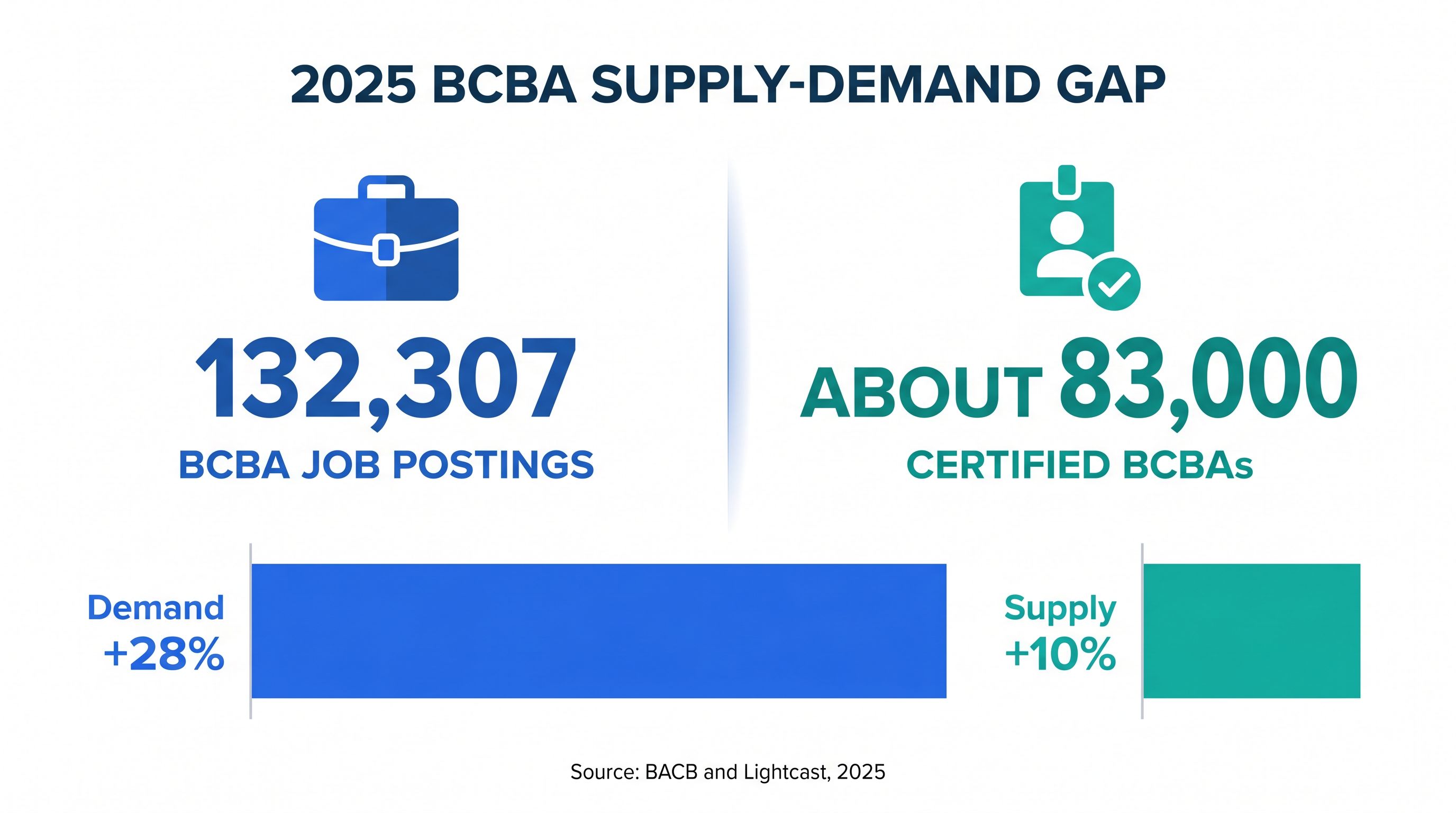
The BCBA shortage is one of the most lopsided supply-and-demand stories in healthcare today. In 2025, employers posted 132,307 jobs requiring a Board Certified Behavior Analyst, while the entire certified workforce numbered roughly 83,000. Demand is not just high; it is growing almost three times faster than the supply of new behavior analysts. For BCBAs, that gap is the single biggest source of career leverage you have.
This article breaks the shortage into three questions: how big is the gap, why the certification pipeline cannot close it, and what it all means for your job search in 2026.
How Big Is the BCBA Shortage in 2026?
Start with the demand side. According to the BACB and Lightcast report US Employment Demand for Behavior Analysts: 2010-2025, employers posted 132,307 unduplicated jobs requiring a BCBA or BCBA-D credential in 2025. That is a 28% jump over the 103,150 postings in 2024, which had itself surged roughly 58% over 2023.
The long view is even more striking. In 2010 there were just 789 BCBA job postings in the entire country. By 2022 that figure had reached 57,596, and it has climbed every year since.
| Year | BCBA/BCBA-D Job Postings | Year-Over-Year Growth |
|---|---|---|
| 2010 | 789 | baseline |
| 2022 | 57,596 | |
| 2023 | ~65,300 | +13% |
| 2024 | 103,150 | +58% |
| 2025 | 132,307 | +28% |
Source: BACB / Lightcast, US Employment Demand for Behavior Analysts: 2010-2025.
Now the supply side. The Behavior Analyst Certification Board reported 83,586 active BCBAs as of April 1, 2026. At the end of 2025 the count stood at 81,566, up only 10% from 74,125 the year before. In other words, the workforce added roughly 7,400 net new BCBAs in a year that generated 132,307 job postings.
That ratio understates the real pressure. The large majority of certified BCBAs are already employed and not actively looking, so employers are competing for a much smaller pool of candidates who are open to a move. Measured against the roughly 7,400 BCBAs who newly entered the workforce in 2025, there were nearly 18 job postings for every new behavior analyst.
A workforce analysis covered by Breaking News ABA put the structural need even higher, estimating that the United States would require approximately 362,500 BCBAs to meet demand, nearly five times the roughly 74,286 supervisor-level clinicians (BCBAs plus BCBA-Ds) practicing as of October 2025. Treat that figure as an estimate, but the direction is unmistakable: the gap is wide and widening.
Demand for BCBAs grew 28% in 2025 while the certified workforce grew just 10%. The shortage is not a temporary spike; it is structural.
Why the Certification Pipeline Cannot Keep Up
If demand has grown this fast, why has supply crawled? The answer is that becoming a BCBA is a long, demanding pipeline that cannot surge on command, and one of its key chokepoints just got tighter.
The exam pass rate has collapsed. The first-time pass rate on the BCBA exam has fallen from 79% in 2021 to 54% in 2024, and then to a record-low 51% in 2025, according to reporting from Behavioral Health Business. Roughly half of all first-time candidates now fail on their first attempt. The January 2025 launch of the sixth-edition exam contributed to the decline. You can read our full breakdown in the BCBA exam pass rate guide.
Training is concentrated and uneven. About 10 university programs produce roughly half of all first-time test-takers, and some of those large programs post low pass rates. Programs accredited by the ABAI are associated with an 11-percentage-point higher pass rate, which points to supervision quality and curriculum integration as decisive factors.
The path is long and expensive. Candidates typically need a master's degree, hundreds to thousands of hours of supervised fieldwork, and a passing exam score. That is a multi-year commitment with significant tuition cost before anyone earns a dollar as a BCBA. A pipeline that long simply cannot respond to a 28% annual jump in demand.
Supervision is its own bottleneck. Every new candidate needs a qualified supervisor for fieldwork, and supervisor capacity is constrained by the same shortage. Add the attrition that comes from burnout, and the workforce loses experienced analysts even as it tries to add new ones.
Where the BCBA Shortage Is Worst
The shortage is not evenly distributed. Demand is heavily concentrated in a handful of states, while access gaps are most severe in rural areas.
The five leading states (California, New Jersey, Texas, Massachusetts, and North Carolina) accounted for 38% of all 2025 BCBA job postings, with California alone representing 15% of national demand. These are intense candidate's markets where employers compete hard for every behavior analyst.
The coverage gap is stark. More than half of all U.S. counties have no BCBA at all. Families in those counties often drive hours, join long waitlists, or go without evidence-based services. The disparity falls hardest on rural communities: 35% of families in rural areas report significant service delays, compared with 23% in urban areas.
The underlying need keeps rising. The CDC now identifies 1 in 36 children with autism spectrum disorder, up from 1 in 44 in 2018. More identified children means more demand for behavior-analytic services, and more pressure on a workforce that is already stretched.
For job seekers, the geography cuts two ways. High-demand states offer volume and competitive pay. Underserved counties offer outsized opportunity, often paired with relocation support, sign-on incentives, or telehealth roles. You can see openings near you in our BCBA jobs near me guide.
What the Shortage Means for Your Job Search
Here is the part that matters most for your career. When openings outnumber available candidates by this margin, the balance of power shifts to you. The shortage is not just an industry headline; it is leverage you can use.
- ✓ Be selective, not just available. With multiple openings per candidate, you can screen employers for caseload size, supervision ratios, ethics, and culture rather than taking the first offer. Our guide to the best ABA companies to work for covers what to look for.
- ✓ Negotiate from strength. The shortage supports stronger asks on salary, sign-on bonuses, and flexible or remote schedules. See our BCBA salary negotiation guide.
- ✓ Widen your options. Remote, telehealth, school-based, and in-home roles are all competing for your time. Geography is less of a constraint than it used to be.
- ✓ Protect your time and privacy. You do not need to broadcast a job search across job boards to benefit from demand. Let employers come to you.
That last point is exactly why CertifyndABA exists. It is an anonymous reverse job marketplace: you build a profile around your qualifications, and verified employers send you interview requests. Your identity stays private until you choose to engage, so you can field offers without alerting your current employer or fielding spam. In a market this tilted toward candidates, that is the most efficient way to convert the shortage into a better role.
Will the BCBA Shortage Get Better?
Not in the near term. Supply growth (10%) continues to trail demand growth (28%), and the exam bottleneck is tightening rather than loosening. The BACB has announced requirement changes for the RBT, BCBA, and BCaBA credentials phasing in across 2026 and 2027, which may reshape the pipeline over time, though the direction of their effect on supply is still playing out.
Several levers could ease the gap eventually: more ABAI-accredited programs with stronger fieldwork supervision, telehealth extending reach into the counties that have no BCBA today, and greater use of BCaBA and RBT tiers to absorb demand under BCBA oversight. None of these closes a five-figure gap quickly. For certified professionals, that means the shortage is a durable advantage, not a passing one. For the deeper demand picture, see our analysis of whether BCBAs are in demand and the BCBA job openings data.
Frequently Asked Questions
How many BCBAs are there in the United States?
The BACB reported 83,586 active BCBAs as of April 1, 2026. At the end of 2025 the count was 81,566, up about 10% from 74,125 a year earlier. For more, see our guide on how many BCBAs there are.
How many BCBA jobs are open?
Employers posted 132,307 jobs requiring a BCBA or BCBA-D in 2025, a 28% increase over 2024, according to the BACB and Lightcast. That is roughly 1.6 postings for every certified BCBA in the country.
Why is there a BCBA shortage?
Demand for behavior-analytic services has grown far faster than the supply of certified analysts. The certification pipeline is long and expensive, supervised fieldwork capacity is limited, and the first-time exam pass rate fell to a record-low 51% in 2025, all while autism identification (now 1 in 36 children) continues to rise.
Which states have the most BCBA demand?
California, New Jersey, Texas, Massachusetts, and North Carolina together accounted for 38% of 2025 BCBA job postings, with California alone making up 15% of national demand.
The Bottom Line
The BCBA shortage in 2026 is structural: 132,307 job postings chasing about 83,000 certified analysts, with demand growing nearly three times faster than supply and a record-low exam pass rate keeping the pipeline tight. For employers, that is a staffing crisis. For you, it is rare and durable leverage; the question is whether you use it to land a role that fits your standards rather than settling for the first one that finds you.
Turn the shortage into your next great role
Create a free, anonymous CertifyndABA profile and let verified employers send interview requests to you. Stay private, compare offers, and choose on your terms.
Create Your Free Profile