

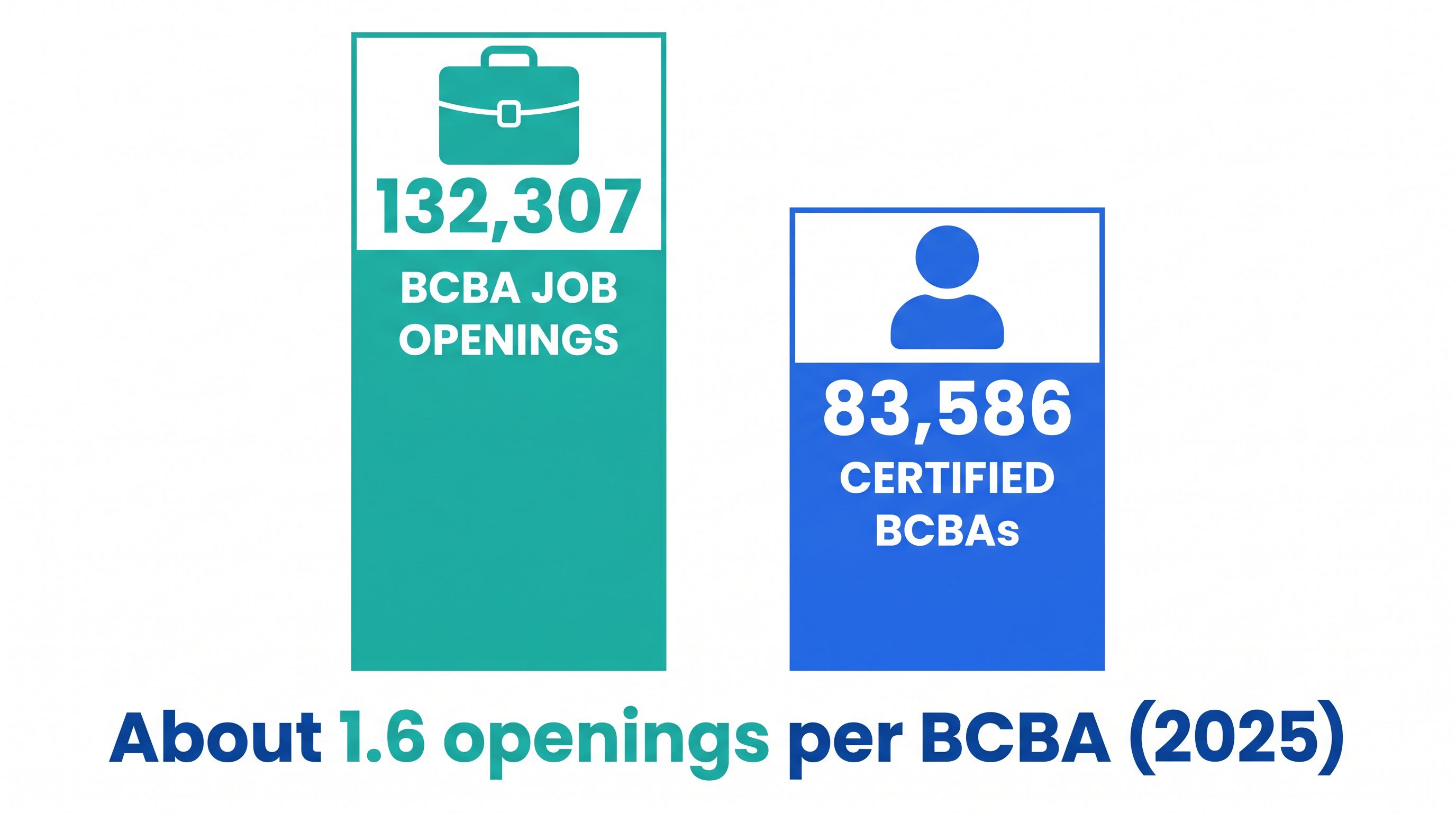
In 2025, US employers posted 132,307 job openings that required a BCBA credential. The problem for those employers, and the opportunity for you, is that only 83,586 people in the country hold one. If you are a Board Certified Behavior Analyst, you are not competing for BCBA job openings; employers are competing for you.
That gap is not a fluke or a single strong year. Demand for behavior analysts has grown every year since 2010, and the supply of certified professionals has never caught up. This article breaks down how many BCBA job openings actually exist, why there are so many, where they concentrate, and how to use a candidate-favorable market to land a better role rather than just any role.
How Many BCBA Job Openings Are There?
The most authoritative count comes from the Behavior Analyst Certification Board (BACB), which partners with the labor-market analytics firm Lightcast to track job postings each year. Their report, US Employment Demand for Behavior Analysts: 2010 to 2025, found 132,307 postings requiring a BCBA or BCBA-D credential in 2025.
That total is up 28% from the 103,150 postings recorded in 2024, which had itself jumped 58% over the 65,366 postings in 2023. In two years, employer demand for behavior analysts roughly doubled. Even with the growth rate cooling slightly in 2025, the field remains one of the fastest-growing in US healthcare.
Now put that next to the workforce. As of April 1, 2026, the BACB reported 83,586 active BCBAs in the United States. Set the two numbers side by side and the math is striking: there were about 1.6 advertised openings for every certified BCBA in the country.
132,307 job openings. 83,586 BCBAs. Roughly 1.6 advertised positions for every certified behavior analyst in the country.
One caveat worth keeping honest: a job posting is not the same as a guaranteed empty chair. A single role can be advertised on several boards, and some postings get refreshed over time. Treat 1.6 as a measure of advertised demand, not a literal count of unfilled seats. Even read conservatively, demand clearly outruns supply, which is exactly why this matters for your search.
Why the Openings Outnumber the BCBAs
Two forces are pulling in opposite directions, and the gap between them is the story.
On the demand side, all 50 states now mandate insurance coverage for ABA therapy, autism diagnosis rates continue to climb, and ABA's evidence base keeps employers expanding services. Every new clinic, school contract, and telehealth program needs a BCBA to supervise it.
On the supply side, the pipeline simply cannot keep pace. Roughly 8,000 new BCBAs earn certification each year, and the first-time exam pass rate has slipped from around 66% in 2020 to roughly 51% in 2025. Fewer candidates clearing the exam means the credential stays scarce even as more people pursue it. If you want the detail, see our breakdown of the BCBA exam pass rate.
There is one more reason employers chase the same people. Most of those 83,586 BCBAs are already employed. The pool of analysts actually on the market at any given moment is a fraction of the headline number, so the effective competition for an available, job-seeking BCBA is far more lopsided than 1.6 to 1.
Some industry analysts argue the true shortfall is far larger than the posting count suggests. One workforce analysis from the recruiting firm TYGES, using a conservative benchmark of eight clients per BCBA, estimated the field would need several times its current supply to meet unmet need. That figure is an industry estimate rather than a BACB-published number, but it points the same direction as the official data: demand for behavior analysts is nowhere near satisfied.
Where the BCBA Job Openings Are
Openings are not spread evenly across the map. In 2025, five states accounted for 38% of all BCBA demand:
| State | Share of 2025 BCBA demand |
|---|---|
| California | 15% (the single largest share) |
| New Jersey | Top five |
| Texas | Top five |
| Massachusetts | Top five |
| North Carolina | Top five |
The big-five states give you the highest raw volume of postings. But concentration cuts both ways. More than half of all US counties have no practicing BCBA at all, according to the TYGES workforce analysis. Those rural and lower-income areas have real openings with almost no local competition, which can mean faster offers and stronger negotiating position for an analyst willing to work there or serve them remotely.
Openings also span every setting, and each has its own demand pattern:
- ✓Clinics, centers, and in-home ABA, which make up the bulk of postings
- ✓School-based BCBA roles tied to district and special-education contracts
- ✓Telehealth positions that reach the counties with no local BCBA
- ✓Hospital and insurance or utilization-review roles for analysts who want non-clinic work
So the honest answer to where the openings are depends on what you want. Optimize for sheer volume and you look at the big-five states; optimize for leverage and low competition and you look at underserved counties and remote roles.
How to Find and Win the Right BCBA Job Opening
Finding postings is the easy part. The general boards (Indeed, LinkedIn, ZipRecruiter), the ABA-specific boards, and individual company career pages are all full of them. Our guide to the best BCBA job boards covers where to look. The harder, more valuable skill in this market is choosing well.
With more than one advertised opening per BCBA, the goal is not to land any job; it is to filter for fit. Before you accept, weigh caseload size, supervision ratios, billable-hour expectations, PTO, and growth path. Strong questions during the interview surface the real picture; see our list of questions to ask in an ABA interview and our roundup of the best ABA companies to work for.
A candidate-favorable market is also the time to negotiate. When employers are short on analysts, your offer has room to move on salary, schedule, and signing incentives. Our BCBA salary negotiation guide walks through how to use the shortage at the table.
Move fast when a good opening appears by keeping your materials ready. A sharp BCBA resume and a targeted cover letter let you apply the day a strong role is posted. And do not let high demand lull you; a flood of openings can sometimes signal high turnover or thin clinical support, so vet the employer as carefully as they vet you.
Flip the Search: Let Employers Come to You
Here is the strategic point hiding inside all this data. When there are more openings than there are BCBAs, scrolling job boards and cold-applying is the inefficient side of the market. The leverage belongs to the candidate, so the smartest search makes employers do the reaching.
That is the model behind CertifyndABA. It is an anonymous reverse job marketplace: BCBAs build a profile, and interested employers send interview requests without you exposing personal contact information until you choose to respond. In a market this tight, that inverts the usual grind. Instead of chasing postings, you review the employers who want you, and you can explore options while staying anonymous to your current workplace.
The Bottom Line on BCBA Job Openings
The numbers tell a clear story. With 132,307 openings against 83,586 certified BCBAs, and demand rising every year since 2010, this is the most candidate-favorable job market in the history of behavior analysis. The opportunity is not just to find work; nearly every BCBA can do that. The opportunity is to be selective, negotiate hard, and choose a role that fits your career rather than settling for the first offer. To see how the broader demand picture is shifting, read our analysis of whether BCBAs are in demand in 2026.
Stop scrolling job boards. Let employers find you.
With more BCBA job openings than certified BCBAs, you hold the leverage. Build an anonymous profile on CertifyndABA and let qualified employers send you interview requests, on your terms.
Create Your Free Profile