
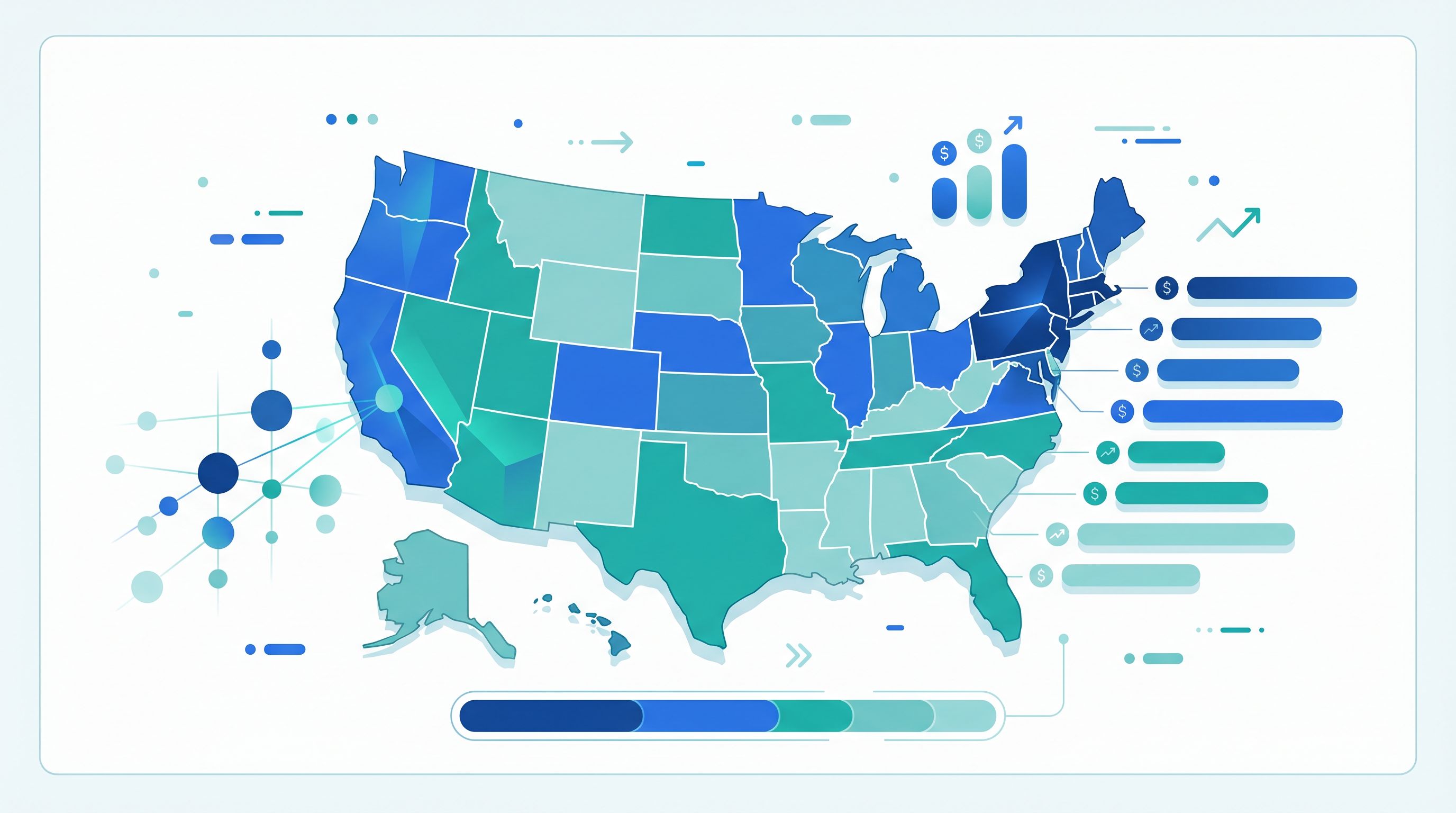

The highest-paying state for BCBAs is not necessarily the best state to work in. BCBA salary by state varies by more than $40,000 depending on where you practice, but raw pay only tells part of the story. When you factor in cost of living, BCBA shortage severity, and negotiating leverage, the map of opportunity looks very different from a simple salary ranking. This guide breaks down what BCBAs actually earn in all 50 states, which states offer the strongest purchasing power, and where the workforce gap gives you the most leverage to negotiate.
National BCBA Salary Overview
Before comparing states, it helps to understand the national baseline. BCBA compensation data comes from two main sources, and they tell different stories.
The Bureau of Labor Statistics reports a median salary of $59,190 for SOC code 21-1018 (Substance Abuse, Behavioral Disorder, and Mental Health Counselors) based on May 2024 data. However, this occupational category includes all behavioral health counselors, not exclusively BCBAs. Actual BCBA-specific salaries run significantly higher.
ZipRecruiter, which tracks BCBA-titled job postings directly, reports a national average of $89,075 as of April 2026. The full range spans $47,500 to $149,500, with most BCBAs earning between $74,000 (25th percentile) and $90,500 (75th percentile). Top earners at the 90th percentile make $132,500 or more.
The BLS projects 17% job growth for this occupational category from 2024 to 2034, more than four times faster than the national average. That growth rate, combined with the current BCBA workforce shortage, makes geography one of the most powerful levers BCBAs have for increasing their compensation.
Top 10 Highest-Paying States for BCBAs
The states offering the highest nominal BCBA salaries are concentrated on the coasts and in areas with high cost of living. According to ZipRecruiter (2026), the top 10 are:
| Rank | State | Avg. Salary |
|---|---|---|
| 1 | Washington | $100,886 |
| 2 | District of Columbia | $100,657 |
| 3 | New York | $97,451 |
| 4 | Massachusetts | $97,281 |
| 5 | Alaska | $95,929 |
| 6 | Vermont | $94,710 |
| 7 | North Dakota | $94,249 |
| 8 | Oregon | $94,178 |
| 9 | Colorado | $93,664 |
| 10 | Hawaii | $92,546 |
BLS data tells a slightly different story because it captures a broader occupational category. Under BLS figures, Alaska leads at $79,220 median, followed by New Mexico ($70,770), Oregon ($69,660), and North Dakota ($66,450). The gap between BLS and ZipRecruiter numbers reflects the fact that BCBA-specific roles command a premium over the broader behavioral health counselor category.
One detail worth noting: many of the highest-paying states also have high BCBA density. Massachusetts has 55.1 BCBAs per 100,000 residents, and New Jersey has 39.2, according to TYGES Healthcare. More BCBAs per capita means more competition for the best roles. States further down the salary list often have far fewer BCBAs, and that scarcity translates to stronger negotiating power.
BCBA Salary by State: Complete 2026 Comparison
The table below combines BLS median salary data (May 2024), BCBA-specific averages from The Behavior Academy/ZipRecruiter (2026), and BCBA density data from TYGES Healthcare. This three-dimensional view helps you compare states on pay, competition, and opportunity simultaneously.
| State | BLS Median | BCBA Avg. | BCBAs per 100K |
|---|---|---|---|
| Alabama | $48,880 | $58,657 | 11.8 |
| Alaska | $79,220 | $74,732 | 13.8 |
| Arizona | $63,830 | $66,275 | 17.7 |
| Arkansas | $49,990 | $65,931 | 10.8 |
| California | $61,310 | $69,362 | 27.1 |
| Colorado | $59,190 | $67,716 | 29.5 |
| Connecticut | $62,960 | $77,062 | 41.9 |
| Delaware | $49,680 | $67,773 | 17.1 |
| Florida | $56,830 | $56,853 | 36.0 |
| Georgia | $55,320 | $53,007 | 19.6 |
| Hawaii | $54,390 | $78,202 | 36.7 |
| Idaho | $65,240 | $68,657 | 11.9 |
| Illinois | $59,570 | $62,257 | 18.4 |
| Indiana | $49,280 | $64,257 | 25.4 |
| Iowa | $60,880 | $71,447 | 10.2 |
| Kansas | $57,760 | $67,369 | 12.9 |
| Kentucky | $51,790 | $63,987 | 15.5 |
| Louisiana | $40,200 | $62,031 | 17.0 |
| Maine | $60,970 | $65,036 | 23.9 |
| Maryland | $57,820 | $71,194 | 19.7 |
| Massachusetts | $59,030 | $78,612 | 55.1 |
| Michigan | $59,530 | $63,972 | 26.5 |
| Minnesota | $58,720 | $77,480 | 10.7 |
| Mississippi | $46,810 | $65,691 | 8.1 |
| Missouri | $56,640 | $61,673 | 16.7 |
| Montana | $58,660 | $64,905 | 8.5 |
| Nebraska | $64,410 | $68,259 | 18.7 |
| Nevada | $59,470 | $77,233 | 20.4 |
| New Hampshire | $58,520 | $70,775 | 45.6 |
| New Jersey | $64,710 | $83,183 | 39.2 |
| New Mexico | $70,770 | $71,037 | 11.0 |
| New York | $62,070 | $75,104 | 16.9 |
| North Carolina | $56,470 | $56,305 | 17.7 |
| North Dakota | $66,450 | $73,593 | 13.1 |
| Ohio | $56,990 | $73,368 | 12.6 |
| Oklahoma | $58,610 | $64,464 | 9.8 |
| Oregon | $69,660 | $74,456 | 12.9 |
| Pennsylvania | $58,320 | $61,973 | 22.6 |
| Rhode Island | $49,770 | $75,579 | 35.8 |
| South Carolina | $50,720 | $66,799 | 15.2 |
| South Dakota | $53,400 | $69,972 | 10.9 |
| Tennessee | $48,170 | $79,464 | 19.2 |
| Texas | $60,630 | $60,818 | 16.6 |
| Utah | $65,920 | $71,702 | 24.9 |
| Vermont | $60,410 | $68,807 | 35.8 |
| Virginia | $58,410 | $69,915 | 24.4 |
| Washington | $64,220 | $75,657 | 19.2 |
| West Virginia | $46,710 | $63,133 | 10.5 |
| Wisconsin | $62,470 | $74,407 | 12.3 |
| Wyoming | $61,640 | $65,765 | 7.5 |
Sources: BLS Median from May 2024 OES data (SOC 21-1018); BCBA Avg. from The Behavior Academy/ZipRecruiter (2026); BCBAs per 100K from TYGES Healthcare.
Cost-of-Living Adjusted BCBA Salary by State
A $100,000 salary in Washington does not buy the same life as $90,000 in South Dakota. To compare states fairly, you need to adjust for cost of living using Regional Price Parities (RPP) from the U.S. Bureau of Economic Analysis. RPP measures the overall price level in each state relative to a national average of 100. A state with an RPP of 85 is 15% cheaper than average; a state at 112 is 12% more expensive.
The formula is straightforward: divide the nominal salary by the state's RPP, then multiply by 100. That gives you the salary's purchasing power in national-average dollars.
Here is how that math reshapes the top-earner picture:
| State | Nominal Salary | RPP (2023) | Adjusted Salary |
|---|---|---|---|
| South Dakota | $69,972 | 88.1 | $79,423 |
| Mississippi | $65,691 | 84.4 | $77,834 |
| Arkansas | $65,931 | 86.5 | $76,220 |
| Iowa | $71,447 | 90.5 | $78,948 |
| Minnesota | $77,480 | 98.1 | $78,981 |
| Nebraska | $68,259 | 90.0 | $75,843 |
| Washington (top nominal) | $100,886 | 108.6 | $92,900 |
| Massachusetts | $78,612 | 108.2 | $72,654 |
| California | $69,362 | 112.6 | $61,601 |
The takeaway: states like South Dakota, Mississippi, and Arkansas that appear modest on a nominal salary list can actually deliver stronger purchasing power than high-cost coastal states. A BCBA earning $70,000 in South Dakota has roughly the same buying power as one earning $85,000 in Washington. If you can work remotely via telehealth, earning a higher-state salary while living in a lower-cost state is one of the most effective compensation strategies available.
"The best-paying state for BCBAs depends on how you define 'best.' If you mean take-home purchasing power, the Midwest and Mountain West consistently outperform the coasts."
The BCBA Shortage: Your Salary Negotiation Leverage
The single most important factor in BCBA compensation is not your state, your experience, or your negotiation skills. It is the structural workforce shortage that gives every certified BCBA leverage no matter where they practice.

According to the BACB's Lightcast labor market report, employers posted 132,307 positions requesting BCBA or BCBA-D certification in 2025. As of April 2026, only 83,586 BCBAs held active credentials. That works out to roughly 1.6 open positions for every certified BCBA in the country, and the gap has been widening: demand grew 28% from 2024 to 2025, building on a 58% surge the prior year.
But the shortage is not evenly distributed. According to TYGES Healthcare, BCBAs still do not serve 46% of U.S. counties. Wyoming has just 7.5 BCBAs per 100,000 residents while Massachusetts has 55.1. The bottom 10 states by BCBA density (Wyoming, Mississippi, Montana, Oklahoma, Iowa, West Virginia, Minnesota, Arkansas, South Dakota, and New Mexico) represent some of the most acute hiring challenges in healthcare.
For BCBAs, this shortage translates directly into negotiating power. In states with low BCBA density, employers routinely offer signing bonuses, relocation packages, flexible schedules, and above-market salaries to attract candidates. The top five demand states in 2025 were California, New Jersey, Texas, Massachusetts, and North Carolina, which together accounted for 38% of all BCBA job postings. For a deeper look at the overall demand picture, see our BCBA job outlook guide.
5 Best-Value States for BCBAs in 2026
The best state for a BCBA balances three factors: competitive salary, reasonable cost of living, and strong demand. These five states offer that combination in 2026.
1. Texas
With a BLS median of $60,630 and an RPP near the national average (98.2), Texas offers solid purchasing power without the coastal premium. It ranks in the top five nationally for BCBA job postings, with 16.6 BCBAs per 100,000 residents, well below the national density average. Major metros like Houston, Dallas, and Austin have robust ABA markets with multiple employers competing for talent.
2. North Carolina
North Carolina lands in the top five demand states and offers a moderate cost of living. BCBA density sits at 17.7 per 100,000, leaving room for job seekers to negotiate. The Research Triangle area (Raleigh, Durham, Chapel Hill) has a growing concentration of ABA providers, while rural areas of the state face significant access gaps.
3. Ohio
With a BCBA average of $73,368 and only 12.6 BCBAs per 100,000 residents, Ohio pairs above-average pay with below-average competition. Columbus, Cleveland, and Cincinnati all have active ABA markets. Ohio's low cost of living (RPP below 90 in most regions) makes that salary stretch further than comparable figures in the Northeast.
4. Utah
Utah's BCBA average of $71,702 sits well above the national BLS median, and the state's growing population is creating steady demand for ABA services. With 24.9 BCBAs per 100,000 residents, coverage is better than many states but still leaves room for new entrants. Salt Lake City in particular has seen a surge in ABA clinic openings.
5. Nebraska
Nebraska is a hidden gem. The BCBA average of $68,259 combined with very low cost of living (RPP around 90) produces strong adjusted earnings. At just 18.7 BCBAs per 100,000 residents, the state's providers are actively recruiting, and the shortage is more acute outside Omaha and Lincoln.
Frequently Asked Questions
What state pays the highest for BCBA?
By nominal salary, Washington leads at approximately $100,886 per year according to ZipRecruiter (2026). By BLS median for the broader behavioral health counselor category, Alaska tops the list at $79,220. However, when adjusted for cost of living, lower-cost states like South Dakota and Iowa can deliver equal or greater purchasing power.
Can a BCBA make $150K a year?
Yes. ZipRecruiter reports BCBA salaries as high as $149,500, and BCBAs in high-cost metros, private practice, or 1099 contractor roles can exceed $150,000 annually. The path to six figures typically involves 5+ years of experience, a specialty niche (such as organizational behavior management), or combining a part-time W2 role with independent contract work. For more on the contractor vs. employee decision, see our detailed comparison.
Do BCBA-Ds make more than BCBAs?
Generally, yes. BCBAs who hold the BCBA-D (doctoral) credential typically earn a $5,000 to $15,000 annual premium, particularly in academic, research, or leadership positions. The doctoral credential is most valued in university settings and large clinical organizations where it qualifies holders for director-level roles.
Does a BCBA get paid more than a therapist?
BCBAs typically out-earn other behavioral health professionals. The BLS median for the broader SOC 21-1018 category is $59,190, but BCBA-specific roles average $89,075 nationally (ZipRecruiter). For comparison, licensed professional counselors earn a median of approximately $53,710 (BLS). The BCBA premium reflects the graduate-level coursework, supervised fieldwork, and board certification requirements.
Find BCBA Roles That Match Your Salary Goals
Where you practice shapes what you earn, but the current BCBA shortage means you have more options than ever. Whether you are targeting a high-nominal-salary coastal state, a best-value Midwest market, or a remote position that lets you earn from anywhere, the data supports being selective. With 1.6 open positions for every certified BCBA, employers are competing for you.
See Real Salary Ranges Before You Apply
On CertifyndABA, you create an anonymous profile with your credentials, preferred states, and salary expectations. Employers review your qualifications and reach out with roles that match your goals. No personal information is shared until you decide to accept.
Create Your Free Profile