

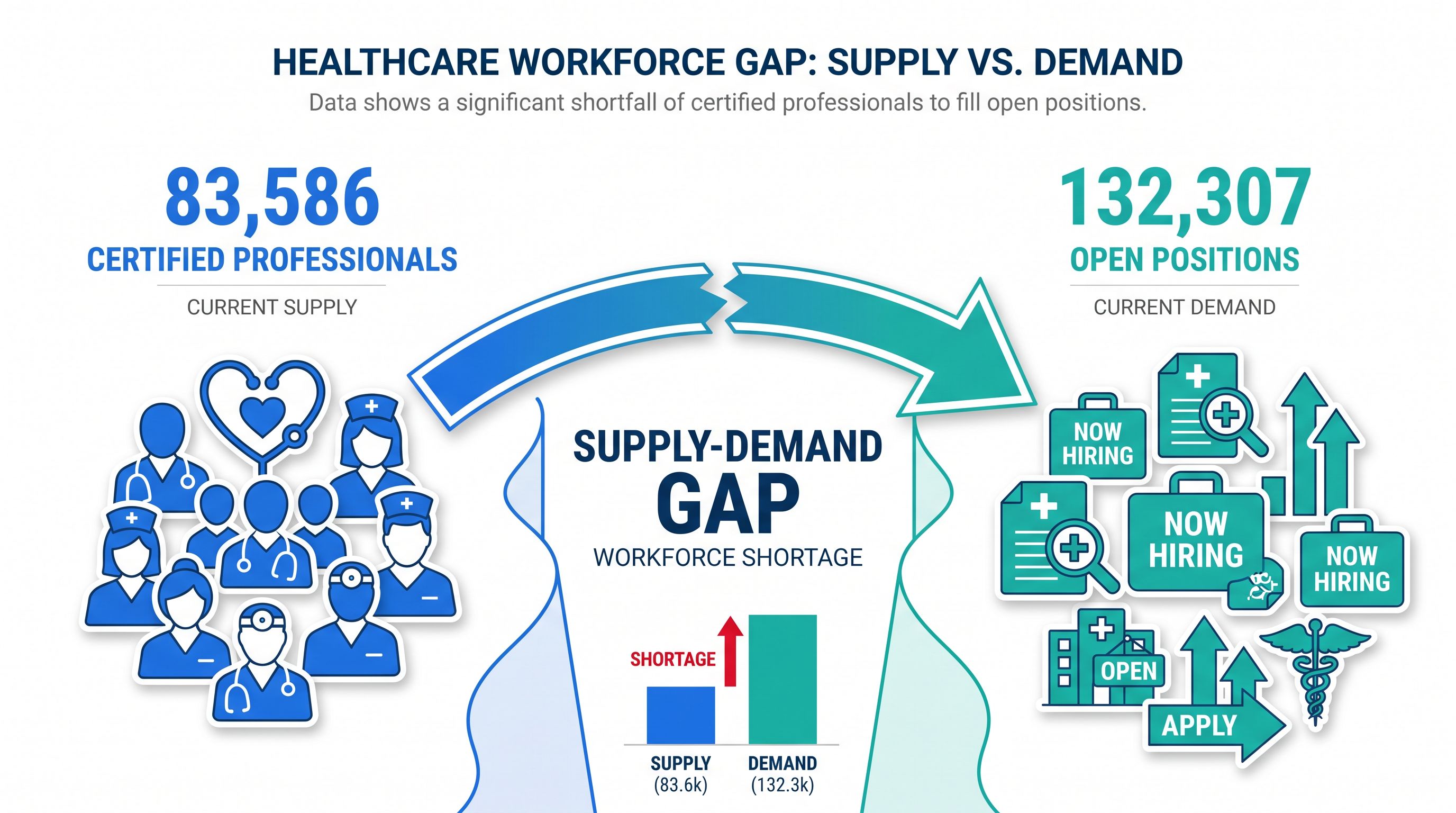
If you have searched for "BCBA jobs near me" recently, you already know the results are overwhelming. That is not a fluke. In 2025, employers posted 132,307 positions requiring BCBA certification, according to the BACB/Lightcast employment demand report. Meanwhile, only 83,586 people hold active BCBA credentials as of April 2026. The math is simple: there are roughly 1.6 open positions for every certified BCBA in the country.
That ratio means the job market favors you, whether you are a newly certified BCBA or a ten-year veteran considering a change. This guide breaks down exactly where demand is highest, how to find positions in your area, and what to look for when employers start competing for your attention.
The BCBA Employment Gap by the Numbers
The gap between BCBA supply and employer demand is not just large; it is accelerating. Job postings for BCBAs and BCBA-Ds grew 28% from 2024 to 2025, building on a 58% surge the year before. Since 2017, postings have grown at a compounded annual rate of 44.2%, according to the BACB/Lightcast report.
Not all certificants are actively seeing clients, either. Of the 83,586 credentialed BCBAs, approximately 71,371 were actively practicing as of October 2025, according to an analysis by Breaking News ABA. The rest work in academia, administration, or non-clinical roles. That widens the effective gap even further.
The geographic picture is even more striking. More than half of all U.S. counties have zero BCBAs practicing within their borders. Rural communities face the steepest shortages, with 35% of rural residents reporting significant delays in accessing ABA services compared to 23% in urban areas.
Looking ahead, the Bureau of Labor Statistics projects 17% employment growth for behavioral health roles from 2024 to 2034. That is roughly five times the 3% national average across all occupations, with about 48,300 new openings projected annually.
"The nation has far too few BCBA-level clinicians to meet potential demand across all regions."
What is driving all of this? The continuously increasing number of individuals diagnosed with autism spectrum disorder, expanded state insurance mandates requiring ABA coverage, and a growing recognition of behavior analysis applications beyond autism services.
Where BCBA Demand Is Highest: A State-by-State Look
Demand for BCBAs is national, but it concentrates heavily in certain states. The top five states by job posting volume, according to the 2025 Lightcast data, are:
- California (15% of all national BCBA job postings)
- New Jersey
- Texas
- Massachusetts
- North Carolina
Together, these five states account for 38% of all BCBA demand nationwide. California alone represents nearly one in six open positions.
States with the Most BCBAs per Capita
Density tells a different story than raw demand. TYGES Healthcare's ABA care desert analysis ranks states by BCBAs per 100,000 residents:
Lowest density: Wyoming (7.5), Mississippi (8.1), Montana (8.5), Oklahoma (9.8), Iowa (10.2)
The gap between the top and bottom is dramatic. Massachusetts has more than seven times the BCBA coverage of Wyoming per capita. For BCBAs willing to relocate, low-density states often mean less competition, higher signing bonuses, and employers eager to negotiate.
Where the Biggest Opportunities Are
High-demand, low-density states represent the sweetest spot for job seekers. Texas, for example, ranks in the top three for total job postings but does not crack the top ten in per-capita coverage. That combination signals intense employer competition for a limited talent pool. The same pattern holds in North Carolina and parts of the Southeast.
Some regions are cooling slightly. Washington and Oregon saw approximately 10% fewer BCBA job postings in 2025, and Arizona declined 6%. These are still strong markets, but BCBAs targeting the Pacific Northwest should expect slightly less urgency from employers compared to 2024.
For salary context, the national average BCBA salary stands at $89,075 according to ZipRecruiter's April 2026 data, with the highest-paying states including New Jersey, Maryland, Nevada, and New York.
How to Find BCBA Jobs Near You
Knowing the market is strong is one thing; knowing where to look is another. Here are the most effective channels for finding BCBA positions in your area.
General Job Boards
The major platforms remain the highest-volume sources. Indeed currently lists over 14,000 BCBA positions, SimplyHired shows 11,700+, and ZipRecruiter and Glassdoor each carry thousands more. These are useful for seeing what is available, but the sheer volume can make it hard to identify quality employers.
ABA-Specific Platforms
Specialized platforms tend to surface higher-quality, more relevant listings. The Association of Professional Behavior Analysts (APBA) job board focuses exclusively on behavior analyst roles. The ABA Resource Center and individual state ABA chapter websites are also worth checking regularly.
The Reverse Marketplace Approach
Traditional job searching puts the burden on you: find listings, tailor applications, wait for responses. In a market where employers outnumber candidates, that model is backwards. CertifyndABA flips the process. You create an anonymous profile highlighting your credentials, experience, and preferences. Employers review profiles and send interview requests to candidates who match their needs. You decide which requests to accept, and your identity stays private until you choose to reveal it.
Direct Employer Outreach
Large ABA providers like LEARN Behavioral, Behavioral Innovations, and ABA Centers of America maintain career pages with current openings. If you have a target employer in mind, going direct often gets a faster response than applying through a third-party board.
Professional Networking
ABAI conferences, state association events, and LinkedIn groups dedicated to behavior analysis remain valuable, especially for positions that never make it to public job boards. Many clinical director and leadership roles are filled through referrals.
What to Look For When Comparing BCBA Positions
With this many options, the challenge shifts from finding a job to finding the right one. Here is what matters most when evaluating offers.
- ✓ Caseload size. The national need would require each BCBA to carry roughly 39 clients. That is nearly five times the 8-client benchmark that workforce researchers use for sustainable practice. Ask employers about their average caseloads; anything above 15 warrants a conversation about support resources.
- ✓ Total compensation. In a seller's market, salary is just the starting point. Sign-on bonuses, CEU reimbursement, supervision stipends, relocation packages, and student loan assistance are all common. If an employer is not offering at least some of these, they are not competing seriously for talent.
- ✓ Work setting. Clinic-based, home-based, school-based, and telehealth roles each come with different daily routines and lifestyle tradeoffs. Be clear about what fits your life before you start comparing offers.
- ✓ Growth trajectory. The shortage is creating leadership openings at an unprecedented rate. Clinical director and regional director roles that once required a decade of experience are now accessible to BCBAs with five to seven years in the field.
- ✓ Red flags. Unreasonably high caseloads, no RBT supervision support, below-market pay, or high turnover are warning signs. In a market this strong, you do not need to settle.
Your Next BCBA Position Is Closer Than You Think
With 1.6 open positions for every certified BCBA and demand growing 28% year over year, the question is not whether you can find a job near you. It is which opportunity best matches your career goals, lifestyle, and compensation expectations. Whether you are in a high-density state like Massachusetts or considering a move to an underserved region where employers are eager to recruit, the market is working in your favor.
The most efficient path forward is to stop applying and start attracting. Let employers who need your credentials come to you.
Let Qualified Employers Reach Out to You
Create a free anonymous profile on CertifyndABA. Employers review your credentials and send interview requests directly. No applications, no resume blasts; just opportunities that match what you are looking for.
Create Your Free Profile