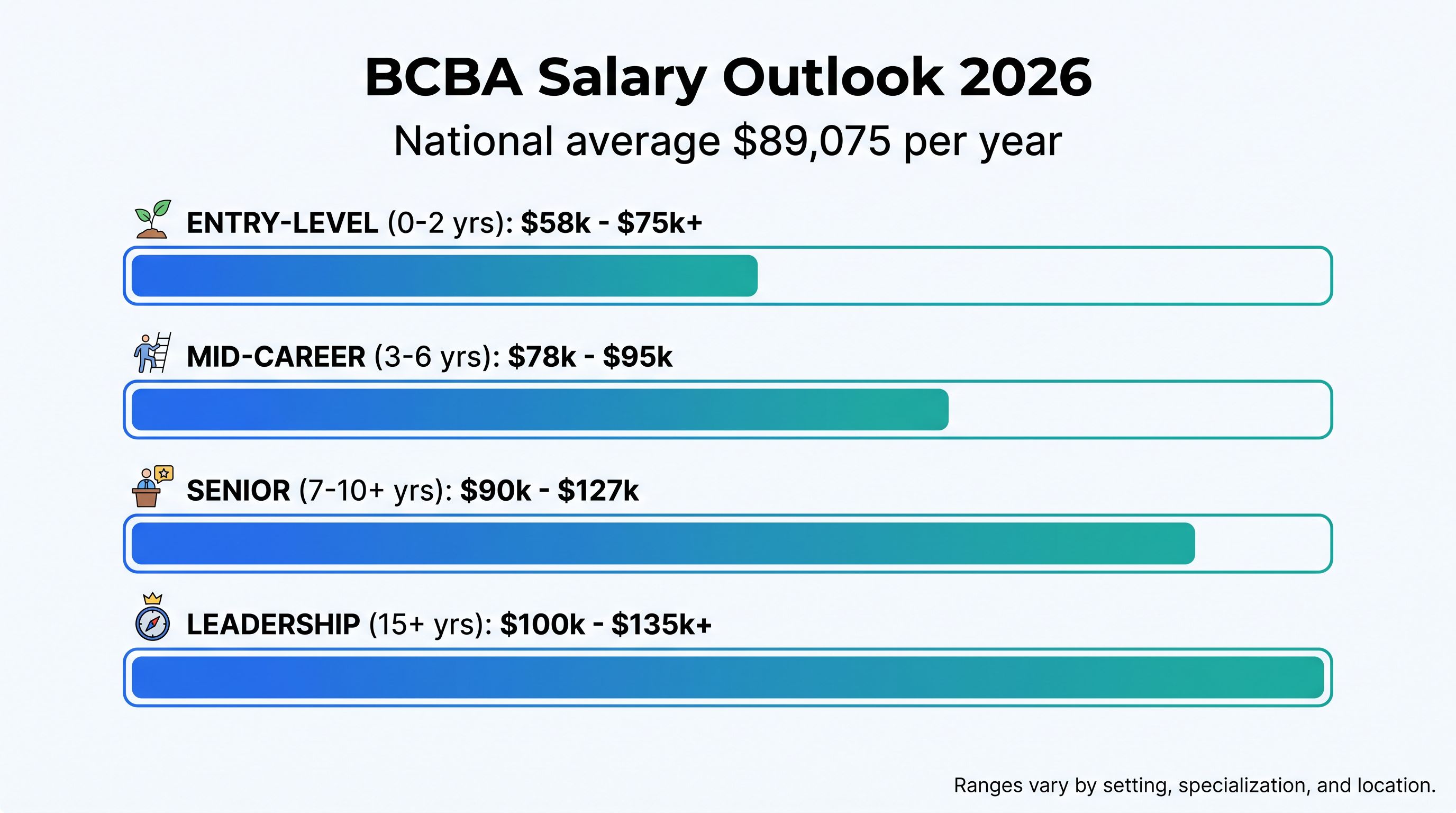

How much does a BCBA make? In 2026, the national average sits around $89,000 per year, with most Board Certified Behavior Analysts earning between $66,000 and $132,500 depending on experience, work setting, and location. But the raw numbers only tell part of the story. With 132,307 job postings chasing just 83,586 certified BCBAs, salaries are climbing faster than nearly any comparable healthcare credential.
Here is a complete breakdown of what BCBAs earn in 2026 and the structural forces that keep pushing compensation higher every year.
National Average BCBA Salary in 2026
According to aggregated job posting and compensation data from ZipRecruiter (March 2026), the national average BCBA salary is approximately $89,075 per year. The 25th percentile earns around $74,000, the 75th percentile reaches $90,500, and the 90th percentile exceeds $132,500.
One important caveat: the Bureau of Labor Statistics groups behavior analysts under a broader occupational category (SOC 21-1018) that reports a median of $59,190. That figure includes non-BCBA roles within the same classification. Self-reported compensation data from PayScale, Glassdoor, and job posting aggregators consistently places BCBA-specific salaries well above the BLS category average.
BCBAs who hold a doctoral designation (BCBA-D) earn an estimated 15 to 25 percent premium, putting their range at $95,000 to $144,000 per year.
How Much Does a BCBA Make by Experience Level?
Experience is the single largest factor in BCBA compensation. Here is how pay breaks down across career stages:
| Experience Level | Salary Range | Notes |
|---|---|---|
| Entry-level (0-2 years) | $58,000 - $75,000+ | High-demand markets now offering $70K+ for new grads |
| Mid-career (3-6 years) | $78,000 - $95,000 | Specialization in feeding disorders or OBM adds a premium |
| Senior (7-10+ years) | $90,000 - $127,000 | Clinical director roles land at the top of this range |
| Leadership (15+ years) | $100,000 - $135,000+ | Regional directors, VP-level, or private practice owners |
The shortage is compressing the entry-level gap. Markets in California, New Jersey, and Texas now regularly offer new BCBAs $70,000 or more, a figure that would have required three to four years of experience just five years ago.
BCBA Salary by Work Setting
Where you work matters almost as much as how long you have been working. Each setting carries different compensation structures, benefits, and earning ceilings.
Clinic-based ($80,000 - $110,000): The most common setting for BCBAs. Clinics typically offer structured career ladders, productivity bonuses, and full benefits packages. Many national ABA providers have standardized pay bands that scale with caseload and tenure.
Hospital and healthcare systems ($75,000 - $125,000): BCBAs working in hospital settings, particularly in specialty programs like feeding disorders or severe behavior, can reach the top of this range. Healthcare employers commonly add quality bonuses of 8 to 12 percent on top of base salary, plus premium benefits including retirement matching and comprehensive insurance.
School-based ($65,000 - $90,000): The base salary is lower, but the total compensation picture changes when you factor in pension plans, predictable schedules, summers off, and professional development funding. These non-salary benefits can add $10,000 to $15,000 in equivalent value.
Private practice ($75,000 - $150,000+): The highest earning ceiling belongs to BCBAs who build their own practices or consulting businesses. Independent practitioners commonly bill $100 or more per hour, and practice owners who build teams can earn well into six figures.
Telehealth and hybrid ($70,000 - $100,000): Telehealth-only positions may pay 5 to 15 percent less than in-person equivalents, though hybrid models increasingly match local market rates. The trade-off is often greater schedule flexibility and zero commute time.
Highest-Paying States for BCBAs
Geography creates significant salary variation. The top-paying states for BCBAs in 2026 include New Jersey, California, Connecticut, Massachusetts, and New York, where averages typically exceed $95,000.
However, high salaries do not always mean high purchasing power. States like Texas, North Carolina, and Georgia offer averages of $80,000 to $90,000 with substantially lower costs of living. A BCBA earning $85,000 in Raleigh often keeps more take-home pay than one earning $100,000 in the New York metro area.
Rural and underserved areas are increasingly competitive on pay. With 46 percent of U.S. counties still lacking any BCBA presence (according to BACB geographic data), employers in these regions are offering sign-on bonuses and relocation packages to attract talent.
For a full state-by-state breakdown, see our BCBA Salary by State 2026 guide.
Why BCBA Salaries Keep Rising
This is the part most salary articles skip. BCBA pay is not rising because of general inflation or because behavior analysis suddenly became more complex. It is rising because of a structural workforce shortage that shows no signs of closing.
The math is straightforward. In 2025, employers posted 132,307 positions requiring BCBA certification, according to the BACB-commissioned Lightcast labor market analysis. That same year, only 83,586 BCBAs held active credentials. That is roughly 1.6 open positions for every certified BCBA in the country, and the real clinical gap is even wider; workforce analyses estimate that only about 30,000 BCBAs work in direct clinical service, while approximately 100,000 are needed nationally.
Three forces keep this gap from closing:
Supply is constrained. The first-time BCBA exam pass rate has dropped from 66 percent in 2020 to 51 percent in 2025, according to BACB examination data. With roughly 21,000 candidates sitting for the exam each year, only about 8,000 earn certification annually.
Demand keeps accelerating. The CDC reported in 2025 that autism prevalence has risen to 1 in 31 children, up from 1 in 36 just two years prior and 1 in 150 in 2000. All 50 states now mandate autism insurance coverage, meaning more families can access ABA services and more employers need BCBAs to deliver them.
Geography compounds the problem. Nearly half of all U.S. counties have zero BCBAs. States in the rural South and Mountain West have BCBA density figures well below 15 per 100,000 residents, forcing employers to compete aggressively on compensation.
"The BLS projects 17 percent job growth for behavior analyst roles through 2034. Combined with a declining exam pass rate and rising autism identification, this is not a temporary spike; it is a structural shift."
For BCBAs, the implication is clear: you have more leverage than you may realize when evaluating offers and negotiating compensation. Our BCBA Salary Negotiation Guide covers specific tactics for turning this market data into a better offer.
How to Maximize Your BCBA Earning Potential
The market favors BCBAs, but specific moves can push your compensation well above the average:
- ✓ Specialize. BCBAs with expertise in feeding disorders, organizational behavior management (OBM), severe behavior, or early intervention command premium rates across every setting.
- ✓ Negotiate with data. Walk into salary conversations knowing the employment gap numbers. When there are 1.6 openings per BCBA, you are not asking for a favor; you are discussing fair market value.
- ✓ Evaluate total compensation. A school-based role at $75,000 with a pension and summers off may outperform a clinic role at $90,000 with higher stress and no retirement match. Compare the full package.
- ✓ Consider geographic strategy. High-demand states with moderate costs of living, like Texas and North Carolina, offer strong purchasing power without the cost-of-living penalty of coastal metros.
- ✓ Benchmark your market value. Create an anonymous profile on CertifyndABA to receive competing offers without revealing your identity. Knowing what multiple employers are willing to pay is the most effective negotiation tool you can have.
The Bottom Line on BCBA Pay in 2026
BCBAs earn a national average of approximately $89,000 per year, with a range of $66,000 to $132,500 or more depending on experience, work setting, and location. More importantly, the structural forces driving salary growth are not temporary. A constrained supply of new BCBAs, rising autism identification, expanding insurance mandates, and severe geographic gaps all point to continued upward pressure on compensation for years to come.
If you are a BCBA, this is a market that rewards informed career decisions. Know your worth, and let the data do the talking.
See What Employers Are Willing to Pay You
Create a free, anonymous CertifyndABA profile and receive real salary offers from employers competing for your skills. No personal information shared until you choose to connect.
Create Your Free Profile