

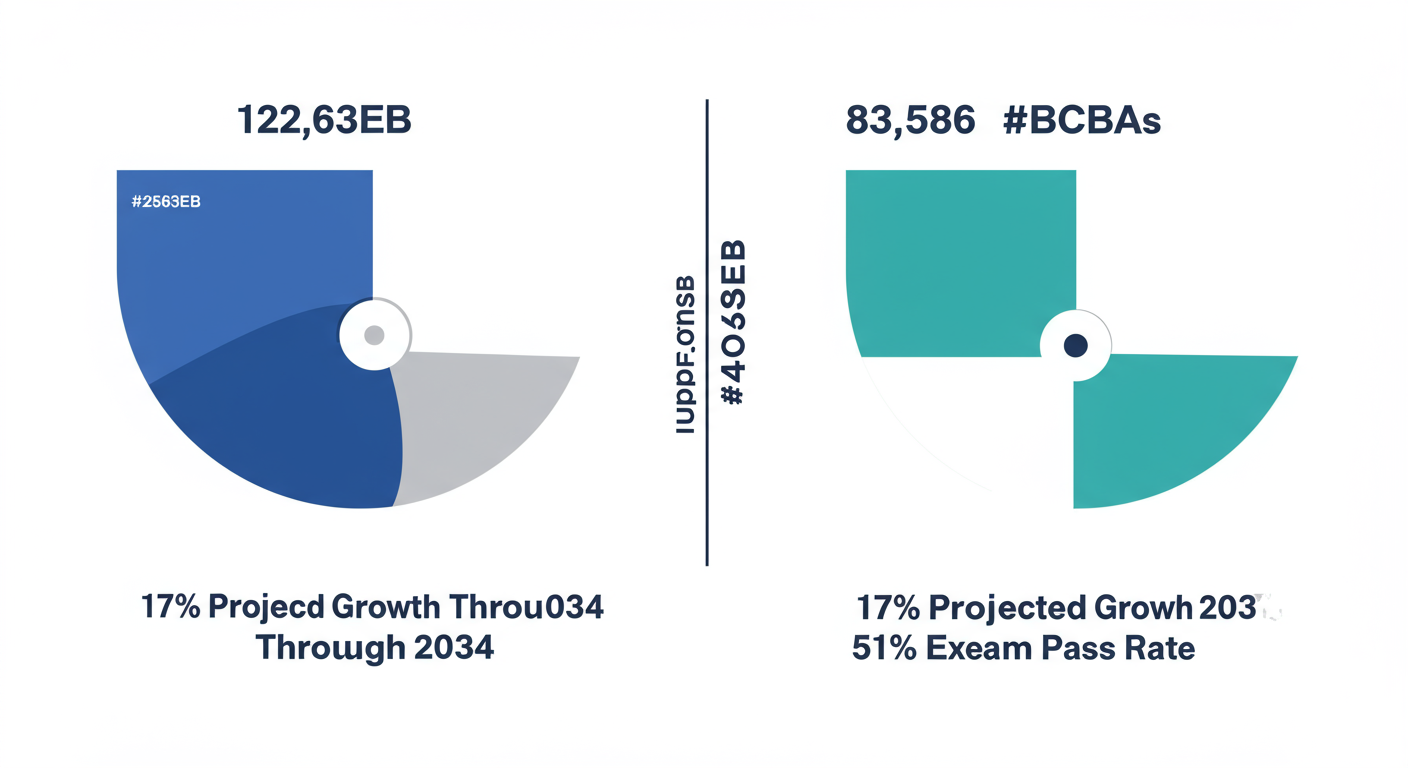
With over 132,000 BCBA job postings in 2025 and only about 83,500 active certificants, the ABA job market tilts heavily in your favor. But landing the right position still requires preparation. Knowing what BCBA interview questions to expect, and what questions to ask in return, is what separates a good interview from a great one.
According to the BACB/Lightcast Employment Demand Report, job postings requiring BCBA certification grew 28% year over year. The Bureau of Labor Statistics projects 17% employment growth for behavioral health roles through 2034, roughly five times the national average. You have options. This guide helps you make the most of them by covering the questions you will face and the questions you should be asking.
Clinical and Technical BCBA Interview Questions
Most BCBA interviews start with questions that assess your clinical foundation. Employers want to see that you can apply ABA principles to real cases, not just define them. Here are the most common clinical questions and how to approach each one.
"Walk me through how you conduct a functional behavior assessment."
This is one of the most frequent BCBA interview questions, and for good reason. Describe your full process: indirect assessments like interviews and rating scales, direct observation using ABC data collection, and how you identify the function of behavior. Mention specific tools you use, such as the FAST or MAS for screening, and explain how you move from assessment to hypothesis to intervention.
"Describe your process for developing a behavior intervention plan."
Walk through how FBA results inform your BIP. Cover how you select replacement behaviors, define measurable goals, choose reinforcement strategies, and plan for generalization. Emphasize that your plans are data-driven and individualized.
"A client has been on their program for three months with minimal progress. What do you do?"
This question tests your problem-solving process. Talk about reviewing data trends, reassessing the function of behavior, evaluating treatment fidelity, checking whether the reinforcer is still motivating, and consulting with the team. Avoid jumping to "change the program"; show that you diagnose before you prescribe.
"What data collection methods do you prefer and why?"
Demonstrate range. Discuss frequency recording, duration, latency, interval recording, and permanent product, explaining which contexts suit each method. Mention how you balance precision with practicality for RBTs in the field.
"How do you ensure your interventions are evidence-based?"
Reference peer-reviewed literature, continuing education, BACB standards, and professional consultation. Give a specific example of a time you chose a particular intervention because the evidence supported it over an alternative.
Behavioral Scenario Questions and How to Answer Them
Scenario-based BCBA interview questions reveal how you think under pressure. Employers present realistic situations to evaluate your clinical judgment, ethical reasoning, and interpersonal skills. Expect at least two or three of these.
"A parent disagrees with your behavior intervention recommendation. How do you handle it?"
Show empathy first, then education. Explain that you would listen to the parent's concerns, validate their perspective, and use data to explain your clinical rationale in accessible language. Emphasize collaboration over compliance. Reference the BACB Ethics Code's guidance on prioritizing client welfare while respecting family input.
"An RBT on your team is struggling with treatment fidelity. What steps do you take?"
Describe a supportive, systematic approach: observe the RBT in session, identify specific skill gaps, provide targeted training with modeling and feedback, and follow up with integrity checks. Avoid framing this as a disciplinary issue; it is a training opportunity.
"You observe a colleague implementing a procedure that could cause harm. What do you do?"
This is an ethics question. Reference your obligation under the BACB Ethics Code to prioritize client safety. Describe how you would address it directly with the colleague first, document the concern, and escalate to a supervisor if the behavior continues. Be specific about the ethical principles at stake.
"A client exhibits a new, severe self-injurious behavior during a session. Walk me through your response."
Demonstrate crisis management: ensure immediate safety, implement any existing crisis protocols, collect data on the new behavior, and communicate with the family and team. Then describe how you would conduct a reassessment to understand the new behavior's function before modifying the treatment plan.
"Data shows your BIP is not working after six weeks. How do you adjust?"
Emphasize that you would first verify treatment integrity before changing the plan itself. Then review the functional hypothesis, check for setting events or establishing operations you may have missed, consider whether the replacement behavior is truly functionally equivalent, and adjust one variable at a time to isolate what works.
Supervision and Leadership Questions
Most BCBA roles involve supervising RBTs, training staff, and collaborating across disciplines. Interviewers want to see that you can lead a team, not just manage a caseload.
"How do you train and supervise RBTs?"
Describe your supervision structure: how often you observe sessions, how you deliver feedback (in the moment vs. scheduled meetings), how you track RBT competencies, and how you ensure they meet their supervision hour requirements. Mention tools or systems you use for documentation.
"What is your approach to giving constructive feedback?"
Explain that you lead with specific, observable behavior rather than generalizations. Describe using a supportive framework: acknowledge what is working, identify the area for growth with a concrete example, model the correct procedure, and follow up. Emphasize that feedback is ongoing, not reserved for problems.
"How do you manage multiple caseloads across different settings?"
Talk about your organizational systems: scheduling, prioritization, and how you allocate time between clinic, home, and school cases. Be honest about the challenges and show you have strategies for staying on top of documentation, parent communication, and team coordination.
"How do you collaborate with other professionals like SLPs, OTs, and teachers?"
Demonstrate that you value multidisciplinary input. Give an example of a time you coordinated with another professional to align goals, share data, or resolve a disagreement about intervention approach. Show that you see collaboration as a clinical strength, not an administrative burden.
BCBA Interview Questions You Should Ask Every Employer
This may be the most important section of this guide. In a market with roughly 1.6 job postings per active certificant, you are not just being evaluated; you are evaluating. The questions you ask reveal whether this employer will support your clinical standards, professional growth, and well-being.
"The best BCBA interviews are two-way conversations. Your questions tell an employer as much about your clinical values as their questions tell you about yours."
"What is the typical BCBA caseload here?"
The Council of Autism Service Providers (CASP) recommends 6 to 12 comprehensive cases (30+ hours per week each) or 10 to 15 focused cases per BCBA. If the answer significantly exceeds these benchmarks, that is a signal worth exploring further.
"How many RBTs will I supervise, and what is the supervision ratio?"
The recommended standard is approximately 20% of direct service hours devoted to supervision. Three full-time RBTs can easily generate 15 to 20 hours of required supervision weekly. Make sure the math works with the rest of your responsibilities.
"What is your BCBA turnover rate?"
This single question reveals more about a company's culture than almost any other. High turnover often signals unsustainable caseloads, poor leadership, or insufficient support. If the interviewer hesitates or deflects, consider that an answer in itself.
"What professional development opportunities do you offer?"
Look for specifics: conference attendance support, CEU funding, internal training programs, mentorship, or pathways to clinical director roles. Generic answers like "we support growth" without concrete examples are a weak signal.
"Do you provide clinic-based, home-based, or both types of services?"
Research has linked home-only service delivery models to higher rates of burnout among BCBAs. Mixed settings offer variety, collegial support, and access to resources that home-only positions may lack.
"What quality assurance procedures are in place?"
A company that invests in QA demonstrates that it values clinical outcomes, not just billable hours. Ask how they monitor treatment effectiveness, ensure procedural fidelity, and handle cases where outcomes are not meeting expectations.
"What is the ratio of administrative to clinical time?"
If you are spending 80% of your week on paperwork and billing and 20% on clinical work, that is not a BCBA role; it is an administrative role with a BCBA title. Clarify expectations before you accept.
Red Flags to Watch For During Your Interview
Not every opportunity is the right one, even in a strong job market. Watch for these warning signs during the interview process.
- ✗ Evasiveness about caseload numbers or supervision ratios. If they cannot or will not give you specifics, the numbers are probably not favorable.
- ✗ Vague professional development promises. "We invest in our team" without concrete programs, budgets, or examples is not a commitment.
- ✗ High turnover or reluctance to discuss retention. Healthy organizations share this data willingly because they are proud of it.
- ✗ No quality assurance framework. If outcomes are not being measured, ask yourself what is driving clinical decisions.
- ✗ Pressure to exceed CASP caseload recommendations. A company that starts you above recommended limits is unlikely to improve your workload over time.
- ✗ No structured onboarding. Being handed a caseload on day one with no orientation signals a reactive, not proactive, organization.
How to Prepare Before Interview Day
The best BCBA interview performances come from preparation that goes beyond reviewing common questions. Here is a focused checklist for the days before your interview.
- ✓ Review the BACB Ethics Code. Ethical scenario questions appear in nearly every BCBA interview. Be ready to reference specific principles, not just the general idea of "acting ethically."
- ✓ Prepare 3 to 5 case examples using STAR. Have concrete stories ready that demonstrate your clinical reasoning, leadership, collaboration, and problem-solving. Different examples for different question types.
- ✓ Research the company thoroughly. Know their service model (clinic, home, school, telehealth), populations they serve, geographic coverage, and any public reviews from employees.
- ✓ Define your non-negotiables. Know your minimum acceptable caseload limits, supervision expectations, and compensation range before you walk in. This clarity prevents you from accepting a role that leads to burnout.
- ✓ Practice explaining ABA in accessible language. You may interview with HR professionals, administrators, or parents who do not share your technical vocabulary. Clear communication is itself a clinical skill.
- ✓ Write down your questions for the employer. Bring a printed list. It signals preparation and seriousness, and it ensures you do not forget to ask the questions that matter most to you.
You Have the Leverage. Use It Wisely.
With 83,586 active BCBAs and over 132,000 open positions, you are in one of the most candidate-favorable job markets in healthcare. The BCBA exam pass rate has dropped to 51%, which means the supply pipeline is tightening even as demand accelerates. Every interview you attend is a chance to find a role that supports your clinical standards, professional growth, and long-term well-being.
Treat every interview as a two-way conversation. Prepare your answers, but prepare your questions with equal care. The employer who welcomes your questions about caseloads, turnover, and quality assurance is probably the employer worth working for.
Skip the Job Boards. Let Employers Find You.
CertifyndABA is a reverse job marketplace where you create an anonymous profile and qualified employers send you interview requests. No applications. No cold outreach. Just opportunities that match your credentials.
Create Your Free Profile