


If you are a board certified behavior analyst in Connecticut, you are job hunting in a market tilted firmly in your favor. Nationwide, employers posted 132,307 jobs for BCBAs and BCBA-Ds in 2025 against a certified supply of roughly 74,000 analysts, and Connecticut lists somewhere between 150 and 260 active BCBA openings across the major job boards at any given time. For a credentialed analyst in the state, that gap between open roles and available people is the single most important fact of your job search.
This guide breaks down how strong BCBA demand really is in Connecticut, what analysts earn from Fairfield County to Hartford, the settings hiring most actively, the state license Connecticut requires on top of your national certification, and how to turn a shortage market into a stronger offer.
The Employment Gap Behind BCBA Jobs in Connecticut
The reason BCBA jobs in Connecticut are so plentiful starts with a national shortage that shows no sign of closing. According to the Behavior Analyst Certification Board's 2025 workforce analysis prepared by Lightcast, U.S. employers posted 132,307 jobs for BCBAs and BCBA-Ds in 2025. Set that against the supply: the country had roughly 74,000 supervisor-level analysts practicing at the time, a mismatch that leaves most postings competing for the same short list of candidates.
The same report estimates the country would need roughly 362,500 BCBAs to fully meet demand, nearly five times the current workforce, and notes that more than half of all U.S. counties still have no behavior analyst practicing within their borders. For analysts who are actively job hunting, the practical result is roughly two to three open roles for every available candidate. Our 2026 BCBA shortage analysis and our breakdown of how many BCBAs there are put the full national picture in context.
"With demand running well ahead of supply, the Connecticut BCBA's problem is not getting hired; it is choosing the right offer."
How Strong Is BCBA Demand in Connecticut?
Connecticut mirrors the national pattern on a smaller scale, and its own numbers make the gap concrete. As of the Behavior Analyst Certification Board's January 2026 data, Connecticut had roughly 1,515 certified BCBAs and 2,212 Registered Behavior Technicians practicing statewide. Against that pool, national job boards routinely list several hundred open roles: ZipRecruiter counted about 154 BCBA jobs in Connecticut in a recent snapshot, LinkedIn showed around 174, and Glassdoor surfaced roughly 260. For a state of about 3.6 million people, that is a deep pool of open work chasing a relatively small group of certified analysts.
Three forces keep that demand climbing. Rising autism identification steadily expands the number of children who qualify for services. Connecticut's insurance mandate, one of the earliest in the country, funds ABA without dollar or age caps, so covered caseloads keep growing. And clinic, school-district, and hospital programs continue to open across the state faster than new analysts can certify. Because the supply of new certificants has not kept pace, a qualified Connecticut BCBA can usually field multiple conversations at once. If you want to see how the state stacks up against the rest of the country, our guide to whether BCBAs are in demand lays out the numbers.
BCBA Salary in Connecticut: What You Can Actually Earn
Salary figures for BCBAs in Connecticut vary by source because each one samples a different slice of the market, but the honest range for a full-time analyst runs from the high $70,000s to the low $90,000s, with clinical directors and senior supervisors clearing well into six figures.
ZipRecruiter puts the statewide average near $84,736, with a typical band of roughly $70,000 to $90,000 and top earners moving past $100,000. Fairfield County sits at the top of that band: Stamford runs about 12% above the state average, pulled up by its cost of living and proximity to the New York City market. New Haven lands near $85,000, while Bridgeport samples closer to $78,000. Hartford and the central part of the state fall in between. For how Connecticut compares nationally, see our BCBA salary by state 2026 guide.
Because openings outnumber candidates, these figures are a floor to negotiate from rather than a ceiling. Sign-on bonuses, relocation help, and CEU stipends are increasingly common where employers are competing for the same short list of analysts, and our salary negotiation guide shows how to use the shortage as leverage.
Where the Jobs Are: Connecticut Metro Breakdown
BCBA jobs in Connecticut cluster in the state's population centers along the I-95 corridor and around Hartford, while the rural northeast and northwest corners remain thinner. The table below summarizes where the roles concentrate and what stands out about each market.
| Metro | Market Depth | What Stands Out |
|---|---|---|
| Fairfield County (Stamford, Bridgeport, Danbury) | Deepest & highest-paying | Highest pay in the state; competes with the New York City market; long commutes and high cost of living |
| New Haven metro | Very strong | Clinics, university-affiliated programs, and hospital autism services; steady clinical demand |
| Hartford & central CT | Strong | State-agency, school-district, and health-system roles; central location covers much of the state |
| Waterbury & the Naugatuck Valley | Growing | Expanding clinic footprint with real negotiating leverage as providers compete for coverage |
| Eastern CT (Norwich, New London) | Underserved | Acute shortages filled increasingly by telehealth and travel roles; least competition |
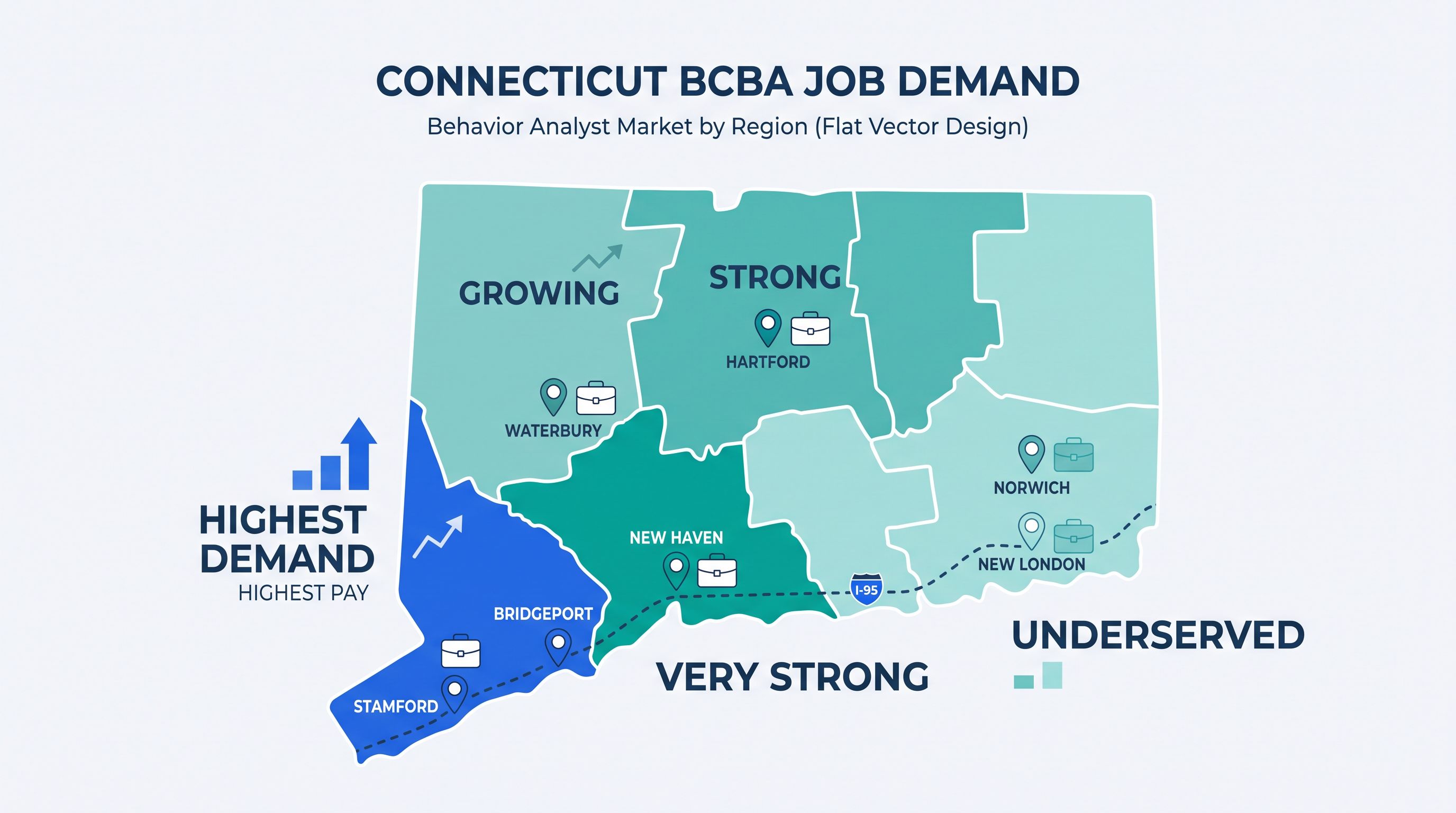
Fairfield County offers the most volume and the highest pay, though the cost of living and commuting realities there are steep. New Haven pairs a strong clinical market with university and hospital programs, and Hartford's central position makes it a practical base for roles that cover much of the state. If you are open to telehealth or travel work, eastern Connecticut is where the shortage is most acute and the flexibility greatest; our remote BCBA jobs guide covers how to find those roles.
Types of BCBA Jobs Available in Connecticut
ABA work in Connecticut has grown well beyond the traditional clinic floor. The roles hiring most actively in 2026 include:
- ✓ Center-based and in-home ABA. The largest segment by far, spanning national providers and independent Connecticut clinics serving early-intervention and school-age clients across the I-95 corridor.
- ✓ School-district BCBA roles. Districts and regional education service centers hire analysts to support IEP teams and behavior intervention plans, often on a school-year calendar with state-pension benefits.
- ✓ Hospital and university-affiliated roles. Connecticut health systems and academic programs use the BCBA credential in developmental pediatrics, feeding clinics, and care coordination.
- ✓ Telehealth and hybrid roles. Remote clinical supervision lets Connecticut BCBAs oversee cases across multiple regions, a permanent fixture since the pandemic.
- ✓ Part-time, contract, and travel. Flexible arrangements are widely available, and the shortage means you can often set your own schedule.
Connecticut Requires a State License
Here is the step that trips up analysts moving into Connecticut, and one most job listings never mention. Connecticut has licensed behavior analysts since 2017, when the state passed its licensure law, and licenses are issued by the Connecticut Department of Public Health. You need this state license to practice, in addition to your BACB certification.
Your BACB certification is a prerequisite for the state license but is not sufficient on its own. Connecticut law requires that ABA services for children under 21 be provided or supervised by a licensed behavior analyst, licensed physician, or licensed psychologist, which is exactly why employers need credentialed, licensed analysts on staff to bill covered services. Start the license application before or alongside your job search rather than after you accept an offer, and ask employers whether they help with state licensing and payer credentialing. For current requirements and forms, see the Connecticut Department of Public Health. Analysts who are already Connecticut-licensed hold a real advantage, because they can start billing immediately.
How to Land the Best BCBA Job in Connecticut
When openings outnumber candidates, the winning strategy flips. Instead of mass-applying and hoping, you can be selective and let the market work in your favor.
- ✓ Vet for sustainability, not just salary. Ask about caseload caps, supervision ratios, indirect-time allocation, and administrative support. These factors predict burnout more than base pay does, and our list of the best ABA companies to work for shows what to look for.
- ✓ Negotiate the full package. With clinics competing for a short list of analysts, sign-on bonuses, relocation help, CEU stipends, and productivity pay are on the table when an employer wants you.
- ✓ Compare offers side by side. With several hundred openings across the state, there is no reason to accept the first bid before you know what a second and third employer will offer. Sharpen your materials with our BCBA resume guide and interview question prep.
That is exactly the dynamic CertifyndABA is built around. Instead of scattering your resume across job boards, you create one anonymous profile, and verified Connecticut employers send you interview requests based on your qualifications. Your name and contact details stay private until you choose to accept, so you can weigh multiple offers without your current employer ever knowing you are looking. If you are still scoping the market, start with our guide to finding BCBA jobs near you.
Frequently Asked Questions
Are BCBAs in demand in Connecticut?
Yes. National job boards list several hundred open BCBA roles across Connecticut, ranging from about 154 on ZipRecruiter to roughly 260 on Glassdoor in recent snapshots, against a statewide pool of about 1,515 certified BCBAs. Nationally, employers posted 132,307 BCBA and BCBA-D jobs in 2025 against a supply of roughly 74,000 analysts, so demand runs well ahead of supply in Connecticut and across the country.
How much does a BCBA make in Connecticut?
Most full-time BCBAs in Connecticut earn between about $70,000 and $90,000, with ZipRecruiter reporting a statewide average near $84,736. Fairfield County pays the most; Stamford runs about 12% above the state average, New Haven lands near $85,000, and Bridgeport samples closer to $78,000. Clinical directors and specialized roles clear $100,000.
Do you need a license to be a BCBA in Connecticut?
Yes. Connecticut has licensed behavior analysts since 2017, with licenses issued by the Connecticut Department of Public Health, in addition to your BACB certification. State law requires ABA services for children under 21 to be provided or supervised by a licensed behavior analyst, physician, or psychologist, so apply for your state license early.
Which part of Connecticut has the most BCBA jobs?
Fairfield County, including Stamford, Bridgeport, and Danbury, has the deepest market and the highest pay, followed by the New Haven metro and the Hartford area. Eastern Connecticut around Norwich and New London is underserved and increasingly filled through telehealth and travel roles.
The Bottom Line on BCBA Jobs in Connecticut
Connecticut in 2026 is a candidate's market. Demand outpaces the state's supply of roughly 1,515 certified analysts, openings concentrate along the I-95 corridor and around Hartford while eastern Connecticut stays hungry, and pay sits near the national average, climbing quickly for directors and specialists and highest in Fairfield County. The one extra step, a Connecticut behavior-analyst license, is worth handling early so you are ready to start. The analysts who do best are not the ones who apply to the most jobs; they are the ones who let qualified employers come to them and then negotiate from a position of strength.
Let Connecticut employers compete for you
Create a free, anonymous CertifyndABA profile and receive interview requests from verified Connecticut ABA employers. Your identity stays private until you decide to respond.
Create Your Free Profile