


There were 132,307 job postings for BCBAs in 2025, yet only 83,586 board certified behavior analysts exist as of April 2026. That means there are roughly 1.6 open positions for every certified BCBA in the country. If you are not using this gap to negotiate better compensation, you are leaving money on the table. This BCBA salary negotiation guide breaks down the numbers, the strategies, and the specific tactics that work in ABA settings.
According to Harvard's Program on Negotiation, 87% of professionals who negotiate their salary receive at least part of what they ask for, with an average increase of $5,000. In a field where employers are actively competing for a limited talent pool, BCBAs have more leverage than most professionals in any industry. The key is knowing how to use it.
The BCBA Employment Gap: Your Negotiation Leverage in Numbers
Before you walk into any salary conversation, understand the market forces working in your favor. The data from the BACB's 2025 Lightcast Employment Demand Report tells a clear story.
That number represents a 28% year-over-year increase and a 102% increase since 2023. Job postings for behavior analysts have grown at a compound annual rate of 44.2% since 2017, according to Behavioral Health Business.
Meanwhile, the supply pipeline remains constrained. The BACB's 2025 Annual Data Report shows only 8,021 new BCBAs were certified last year, and the first-time exam pass rate dropped to 51%, down from 66% in 2020. The profession is growing, but nowhere near fast enough to meet demand.
Geography matters too. Five states account for 38% of all BCBA job postings: California (15% alone), New Jersey, Texas, Massachusetts, and North Carolina. If you practice in one of these markets, your leverage is even greater.
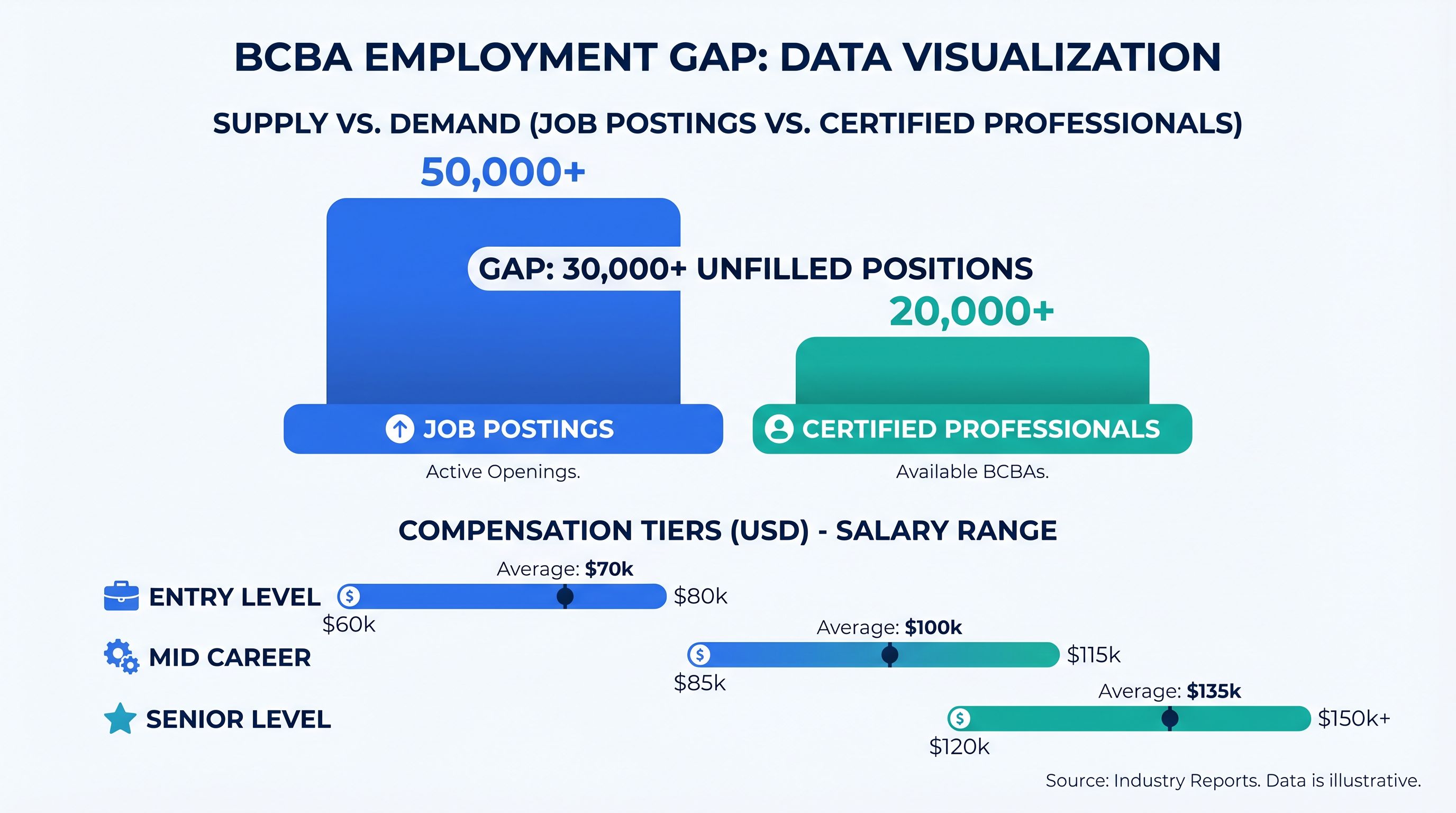
Know Your Worth: BCBA Salary Benchmarks by Experience
Effective BCBA salary negotiation starts with knowing the current market rates. Walking into a conversation without benchmarks is like playing poker without looking at your cards.
Based on 2025-2026 data from Glassdoor, Indeed, and industry salary surveys:
- ✓ Entry-level (0-2 years): $60,000 to $88,000 depending on metro area and setting
- ✓ Mid-career (3-6 years): $85,000 to $100,000, higher with supervisory responsibilities
- ✓ Senior/Lead (7+ years): $100,000 to $135,000+, especially in clinical director or program director roles
- ✓ National median: Approximately $101,539 per year (Glassdoor, 2026)
These ranges shift significantly by geography, setting, and specialization. A BCBA in San Francisco will command a different rate than one in rural Alabama. Before negotiating, research your specific market using salary databases, the BACB certificant data portal, and job postings in your area.
BCBA Salary Negotiation Strategies by Work Setting
Not all ABA positions negotiate the same way. The levers you can pull depend on your work setting, and understanding these differences is what separates a good negotiation from a great one.
Clinic-Based Roles
Clinics typically have structured salary ladders with productivity bonuses. Base salary may have limited flexibility, but the bonus structure often does. Focus your negotiation on caseload caps, billable hour expectations, and how the productivity bonus is calculated. A lower billable hour threshold with the same bonus target can be worth thousands annually. Also ask about the path from your starting salary to the next tier; some clinics promote quickly for strong performers.
School-Based Roles
School districts usually follow rigid pay scales, which means base salary negotiation is limited. Instead, negotiate stipends for specialized skills (autism expertise, bilingual services), summer contract options for year-round income, additional professional development days, and flexible scheduling arrangements. School-based roles also tend to offer stronger benefits packages, including pensions, which adds significant long-term value.
Home Health and Community Roles
For BCBAs providing in-home or community-based services, the real negotiation is around the logistics that affect your actual take-home pay. Negotiate mileage reimbursement rates (the IRS standard rate is your minimum), cancellation policies (whether you get paid for no-shows), scheduling autonomy, and route density guarantees that minimize windshield time. A generous cancellation policy alone can protect thousands of dollars in annual income.
Telehealth and Hybrid Roles
The growing telehealth space offers unique negotiation opportunities. Clarify the ratio of in-person to virtual sessions, negotiate equipment stipends for your home office setup, and make sure you understand how the company defines billable time for virtual services. Hybrid roles that offer scheduling flexibility are increasingly popular; if the base salary is firm, negotiate a more favorable in-person/virtual split.
Beyond Base Pay: Negotiating Your Total Compensation
Base salary is only part of the picture. In ABA, benefits and perks can add $15,000 to $40,000 in annual value. If an employer's salary offer is firm, shift the conversation to these high-value items.
Sign-on bonuses are increasingly common as companies compete for BCBAs. Current ranges span from $5,000 to over $35,000 at competitive organizations. ABA Centers of Virginia, for example, has offered $25,000 sign-on bonuses, while Autism Learning Partners has advertised bonuses exceeding $35,000 over three years.
CEU reimbursement typically ranges from $1,500 to $3,000+ annually, and many companies also cover BCBA license renewal fees. Some organizations like Cortica offer $2,000 annual CEU stipends plus paid days off for continuing education events. Free in-house CEUs are also common at larger organizations.
Paid time off ranges widely. Standard starting PTO is two to three weeks, but top ABA employers offer four weeks or more, and some have moved to unlimited PTO policies. If salary negotiation stalls, asking for an additional week of PTO is often an easy win for both sides.
Other negotiables worth raising include relocation stipends, retention bonuses, tuition reimbursement for advanced certifications, supervision hours toward BCBA-D, reduced caseload during your onboarding period, and 401(k) matching.
"A slightly lower base salary with strong benefits, a generous sign-on bonus, and adequate PTO is often worth more than a higher base with minimal perks."
Step-by-Step: How to Negotiate Your BCBA Offer
With your data in hand, here is how to actually have the conversation.
Step 1: Research before you respond. Gather salary data for your metro area, work setting, and experience level before discussing numbers with anyone. Use job postings, salary databases, and professional networks to establish a realistic range.
Step 2: Anchor with data, not feelings. When making your counter, lead with evidence. Try a framing like: "Based on current market data for BCBAs with [X years] of experience in [city/region], and my background in [specialization], I'm targeting a range of $X to $Y." Ask for 10-15% above the initial offer if the data supports it.
Step 3: Do not ask permission to negotiate. Research from Harvard's Program on Negotiation shows that simply making a counteroffer, rather than asking "Is this negotiable?", leads to better outcomes. Present your counter as a natural part of the process, because it is.
Step 4: Negotiate in writing when possible. Email gives you time to compose thoughtful responses, and it creates documentation. If the initial conversation happens over the phone, follow up with an email summarizing what was discussed and any numbers mentioned.
Step 5: If salary is firm, shift to benefits. When you hear "the salary range is set," that is your cue to negotiate sign-on bonuses, additional PTO, CEU budgets, scheduling flexibility, or reduced billable hour expectations.
Step 6: Get everything in writing. Before accepting any offer, make sure every negotiated term appears in your offer letter or employment agreement. Verbal promises, no matter how sincere, do not hold up if management changes or policies shift.
Use the Market to Your Advantage
The ABA profession is experiencing a historic talent shortage. Job postings for BCBAs have grown at 44.2% annually since 2017, while the supply of new certificants remains constrained by a 51% first-time exam pass rate. Whether you are a newly certified BCBA fielding your first offer or an experienced clinician considering a move, the supply-demand imbalance means this is the strongest negotiating position BCBAs have ever had.
Do the research. Know your benchmarks. Lead with data. And remember that negotiation is not a confrontation; it is a conversation between professionals about fair value in a market that clearly favors your skills.
Negotiate from a Position of Strength
CertifyndABA lets qualified employers come to you with transparent salary ranges. Create an anonymous profile, set your compensation expectations, and let companies compete for your talent.
Create Your Free Profile