

If you are wondering what can you do with a BCBA, the short answer is: more than ever before. Employers posted 132,307 jobs requiring BCBA certification in 2025, according to BACB and Lightcast data, while only 83,586 BCBAs held active credentials. That gap of nearly 50,000 unfilled positions means certified behavior analysts can be selective about where, how, and why they work.
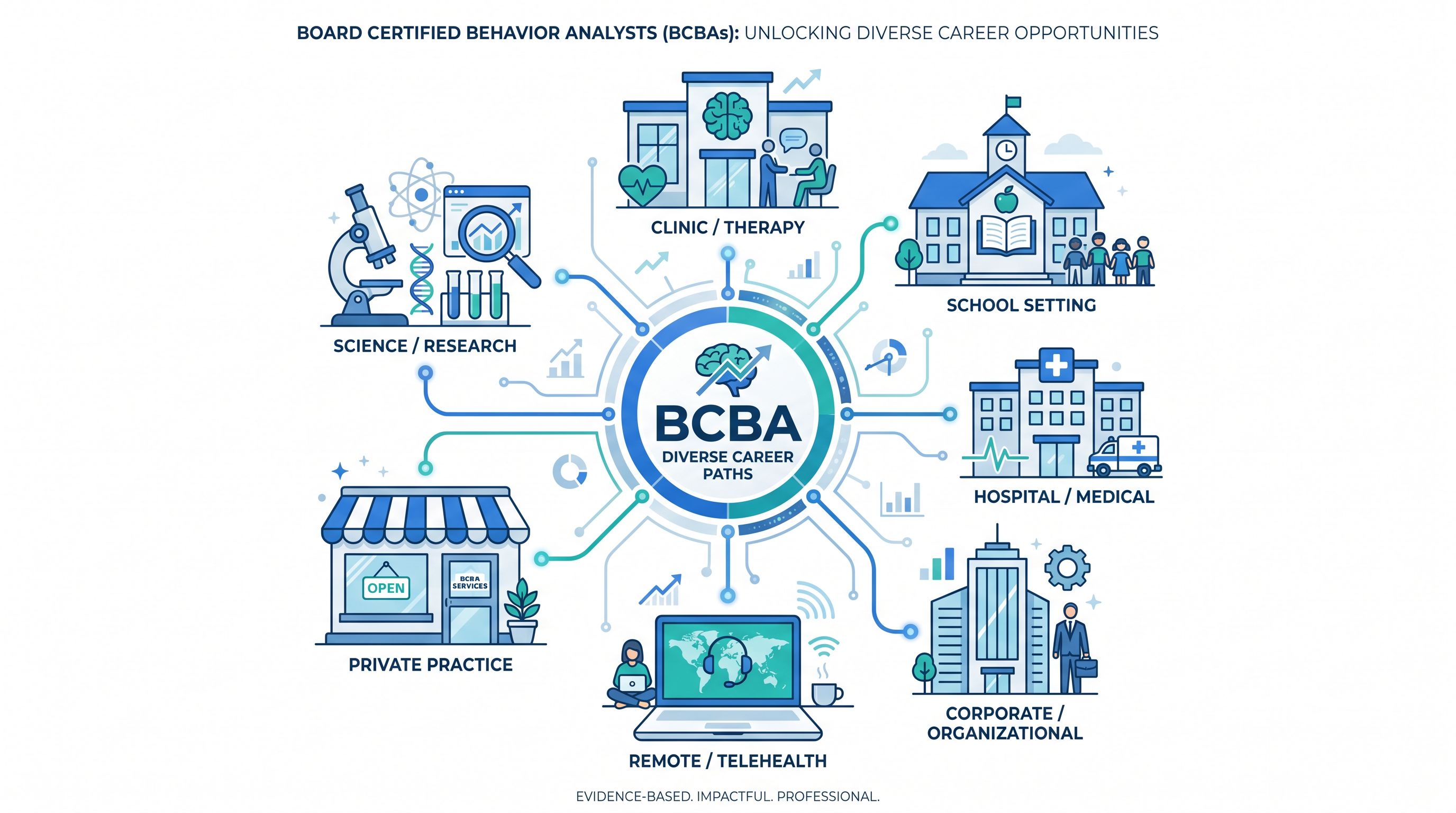
About 72% of BCBAs currently work in autism services. But the remaining 28% work in settings that most certification candidates never hear about during coursework: school districts, hospitals, insurance companies, corporate consulting firms, and health tech startups. As demand continues to outpace supply, these non-traditional career paths are recruiting BCBAs more aggressively than ever.
This guide covers every major career path open to BCBAs in 2026, with salary ranges and demand context for each.
Clinical ABA Therapy
Clinical ABA remains the most common career path, and for good reason. Direct service BCBAs design and oversee behavior intervention programs in homes, clinics, and center-based settings. Most clinical roles focus on autism spectrum support, but the scope extends to developmental disabilities, feeding disorders, and behavioral pediatrics.
The demand in clinical ABA is staggering. According to a 2026 workforce analysis, the average BCBA carries approximately 39 active clients, compared to the planning benchmark of eight. That caseload pressure is driving salaries upward; direct service BCBAs typically earn $75,000 to $95,000, while clinical directors managing teams of RBTs and other BCBAs earn $95,000 to $130,000.
The intensity of clinical caseloads also contributes to BCBA burnout, which in turn creates more openings for professionals willing to take on clinical roles.
Schools and Education
School districts are the second-largest employer of BCBAs after ABA agencies, and the need is growing. Roles include district behavior specialist, special education consultant, IEP team member, and school-based BCBA.
School-based positions offer benefits that many clinical roles cannot match: predictable schedules aligned with school hours, summers and school breaks off, and public-sector benefits packages including pensions. As schools face increasing requirements to address behavioral needs with evidence-based approaches, the demand for BCBAs in education continues to climb.
BCBAs with doctoral degrees or substantial clinical experience can also pursue university teaching positions, training the next generation of behavior analysts. School-based BCBAs typically earn $65,000 to $90,000, while university faculty positions range from $70,000 to $120,000.
Hospitals and Healthcare Systems
Healthcare settings offer BCBAs the chance to work on interdisciplinary teams with physicians, nurses, and therapists. Several specializations are actively recruiting behavior analysts:
- ✓ Behavioral gerontology addresses dementia-related behaviors, depression, and health management in older adults
- ✓ Behavioral pediatrics focuses on feeding disorders, medication compliance, and behavior-related medical concerns in children
- ✓ Brain injury rehabilitation involves building skill-acquisition programs for patients recovering from traumatic brain injuries
- ✓ Substance use disorder treatment uses contingency management and other ABA-based interventions, a growing evidence base that is expanding insurance coverage
Hospital-based BCBAs typically earn $80,000 to $110,000 and benefit from structured hours, comprehensive benefits, and professional development opportunities that come with large healthcare systems.
What Can You Do with a BCBA in Insurance?
Insurance and payer-side roles represent one of the fastest-growing non-clinical paths for BCBAs, yet most career guides barely mention them. Insurance companies need professionals who understand ABA treatment to evaluate authorization requests, review clinical documentation, and ensure quality standards.
Common titles include utilization review analyst, clinical quality reviewer, and prior authorization specialist. These positions are often fully remote with competitive corporate salaries ranging from $85,000 to $120,000 or more. For BCBAs seeking lower burnout risk, the appeal is clear: no caseload, predictable 40-hour weeks, and corporate benefits.
For a deeper look, read our guide to BCBA insurance jobs.
Organizational Behavior Management (OBM)
OBM applies ABA principles to workplace performance, employee training, safety systems, and organizational culture. Many OBM roles do not involve a clinical caseload.
BCBAs in OBM roles work as HR consultants, corporate trainers, safety behavior analysts, and performance management specialists. Industries that hire OBM professionals include manufacturing, healthcare administration, tech companies, and government agencies.
In our review of 2,580 U.S. job postings from September 2026, quality assurance, clinical standards, and staff training roles inside ABA posted a median of $92,750 across 10 employers, with ranges from $70,000 to $115,500. Roles outside ABA, almost all in behavioral safety, posted a median of $108,937 across 40 employers, but they almost never ask for a BCBA. For comparison, the Bureau of Labor Statistics reports May 2025 medians of $69,280 for training and development specialists, $101,860 for management analysts, and $133,000 for training and development managers.
Explore related options in our guide to BCBA specializations.
Private Practice and Telehealth
The BCBA shortage makes private practice more viable than at any point in the profession's history. When demand outstrips supply this dramatically, building a caseload is less about marketing and more about being available.
Solo practitioners typically specialize in a niche: feeding therapy, toileting programs, adult services, or parent coaching. Group practice owners hire RBTs and other BCBAs to scale their services. In both models, telehealth has expanded the geographic reach considerably; parent coaching, supervision, and consultation via telepractice are now reimbursable in most states.
The income ceiling in private practice is higher than salaried positions, but so is the administrative burden. For a practical roadmap, see our guide on how to start an ABA therapy practice.
Emerging and Non-Traditional Fields
The principles of applied behavior analysis extend far beyond clinical therapy, and a growing number of BCBAs are building careers in fields that did not recruit behavior analysts a decade ago:
- ✓ Animal behavior consulting: the BCBA credential is increasingly recognized in animal training and behavior modification
- ✓ Health tech: outcomes analysts, EHR workflow designers, and product roles at ABA practice management companies
- ✓ Forensic behavior analysis: working with justice-involved populations on behavioral assessments and intervention
- ✓ Environmental sustainability: designing behavior change campaigns for conservation and resource management
- ✓ Health and fitness coaching: applying reinforcement and self-management strategies to wellness goals
These fields represent the frontier of behavior analysis. The roles are fewer in number today, but they are growing quickly as ABA's reputation extends well beyond autism services.
Why BCBAs Have More Career Options Than Ever
The breadth of career paths listed above is not a coincidence. It is a direct result of the widening gap between BCBA supply and employer demand.
The numbers tell a clear story. According to the BACB's Lightcast employment analysis, employers posted 132,307 positions requiring BCBA or BCBA-D certification in 2025; that is a 28% increase over the prior year. Meanwhile, only 83,586 BCBAs hold active credentials in the United States as of April 2026.
Workforce analyses estimate the country would need roughly five times its current BCBA workforce to meet demand. More than half of all U.S. counties have zero BCBAs practicing within their borders, and that geographic scarcity creates opportunities in telehealth, relocation-friendly roles, and travel positions.
The supply side is not catching up quickly either. The BCBA exam pass rate fell to 51% in 2025, the lowest on record, which means fewer new BCBAs are entering the workforce each year. The Bureau of Labor Statistics projects 17% employment growth for behavioral health roles through 2034, roughly five times the national average for all occupations.
"With nearly 50,000 more job postings than active BCBAs, certified behavior analysts have something rare in healthcare: the leverage to choose a career path that fits their life, not just one that fills a vacancy."
For BCBAs evaluating their options, the practical takeaway is significant. Whether you prefer clinical work, corporate consulting, remote insurance review, or building your own practice, the market is competing for you. That leverage translates into higher salaries, better benefits, and more flexibility to choose the setting that aligns with your professional interests and personal priorities.
For more on how this shortage is shaping the profession, see our articles on how many BCBAs there are in 2026 and BCBA career paths.
How to Explore Your BCBA Career Options
Whether clinical, corporate, educational, or entrepreneurial, the BCBA credential opens more doors than almost any comparable healthcare certification. The key is evaluating each path by the factors that matter most to you: lifestyle fit, salary ceiling, burnout risk, and alignment with your clinical interests.
Start by reading our guides on whether BCBA is a good career and salary negotiation strategies to understand your leverage in today's market.
Ready to See What Employers Are Offering?
CertifyndABA lets you create an anonymous profile and receive interview requests from employers across every setting listed above. No job applications, no guessing about salary ranges. Let the market come to you.
Create Your Free Profile