

The BCBA career path in 2026 looks different than it did even five years ago. With 83,586 active BCBAs in the United States and job postings that consistently outnumber available professionals, Board Certified Behavior Analysts have more career options and more leverage than at any point in the field's history.
According to the Behavior Analyst Certification Board (BACB), the number of certified BCBAs has nearly doubled since 2020, when there were 44,025. Yet demand has grown even faster: the BACB's Lightcast employment report documented 132,307 BCBA job postings nationwide in 2025, a 28% increase over the prior year.
That gap between supply and demand is the defining feature of the BCBA career path right now. It means you can be selective about where you work, what populations you serve, and how your career progresses. This guide maps every major direction available to you.
Traditional BCBA Career Settings
About 70% of BCBAs work primarily with individuals on the autism spectrum. But even within that focus, the work setting shapes your day-to-day experience, salary, and career trajectory.
Clinical ABA Therapy
Center-based ABA clinics remain the most common entry point for new BCBAs. You will manage client caseloads, design behavior intervention plans, supervise RBTs, and collect data on treatment progress. Salaries typically range from $74,000 to $90,000, depending on geography and clinic size. Larger multi-site organizations often offer clearer paths to clinical director roles.
Home-Based Services
Home and community-based ABA services offer flexibility but come with trade-offs. You will travel between clients, which means mileage stipends and variable schedules. Cancellations can affect billable hours. Many BCBAs start in home-based roles before transitioning to clinic or school settings as they gain experience.
School-Based BCBAs
Schools are increasingly hiring BCBAs to support students with behavioral needs, and this setting offers distinct advantages. School-based BCBAs supervising multiple campuses can earn $80,000 to $110,000, plus benefits like retirement contributions and summers off. The work is more consultative; you train teachers, develop behavior plans for IEPs, and collaborate with special education teams rather than providing direct 1:1 therapy.
Hospitals and Healthcare
Hospital-based positions, particularly in neurodevelopmental and behavioral care units, tend to pay the highest salaries among traditional settings: $90,000 to $125,000. The cases are more complex, often involving co-occurring medical conditions, and the interdisciplinary collaboration with physicians, psychologists, and occupational therapists differs significantly from clinic-based ABA work.
Early Intervention Programs
Early intervention BCBAs work with children ages 0 to 3 through state-funded programs. The work is family-centered, with a strong emphasis on parent training and coaching. These roles can be deeply rewarding for BCBAs who want to intervene early when behavior-analytic approaches have the greatest impact.
Non-Traditional BCBA Career Paths Beyond Autism
The principles of applied behavior analysis extend well beyond autism services. If you are considering a BCBA career path outside the traditional clinical model, these emerging fields are worth knowing about.
Organizational Behavior Management (OBM)
OBM applies behavior analysis to the workplace: improving employee performance, safety compliance, training effectiveness, and organizational culture. According to a 2024 study published in PMC, OBM is a growing sub-discipline that attracts BCBAs who want to work outside healthcare entirely. Industries include manufacturing, corporate offices, and service businesses. OBM roles often carry higher salaries than clinical positions because they fall under corporate budgets rather than insurance reimbursement models.
Behavioral Gerontology
BCBAs in gerontology support aging adults with maintaining daily living skills, encouraging independence, and addressing memory-related behavioral changes. As the U.S. population ages, this is one of the fastest-growing applications of behavior analysis outside of autism services.
Animal Behavior Consulting
Some BCBAs apply behavior analysis principles to animal training, welfare, and care practices. This path is most common in zoo settings, animal shelters, and veterinary behavioral medicine. It is a niche career path, but one that attracts BCBAs who want to apply the science in a completely different context.
Substance Abuse and Addiction Treatment
Behavior-analytic approaches to substance use disorders are gaining recognition. BCBAs in this setting design contingency management programs, reinforcement-based interventions, and relapse prevention strategies. The Bureau of Labor Statistics projects 17% growth in substance abuse and behavioral disorder counseling roles from 2024 to 2034.
Telehealth and Remote Practice
Remote BCBA positions have moved from pandemic necessity to permanent career option. Telehealth roles typically pay $80,000 to $100,000 and eliminate geographic constraints entirely. "Remote BCBA jobs" is one of the most searched career queries in the field, and this is clearly a setting BCBAs are actively pursuing. Remote work is especially common for supervision, parent training, and consultation services.
Other Emerging Paths
BCBAs are also finding roles in sports performance coaching, forensic behavior analysis within the criminal justice system, and academic research. These paths typically require additional specialization or a doctoral degree (BCBA-D), but they represent the broadening scope of where behavior analysis is valued.
BCBA Career Progression: Entry-Level to Leadership
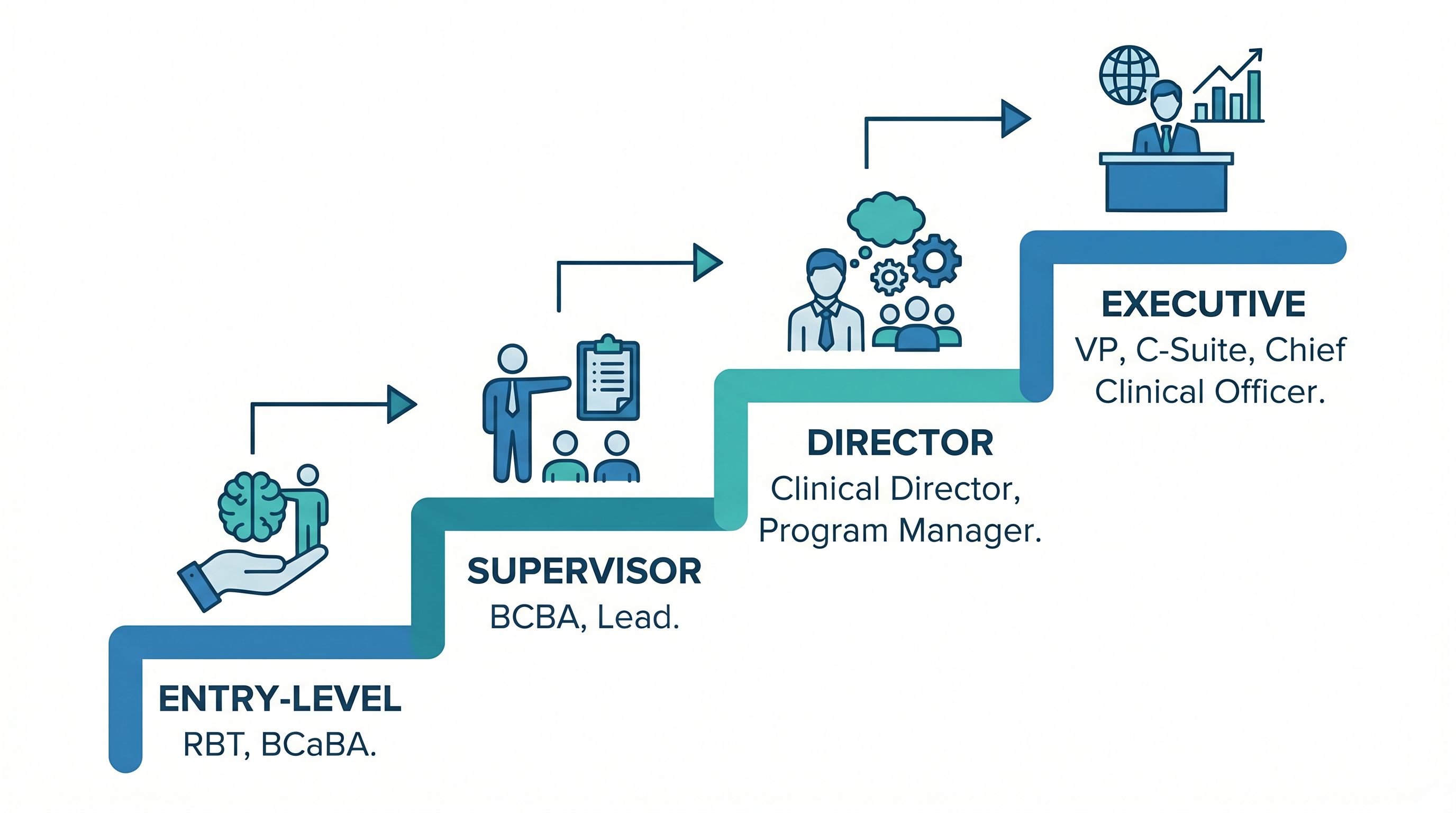
Understanding the typical BCBA career path from a progression standpoint helps you plan strategically, whether you are a new BCBA or five years into your career.
| Career Stage | Typical Roles | Salary Range |
|---|---|---|
| Entry-Level (0-2 years) | BCBA, Behavior Analyst | $65,000 - $78,000 |
| Mid-Career (3-5 years) | Senior BCBA, Clinical Supervisor, Program Director | $80,000 - $100,000 |
| Senior (5-10 years) | Clinical Director, Regional Director | $95,000 - $125,000 |
| Executive (10+ years) | VP of Clinical Services, Chief Clinical Officer, Practice Owner | $120,000 - $160,000+ |
Entry-level BCBAs (0-2 years) typically carry their own client caseloads and receive mentorship from senior BCBAs. This is the stage where you develop your clinical intuition and learn how the business side of ABA works in your specific setting.
Mid-career BCBAs (3-5 years) move into supervisory roles, overseeing RBTs and BCaBAs while maintaining reduced caseloads. Program director positions become available, and many BCBAs at this stage start specializing in a particular population or intervention type.
Senior BCBAs (5-10 years) often manage entire clinical programs or regions. Clinical director roles involve hiring, training, quality assurance, and business development alongside clinical work. This is where compensation jumps most significantly.
Executive-level BCBAs (10+ years) lead organizations. VP of Clinical Services and Chief Clinical Officer roles exist at larger ABA providers. Others launch their own practices; the current employment gap makes entrepreneurship especially viable because client demand is already there.
The Employment Gap: What It Means for Your BCBA Career Path
The single most important factor shaping the BCBA career path in 2026 is the structural gap between how many BCBAs the market needs and how many are available.
"BCBA job postings grew 800% between 2010 and 2022, and the pace has only accelerated since." (BACB/Lightcast)
The numbers tell the story clearly. In 2024, there were approximately 103,000 BCBA job openings against roughly 74,000 certified BCBAs. By 2025, postings climbed to 132,307. Meanwhile, the BCBA workforce grows by roughly 8,000 to 10,000 new certifications per year, which helps but does not close the gap.
Several factors drive this demand:
- ✓ Rising autism diagnoses. The CDC reports increasing prevalence rates, which directly increases demand for ABA services.
- ✓ Insurance mandates. All 50 states now require some level of insurance coverage for ABA therapy, expanding access and creating new positions.
- ✓ Expanded applications. As ABA moves into schools, hospitals, corporate settings, and telehealth, demand grows beyond the traditional clinic model.
- ✓ BLS projections. The Bureau of Labor Statistics projects 17% growth in behavioral health roles from 2024 to 2034, far exceeding the average for all occupations.
Practically, this employment gap means BCBAs can negotiate stronger compensation packages, choose their preferred work settings, and switch jobs with minimal downtime between positions. If you are planning your BCBA career path, this market reality should inform every decision you make.
How to Choose Your BCBA Career Path
With so many options available, choosing a direction can feel overwhelming. These questions can help you narrow it down:
What population energizes you? If working with young children feels natural, clinical ABA or early intervention may be your best fit. If you are drawn to systems-level change, OBM or school consulting might suit you better.
What does your ideal workday look like? Home-based roles offer autonomy but require travel. Hospital roles offer high salaries but structured schedules. Telehealth removes commuting entirely. Be honest about the lifestyle you want.
Where do you want to be in five years? If you want to run a clinic, start in a clinical setting where you can learn the business side. If you want to consult, build expertise in a specialized area first. If academia appeals to you, pursue the BCBA-D doctoral designation.
BCBA Career Path FAQ
Is BCBA a good career?
Yes. BCBAs earn above the national median salary, enjoy strong job security due to the employment gap, and do work that directly improves people's lives. The BLS projects 17% growth through 2034, which means demand will remain strong for the foreseeable future.
What is the highest-paying BCBA job?
Clinical directors and practice owners consistently earn the highest salaries, ranging from $120,000 to $160,000 or more. Hospital-based BCBAs and OBM professionals also command premium compensation. Geographic location matters too; BCBAs in high-cost-of-living states like California and Massachusetts earn more, though living expenses offset some of that advantage.
Can BCBAs work outside of autism?
Absolutely. While about 70% of BCBAs currently work with autism populations, the certification qualifies you for roles in organizational behavior management, behavioral gerontology, animal behavior consulting, substance abuse treatment, forensic behavior analysis, and more. The science of behavior analysis applies to any setting where human (or animal) behavior is the focus.
How long does it take to become a BCBA?
The typical timeline is 6 to 8 years after high school: a 4-year bachelor's degree, a 2-year master's program with approved coursework, and 1,500 to 2,000 hours of supervised fieldwork. After completing these requirements, you must pass the BCBA certification exam administered through Pearson VUE.
Ready to Explore Your Next BCBA Career Move?
CertifyndABA lets you create an anonymous profile so employers across every setting can reach out to you. Compare opportunities without putting your current position at risk.
Create Your Free Profile