


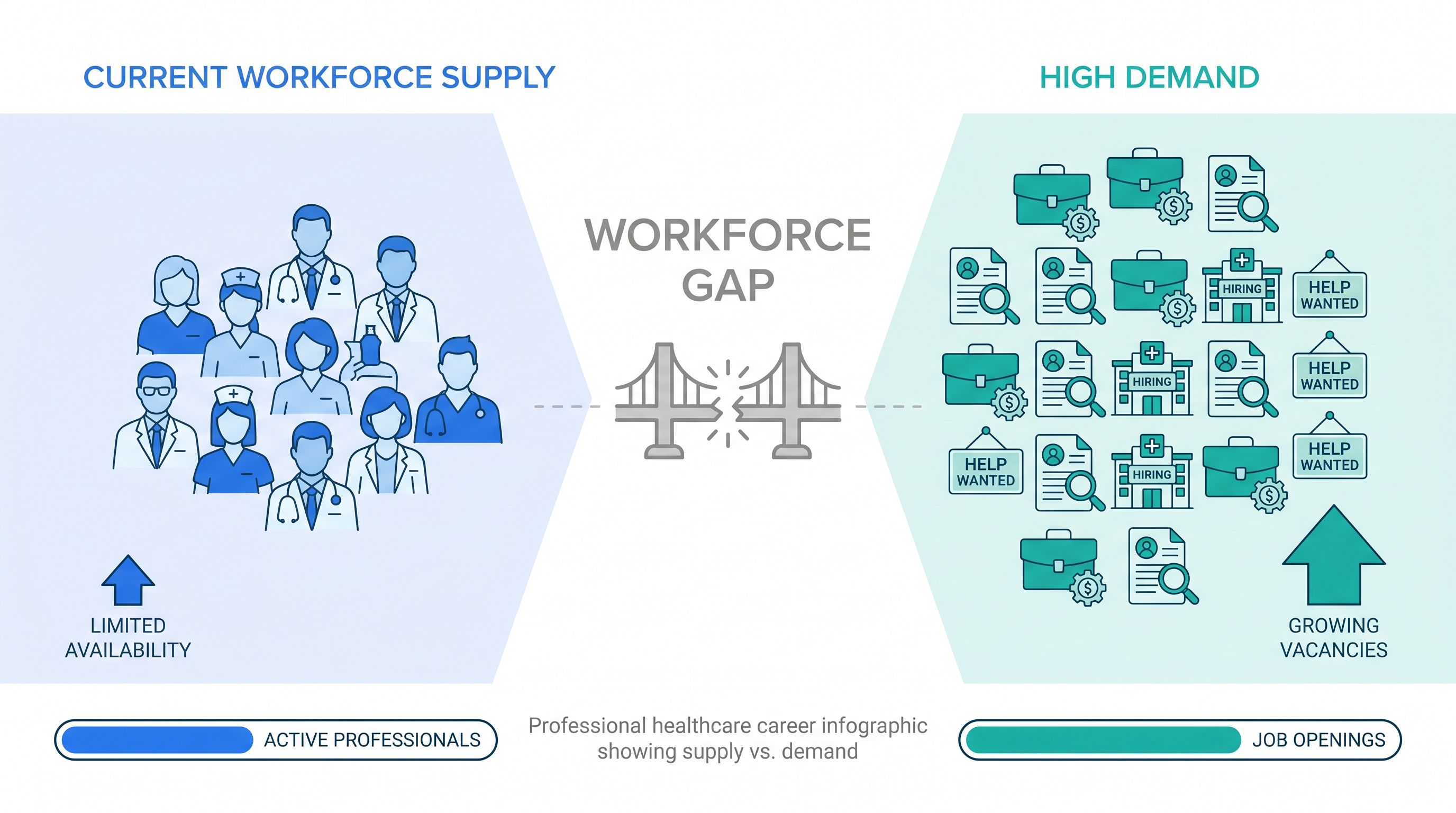
There are 83,586 active BCBAs in the United States. Employers posted 132,307 positions for them last year. If you have ever considered learning how to start an ABA therapy practice, the math has never been more in your favor.
The gap between supply and demand in applied behavior analysis is not closing. According to a 2025 workforce analysis, the nation needs roughly five times its current BCBA workforce to meet estimated need, and over half of all U.S. counties have zero BCBAs practicing within their borders. The Bureau of Labor Statistics projects 17% growth for behavioral health occupations through 2034, far above the 3% average for all occupations.
For BCBAs tired of corporate caseload quotas and ready to build something of their own, these numbers represent more than a labor statistic. They represent a window. This guide walks you through every step of launching your own ABA therapy practice, from choosing a service model to billing your first client.
Why BCBAs Are Launching Their Own Practices
The decision to go independent is rarely just about money. BCBAs who start their own practices consistently cite three drivers: clinical autonomy, schedule control, and the ability to set their own quality standards.
In a salaried position, a BCBA typically earns between $70,000 and $100,000 per year. As a practice owner billing at $120 to $150 per hour for BCBA-level services, the income ceiling rises significantly; especially once you hire RBTs who generate additional billable hours under your supervision. But perhaps more importantly, you decide how many clients you take, how you structure supervision, and what your career path looks like long term.
The workforce shortage also makes client acquisition far easier than in most healthcare fields. With over half of U.S. counties lacking a single BCBA, families in many areas are waiting months for services. Two-thirds of specialty centers report assessment wait times of four months or longer. If you are a credentialed BCBA willing to serve an underserved area, clients will find you.
Burnout is another factor. Many BCBAs leave salaried positions due to unsustainable productivity demands, and starting a practice lets you design a workload that is sustainable over the long term.
Step 1: Choose Your Service Model
Your service model determines your startup costs, overhead, and how quickly you can begin seeing clients. There are four primary options, and you do not have to pick just one.
| Model | Startup Cost | Best For |
|---|---|---|
| In-home | ~$15,000 | Solo BCBAs starting lean; early intervention services |
| Telehealth | Under $5,000 | Parent training, supervision, rural/underserved areas |
| Clinic-based | $200K–$500K+ | Scaling with multiple therapists; center-based programs |
| Hybrid | Varies | Maximum flexibility; combining in-home + telehealth |
Many successful practice owners start with in-home or telehealth services to keep overhead low, then transition to a clinic model once they have a stable revenue base and a team in place. If you are targeting a rural or underserved area where over half of counties have no BCBA, a telehealth-first approach lets you reach families who might otherwise wait a year or more for services.
Step 2: Form Your Business Entity
Before you see your first client, you need a legal business structure. Most BCBAs choose a Limited Liability Company (LLC) because it separates personal assets from business liabilities. Some states require healthcare providers to form a Professional Corporation (PC) or Professional LLC instead; check your state's specific requirements.
Here is your business formation checklist:
- ✓ Register your LLC or PC with your state ($50 to $500 depending on the state)
- ✓ Get an EIN from the IRS (free, takes minutes online)
- ✓ Open a business bank account to keep personal and business finances separate
- ✓ Purchase business insurance: general liability ($500 to $1,200/year), professional liability ($800 to $2,000/year), and workers' compensation if hiring staff ($1,000 to $3,000/year)
This step can be completed in a week or two if you are organized. Do not overthink the business name; you can always file a DBA (doing business as) later if you want to rebrand.
Step 3: Secure State Licensure
More than 34 states now require licensure for behavior analysts, and practicing without it in a regulated state can result in disciplinary action against your BCBA certification or even criminal penalties. Licensing fees range from $100 to $1,000 depending on the state.
The BACB maintains a complete list of state licensure requirements with links to each state's regulatory board. Check this before you do anything else. Some states also require a separate business license or healthcare facility permit, so confirm both your individual and practice-level requirements.
Step 4: Get Credentialed with Insurance Payers
Insurance credentialing is the step that trips up most new practice owners, primarily because it takes 60 to 120 days and you cannot bill until it is complete. Start this process the moment you have your business entity and state license in place.
The credentialing process follows a consistent sequence regardless of the payer:
1. Register for an NPI number. Your National Provider Identifier is a unique 10-digit number assigned through the NPPES portal. It is free and required for all healthcare billing. You may need both a Type 1 (individual) and Type 2 (organization) NPI.
2. Create a CAQH profile. The Council for Affordable Quality Health Care maintains a centralized database that insurance companies use to verify provider credentials. Upload your education, licenses, certifications, malpractice insurance, and work history here. Keep it updated; insurers pull from it regularly.
3. Apply to insurance panels. Each payer has its own application process and timeline. Start with the largest payers in your state and with Medicaid, since ABA is a mandated benefit in most states. Credentialing costs $150 to $250 per payer if you do it yourself, or $1,000 to $2,500 if you outsource the process.
4. Learn the billing codes. The key ABA CPT codes you will use daily are 97151 (behavior assessment), 97153 (direct treatment delivered by an RBT under supervision), and 97155 (BCBA-level treatment with protocol modification). Understanding these codes and their documentation requirements is essential to getting paid on time; typical reimbursement cycles run 14 to 30 days.
Step 5: Build Your Clinical Team
As a solo BCBA, your billable hours are capped by your own schedule. Scaling a practice means hiring Registered Behavior Technicians who deliver the majority of direct service hours under your supervision.
RBT salaries typically range from $35,000 to $50,000 per year. However, the real cost of staffing is turnover. Industry-wide, RBT turnover runs between 77% and 103% annually, and replacing a single therapist costs $15,000 to $25,000 when you account for recruiting, training, and lost billable hours. Your retention strategy matters as much as your hiring strategy.
What keeps RBTs at a practice? Competitive pay is table stakes. Beyond that, the evidence points to quality supervision, predictable scheduling, career development opportunities, and a manageable caseload. As a practice owner, you have the ability to provide all of these; something that drew many BCBAs to private practice in the first place.
You will also need administrative support once your caseload grows. A part-time office manager ($35,000 to $60,000/year full-time equivalent) can handle intake, scheduling, and billing follow-up, freeing you to focus on clinical work.
"The BCBA workforce has nearly doubled in five years, from 44,025 in 2020 to over 83,000 in 2026. Yet demand continues to outpace supply at a ratio of roughly 5 to 1."
Understanding Your Practice Financials
The financial picture for a new ABA therapy practice depends heavily on your service model. Here is a realistic breakdown of what to expect.
Startup costs range from approximately $15,000 for an in-home practice (licensing, insurance, basic supplies, a laptop, and credentialing fees) to $200,000 or more for a clinic-based practice (commercial lease, build-out, equipment, and furniture). Budget for at least six months of operating expenses before revenue stabilizes, as credentialing delays and client ramp-up take time.
Revenue potential scales with your team. BCBA-level services (CPT 97155) reimburse at $120 to $150 per hour depending on the payer and region. Each full-time RBT on your team generates additional billable hours at $40 to $80 per hour (CPT 97153), minus their salary and overhead. A practice with three to five RBTs can generate meaningful revenue within the first 12 to 18 months.
Key ongoing costs include office lease ($1,500 to $4,000/month for clinic-based), staff salaries, liability insurance, practice management software, and continuing education. Many new practice owners underestimate the cost of billing and collections; consider outsourcing revenue cycle management if your claim denial rate exceeds 5%.
BACB Ethics Requirements for Practice Owners
Running your own practice does not exempt you from the BACB Ethics Code; it actually increases your responsibilities. As both clinician and business owner, you are accountable for every service delivered under your supervision.
Pay close attention to supervision requirements for RBTs. You are clinically responsible for their work, and the BACB sets specific ratios and documentation standards. All marketing materials must accurately represent your credentials and services. Maintain proper records, establish clear professional boundaries, and ensure informed consent processes are thorough. If you have not reviewed the BACB Ethics Code recently, do so before launching your practice.
From Employee to Practice Owner
Starting an ABA therapy practice is not a decision to make impulsively, but the conditions for doing so have never been stronger. With 132,307 job postings chasing 83,586 BCBAs, families waiting months for services, and over half of U.S. counties lacking a single behavior analyst, the demand is real and growing.
Start small. An in-home or telehealth model lets you prove the concept with minimal financial risk. Get credentialed early, build your team thoughtfully, and let the market work in your favor. The families who need ABA services are already looking for you.
Whether you are ready to launch a practice or still exploring the right career move, the first step is understanding your options and the leverage you hold in today's ABA job market.
Ready to Explore Your ABA Career Options?
Whether you are building your own practice or looking for the right employer, CertifyndABA puts you in control. Create an anonymous profile, set your preferences, and let opportunities come to you.
Create Your Free Profile