

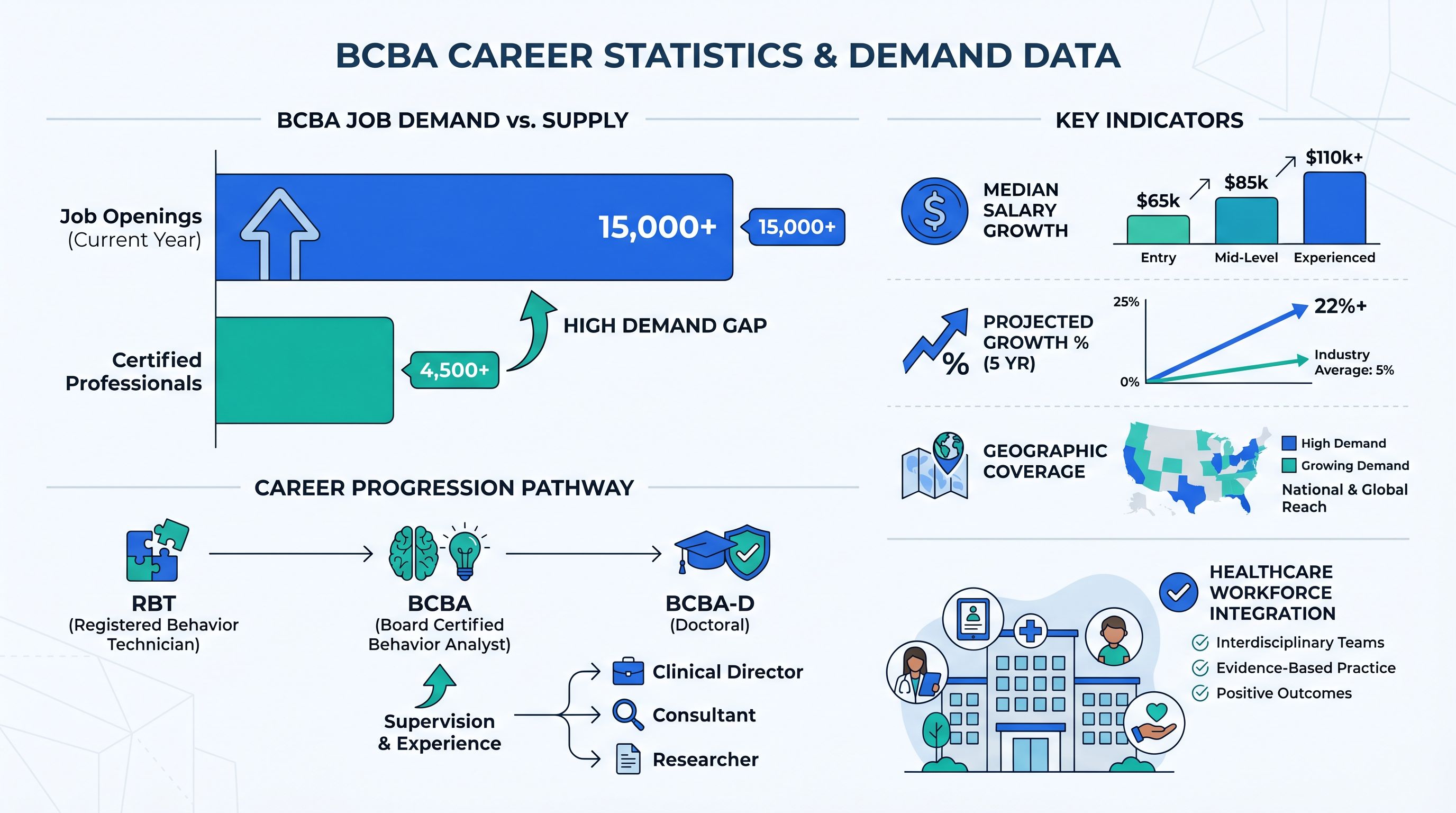
Is BCBA a good career? Consider this: in 2025, employers posted 132,307 positions requiring BCBA certification. Only 83,586 Board Certified Behavior Analysts hold active credentials in the United States. That means there are roughly 1.6 open positions for every certified BCBA in the country. Whether you are weighing a career change or deciding if a master's in behavior analysis is worth the investment, the job market data points to a clear answer.
This article breaks down the numbers behind the BCBA career in 2026: salary ranges, demand projections, where BCBAs work, and the honest challenges you should expect. Every claim is backed by data from the BACB, Bureau of Labor Statistics, and CDC.
BCBA Demand in 2026: The Numbers Behind the Shortage
The gap between BCBA supply and employer demand is not a projection. It is already here.
According to workforce data compiled by the ABA Resource Center, BCBA job postings grew 28% year over year from 2024 to 2025. This continues a trend that has risen steadily every year since 2010. Meanwhile, the Behavior Analyst Certification Board reports 83,586 active BCBAs as of April 2026.
The real gap is even wider than that ratio suggests. Not all certified BCBAs are available for open clinical roles. Many work in supervisory, academic, or research positions. Workforce analyses estimate that only about 30,000 BCBAs work in direct clinical service, while roughly 100,000 are needed nationally.
The geographic picture adds another layer. According to BACB regional data, 46% of U.S. counties still lack any BCBA presence, an improvement from 54% in 2018 but still a significant gap. States like South Carolina (+102%), Utah (+94%), and North Carolina (+63%) saw some of the sharpest increases in BCBA job postings last year.
Compounding the shortage is a pipeline constraint. The first-time BCBA exam pass rate has dropped from 66% in 2020 to 51% in 2025. With over 21,000 candidates taking the exam each year, only about 8,000 earn certification annually. Demand is growing faster than the profession can produce new clinicians.
For a deeper look at where these trends are heading, see our BCBA Job Outlook 2026 guide.
What Is Driving BCBA Demand?
Several structural forces are fueling the sustained demand for BCBAs, and none of them show signs of slowing.
Rising autism prevalence. The CDC's 2025 Community Report found that 1 in 31 eight-year-olds in the U.S. has been identified with autism spectrum disorder. That figure was 1 in 150 in 2000 and 1 in 36 as recently as 2020. Experts attribute the increase largely to better screening and diagnostic access, but the practical result is clear: more families need ABA services.
Universal insurance mandates. All 50 states and Washington, D.C. have enacted autism insurance mandates requiring coverage for ABA therapy. Medicaid covers ABA services in every state as well. This creates a reliable funding pipeline that supports employer hiring and long-term job stability.
Expanding applications. While roughly 70% of BCBAs provide services related to autism (per BACB data), behavior analysis is expanding into school systems, organizational behavior management, gerontology, and substance abuse treatment. This diversification broadens the career and reduces the profession's dependence on any single service model.
Strong BLS projections. The Bureau of Labor Statistics projects that healthcare and social assistance will be the fastest-growing sector through 2034 (+8.4%). ABA-related occupations are expected to grow 20% or more over the same period, far outpacing the 3% average for all occupations.
BCBA Salary: What You Can Realistically Expect
Compensation is one of the strongest arguments for the BCBA career. Here is what the data shows in 2026.
According to ZipRecruiter (April 2026), the average BCBA salary is $89,075 per year, with a median of $81,600. Glassdoor's 2026 data places the average higher at $105,656. The difference reflects methodology; both are useful as bounds.
The full range spans widely based on experience, location, and setting:
- Entry-level / new BCBA: $51,000 - $65,000
- 25th percentile: $74,000
- 75th percentile: $90,500
- Top earners (90th percentile): $132,500
- Clinical directors with BCBA: $100,000+
- Private practice / independent BCBAs: $75+/hour ($150,000+ potential)
Compared to the investment required (a master's degree plus 1,500-2,000 hours of supervised fieldwork), the salary trajectory offers strong ROI. Many comparable graduate-level healthcare roles require more training time for similar or lower compensation.
For a state-by-state breakdown, see our BCBA Salary by State 2026 guide.
Where BCBAs Work: Career Flexibility
One of the most underrated advantages of BCBA certification is the range of settings where you can work. The same credential opens doors across very different environments.
- ✓ Clinical ABA therapy centers are the most common setting, with the majority of BCBAs providing direct or supervised autism services.
- ✓ Schools and school districts are a growing sector as more districts create dedicated BCBA positions for behavior support.
- ✓ Telehealth and remote roles have expanded rapidly. Many BCBAs now provide parent training, supervision, and consultation remotely. See our Remote BCBA Jobs Guide.
- ✓ Private practice offers higher earning potential and more control over caseload and schedule.
- ✓ Hospitals, research institutions, and universities employ BCBAs in clinical research, teaching, and program development.
- ✓ Organizational behavior management (OBM) applies behavior analysis to corporate training, workplace safety, and performance improvement.
This flexibility means you can shift settings as your career evolves without needing additional credentials. For a complete guide to career trajectories, see BCBA Career Path 2026.
The Honest Truth: Challenges BCBAs Face
No responsible career guide ignores the downsides. The BCBA field has real challenges, and understanding them upfront helps you make a better decision.
"Two-thirds of BCBAs report moderate to high levels of burnout. But research shows the primary predictors are workplace factors, not the work itself."
Burnout is real. A 2021 industry survey found that 72% of BCBAs and RBTs reported medium to high levels of burnout. Research by Platino et al. (2018) confirmed that two-thirds of BCBAs experience moderate to high burnout, with lack of workplace support being the strongest predictor.
Turnover rates are high. ABA organizations see 30-50% annual turnover across staff. RBT turnover in particular creates cascading effects on BCBA workload and client continuity.
Billable hour pressure varies widely. Some employers require 25-32+ billable hours per week. Others set more sustainable expectations. This single variable has an outsized impact on job satisfaction and long-term sustainability.
Documentation demands are significant. BCBAs spend substantial time on treatment plans, progress reports, insurance authorizations, and supervision documentation; time that is often unbillable.
For evidence-based strategies, see our guide on BCBA Burnout: Signs, Causes, and Prevention Strategies.
How to Leverage the BCBA Demand Gap
With 1.6 open positions per certified BCBA, professionals have more negotiating power than most realize. Here is how to use it.
Know your worth before you negotiate. Reference salary data for your state and setting. Our BCBA Salary by State guide provides a starting point. Come to the table with numbers, not assumptions.
Negotiate beyond base salary. The best BCBA compensation packages include caseload caps, realistic billable hour expectations, CEU funding, supervision support, signing bonuses, and professional development budgets. In a market with 132,000+ open positions, employers who want to attract talent need to compete on these factors.
Watch for red flags. Unrealistic billable hour requirements (35+ per week), high historical turnover, no structured supervision support, and vague answers about caseload expectations are warning signs. The demand gap means you can afford to be selective.
Watch for green flags. Manageable caseloads (10-15 clients), dedicated admin time, mentorship programs, transparent pay structures, and investment in employee well-being all signal an employer who values retention over turnover.
For interview preparation, see our guides on BCBA Interview Questions and BCBA Resume Guide.
Is Being a BCBA Worth It? The Bottom Line
The data makes a strong case. With 132,307 open positions competing for 83,586 certified professionals, a salary range of $89,000 to $106,000 (with top earners exceeding $132,000), projected growth exceeding 20% through 2034, and universal insurance mandates guaranteeing service funding, BCBA is one of the most secure and well-compensated career paths in applied healthcare.
That said, the quality of your career depends heavily on the employer you choose. The same certification can lead to a fulfilling, sustainable career with manageable caseloads and strong support, or to burnout and frustration under unsustainable productivity demands. The numbers are in your favor; use that leverage to find the right fit.
For more on how to plan your career trajectory, explore our ABA Careers 2026 overview or dive into the BCBA Certification Guide if you are still on the path to certification.
Let Employers Come to You
With more open positions than certified BCBAs, you do not have to chase job listings. Create an anonymous profile on CertifyndABA and let employers send you interview requests based on your qualifications.
Create Your Free Profile