


In 2025, employers posted 132,307 positions requiring BCBA certification. Only 83,586 Board Certified Behavior Analysts hold active credentials in the United States. That gap is reshaping who hires BCBAs and where they work. Insurance companies, hospital systems, and consulting firms are now actively recruiting behavior analysts for roles that look nothing like traditional ABA therapy.
The reason is straightforward. All 50 states and Washington, D.C., now mandate insurance coverage for ABA therapy. That means every major insurer needs qualified professionals who can review treatment plans, evaluate clinical documentation, and make authorization decisions. Hospitals are expanding behavioral health departments. Corporations are discovering that behavior analysis principles improve workplace safety and performance. For BCBAs considering their next career move, the options extend well beyond the clinic.
This guide breaks down three growing categories of non-clinical BCBA roles: insurance and utilization review, hospital-based positions, and organizational behavior management consulting. For each, you will find salary data, daily responsibilities, and practical steps for making the transition.
BCBA Insurance and Utilization Review Roles
Utilization review is the fastest-growing non-clinical path for BCBAs. In these roles, you review ABA treatment plans submitted by providers to determine whether the proposed services meet medical necessity criteria. Your clinical training becomes the lens through which you evaluate documentation quality, treatment goals, and recommended service hours.
What You Actually Do
A typical day as a utilization review BCBA involves reading through authorization requests, assessing whether treatment plans align with evidence-based ABA practices, and communicating decisions to providers. You might review 8 to 12 cases per day, depending on complexity. When documentation is insufficient, you request additional information or schedule peer-to-peer calls with the treating BCBA. The work is analytical, structured, and almost entirely desk-based.
Key responsibilities include:
- ✓ Reviewing ABA treatment plans and clinical documentation for medical necessity
- ✓ Preparing and submitting authorization approvals or denial rationales
- ✓ Conducting peer-to-peer reviews with treating clinicians
- ✓ Ensuring compliance with state regulations and payer-specific guidelines
- ✓ Collaborating with clinical operations teams on quality improvement
Who Hires and What They Pay
Major insurance carriers actively recruit BCBAs for these positions. Cigna, Anthem, UnitedHealth Group (through Optum), Magellan Health, and Blue Cross Blue Shield affiliates all maintain utilization review teams that include behavior analysts. Third-party utilization management firms also hire BCBAs on both full-time and contract bases.
Insurance reviewer positions, which may involve less complex authorization work, typically pay between $74,000 and $100,000. Senior utilization review roles and positions at larger carriers command the higher end of the range. Some employers offer signing bonuses of $10,000 or more, reflecting the difficulty of filling these positions.
Why BCBAs Choose This Path
The appeal is predictability. Most utilization review roles are fully remote with standard business hours. There is no driving between client homes, no last-minute schedule changes, and no direct client behavioral crises to manage. For BCBAs experiencing burnout from clinical work, the shift to a structured, desk-based role can be significant. Your clinical expertise remains central to the work; the setting simply changes.
Hospital and Healthcare System BCBA Positions
Hospitals represent another expanding frontier for BCBAs. These roles place behavior analysts on interdisciplinary medical teams where they apply ABA principles to patient populations that extend well beyond autism spectrum disorder.
Types of Hospital BCBA Roles
Hospital-based BCBAs typically work in one of several capacities. Behavioral health consultants provide assessment and intervention recommendations for patients with challenging behaviors across inpatient units. Pediatric behavior specialists work within children's hospitals supporting patients with developmental disabilities, brain injuries, or chronic conditions that affect behavior. Staff training specialists teach nurses, aides, and other hospital personnel how to implement behavior support strategies consistently.
Notable employers include Kennedy Krieger Institute (affiliated with Johns Hopkins), where BCBAs work alongside licensed psychologists and psychiatrists on behavioral psychology teams. Cleveland Clinic, Cincinnati Children's Hospital, and other major pediatric systems also employ BCBAs in clinical and consultative roles. At Kennedy Krieger specifically, behavior analysts provide consultation, assessment, and treatment for patients with behavioral, coping, and adjustment difficulties across inpatient and outpatient settings.
Compensation and Work Environment
Hospital BCBA salaries generally range from $74,000 to $120,000, according to ZipRecruiter data. Positions at major medical centers in high-cost states can exceed this range considerably. Unlike utilization review roles, hospital positions are typically on-site or hybrid, with schedules that may include some shift-based work.
The trade-off is meaningful. Hospital BCBAs work with diverse patient populations and gain experience that few clinical ABA settings offer. The interdisciplinary collaboration with physicians, psychologists, social workers, and nursing staff broadens your professional network and clinical perspective. For BCBAs interested in a career path that combines behavior analysis with broader healthcare, these roles provide a compelling entry point.
Consulting and Organizational Behavior Management
Organizational Behavior Management, or OBM, applies the same principles that drive effective ABA therapy to workplace environments. The Behavior Analyst Certification Board describes OBM as one of many ABA subspecialties, though it offers no separate OBM credential. It is a small niche: 623 BCBAs, about 0.8% of those who named a primary emphasis, list OBM in BACB data from January 2026.
OBM professionals work across industries to improve employee performance, workplace safety, training effectiveness, and organizational culture. The core skill set transfers directly: you observe behavior, collect data, design interventions, and measure outcomes. The context simply shifts from individual clients to teams and systems.
Where to Find OBM Roles
One challenge with OBM is that job titles rarely mention "BCBA" or "behavior analyst." Instead, look for titles like performance consultant, organizational effectiveness specialist, safety behavior analyst, training and development manager, or human performance improvement specialist. Industries that commonly employ OBM professionals include healthcare operations, manufacturing (particularly safety programs), corporate learning and development, and human resources consulting.
Dedicated OBM consulting firms like Aubrey Daniels International and ALULA work exclusively with business organizations. The OBM Network maintains a career center and professional community at obmnetwork.com. A peer-reviewed article published in the Journal of Organizational Behavior Management through PMC notes that OBM professionals have built careers in consulting, business development, and talent management by emphasizing transferable skills and clearly communicating behavior analysis value to non-ABA audiences.
Pay depends on where the role sits. In our review of 2,580 U.S. job postings from September 2026, OBM-type roles inside ABA, mostly quality assurance and staff training, posted a median of $92,750 across 10 employers, with ranges from $70,000 to $115,500. Roles outside ABA, almost all in behavioral safety, posted a median of $108,937 across 40 employers, but those employers almost never asked for a BCBA.
Why Non-Clinical BCBA Jobs Are Booming in 2026
Several forces are converging to create unprecedented demand for BCBAs outside traditional ABA therapy settings.
Insurance mandate expansion. With all 50 states now requiring coverage for ABA therapy, insurance companies must staff qualified reviewers. Every authorization request for ABA services needs evaluation by someone who understands treatment protocols, and BCBAs are the obvious choice.
Supply cannot keep pace with demand. Approximately 8,000 new BCBAs earn certification each year, according to exam and certification data. Meanwhile, the workforce would need to grow roughly fivefold to meet estimated demand, according to analysis of BACB and Lightcast data. Traditional ABA providers cannot absorb all available talent, and non-traditional employers are stepping in.
Geographic maldistribution. More than half of all U.S. counties have zero practicing BCBAs. This geographic reality pushes employers to offer remote positions, particularly in utilization review and telehealth consulting, to access talent regardless of location.
Burnout drives diversification. The demanding nature of clinical ABA work contributes to career turnover. BCBAs seeking sustainable career options increasingly look beyond direct service delivery. Non-clinical roles offer different daily rhythms while still leveraging the credential. The broader job outlook for BCBAs confirms that demand is strong across multiple settings.
How to Transition from Clinical ABA to Non-Clinical Roles
Moving from clinical practice to a non-clinical BCBA role does not require starting over. Your existing skills are the foundation. The key is reframing how you present them.
Identify your transferable skills. Data analysis, treatment plan development, clinical documentation, staff training, and ethical decision-making are valuable in every non-clinical BCBA setting. Insurance reviewers need your ability to evaluate treatment plans critically. Hospital teams need your behavioral assessment expertise. OBM consultants need your data-driven approach to behavior change.
Update your resume strategically. Emphasize analytical and systems-level competencies rather than leading with client-facing hours. Highlight experience supervising RBTs (which demonstrates leadership), writing insurance-ready documentation (directly relevant to UR roles), and training staff on behavior protocols. Our BCBA resume guide covers formatting and content strategies in detail.
Build targeted knowledge. For utilization review, familiarize yourself with insurance authorization processes, medical necessity criteria, and payer-specific guidelines. For OBM, consider workshops through ABA Technologies or the OBM Network. For hospital roles, seek out continuing education on interdisciplinary behavioral health care.
Test the waters with contract work. Many insurance companies and third-party UR firms hire BCBAs on a per diem or contract basis. This lets you experience the work before committing to a full career change. It also builds your resume in the new domain.
Maintain your certification. Non-clinical roles still require active BCBA certification. Continue earning CEUs and meeting all BACB maintenance requirements, even if your day-to-day work looks different from traditional ABA. If you are considering how to negotiate salary in these new settings, your active certification and clinical experience are your strongest leverage points.
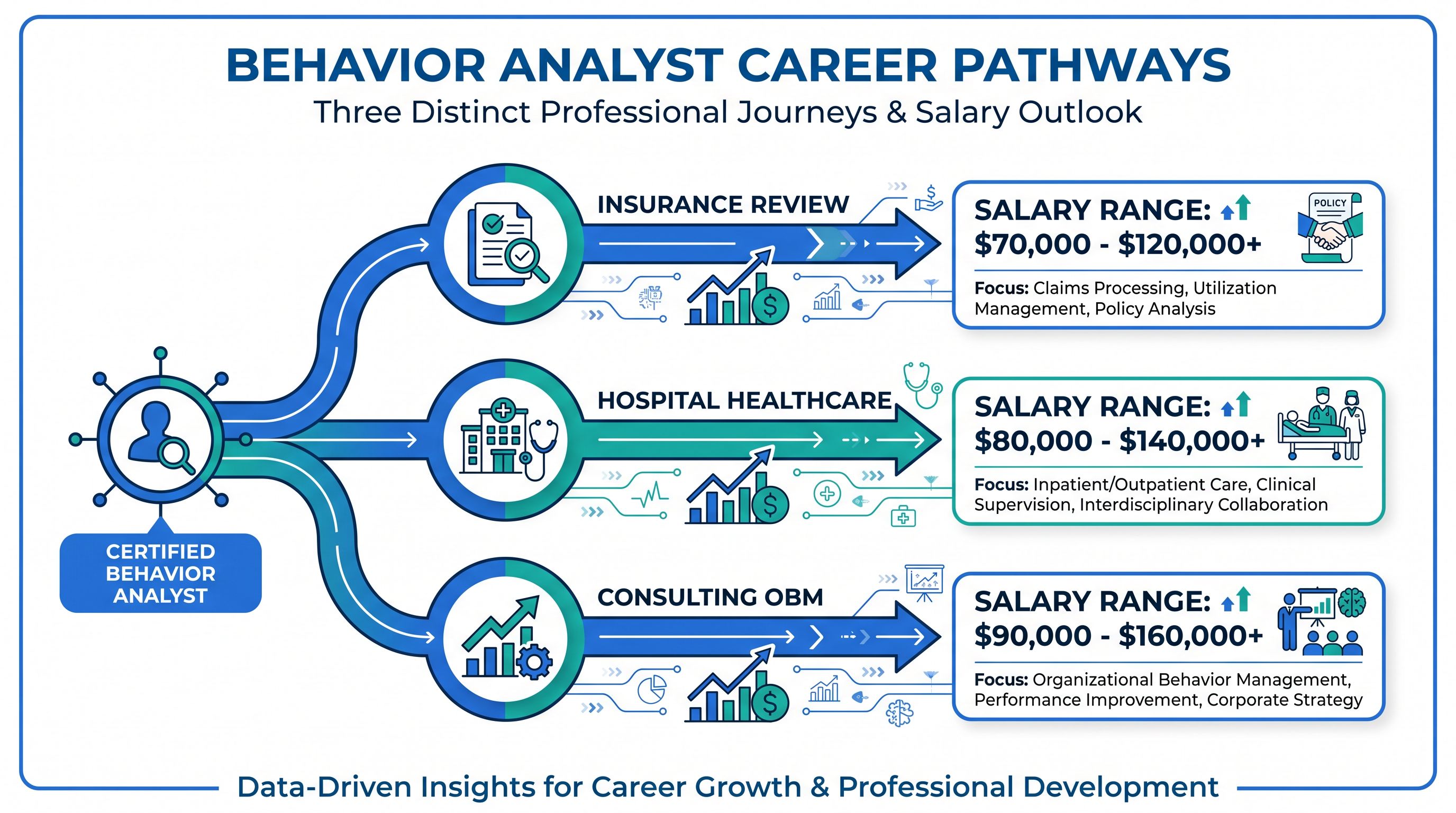
Non-Clinical BCBA Roles at a Glance
| Role | Salary Range | Remote? | Schedule | Key Skills |
|---|---|---|---|---|
| Insurance / Utilization Review | $84K – $177K | Mostly remote | Standard business hours | Clinical documentation review, authorization processes, compliance |
| Hospital / Healthcare | $74K – $120K+ | On-site or hybrid | Shift-based, some flexibility | Behavioral assessment, interdisciplinary collaboration, staff training |
| OBM / Consulting | $93K median in ABA; $109K outside ABA | Remote or travel | Project-based | Performance analysis, data-driven consulting, business communication |
| Traditional Clinical ABA | $75K – $105K | On-site / in-home | Variable, often evenings | Direct client therapy, supervision, parent training |
Your BCBA Opens More Doors Than You Think
The BCBA credential was designed around clinical behavior analysis, but the skills it represents are valuable far beyond the therapy room. Data-driven decision making, systematic behavior assessment, evidence-based intervention design, and ethical professional conduct are competencies that insurance companies, hospitals, and corporations genuinely need.
The workforce shortage gives you leverage. With roughly 132,000 open positions and fewer than 84,000 certified professionals, employers across every setting are competing for your attention. Whether you are drawn to the predictability of utilization review, the clinical variety of hospital work, or the business impact of OBM consulting, your certification opens the door.
The best time to explore your options is before you need a change. Start learning what is out there, and let the right opportunity come to you.
Let Employers Across All Settings Find You
Create an anonymous profile on CertifyndABA and receive interview requests from traditional ABA providers, insurance companies, hospitals, and more. You control what employers see and when to reveal your identity.
Create Your Free Profile