


School-based BCBA jobs are one of the fastest-growing segments of the ABA job market, and one of the least talked about. In 2025, employers posted 132,307 BCBA positions nationwide, a 28% jump from the prior year (ABA Resource Center, 2025). A growing share of those postings come from school districts scrambling to meet federal special education mandates with qualified behavior analysts. Yet when you search for school-based BCBA jobs online, you find job boards and listings; almost no one has written a guide to what these roles actually look like, what they pay, or how to land one.
This guide fills that gap. Whether you are a clinical BCBA considering a move to schools, a new BCBA exploring your options, or an RBT planning a long-term career path, here is what you need to know about working as a behavior analyst in a school setting in 2026.
What does a school-based BCBA do?
A school-based BCBA operates differently from a BCBA in a clinic or home setting. The role is more consultative and collaborative, less direct-service. Rather than carrying a caseload of individual clients for 30 or 40 hours per week, a school BCBA supports entire buildings, sometimes multiple schools within a district, by working with teachers, administrators, and special education teams.
Core responsibilities typically include:
- ✓Functional Behavior Assessments (FBAs) for students exhibiting challenging behavior, including direct and indirect assessment methods
- ✓Behavior Intervention Plans (BIPs) that classroom teachers and paraprofessionals can implement with fidelity throughout the school day
- ✓IEP team participation as the behavioral expert, ensuring behavior goals align with educational objectives and IDEA requirements
- ✓Teacher and staff training on ABA principles, classroom management strategies, de-escalation techniques, and PBIS (Positive Behavioral Interventions and Supports)
- ✓Data collection and analysis to track student progress, monitor intervention fidelity, and inform IEP updates
- ✓Crisis intervention and support for students in acute behavioral episodes
A 2024 peer-reviewed survey published in the Journal of Positive Behavior Interventions found that school-based behavior analysts spend significant time on assessment, intervention design, data analysis, and staff training (Layden et al., 2024). The research also noted that school BCBAs often serve on collaborative teams like PBIS committees and multi-tiered systems of support (MTSS) teams, giving them a systems-level influence that most clinical BCBAs do not have.
Why schools are hiring more BCBAs than ever
Three forces are driving the surge in school-based BCBA hiring.
1. IDEA compliance. The Individuals with Disabilities Education Act (IDEA) requires that students with behavioral needs documented in their IEPs receive consistent, evidence-based interventions. School districts need professionals who can conduct FBAs, write defensible BIPs, and train staff to implement them with fidelity. BCBAs are among the few professionals specifically trained for this work.
2. Rising autism prevalence. The CDC now reports that 1 in 31 children (3.2%) are identified as being on the autism spectrum, up from 1 in 150 roughly twenty years ago (CDC, 2025). More students on the spectrum means more IEPs with behavioral components, which means more demand for qualified behavior analysts in schools.
3. A massive workforce shortage. As of April 2026, there are 83,586 certified BCBAs in the United States (BACB, 2026). In 2025 alone, employers posted 132,307 BCBA job openings; that is roughly 50,000 more open positions than there are certified professionals to fill them (ABA Resource Center, 2025). One analysis estimates the nation needs nearly five times as many BCBA-level clinicians just to serve the population aged 21 and under on the autism spectrum (TYGES, 2025). Schools are competing directly with clinics, hospitals, and private practices for a limited talent pool, and many districts are losing that competition.
The Bureau of Labor Statistics projects 19% growth for behavior-related occupations through 2033, far exceeding the average for all occupations (BLS, 2025). For school districts, the hiring challenge is only getting steeper.
School BCBA salary and benefits: the full picture
The salary comparison between school-based and clinical BCBA roles requires context, because base salary alone tells a misleading story.
Base salary ranges:
- School district BCBAs: $60,000 to $80,000 (varies significantly by state and district size)
- Clinical BCBAs (ABA centers): $65,000 to $85,000
- Private practice or consulting BCBAs: $75,000 to $120,000+
On base salary alone, schools typically pay less than clinical or private-sector roles. But total compensation often closes that gap or reverses it. Here is what most salary comparisons leave out:
- ✓10-month work year. Most school-based positions follow the academic calendar. You get summers off, plus winter and spring breaks. A $70,000 school salary for 10 months of work is an effective rate of $7,000 per month; a $85,000 clinical salary for 12 months is $7,083 per month. The gap narrows significantly when you account for time.
- ✓Pension and retirement. Many school districts enroll BCBAs in the Teacher Retirement System (TRS) or a similar defined-benefit pension plan. This is increasingly rare in the private sector, where 401(k) plans with modest matching are standard.
- ✓Health benefits. Public-sector health insurance plans tend to be comprehensive with lower employee premium contributions than private-sector equivalents.
- ✓Job security. Public school positions offer stability that private ABA providers, many of which are venture-backed and subject to market cycles, generally cannot match.
- ✓Predictable schedule. No evening sessions, no weekend home visits, no cancellations that cut into billable hours. School BCBAs work during school hours on school days.
A $70,000 school salary with summers off, a pension, and no evening sessions is not the same as a $70,000 clinic salary working 12 months with a 401(k). Compare total compensation and effective hourly rate, not just base pay.
Salary varies widely by state. Top-paying states for school BCBAs include New Jersey ($75,000 to $158,000 range), California ($73,000 to $150,000 range), and New York ($81,000 to $120,000 range), according to ZipRecruiter job data. For a deeper look at BCBA compensation across settings and states, see our behavior analyst salary guide.
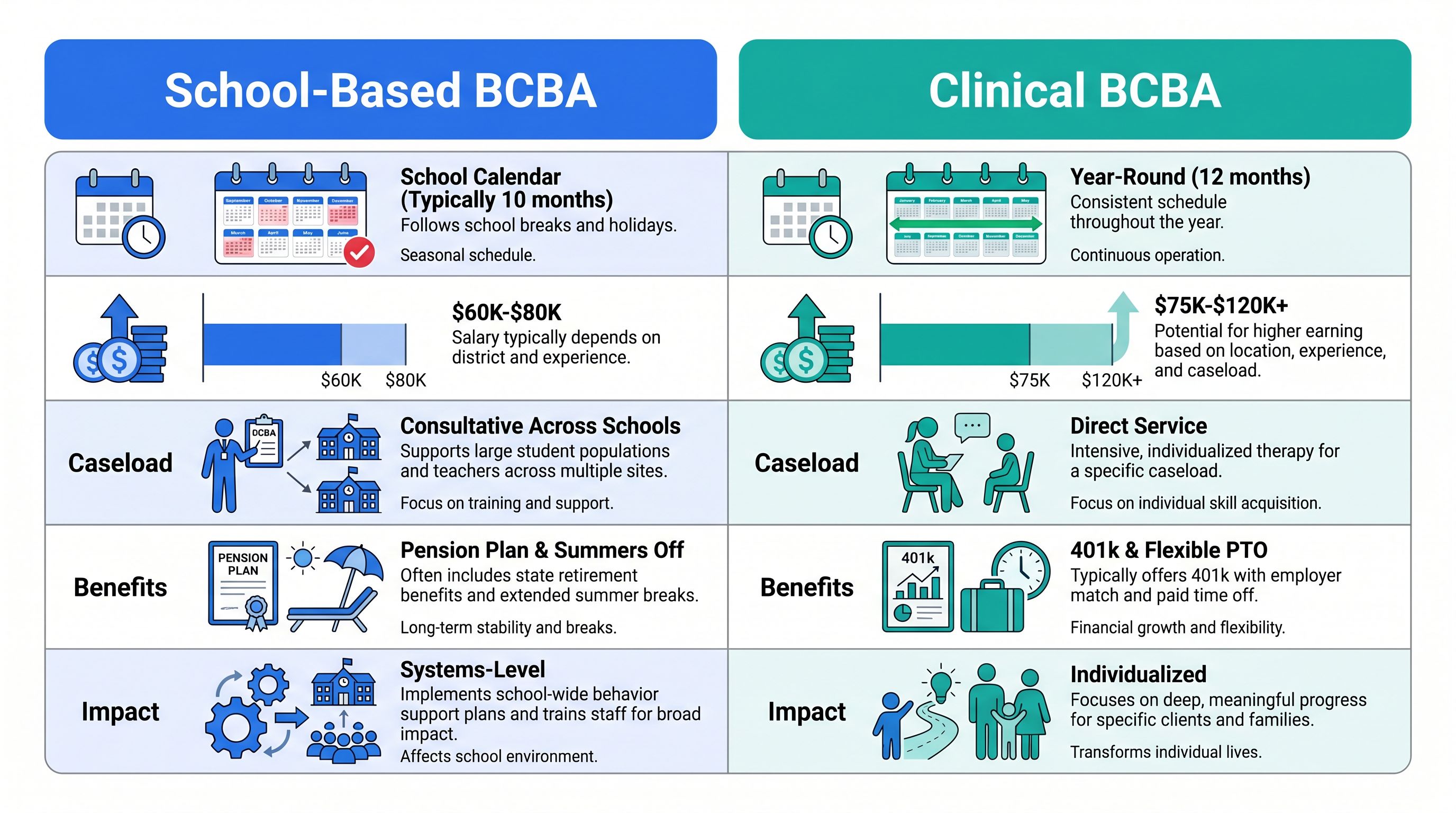
School-based vs. clinical BCBA: key differences
Choosing between a school-based and clinical BCBA role is not just about salary. The day-to-day work, professional relationships, and career trajectory differ in meaningful ways.
| Factor | School-Based BCBA | Clinical BCBA |
|---|---|---|
| Primary role | Consultant to teachers and IEP teams | Direct service provider to individual clients |
| Caseload | Many students across multiple classrooms or schools | Fewer clients with higher direct contact hours |
| Schedule | School calendar (summers, breaks off) | Year-round, often including evenings |
| Documentation | IEP-driven (IDEA compliance) | Insurance-driven (authorization renewals) |
| Team dynamic | Collaborative with teachers, psychologists, SLPs, administrators | Supervising RBTs; working with families |
| Impact scope | Systems-level change (PBIS, MTSS, school culture) | Individual client outcomes |
| Population | Students with various behavioral needs (not only autism) | Primarily autism spectrum; some OBM or other specialties |
| Compensation | Lower base salary; pension, summers, stability | Higher base salary; 401(k), year-round schedule |
Neither setting is objectively better. The right choice depends on what you value in your work and your life. If you thrive in collaborative environments, want systems-level impact, and value work-life balance with built-in breaks, school-based work deserves serious consideration. If you prefer deep clinical autonomy with individual clients and are motivated by higher earning potential, clinical roles may be the better fit.
For more on BCBA career options across all settings, see our BCBA career path guide.
How to land a school-based BCBA position
Finding and securing a school BCBA job follows a slightly different playbook than applying to clinics. Here is what works.
Where to find school BCBA jobs
- District websites directly. Most school districts post openings on their HR pages before they hit job boards. Identify target districts and check their career pages regularly.
- EDJOIN (for California) and state-specific education job boards. Many states have dedicated education employment platforms.
- Education staffing agencies like Epic Special Education Staffing and ProCare Therapy, which act as liaisons between districts and qualified BCBAs. These are especially useful for contract positions.
- Indeed, LinkedIn, and ZipRecruiter using search terms like "school BCBA," "district BCBA," or "school based behavior analyst."
- CertifyndABA. Build an anonymous profile highlighting your school-relevant experience and let districts with open positions reach out to you directly.
Qualifications that matter most
Beyond the standard BCBA certification, school districts look for specific skills and experience:
- ✓IDEA and IEP knowledge. Understanding how behavioral services fit within the IEP framework is essential. If you do not have this yet, seek out professional development before applying.
- ✓FBA and BIP expertise in educational settings. School-based FBAs look different from clinical ones. Classroom observations, teacher interviews, and academic antecedent analysis are central.
- ✓Teacher and staff training experience. Your ability to coach non-behavioral professionals to implement interventions with fidelity is the single most valuable skill in a school setting.
- ✓Experience with school-age populations. If your clinical background is exclusively with early learners (ages 2 to 5), emphasize any experience you have with older children and adolescents.
- ✓PBIS and MTSS familiarity. Many school districts use multi-tiered behavioral frameworks. Knowing how ABA fits within those systems makes you immediately more attractive as a candidate.
Resume and interview tips
Tailor your application materials specifically for school settings. On your resume, lead with FBA and BIP outcomes, teacher coaching metrics, and any multi-tiered systems experience. Remove or de-emphasize insurance authorization language and billable-hours framing; that language signals clinical, not educational. For detailed resume guidance, see our BCBA resume guide.
In the interview, expect questions about collaboration. School hiring committees often include administrators, special education teachers, and school psychologists; not just a clinical director. Be ready to discuss how you would support a teacher who is struggling with a student's behavior, how you approach crisis situations in a classroom with 25 other students present, and how you build buy-in with staff who may be unfamiliar with ABA. Our BCBA interview questions guide covers the behavioral and situational questions to prepare for.
Contract vs. direct-hire positions
School districts fill BCBA positions through two main channels: direct hire (you are a district employee) and contract through a staffing agency. Direct-hire positions offer full benefits, pension eligibility, and long-term stability. Contract positions pay a higher hourly rate but without benefits, and the engagement may last only one school year. If you are exploring schools for the first time, a contract position can be a low-risk way to test whether the setting is right for you.
Is a school-based BCBA career right for you?
School-based BCBA jobs offer something rare in the ABA field: a chance to create systems-level change while working a predictable schedule with built-in breaks. The salary may start lower than clinical roles, but the total compensation package, including pension, benefits, time off, and job security, makes these positions genuinely competitive.
With 50,000 more job openings than there are certified BCBAs to fill them, the leverage is on your side. School districts need you, and many are willing to offer competitive packages to attract qualified behavior analysts.
If you value collaboration over autonomy, want to influence how entire schools approach behavior, and are ready for a work schedule that gives you summers back, school-based work is worth a serious look.
Let School Districts Come to You
Build an anonymous CertifyndABA profile in about 10 minutes. Highlight your school-relevant skills, see the role and compensation range before employers see your name, and receive interview requests from districts that match your qualifications.
Create Your Free Profile