


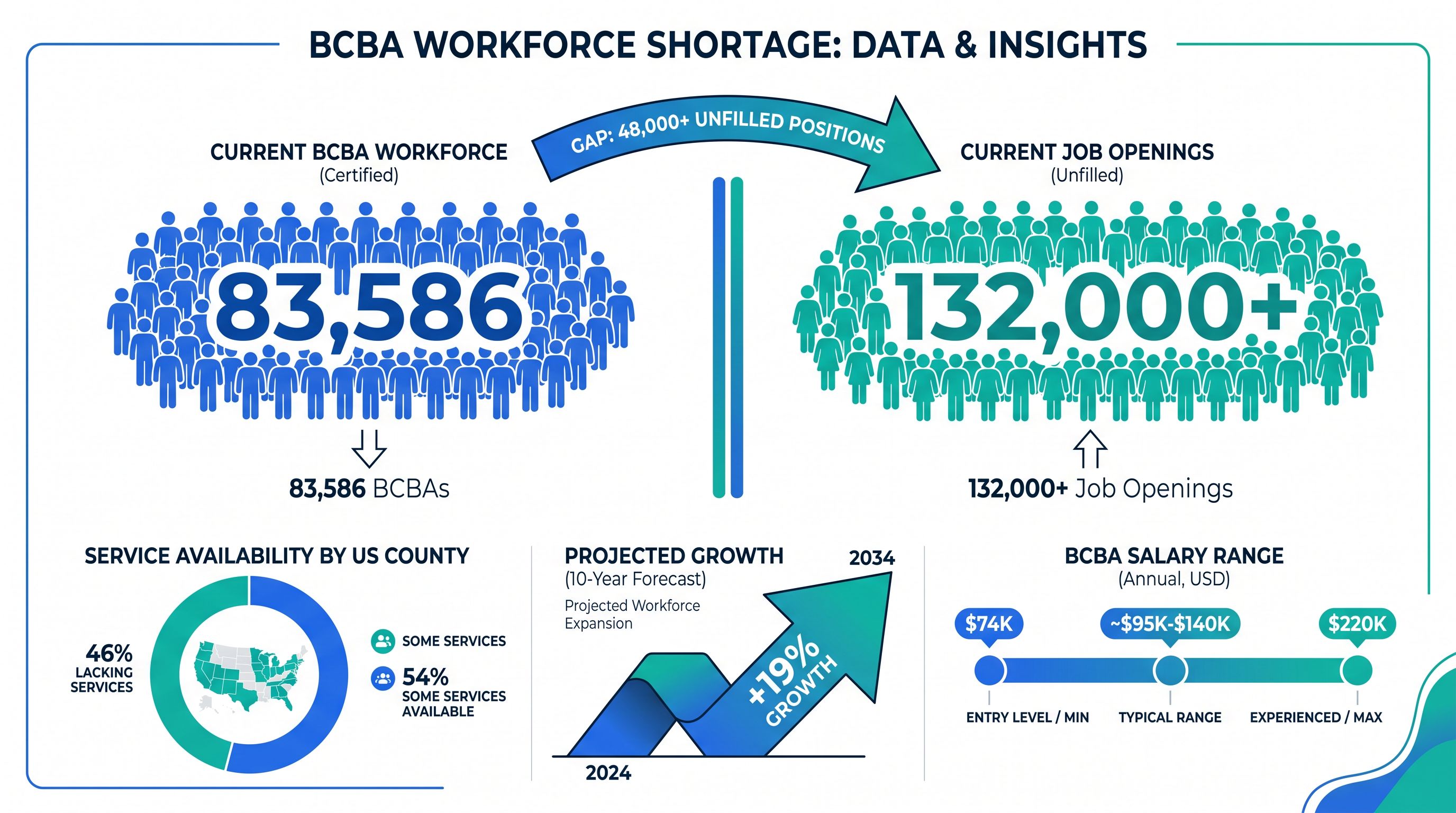
Telehealth BCBA jobs have moved from a pandemic stopgap to one of the fastest-growing segments of the ABA job market. With more than 132,000 BCBA job postings in 2025 and only 83,586 certified BCBAs worldwide, the profession faces a workforce gap that telehealth is uniquely positioned to close. If you are a Board Certified Behavior Analyst exploring virtual roles, or considering the shift from in-person to telehealth practice, this guide covers everything you need to know.
What Are Telehealth BCBA Jobs?
Telehealth BCBA jobs involve delivering clinical ABA services through video technology. This is different from general remote BCBA jobs, which might include administrative tasks, curriculum development, or consulting that simply happen to be done from home.
Telehealth BCBA roles are clinical positions. You are working directly with clients, families, and care teams through a screen. The most common telehealth BCBA services include:
- ✓ Parent and caregiver training: Coaching families to implement ABA strategies in real time via video
- ✓ Remote clinical supervision: Observing and supervising RBTs through live video sessions
- ✓ Functional behavior assessments: Conducting FBAs, VB-MAPP, and ABLLS-R assessments remotely with caregiver assistance
- ✓ Treatment plan development and review: Creating, updating, and monitoring behavior intervention plans
- ✓ Hybrid roles: Splitting caseloads between in-person direct therapy and telehealth parent training or supervision
Many employers now offer hybrid models where BCBAs handle supervision and parent training via telehealth while RBTs deliver direct services in person. This structure lets a single BCBA serve clients across a wider geographic area.
The BCBA Shortage Driving Telehealth Growth
The growth of telehealth BCBA jobs is not accidental. It is a direct response to one of the most pressing workforce crises in healthcare.
According to the Behavior Analyst Certification Board, there are 83,586 certified BCBAs as of April 2026. Meanwhile, industry data shows more than 132,000 BCBA job postings appeared in 2025 alone, a 28% increase year over year. The math is simple: there are not enough BCBAs to fill the available roles.
Several factors compound this shortage:
- Rising autism prevalence: The CDC estimates 1 in 36 children has autism, sustaining high demand for ABA services
- Shrinking exam pipeline: BCBA exam pass rates have dropped from 66% in 2020 to 51% in 2025, slowing the flow of newly certified analysts
- Geographic concentration: According to TYGES Healthcare, 46% of U.S. counties lack any BCBA services at all, creating vast ABA care deserts
- Strong growth projections: The Bureau of Labor Statistics projects 19% job growth for behavior analyst roles through 2033, far outpacing the 3.1% national average
Telehealth directly addresses the geographic piece of this problem. A BCBA in a well-served metro area can provide parent training and supervision to families in rural counties that have no local behavior analyst. For the BCBA job outlook, telehealth is not a nice-to-have; it is becoming essential infrastructure.
Does Telehealth ABA Actually Work?
Before pursuing telehealth BCBA jobs, you may wonder whether the clinical outcomes hold up. The research is encouraging.
A peer-reviewed study published in the Journal of Autism and Developmental Disorders (Lindgren et al.) found that telehealth-based parent training achieved a mean reduction in problem behavior exceeding 90%, with outcomes comparable to in-person delivery at lower cost.
Additional research published in PMC confirmed that skills across language, social, and adaptive domains are effectively taught via telehealth, with participants mastering and maintaining learned behaviors over time.
"Telehealth ABA can achieve similar outcomes at lower cost compared with in-home therapy, minimizing geographic barriers to providing access to ABA for treating problem behavior."
State Licensing: The Biggest Challenge for Telehealth BCBAs
Licensing is the single most important consideration for anyone pursuing telehealth BCBA jobs. The rules are straightforward but strict: you must hold an active license in the state where your client is physically located at the time of service.
This means your BACB certification alone is not enough. As of 2025, all 51 U.S. jurisdictions (50 states plus Washington, D.C.) have enacted behavior analyst licensure laws, according to the BACB's licensure page.
Here is what makes multi-state telehealth practice complex:
- No ABA interstate compact exists. Unlike psychologists who benefit from PSYPACT (covering 43 states), behavior analysts have no equivalent compact. You need a separate license for each state where you serve clients.
- Licensing requirements vary. Each state has its own application process, fees, supervision documentation requirements, and renewal cycles.
- Emerging compacts are underway. The Counseling Compact and Social Work Licensure Compact are in early implementation stages, potentially paving the way for a future behavior analyst compact.
Telehealth BCBA Salary: What to Expect
Compensation for telehealth BCBA roles varies based on employment structure, state, and experience level.
Here is how telehealth pay generally breaks down:
- Salaried telehealth positions typically pay 5-15% less than equivalent in-person roles, reflecting reduced overhead costs for employers
- Independent telehealth contractors can command $85 or more per hour, often exceeding in-person rates due to scheduling flexibility and specialized expertise
- Hybrid roles that combine telehealth and in-person work tend to pay comparably to full in-person positions
The salary picture improves when you factor in indirect financial benefits. Telehealth BCBAs save on commuting costs, work clothing, and meals. They can also serve clients in higher-cost markets while living in more affordable areas. For a deeper dive into compensation data, see our behavior analyst salary guide.
Skills and Technology You Need
Succeeding in telehealth BCBA jobs requires a slightly different skill set than traditional in-person practice. The clinical knowledge is the same, but the delivery method shifts your role significantly.
Clinical skills for telehealth:
- Strong parent and caregiver coaching abilities; telehealth shifts your role from "doer" to "coach"
- Clear, concise verbal communication; you cannot rely on physical prompting or modeling in the same way
- Creative engagement strategies for maintaining client attention through a screen
- Cultural competence for serving diverse families across geographic regions
Technology essentials:
- HIPAA-compliant video platform (Zoom for Healthcare, doxy.me, or SimplePractice)
- Reliable high-speed internet and professional-quality camera and microphone
- Digital data collection and treatment planning tools
- Ability to guide families on camera positioning and environmental setup for effective observation
If you are building a telehealth-focused BCBA resume, highlight these technical competencies alongside your clinical qualifications. Employers specifically look for candidates who can demonstrate comfort with virtual service delivery.
How to Find Telehealth BCBA Jobs
The market for telehealth BCBA positions is strong, but knowing where and how to search makes a difference.
Where to search:
- ABA-specific platforms: CertifyndABA lets you create an anonymous profile highlighting your telehealth experience and multi-state licensure, so employers actively reach out to you
- Major job boards: Indeed, ZipRecruiter, and LinkedIn all support filtering for "telehealth" or "virtual" in BCBA searches
- Professional communities: Facebook groups dedicated to telehealth BCBA positions share openings that do not always appear on job boards
- Direct outreach: Contact telehealth-focused ABA companies directly; many are growing faster than their job postings reflect
How to stand out:
- List all state licenses you hold prominently on your profile and resume
- Quantify your telehealth experience (e.g., "Supervised 12 RBTs across 3 states via telehealth over 18 months")
- Mention specific platforms and tools you are proficient with
- Highlight any parent training outcomes or data you have tracked
For help positioning yourself for telehealth roles, check out our BCBA cover letter guide for tips on framing your virtual practice experience.
Is a Telehealth BCBA Career Right for You?
Telehealth BCBA jobs are not a passing trend. They are a structural response to the most significant workforce shortage in ABA's history. With 46% of U.S. counties lacking any BCBA services and demand growing at 6 times the national average, virtual service delivery will only become more central to how ABA care reaches the families who need it.
For BCBAs, the opportunity is clear: telehealth roles offer geographic flexibility, strong demand, and the chance to expand your clinical impact beyond what any single caseload could achieve in person. The key is preparing strategically by building multi-state licensure, developing strong parent coaching skills, and positioning yourself where employers can find you.
Ready for Your Next Telehealth BCBA Role?
Create a free anonymous profile on CertifyndABA and let qualified employers reach out to you. Highlight your telehealth experience, list your state licenses, and start receiving interview requests from organizations hiring for virtual ABA positions.
Create Your Free Profile