


Applied Behavior Analysis is one of the fastest-growing fields in allied health. The Behavior Analyst Certification Board (BACB) now oversees 342,206 certified professionals; that is an eightfold increase from just 38,000 in 2015. Yet even at this pace, employers posted more than 132,000 BCBA positions in 2025 while only about 81,500 BCBAs held active credentials. Whether you are exploring ABA careers for the first time or planning your next move, understanding this landscape is worth your time.
This guide maps every rung of the ABA career ladder, the salary ranges at each level, where professionals work, and what the historic supply-demand gap means for anyone considering a career in applied behavior analysis.
The ABA Workforce in 2026: A Snapshot
The BACB tracks three core credentials. Here is where each one stands as of April 2026:
| Credential | 2020 | 2022 | 2025 | Avg. Annual Growth |
|---|---|---|---|---|
| BCBA | 44,025 | 59,976 | 81,566 | ~11% |
| RBT | 89,122 | 130,273 | 246,109 | ~22% |
| BCaBA | 4,729 | 5,580 | 5,171 | Declining |
Source: BACB Annual Certificant Report Data
The Bureau of Labor Statistics projects 17% employment growth for behavioral health roles through 2034, roughly five times the national average for all occupations. About 48,300 new openings are expected each year in this period (BLS, 2025).
ABA Career Paths: From Entry Level to Leadership
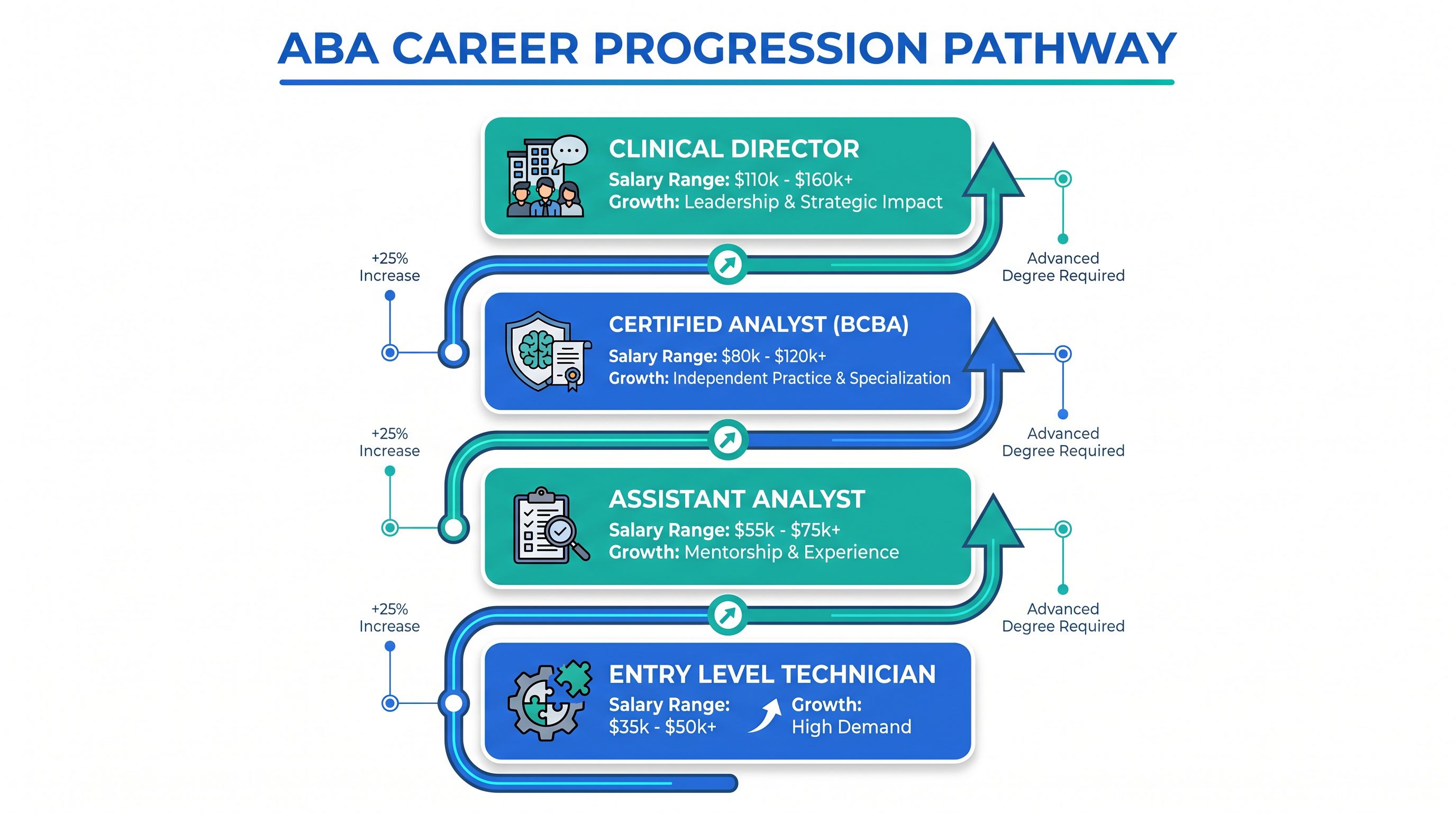
ABA offers a clear career ladder. Each step up brings more autonomy, higher pay, and broader scope of practice. Here is what each role looks like in 2026.
Registered Behavior Technician (RBT)
The RBT credential is the entry point into applied behavior analysis. It requires a high school diploma, a 40-hour training program, a competency assessment, and passing a national exam with a 75% first-time pass rate (BACB, 2025).
With 253,397 active RBTs as of April 2026, this is the largest segment of the ABA workforce and the fastest growing; the credential base expanded roughly 25% between 2024 and 2025 alone. RBTs work under the direct supervision of a BCBA, implementing behavior intervention plans with clients across homes, clinics, and schools.
Salary range: $40,000 to $55,000 annually, with top earners reaching $66,000 or more depending on location and experience (ZipRecruiter, 2026; BLS, 2024).
Many RBTs treat this credential as a stepping stone. If you are considering moving from RBT to BCBA, our RBT-to-BCBA timeline guide breaks down the full path, including coursework, supervised hours, and realistic timelines.
Board Certified Assistant Behavior Analyst (BCaBA)
The BCaBA requires a bachelor's degree, approved coursework, supervised fieldwork, and passing a certification exam (60% first-time pass rate). BCaBAs can design and oversee behavior plans but must work under BCBA supervision.
This is the smallest BACB credential at 5,223 active holders, and it is shrinking. Job postings for BCaBAs declined approximately 25% in 2025, falling to 10,717 positions (Acuity, 2026). The trend reflects a broader shift: as accelerated master's programs become more accessible, many candidates skip the BCaBA and pursue BCBA certification directly.
Salary range: $48,000 to $60,000 annually. The BCaBA certification guide covers current requirements in detail.
Board Certified Behavior Analyst (BCBA)
The BCBA is where demand and compensation converge. Earning this credential requires a master's degree, approved coursework, at least 2,000 hours of supervised experience, and passing the BCBA exam, which has a 51% first-time pass rate (BACB, 2025).
That ratio, roughly 1.6 open positions for every active BCBA, gives certified behavior analysts significant leverage in the job market. BCBAs can practice independently, supervise RBTs and BCaBAs, design treatment programs, and work in virtually any setting.
Salary range: $75,000 to $105,000 depending on setting, location, and experience. ZipRecruiter reports a national average of $89,075; Glassdoor's self-reported average reaches $105,656 including total compensation. For state-level breakdowns, see our BCBA salary by state guide.
Clinical Director and Senior Leadership
Clinical directors typically hold BCBA certification plus three to five years of clinical experience. They oversee clinical teams, manage program quality, train staff, and ensure compliance with payer and licensing requirements.
Salary range: $95,000 to $130,000 or more, depending on organization size and geography. The ABA talent shortage is fast-tracking leadership careers; BCBAs with strong clinical track records are being promoted faster than ever. Our clinical director jobs guide covers this path in detail.
Non-Clinical and Emerging ABA Roles
The ABA field extends well beyond direct therapy. BCBAs increasingly move into roles that apply behavioral principles in different contexts:
- ✓ Insurance utilization review: reviewing ABA treatment plans on behalf of payers. See our BCBA insurance jobs guide.
- ✓ Organizational Behavior Management (OBM): applying ABA principles to workplace performance, safety, and employee training.
- ✓ ABA operations: scheduling, billing, quality assurance, and recruiting within ABA organizations.
- ✓ Private practice: the most autonomous path, with earning potential above $130,000. Our guide to starting an ABA practice covers the business side.
- ✓ Research and academia: university faculty positions, research labs, and program development.
These roles reflect the field's maturation. As ABA companies grow and the regulatory landscape becomes more complex, demand for professionals who can operate beyond the clinical setting continues to increase.
The ABA Employment Gap: By the Numbers
The defining feature of ABA careers in 2026 is the gap between supply and demand. According to Lightcast labor market data cited by Acuity Media, BCBA job postings have grown at a compound annual rate of 44.2% since 2017, and demand roughly doubled between 2023 and 2025.
More than half of all U.S. counties have zero BCBAs practicing within their borders.
The geographic concentration is stark. Five states (California, New Jersey, Texas, Massachusetts, and North Carolina) account for 38% of all BCBA demand, with California alone representing 15% (Acuity, 2026). Rural and low-income areas are especially underserved, with two-thirds of specialty centers reporting wait times of four months or longer for initial assessments.
The supply bottleneck has multiple causes. The 51% first-time BCBA exam pass rate limits how quickly new BCBAs enter the workforce. Master's degree requirements create a two-to-three-year pipeline, and the 2,000-hour supervised experience requirement adds additional time. Meanwhile, demand continues to accelerate as autism diagnosis rates rise and insurance mandates expand ABA coverage.
For job seekers, this gap translates directly into leverage. With 1.6 open positions per active BCBA, employers compete for candidates rather than the reverse. If you are a BCBA weighing a move, our salary negotiation guide explains how to use this market dynamic to your advantage.
Where ABA Professionals Work
ABA careers span a wide range of settings, each with its own pace, population, and professional culture:
In-home therapy remains the largest employment setting. Practitioners deliver services in the client's natural environment, which supports skill generalization but requires travel between locations.
Clinic and center-based settings offer structured environments with multiple clients and team collaboration. These are common for RBTs and BCBAs who prefer consistency in their daily schedule.
Schools are a growing sector, particularly for BCBAs. Both public school districts and private schools hire behavior analysts to support students with behavioral needs. Our school-based BCBA jobs guide covers this path.
Telehealth is the fastest-growing delivery model in ABA, driven by care deserts in rural communities. Remote ABA roles have expanded significantly since 2020; see our telehealth BCBA jobs guide for details.
Hospitals and healthcare systems represent an emerging integration point as behavioral health becomes part of coordinated care models.
Private practice offers the most autonomy and highest earning potential but requires business skills alongside clinical expertise.
How to Start or Advance Your ABA Career
The right entry point depends on where you are today:
New to ABA: Start as an RBT. The 40-hour training requires no degree, and employment is immediate given current demand. This is the fastest way to begin working in the field while deciding whether to pursue advanced credentials. See the RBT certification guide for requirements.
Career changers: Accelerated master's programs in ABA can get you to BCBA eligibility in 18 to 24 months. Many programs offer online coursework, making them accessible to working professionals.
Current RBTs leveling up: The path from RBT to BCBA involves a master's degree and 2,000 supervised hours. It is a real commitment, but the salary jump from $42,000 to $89,000 on average makes the investment tangible. Our RBT-to-BCBA timeline lays out realistic milestones.
Current BCBAs exploring options: With 1.6 open positions per BCBA, you have negotiating power. Explore high-demand specializations, consider remote positions, or evaluate whether a private practice fits your long-term goals.
The ABA Field Needs Professionals at Every Level
A field that has grown eightfold in a decade and still cannot fill demand is a field with opportunity at every rung. From RBTs entering with a 40-hour training to BCBAs commanding six-figure salaries, ABA careers in 2026 offer something increasingly rare: strong compensation, meaningful work, and a job market that genuinely favors the professional.
The question is not whether opportunities exist. It is how you want to find them.
Let Employers Come to You
CertifyndABA is a reverse job marketplace for ABA professionals. Create an anonymous profile, showcase your credentials, and receive interview requests from employers who meet your criteria. You stay in control of your information until you are ready to connect.
Create Your Free Profile