

The BCBA vs BCaBA decision is usually framed as a choice between two rungs on the same ladder: get the bachelor's-level credential now, move up to the master's-level one later. The certification data says something different. On September 21, 2026 the United States had 77,955 active Board Certified Behavior Analysts and 4,480 Board Certified Assistant Behavior Analysts, a gap of more than 17 to 1. Employers posted 132,307 jobs naming a BCBA or BCBA-D in 2025 and 10,717 naming a BCaBA. And between 2021 and 2025, roughly as many people gave up a BCaBA as earned one.
This guide compares the two credentials with primary sources rather than program brochures. The certificant counts come from the Behavior Analyst Certification Board's live region-specific database, which we parsed down to the state level ourselves. The hiring figures come from the BACB's own employment-demand report, prepared with Lightcast. The requirements and the supervision rules come from the current BACB handbooks. The attrition figures are our calculation from BACB's published Annual Data Reports, because BACB does not publish an attrition rate directly. The pay figures come from 577 job ads with employer-stated pay that we collected on September 21, 2026.
BCBA vs BCaBA at a glance
Every line below comes from the BACB's current BCaBA and BCBA handbooks or its 2025 Annual Data Report. Fees are BACB and Pearson VUE charges only; tuition is separate and varies enormously.
| BCaBA | BCBA | |
|---|---|---|
| Level | Undergraduate-level certification | Graduate-level certification |
| Independence | Must practice under a BCBA supervisor on record at all times | Independent practitioner; supervises RBTs and BCaBAs |
| Degree | Bachelor's degree | Master's or doctoral degree |
| Coursework | 225 classroom hours (270 from January 2027) | 315 classroom hours |
| Fieldwork | 1,300 Supervised or 1,000 Concentrated hours (800 Concentrated from January 2027) | 2,000 Supervised or 1,500 Concentrated hours |
| Exam | 175 questions, 4 hours | 185 questions, 4 hours |
| 2025 first-time pass rate | 60% | 51% |
| BACB fees to certify | $175 application plus $125 exam appointment | $245 application plus $125 exam appointment |
| Recertification | Every 2 years, 20 CEUs including 4 ethics | Every 2 years, 32 CEUs including 4 ethics |
| Active US certificants | 4,480 | 77,955 |
| 2025 US job postings | 10,717, down 26% | 132,307 (BCBA and BCBA-D), up 28% |
The requirements gap is narrower than the career gap
On paper the two credentials are not far apart. A BCaBA needs 225 classroom hours against a BCBA's 315, and 1,300 supervised fieldwork hours against 2,000. That is roughly 70% of the coursework and 65% of the fieldwork. The exam is ten questions shorter and the BACB application fee is $70 cheaper.
The one requirement that genuinely separates them is the degree. A BCaBA needs a bachelor's; a BCBA needs a master's. For someone who does not want to spend two years and the associated tuition on graduate school, that is the whole argument for the BCaBA, and it is a real one.
What the requirements do not explain is difficulty. A common assumption is that fewer people hold the BCaBA because the credential is a stepping stone for people who could not manage the harder path. The pass rates say the opposite. In 2025 the BCaBA exam had a 60% first-time pass rate against the BCBA's 51%, and a 30% retake rate against 23%. Across 2020 to 2025 the two exams tracked each other closely: the BCaBA first-time rate was higher in 2021 and 2025, identical in 2020, 2023 and 2024, and lower only in 2022. Whatever is keeping the BCaBA population small, it is not the exam.
What employers actually post
The BACB's employment-demand report, built from Lightcast job-posting data, has tracked US postings by credential since 2010. In 2025 employers posted 132,307 jobs naming a BCBA or BCBA-D, up 28% year over year and the fifteenth consecutive year of growth, a run we unpack in our analysis of the BCBA shortage. Postings naming a BCaBA came to 10,717, down 26% after a one-off spike in 2024. We cover the BCaBA side of that market in more depth in our guide to BCaBA jobs.
The more revealing number is the share. Of all analyst-level postings that named one credential or the other, BCaBA accounted for 16.4% in 2019, 13.1% in 2021, 8.8% in 2023 and 7.5% in 2025. The BCaBA share of the analyst hiring market has been cut in half in six years, during a period when the overall market more than quadrupled.
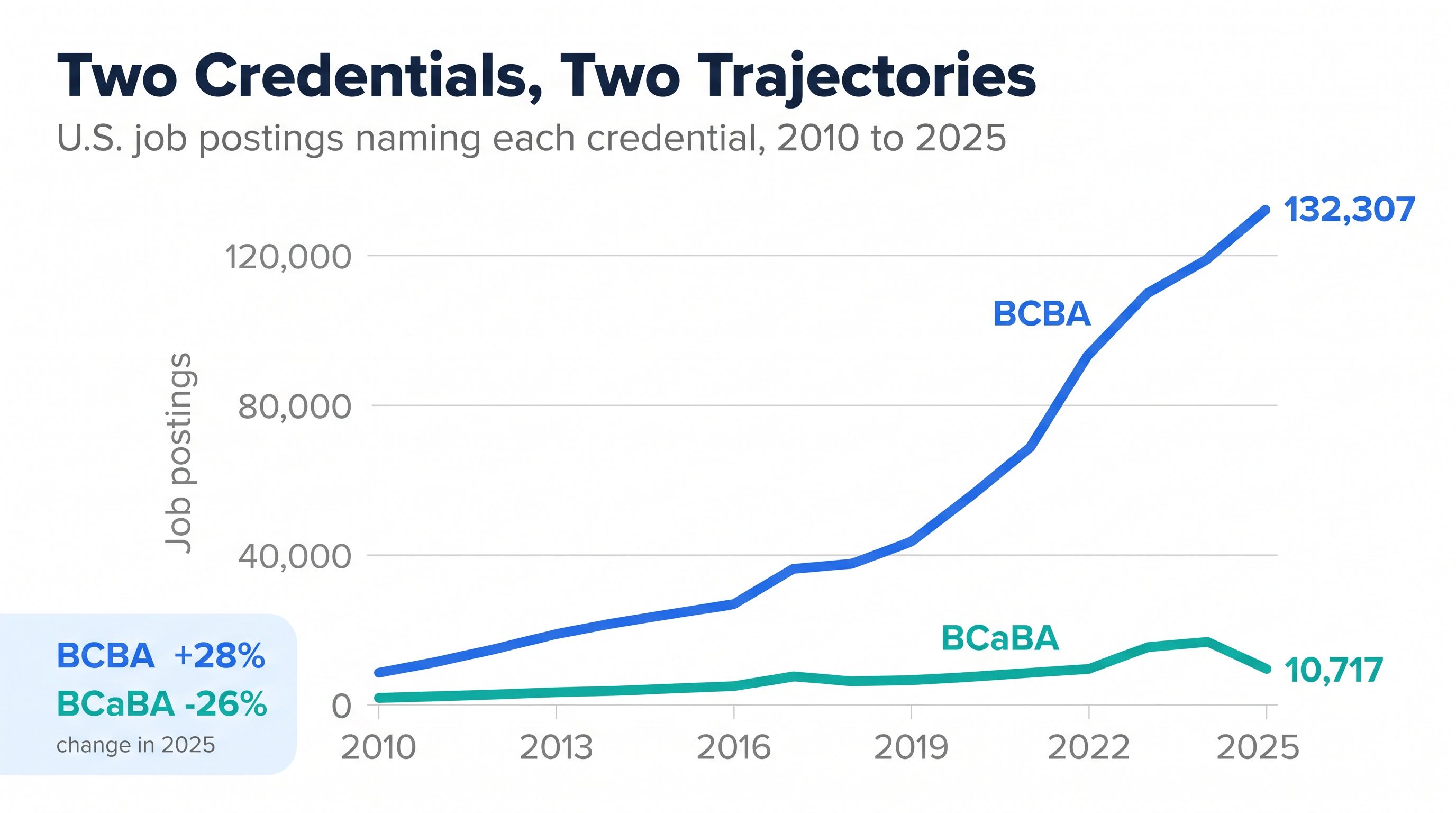
There is a counterpoint worth stating plainly, because it cuts against the obvious conclusion. Measured per certificant, BCaBA postings are not scarce. Divide 2025 postings by the certificants active at the end of that year and you get about 1.8 BCBA postings per BCBA and about 2.6 BCaBA postings per BCaBA. On that measure a BCaBA faces less competition, not more.
Two cautions apply to that arithmetic. Annual posting volume is a flow and certificant counts are a stock, so neither figure means "open jobs available right now"; a point-in-time check of one major job board on September 21, 2026 returned 836 live BCBA listings and 672 BCaBA listings. And the per-certificant ratio is flattered by how tiny the BCaBA pool is. A market with 10,717 postings a year is a twelfth the size of one with 132,307, it lost ground in 2025 while the BCBA market grew, and as the next section shows, the certificants are not spread across the country. In fairness to the credential, BACB notes that BCaBA demand still shows an overall increasing trend since 2010; the point is not that the market is collapsing but that it is being outgrown.
Where the BCaBAs actually are
This is the finding that changes the decision, and we have not seen it published anywhere else. We parsed all 55 US state and territory rows from the BACB's live certificant database on September 21, 2026. They sum exactly to the national totals, so the distribution below is complete rather than a sample.
Florida alone holds 1,835 BCaBAs. That is 41.0% of every BCaBA in the United States, in a state with about 7% of the population. The next largest is Virginia with 253. The top three states hold 51.6% of the national total and the top ten hold 73.3%.
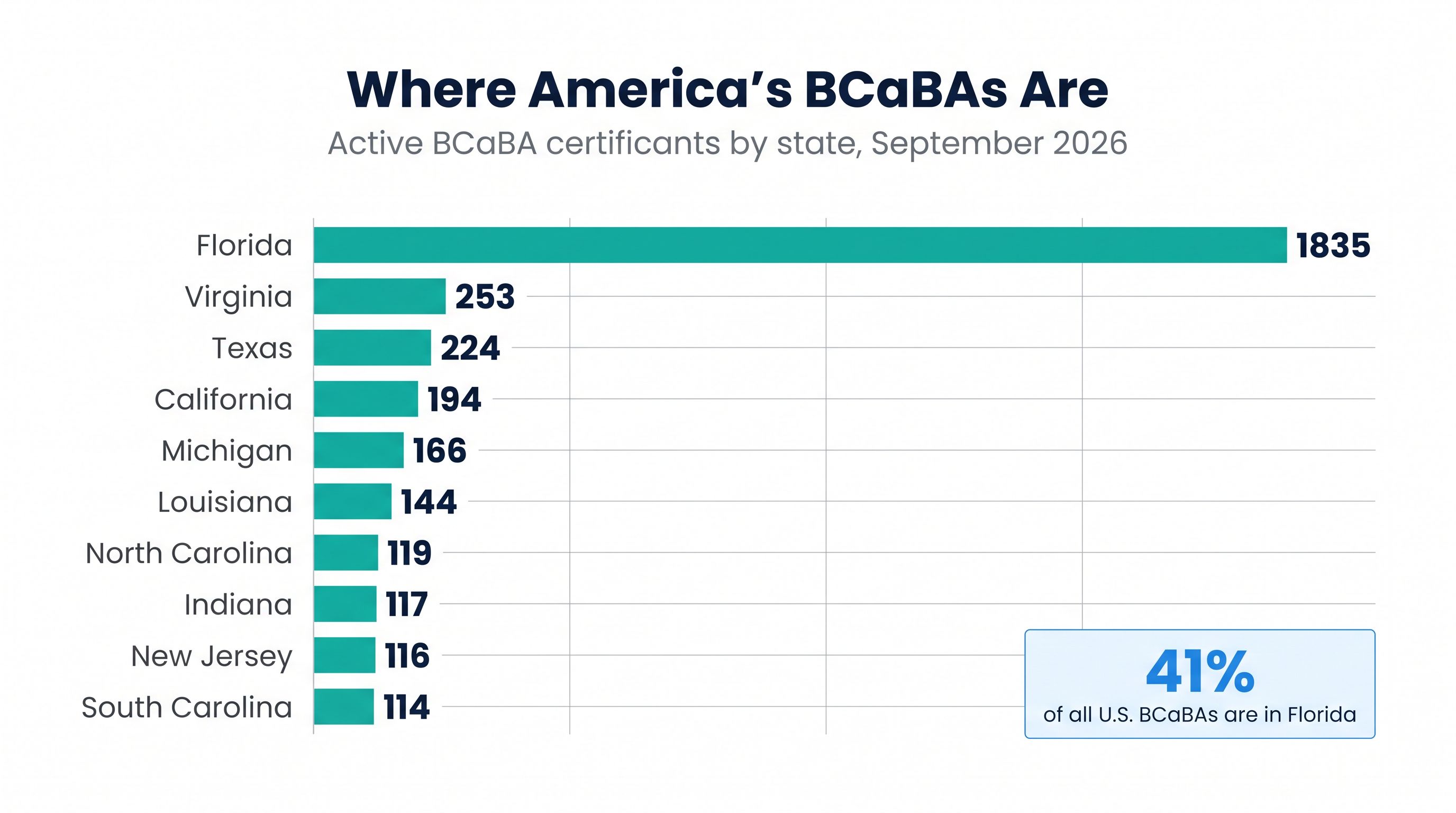
| State | BCaBAs | BCBAs | BCBAs per BCaBA |
|---|---|---|---|
| Florida | 1,835 | 9,340 | 5.1 |
| Virginia | 253 | 2,241 | 8.9 |
| Texas | 224 | 5,575 | 24.9 |
| California | 194 | 10,912 | 56.2 |
| Michigan | 166 | 2,739 | 16.5 |
| Louisiana | 144 | 801 | 5.6 |
| North Carolina | 119 | 2,208 | 18.6 |
| Indiana | 117 | 1,863 | 15.9 |
| New Jersey | 116 | 3,864 | 33.3 |
| South Carolina | 114 | 868 | 7.6 |
The other end of the distribution matters just as much. Twenty-four of the 55 US jurisdictions have fewer than 25 BCaBAs. Guam, North Dakota, the Northern Mariana Islands and the US Virgin Islands have none at all. Wyoming has one and the District of Columbia has two.
Look at the large states and the pattern gets sharper. Massachusetts has 3,902 BCBAs and 43 BCaBAs, a ratio of 91 to 1. New York has 3,378 and 44, or 77 to 1. California has 10,912 and 194, or 56 to 1. In those states the BCaBA is not a junior tier of a profession; it is a credential almost nobody around you holds, which means few employers have a job description written for it, a supervision structure built for it, or a billing code mapped to it.
One wrinkle cuts the other way and is worth knowing if you are in a low-supply state. The places posting the most BCaBA jobs are not the places with the most BCaBAs. BACB reports that the five states with the highest BCaBA demand in 2025 were California, Florida, Michigan, Texas and Pennsylvania, together 43% of all BCaBA postings, with California alone at 15%. California has 194 BCaBAs. Some of that demand is roles that would accept a BCaBA among other credentials rather than require one, but if you already hold the credential in a thin state, the postings are less scarce than the certificant map suggests.
Why the map looks like that
The obvious explanation is state licensure, and it is wrong. Massachusetts licenses a Licensed Assistant Applied Behavior Analyst and has 43 BCaBAs. New York licenses a Certified Behavior Analyst Assistant and has 44. Illinois licenses a Licensed Assistant Behavior Analyst and has 48. Florida, meanwhile, has no behavior-analyst licensure at all and defers entirely to BACB certification, and it has 1,835. Having an assistant tier on the books plainly does not produce assistants; our state-by-state guide to behavior analyst licensure covers how the licensing picture varies.
What the evidence does support is payer policy. Florida Medicaid's behavior analysis coverage policy, adopted under Rule 59G-4.125 of the Florida Administrative Code, names the BCaBA as one of three defined provider tiers and gives it genuine clinical scope: protocol modification and family training under CPT codes 97155 and 97156, plus authority to supervise RBTs. Florida reimburses a BCaBA at $15.37 per unit for 97155 against $19.17 for a lead analyst, roughly 80% parity. A Florida provider can therefore staff real billable work with a BCaBA and collect most of the revenue.
Compare California, where the main Medi-Cal billing pathway lets only BCBAs and educational psychologists enroll individually as qualified autism service providers; there is no BCaBA enrollment tier, though the separate regional-center system does vendorize BCaBAs. South Dakota Medicaid goes further and does not let BCaBAs enroll as billing providers at all, restricting them to technician-level codes under a supervising BCBA's enrollment. Where a payer will not pay a BCaBA to do analyst work, employers stop writing BCaBA job descriptions, and the credential quietly disappears from the state.
Two other documented factors reinforce the Florida picture. Florida Tech runs a large ABAI-accredited bachelor's program built to graduate students ready for the BCaBA exam, a pipeline most states do not have. And Florida had a decade's head start: its state certification program added a bachelor's-level assistant tier in 1996, before the BACB existed, and transferred its remaining certificants to the BACB by 2004. South Carolina's unusually low ratio has its own documented cause; the state Medicaid agency directly funds BCaBA coursework through partnerships with the University of South Carolina and Clemson.
We should be honest about the limits here. No single document says "this is why Florida has 41% of the country's BCaBAs," and Massachusetts remains a genuine puzzle: it licenses an assistant tier and has one of the lowest BCaBA counts of any large state, and nothing we found explains it. The practical takeaway does not depend on resolving that. Before you pursue a BCaBA, look up how many your state has and check whether your state Medicaid program recognizes a BCaBA as a billable provider. Those two facts will tell you more about your job prospects than any national comparison.
Why employers hesitate
The supervision requirement is the mechanism. The BACB's BCaBA Handbook is unambiguous: "Professionals certified at the BCaBA level may not provide behavior-analytic services without the supervision of a BCBA." And, more sharply, "Every BCaBA must practice under the supervision of a qualified supervisor. Any BCaBA who does not have a qualified supervisor will be considered inactive and may not practice or use their BCaBA certification until they have a supervisor on record with the BACB."
That inactivity is not a formality. It removes the BCaBA's ability to supervise RBTs, deliver RBT 40-hour trainings, complete competency assessments, or sign RBT certification attestations. A supervisor must also be on record for every case, not most of them, and must observe the BCaBA with a client in the natural environment once a quarter.
From the employer's side, a BCaBA hire is a BCBA's time. Someone has to take formal responsibility for the caseload, hold monthly supervision meetings and do quarterly in-person observations. In a market where BCBA capacity is the binding constraint, spending BCBA hours to unlock a lower-billing clinician is a trade many organizations decline. That, rather than any judgment about the individual, is why so many postings say BCBA required.
BCBA vs BCaBA pay: what each credential earns
There is no government wage series for either credential, so we collected our own. On September 21, 2026 we searched a job site that syndicates Indeed listings for "BCaBA" and for "BCBA" across all 50 states and Washington, DC, and kept only ads with a closed pay figure stated by the employer, a genuine title match and a date within the past year. That left 115 usable BCaBA ads from 76 employers and 462 usable BCBA ads from 262 employers. Employers posting the same range across many sites are counted once.
Because roughly half the ads quote an hourly rate and half an annual salary, and those two groups are not comparable, here they are separately.
| Employer-stated pay | BCaBA | BCBA | Gap |
|---|---|---|---|
| Median annual salary | $75,000 | $92,500 | $17,500 |
| Middle half, annual | $67,500 to $80,000 | $87,500 to $100,000 | |
| Median hourly rate | $48.75 | $80.00 | $31.25 |
| Middle half, hourly | $39.00 to $65.00 | $61.50 to $92.50 | |
| Ads in sample | 115 | 462 |
On salaried roles a BCaBA is posted about $17,500 below a BCBA, roughly 19% less. On hourly roles the gap is far wider, $48.75 against $80.00, or about 39% less. The hourly figures include contract and per-session work, where a BCBA's rate reflects billing for assessment and protocol-modification codes that a BCaBA cannot bill independently.
Two findings from the harvest matter as much as the medians. First, 32 of the 115 usable BCaBA ads, 28% of them, were dual-titled: the employer advertised for a "BCBA/BCaBA" and would take either. The six best-paid postings in the whole BCaBA sample were all dual-titled roles, which means the rate for a job written specifically for a BCaBA is probably a little below the $75,000 median above. Second, scarcity showed up directly in the collection: 953 raw results for the BCaBA query yielded only 115 usable ads, against 985 raw results and 462 usable ads for BCBA. Most listings that surface on a BCaBA search are not actually BCaBA jobs.
For comparison, the public salary aggregators put BCaBA pay between $56,816 and $73,918 and BCBA pay between $71,548 and $111,484 as of September 2026, depending on which one you read. Those are self-reported estimates rather than employer-stated pay or government data, and they disagree with each other by more than $39,000 on BCBA alone, so treat them as a range check rather than an answer. Our own posted-pay figures sit inside that range. If you want numbers for your own market, start from our BCBA salary by state breakdown and look at what employers near you are actually posting.
The revolving door in the BCaBA numbers
BACB publishes how many people newly certify each year and how many hold each credential at year end. It does not publish how many leave. Subtracting one from the other gives a figure BACB does not print, and it is the most striking thing in the data.
| Year | BCaBAs certified | BCaBAs who left | BCaBA attrition | BCBA attrition |
|---|---|---|---|---|
| 2021 | 1,702 | 808 | 17.1% | 0.6% |
| 2022 | 819 | 862 | 15.3% | 0.4% |
| 2023 | 733 | 899 | 16.1% | 1.0% |
| 2024 | 777 | 712 | 13.2% | 0.6% |
| 2025 | 1,016 | 1,324 | 24.2% | 0.8% |
Across those five years BACB certified 5,047 new BCaBAs worldwide and roughly 4,605 stopped holding the credential. Ninety-one people left for every hundred who arrived. The population ended 2025 at 5,171, below its 2021 peak of 5,623. Over the same five years 39,573 people became BCBAs and about 2,032 left, five departures per hundred arrivals, and the BCBA population grew 85%; we track that growth in how many BCBAs there are.
In the United States specifically, BCaBAs went from 4,375 in December 2021 to 4,480 in September 2026, a rise of 2.4%. BCBAs went from 46,370 to 77,955 over the same period, a rise of 68.1%.
One caveat matters. BACB does not publish why people stop holding a BCaBA, and our figure lumps together three different exits: letting the certification lapse, leaving the field, and moving up to BCBA. The BCaBA Handbook notes that a certificant may hold only one BACB certification at a time and that the lower-level credential expires 180 days after the higher one is earned, so every BCaBA who becomes a BCBA appears in that attrition column. Some of this churn is success rather than failure. What the numbers cannot support is the idea that the BCaBA population is quietly accumulating; it is not.
Does a BCaBA get you to BCBA faster?
No, and this is the single most important thing to understand before enrolling in a BCaBA program with the BCBA as your real goal.
We checked the BCBA Handbook, the BCaBA Handbook and the BACB's fieldwork guidance. No BACB document lets BCaBA coursework, BCaBA fieldwork hours or the BCaBA exam count toward BCBA certification. They are parallel tracks. A BCaBA who later pursues the BCBA must complete master's-level coursework and start the 2,000-hour supervised fieldwork requirement from zero.
There is one narrow overlap. Someone already employed as a BCaBA can accrue BCBA fieldwork hours in that job, provided those hours independently meet BCBA supervision requirements. That is a scheduling convenience, not banked credit; the hours count because they meet the BCBA standard while being worked, not because a BCaBA earned them.
So the BCaBA is best understood as a destination credential for people who want to practice at the assistant level, not as a shortcut. If your plan is a master's degree anyway, the roughly 1,300 fieldwork hours and 225 coursework hours spent on a BCaBA buy you a credential you will surrender 180 days after you certify as a BCBA. If you are looking for a role while you accrue hours, a BCBA-in-training position or RBT certification gets you into the field far faster and with far less sunk effort.
When the BCaBA is still the right choice
None of the above makes the BCaBA a bad credential. It makes it a specific one. If you decide it fits, our BCaBA certification guide walks through the requirements step by step. It is a genuinely good fit when several of these are true:
- You are in a state where it counts. Florida above all, and to a lesser degree Virginia, Louisiana and South Carolina. In Florida a BCaBA can bill real analyst work at close to BCBA rates, and 1,835 colleagues hold the same credential.
- A master's is not in your plan. If graduate school is off the table for financial or personal reasons, the BCaBA is the highest behavior-analytic credential open to you, and it is a substantial step up from RBT in scope and pay.
- Your employer is paying and supervising. An organization that already employs BCBAs, has a supervision structure and will fund your coursework removes most of the credential's downside.
- You want to supervise RBTs. A BCaBA can supervise RBTs, run 40-hour trainings and complete competency assessments, all of which an RBT cannot do.
- You want to test the field first. The bachelor's-level path is a lower-cost way to find out whether clinical behavior analysis suits you before committing to a master's.
It is the wrong choice if you live in a state with two dozen BCaBAs, if your goal is independent practice, or if you are treating it as a down payment on a BCBA.
What changes on January 1, 2027
The BACB's 2027 requirement changes affect both credentials. BCaBA coursework rises from 225 to 270 hours and is restructured into more standalone courses, while Concentrated Supervised Fieldwork falls from 1,000 hours to 800. BCBA coursework stays at 315 hours, the fieldwork totals are unchanged, and BCBA Pathways 3 and 4 are eliminated. A further change in 2032 removes BCBA Pathway 2, leaving the accredited-program route as the only way in. Employers in some states now also accept non-BACB credentials; see QBA vs BCBA.
Two things worth noting. The BCaBA requirement changes are net roughly neutral, adding coursework while cutting concentrated fieldwork. And despite persistent speculation in ABA forums, BACB has published nothing indicating it intends to retire the BCaBA credential. The 2032 pathway elimination applies to BCBA Pathway 2 only. Our reading of the BACB's published changes found no sunset language for BCaBA at all, which is worth stating clearly because the absence is itself informative. For the fieldwork detail on the BCBA side, see our guide to BCBA fieldwork requirements and the 2027 changes.
Frequently asked questions
How much do BCaBAs make compared to BCBAs?
In 577 job ads with employer-stated pay that we collected on September 21, 2026, the median posted salary was $75,000 for a BCaBA and $92,500 for a BCBA, a gap of $17,500 or about 19%. On hourly roles the gap was wider: $48.75 against $80.00, about 39%. Public salary aggregators give a wider and less consistent picture, putting BCaBA pay between $56,816 and $73,918 and BCBA pay between $71,548 and $111,484, but those are self-reported estimates rather than employer-stated pay.
Is the BCaBA exam harder than the BCBA exam?
No. In 2025 the BCaBA exam had a 60% first-time pass rate against the BCBA's 51%, and a 30% retake rate against 23%. The BCaBA exam is also shorter, at 175 questions against 185. The credentials differ in degree level and fieldwork volume, not in exam difficulty.
How long does it take to become a BCaBA?
After a bachelor's degree, you need 225 classroom hours of behavior-analytic coursework and either 1,300 Supervised Fieldwork hours or 1,000 Concentrated Supervised Fieldwork hours, then the exam. Most people accrue fieldwork alongside part-time or full-time work, which typically puts the coursework-plus-fieldwork stage at 12 to 24 months. From January 2027 the coursework requirement rises to 270 hours and Concentrated Supervised Fieldwork falls to 800 hours.
How do I go from BCaBA to BCBA?
You complete the BCBA requirements in full: a master's or doctoral degree, 315 classroom hours of coursework, and 2,000 Supervised or 1,500 Concentrated Supervised Fieldwork hours. No BACB document lets your BCaBA coursework, fieldwork or exam count toward the BCBA. You can accrue BCBA fieldwork hours while working as a BCaBA if those hours independently meet BCBA supervision requirements. Once you certify as a BCBA, your BCaBA expires after 180 days, because BACB certificants may hold only one certification at a time.
Can a BCaBA work independently?
No. The BACB requires every BCaBA to have a BCBA supervisor on record at all times. A BCaBA without a qualified supervisor is considered inactive and may not practice or use the certification, including supervising RBTs or completing RBT competency assessments.
Is the BACB phasing out the BCaBA?
There is no published indication that it is. BACB's 2027 changes revise BCaBA coursework and fieldwork requirements rather than retiring the credential, and the 2032 pathway elimination applies only to BCBA Pathway 2. The credential's population has been flat to slightly declining since 2021, but that is a market outcome, not an announced policy.
Which states are best for BCaBA jobs?
Florida by a wide margin; it holds 41% of all US BCaBAs and its Medicaid program pays BCaBAs roughly 80% of the lead-analyst rate for protocol modification and family training. Virginia, Louisiana and South Carolina also have relatively high BCaBA concentrations. California, Massachusetts and New York have very few BCaBAs relative to their BCBA populations, and California's main Medi-Cal pathway has no individual BCaBA enrollment tier.
BCBA vs BCaBA: the bottom line
The BCBA vs BCaBA question is not really about which credential is better. It is about whether the BCaBA is a credential your state, your payers and your employers have built a place for. In Florida they have. In most of the country, on the evidence of 4,480 certificants concentrated into a handful of states, a hiring market that has halved as a share of analyst postings since 2019, and a population that loses roughly as many people each year as it gains, they largely have not.
If you are weighing the two, do three things before you enroll anywhere. Check how many BCaBAs your state has. Check whether your state Medicaid program lets a BCaBA bill analyst-level codes. And be clear with yourself about whether you want to practice at the assistant level or are hoping for a shortcut, because the hours do not transfer and the shortcut does not exist.
Let employers come to you, whichever credential you hold
CertifyndABA is an anonymous marketplace where BCBAs, BCaBAs and RBTs get interview requests based on verified credentials, not on how many postings they can answer. Your profile stays private until you accept.
Create Your Free Profile