


There were 10,717 US job postings in 2025 that required or preferred BCaBA certification, and there are 5,246 actively certified BCaBAs in the entire country. That works out to roughly two postings for every certificant. For comparison, the credential everyone calls a shortage, the BCBA, runs at about 1.5 postings per certificant. If you are searching for BCaBA jobs, you hold the scarcest credential in applied behavior analysis, and per capita it is the one employers are chasing hardest.
That is the good news, and it is real. The complication is that BCaBA demand is also the most volatile number in ABA hiring, and the credential carries a supervision requirement that can switch your ability to work on or off. Both facts matter more to your job search than any listing page will tell you. This guide covers what the labor-market data actually shows, where the roles are concentrated, what they pay, the supervision rule that decides whether a BCaBA job works, and how to run a search around all of it.
How many BCaBA jobs are actually out there?
The best available count comes from the Behavior Analyst Certification Board, which commissions an annual analysis of the Lightcast Developer database, a labor-market dataset built from more than 65,000 job-posting sources with duplicates removed. In its 2026 report covering 2010 through 2025, the BACB counted 10,717 US job postings that required or preferred BCaBA certification in 2025.
The long arc is dramatic. In 2010, the same dataset found 11 postings nationwide. By 2019 it was 5,675. In 2025 it was 10,717. Over sixteen years, employer demand for this credential went from a rounding error to five figures.
Here is the part that most pages covering BCaBA careers leave out, and it is important if you are making a career decision: demand fell in 2025. Postings dropped from 14,479 in 2024 to 10,717 in 2025, a decline of about 26 percent. That followed a 131 percent surge from 6,268 postings in 2023 to 14,479 in 2024. The BACB describes the pattern directly, noting that demand for assistant behavior analysts decreased in 2025 while the overall trend since 2010 remains an increasing one.
Two years of whiplash like that usually reflects employers testing a staffing model rather than a collapse in need. The BCaBA sits between the technician who delivers therapy hours and the analyst who designs programs, and organizations periodically decide whether to formally staff that middle tier or absorb it into existing roles. Funding cycles and payer rules move the answer around.
The useful way to read it is by level rather than direction. Even after a 26 percent drop, 2025 was the second-highest year for BCaBA demand ever recorded. This is not a shrinking field; it is a growing field with a noisy signal.
The supply side: the rarest credential in ABA
Demand only means something next to supply, and this is where the BCaBA story gets genuinely unusual. As of July 1, 2026, the BACB reports 85,587 active BCBAs, 260,174 active RBTs, and just 5,246 active BCaBAs.
| Credential | Active certificants | Share of all certificants |
|---|---|---|
| RBT | 260,174 | 74.1% |
| BCBA | 85,587 | 24.4% |
| BCaBA | 5,246 | 1.5% |
Source: BACB certificant data, as of July 1, 2026.
For every BCaBA in the United States there are roughly 50 RBTs and 16 BCBAs. The credential accounts for about one and a half percent of the roughly 351,000 people the BACB certifies.
Why so few? The BCaBA occupies an awkward position in the career ladder. Plenty of bachelor's-level staff enter as RBTs, where the barrier is a 40-hour training and a competency assessment rather than a degree plus coursework plus fieldwork. Many people who do invest in behavior-analytic coursework decide to keep going to the master's-level BCBA, which permits independent practice. The BCaBA asks for real investment while still requiring supervision, so it gets skipped from both directions. That scarcity is precisely what makes the demand math work in your favor. You can read more about how the pipeline narrows in our RBT to BCBA timeline.
The BCaBA gap math, and what it means for your leverage
Put the two datasets side by side and you get a figure nobody appears to have published: postings per certificant, calculated for each credential.
| Credential | 2025 postings | Active certificants | Postings per certificant |
|---|---|---|---|
| BCaBA | 10,717 | 5,246 | 2.04 |
| BCBA / BCBA-D | 132,307 | 85,587 | 1.55 |
BCaBA demand per certificant runs about 32 percent higher than BCBA demand per certificant. The assistant credential is, on a per-person basis, harder for employers to fill than the one the industry has spent five years calling a shortage. Our BCBA shortage analysis covers the other side of that comparison.
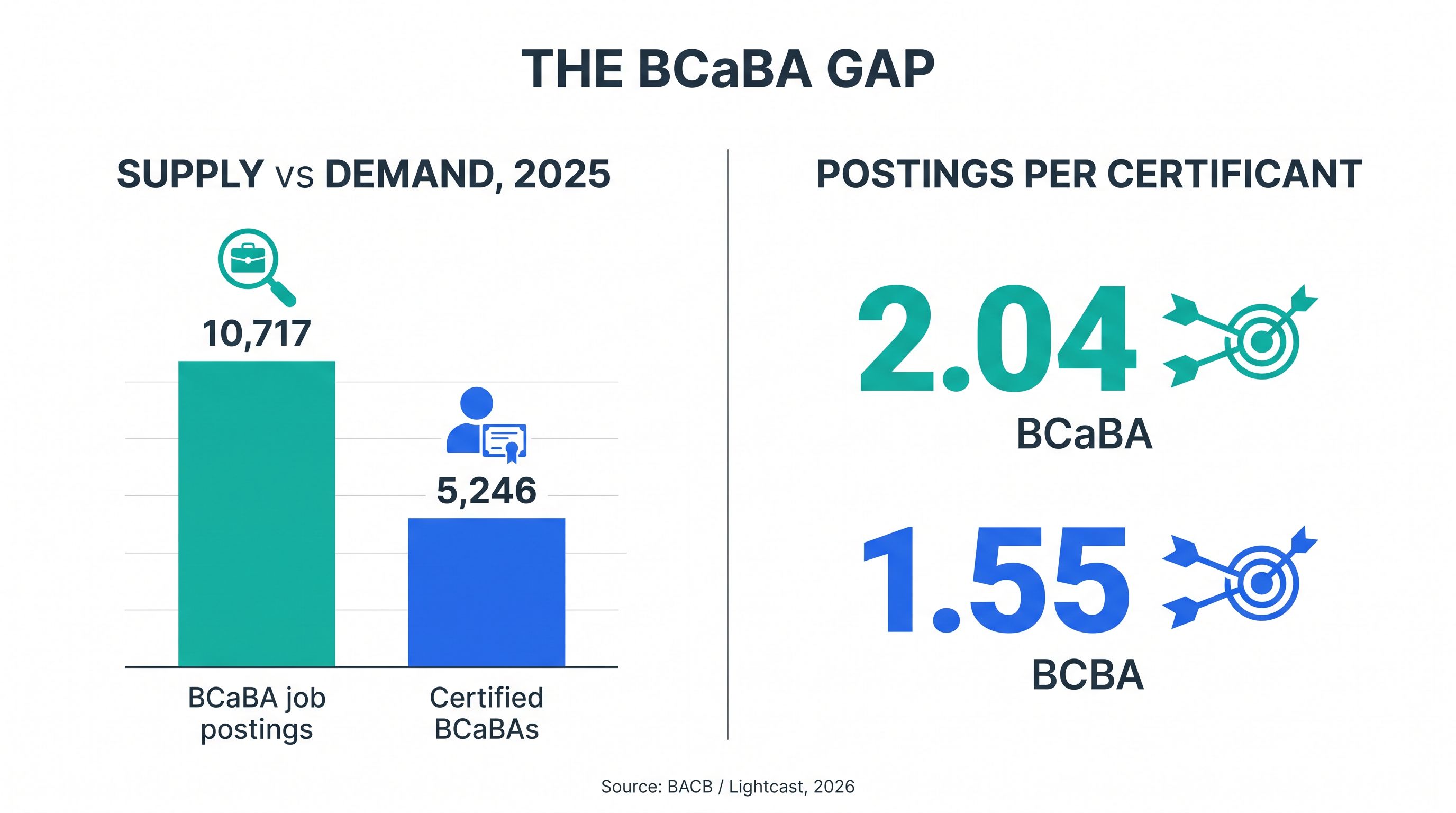
What this translates to practically is that you are rarely competing against a deep bench of other BCaBAs. In a market with 5,246 credential holders spread across 50 states, most employers hiring for a BCaBA role are not sorting through 40 qualified applicants. Your leverage is real. It is also local, and it depends on a second factor covered further down.
Where the BCaBA jobs are
BCaBA demand is far more concentrated than BCBA demand. Five states accounted for 43 percent of all 2025 postings, with California alone representing 15 percent.
But the headline ranking is not the most useful cut of this data. National demand fell 26 percent in 2025, and yet nine of the top 30 states grew. Those nine are where hiring pressure is actually building.
| State | 2024 | 2025 | Change |
|---|---|---|---|
| California | 2,610 | 1,612 | -38% |
| Florida | 1,408 | 978 | -31% |
| Michigan | 734 | 788 | +7% |
| Texas | 1,341 | 669 | -50% |
| Pennsylvania | 705 | 560 | -21% |
| Georgia | 590 | 554 | -6% |
| Virginia | 920 | 470 | -49% |
| New Jersey | 393 | 402 | +2% |
| Tennessee | 405 | 346 | -15% |
| North Carolina | 423 | 307 | -27% |
| Missouri | 253 | 305 | +21% |
| South Carolina | 248 | 278 | +12% |
| Washington | 324 | 272 | -16% |
| Massachusetts | 374 | 266 | -29% |
| Indiana | 226 | 261 | +15% |
| Illinois | 517 | 230 | -56% |
| Oregon | 214 | 203 | -5% |
| Colorado | 254 | 198 | -22% |
| Alabama | 256 | 190 | -26% |
| Ohio | 221 | 165 | -25% |
| Minnesota | 202 | 149 | -26% |
| Arizona | 212 | 137 | -35% |
| Maryland | 120 | 133 | +11% |
| Louisiana | 194 | 110 | -43% |
| Kansas | 267 | 107 | -60% |
| New York | 86 | 106 | +23% |
| Hawaii | 83 | 92 | +11% |
| Oklahoma | 201 | 82 | -59% |
| Nevada | 175 | 79 | -55% |
| New Hampshire | 18 | 71 | +294% |
Top 30 states by 2025 BCaBA job postings. Source: BACB/Lightcast, 2026. Growing states highlighted.
A few things worth pulling out of that table:
- ✓ Michigan is the standout. It is the only top-five state that grew, rising 7 percent to 788 postings, and it now ranks third nationally for BCaBA demand. If you want volume and a rising market at the same time, it is the clearest candidate. Our Michigan ABA hiring guide covers the state's workforce picture in depth.
- ✓ Smaller markets are heating up fastest. New Hampshire grew 294 percent, though from a base of just 18 postings. New York rose 23 percent, Missouri 21 percent, and Indiana 15 percent. These are thin markets where a handful of employers can shift the whole picture, which cuts both ways.
- ✓ Check before you relocate. Several states contracted sharply: Kansas fell 60 percent, Oklahoma 59 percent, Illinois 56 percent, Nevada 55 percent, Texas 50 percent, and Virginia 49 percent. Texas still ranks fourth by volume, so a big market and a shrinking one can be the same place.
What BCaBA jobs pay in 2026
Salary data for a credential this small comes from self-reported aggregators rather than federal statistics, so the honest approach is a range rather than a single figure. Three providers, checked in August 2026:
| Source | Average BCaBA salary | As of |
|---|---|---|
| Indeed (n = 2,200 reported salaries) | $73,918 | Aug 2, 2026 |
| Salary.com | $69,258 | Aug 1, 2026 |
| ZipRecruiter | $65,978 | 2026 |
A reasonable planning range is $66,000 to $74,000, with a midpoint near $69,000. Hourly BCaBA roles commonly land between $25 and $33 per hour. The roughly $8,000 spread between sources reflects different role mixes and self-selection in who reports pay, not a measurement error you can resolve.
Geography moves this more than any other variable. The Northeast and Pacific Northwest sit at the top of the range, with Washington, Maryland, and New York among the strongest; Georgia and Louisiana sit near the bottom. If you are weighing the step up to the analyst level, our BCBA salary by state guide shows what that jump is worth in your market, and the RBT salary guide shows the tier below.
The supervision rule that decides whether a BCaBA job works
This is the single most important thing to understand about BCaBA jobs, and it is the thing no job board will surface.
A BCaBA may only provide behavior-analytic services under the supervision of a qualified BCBA. That is not a preference or a best practice; it is a condition of practicing at all. The BACB is explicit about the consequence of losing it:
"Any BCaBA who does not have a qualified supervisor will be considered inactive and may not practice or use their BCaBA certification until they have a supervisor on record with the BACB."
That inactive status also removes your ability to supervise RBTs, deliver the RBT 40-hour training, and complete RBT competency assessments, which are often exactly the responsibilities that justify a BCaBA role in the first place.
The ongoing requirements themselves are modest. Your supervisor must be an active BCBA in good standing who meets the supervision continuing-education requirement. At least 5 percent of your behavior-analytic service hours must be supervised, contact must happen at least once a month, and your supervisor must observe you with a client once per quarter. Under the requirements taking effect in 2027, there is no longer a higher supervision percentage during your first 1,000 hours after certification.
The job-search implication is significant: your credential is only as portable as your employer's BCBA bench. A clinic with one overextended BCBA covering a dozen staff is a genuine professional risk, not merely an inconvenience. If that person leaves and is not replaced promptly, you cannot bill, supervise, or practice.
Before you accept an offer, get specific answers:
- ✓ Which named BCBA will be on record as your supervisor, and how long have they been certified?
- ✓ How many supervisees and clients do they already carry?
- ✓ What is the coverage plan if that supervisor resigns or goes on leave?
- ✓ Is supervision time scheduled and paid, or expected to happen around a full billable caseload?
An employer that answers these crisply is telling you they have run this before. One that improvises is telling you something too. Our guide to questions to ask in an ABA interview covers the broader set, and what to look for in an ABA employer goes deeper on organizational red flags.
What BCaBA roles actually look like
BCaBAs work across school districts, clinic-based ABA programs, in-home services, residential programs, and community clinics. Day to day, the work typically includes running skill-acquisition programs and assisting with assessments, collecting and graphing data, monitoring client progress, providing direct client support, and training and supporting RBTs under BCBA oversight.
The boundary is what matters. BCaBAs implement and assist with assessment and intervention work under supervision. They do not practice independently and cannot operate as the responsible analyst on a case. Supervisory activities they do perform, such as overseeing RBTs, depend on holding active status.
One practical warning about listings. Postings for these roles appear under several titles, including "Assistant Behavior Analyst," "BCaBA," and "Behavior Specialist," and a large share of listings read "BCBA or BCaBA." Many of those dual postings are BCBA roles with a fallback, written by employers who would rather hire an analyst and will settle. Read the supervision language, the caseload description, and the pay band rather than the title. If a posting describes independent case responsibility, it was not written for a BCaBA.
Remote and school-based BCaBA work exists but is thinner than the equivalent BCBA market, largely because the supervision requirement is harder to satisfy at a distance. Our guides to school-based ABA roles and remote behavior analyst work give useful context on both settings.
BCaBA vs BCBA vs RBT: which credential fits your plan
| RBT | BCaBA | BCBA | |
|---|---|---|---|
| Education | High school diploma | Bachelor's degree | Master's degree |
| Training | 40-hour course plus competency assessment | Coursework plus 1,300 fieldwork hours | Coursework plus 2,000 fieldwork hours |
| Practices independently | No | No | Yes |
| Can supervise RBTs | No | Yes, when active | Yes |
| Active certificants | 260,174 | 5,246 | 85,587 |
| Typical pay | $18 to $28 per hour | $66,000 to $74,000 | $75,000 to $100,000+ |
The BCaBA makes sense if you already hold a bachelor's degree, you want to move beyond direct-service pay without committing to a master's program yet, or your employer will fund the coursework and supervision. It is also a reasonable move if you want to test whether analytic work suits you before taking on graduate tuition.
Consider going straight to the BCBA if a master's degree is already in your plan. In that case the BCaBA adds cost, time, and a permanent supervision dependency without granting independent practice. Note too that the BCBA pipeline is under strain, with the first-time exam pass rate at 51 percent in 2025 and 23,151 candidates tested in all; our BCBA exam pass rate analysis covers why that matters. Full requirements are in our BCaBA certification guide.
What changes on January 1, 2027
If you are considering the credential rather than already holding it, the requirements are changing, and the timing works in your favor.
From January 1, 2027, two eligibility pathways remain. Pathway 1 requires a bachelor's degree or higher earned in 2015 or later from a program accredited by the Association for Behavior Analysis International at the time you attended. Pathway 2 requires a bachelor's degree in any field plus behavior-analytic coursework.
Pathway 2 coursework totals 270 instructional hours: 45 in Foundations of Behavior Analysis, 45 in Methods of Behavior Analysis, 90 in Behavior Assessment and Intervention, 45 in Organizational Behavior Management, and 45 in Ethics, of which at least 15 must be taught in a freestanding course. Coursework must have been completed within 10 years of your application and earned a grade of C or higher.
Fieldwork supervision runs at 5 percent of hours for standard Supervised Fieldwork and 10 percent for the concentrated route, with 20 to 160 hours per supervisory period, at least half of supervision delivered individually, and at least 40 percent of total hours spent on unrestricted activities. The exam follows the BCaBA Test Content Outline, 6th edition, which took effect January 1, 2025. To maintain certification you need 20 continuing education units per two-year cycle, including 4 in ethics and 3 in supervision if you supervise.
One caution: these are the 2027 rules. If you are applying during 2026, the current requirements still govern, including the 1,000-hour concentrated fieldwork standard. Confirm against the BACB's current handbook before making plans around any single figure.
How to run a BCaBA job search that actually works
The data above points to a search strategy that differs from a standard BCBA search in four ways.
1. Search the title variants, not just the acronym. Aggregators index "Assistant Behavior Analyst" and "Behavior Specialist" as separate strings from "BCaBA." Searching only the acronym on a large job board frequently returns BCBA listings instead, since the engines treat the terms as near-matches. Run all three searches separately and save each one.
2. Target the growing markets, not just the big ones. California posts the most BCaBA roles and also fell 38 percent last year. Michigan, New York, Missouri, Indiana, South Carolina, Maryland, and New Jersey all grew. If relocation is on the table, the growth column in the table above is more predictive of your experience than the volume column.
3. Vet supervision before you negotiate compensation. This inverts the usual order for a reason. A slightly lower offer at an organization with three BCBAs and a written coverage plan is worth more than a higher offer somewhere your active status depends on one person not quitting. Get the supervision arrangement named in writing in your offer letter.
4. Ask about the RBT bench. Much of the value a BCaBA adds is supervising and training technicians. An employer with a large RBT team and thin analyst coverage is a strong fit for your role. An employer with no RBTs may not have a clear reason for the position to exist, which tends to show up later as scope confusion.
There is a structural problem none of this fully solves: the hardest part of a BCaBA search is finding the employers who already have supervision capacity, and that information is almost never in the posting. Applying blind means discovering it in a third interview, or after you start. Making yourself visible to employers instead flips that sequence, because the organizations that reach out to a BCaBA are generally the ones who have already worked out how they will supervise one.
BCaBA jobs: frequently asked questions
Is it hard to find a job as a BCaBA?
Nationally the numbers favor you: roughly two job postings existed in 2025 for every active BCaBA, a better ratio than BCBAs have. The difficulty is concentration rather than volume. Five states hold 43 percent of demand, and any given role also depends on the employer having a qualified BCBA available to supervise you. In a state with few postings, the search can be genuinely slow despite the national picture.
Are BCaBAs in demand?
Yes, on a per-certificant basis more so than BCBAs. The honest caveat is that demand is volatile: postings jumped 131 percent from 2023 to 2024, then fell 26 percent in 2025 to 10,717. The BACB notes the overall trend since 2010 is still increasing, and 2025 remained the second-highest year on record.
Is a BCaBA the same as an RBT?
No. An RBT needs a high school diploma, a 40-hour training, and a competency assessment, and delivers direct therapy. A BCaBA needs a bachelor's degree, behavior-analytic coursework, and 1,300 supervised fieldwork hours, and can assist with assessment and program design and supervise RBTs. Pay differs substantially, with RBTs typically earning $18 to $28 per hour against a BCaBA range of roughly $66,000 to $74,000. Both work under supervision, but the scope is not comparable.
What can you do with a BCaBA certification?
BCaBAs work in school districts, ABA clinics, in-home programs, residential settings, and community clinics. Typical duties include assisting with assessments, running skill-acquisition programs, collecting and graphing data, monitoring progress, providing direct support, and training and supervising RBTs, all under BCBA supervision.
How much do BCaBAs make?
Roughly $66,000 to $74,000 per year based on August 2026 figures from Indeed ($73,918), Salary.com ($69,258), and ZipRecruiter ($65,978). Hourly roles commonly pay $25 to $33. Pay runs highest in the Northeast and Pacific Northwest.
Can a BCaBA work independently or open a practice?
No. BCaBAs may only provide behavior-analytic services under the supervision of a BCBA. Without a qualified supervisor on record with the BACB, a BCaBA is considered inactive and may not practice or use the certification.
Can a BCaBA supervise RBTs?
Yes, provided the BCaBA holds active status with a qualified supervisor on record. Active BCaBAs may supervise RBTs, deliver the RBT 40-hour training, and complete RBT competency assessments. All of those abilities are suspended if the BCaBA becomes inactive.
Which states have the most BCaBA jobs?
By 2025 posting volume: California (1,612), Florida (978), Michigan (788), Texas (669), and Pennsylvania (560). Michigan is the only one of the five where demand grew year over year.
Should I get a BCaBA or go straight for the BCBA?
If a master's degree is already in your plan, going directly to the BCBA usually makes more sense, since the BCaBA adds cost and a permanent supervision requirement without independent practice. The BCaBA is a strong choice if you hold a bachelor's degree, want to move beyond direct-service work now, or have an employer willing to fund coursework and supervision.
The bottom line
BCaBAs hold the rarest credential in applied behavior analysis, roughly 1.5 percent of all BACB certificants, and employers posted about two jobs in 2025 for every person who holds it. Measured per certificant, demand for the assistant credential runs about a third higher than demand for the BCBA. That is genuine leverage, and most BCaBAs do not know they have it.
It converts into a good job only under two conditions: you look where demand is actually rising rather than where it is merely large, and you land somewhere with real BCBA supervision capacity. Get those two right and the numbers work for you. Get the second one wrong and the credential you worked for can go inactive through no fault of your own.
Let ABA employers come to you
With only 5,246 BCaBAs nationwide, you are a scarce hire. Create an anonymous CertifyndABA profile, list your credential and what you need from a supervision arrangement, and let employers who can actually support a BCaBA reach out first. Your identity stays private until you choose to respond.
Create Your Free Profile