


The BCBA fieldwork requirements are the longest, most expensive, and most easily botched part of getting certified. The coursework has a syllabus. The exam has a study guide. Fieldwork is 2,000 hours accrued a month at a time under a supervisor whose paperwork you do not control, and a single missed requirement can void an entire month retroactively.
This guide lays out exactly what the Behavior Analyst Certification Board (BACB) requires today, what changes on January 1, 2027, how long the hours realistically take, and how to evaluate a fieldwork placement before you accept the job. Every number here comes from a BACB primary source: the BCBA Handbook updated June 2026, the BACB's 2027 requirements document, or the BACB's own certificant and employment-demand data.
Why fieldwork is the bottleneck in the BCBA pipeline
Fieldwork is not just a personal hurdle; it is the reason the profession cannot keep up with demand. According to the BACB and Lightcast, 132,307 US job postings required or preferred BCBA or BCBA-D certification in 2025, a 28% increase over the 103,150 postings in 2024. Demand has risen every single year since 2010, when there were 789 postings.
The supply side did not move with it. The BACB's 2025 Annual Data Report shows 8,021 people earned BCBA certification in 2025, which is fewer than the 8,164 who earned it in 2024. Demand rose 28%; new certifications fell.
That works out to roughly 16 postings for every newly certified BCBA in 2025, or about 1.5 postings for every one of the 85,587 BCBAs active as of July 1, 2026. Those are derived comparisons, not vacancy counts; one employer can post the same role in several places, and a posting is not the same thing as an unfilled seat. Even discounted heavily, the direction is unambiguous, and the constraint is not interest in the field. In 2025 there were 9,955 first-time BCBA exam candidates and a 51% first-time pass rate. The pipeline narrows long before the exam, in the two years most trainees spend accruing hours.
"Every requirement below is a place where a month of work either counts or evaporates. That is the whole game."
BCBA fieldwork requirements at a glance
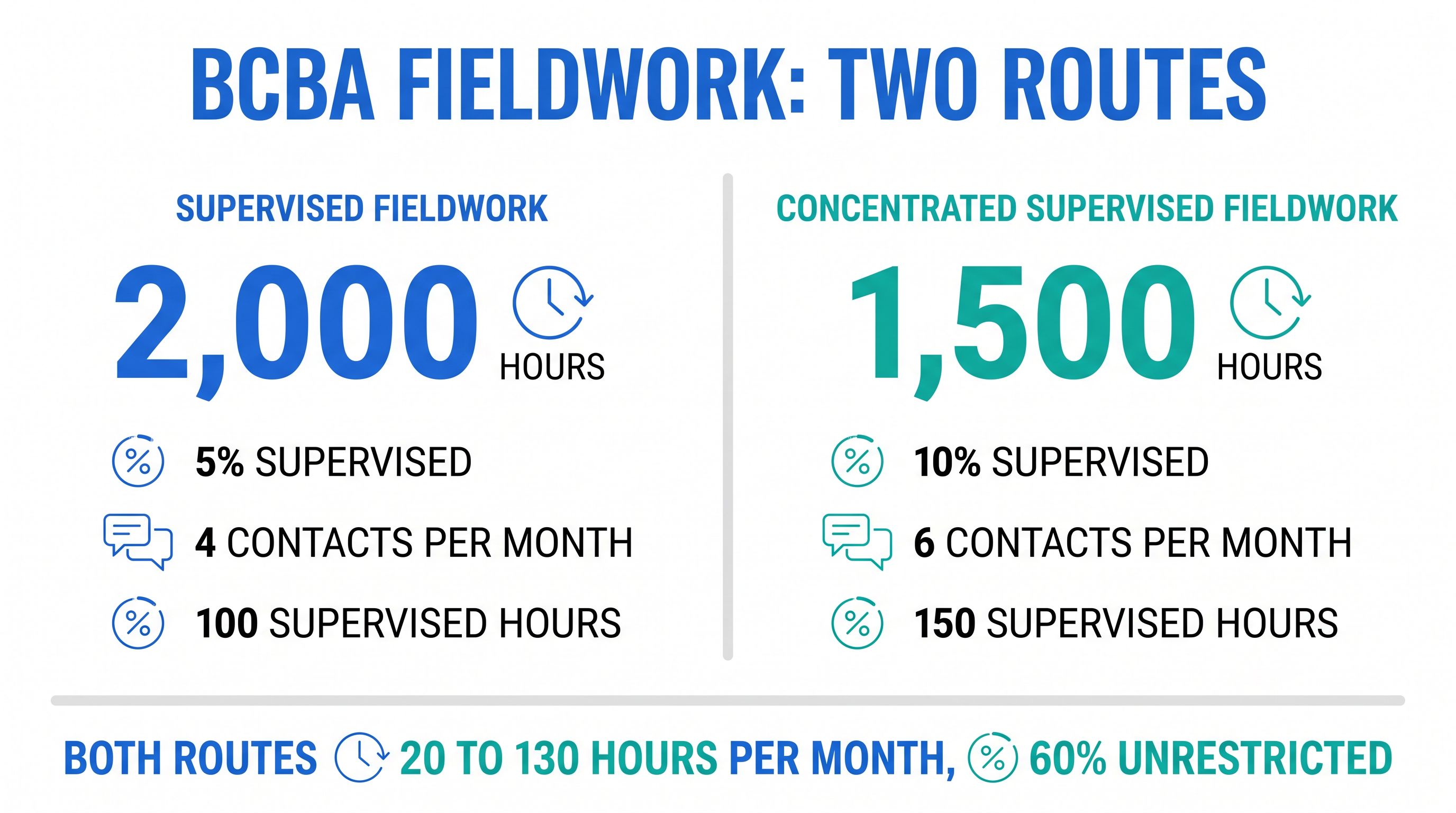
The BACB offers two fieldwork types. You can use either one or mix them, but you can only accrue under one type per month, per supervision structure, and every requirement of that type must be met for the month to count.
| Requirement | Supervised Fieldwork | Concentrated Supervised Fieldwork |
|---|---|---|
| Total hours to qualify | 2,000 | 1,500 |
| Supervisory period | 1 calendar month | |
| Hours per period | Minimum 20, maximum 130 | |
| Supervisor contacts per period | 4 | 6 |
| Observation with a client per period | 1 | 1 |
| Supervision as a share of hours | 5% | 10% |
| Individual supervision | At least 50% of supervised hours; group may not exceed 50% | |
| Unrestricted activities | At least 60% of total fieldwork hours | |
| Overall time limit | Five continuous years, counted by calendar month | |
Supervised vs Concentrated: the trade-off nobody explains
Concentrated Supervised Fieldwork looks like a straightforward discount: 1,500 hours instead of 2,000, a saving of 500 hours. The catch is on your supervisor's side of the ledger.
Supervised Fieldwork requires 5% of your hours to be supervised. Across 2,000 hours, that is 100 supervised hours. Concentrated requires 10%, and across 1,500 hours that is 150 supervised hours. The concentrated route saves you 500 hours of work and costs your supervisor 50 additional hours of direct supervision, plus six contacts a month instead of four.
That asymmetry explains a pattern trainees find baffling: organizations with plenty of billable pressure on their BCBAs often decline to offer the concentrated track. It is not gatekeeping. Concentrated supervision is genuinely more expensive to deliver, and the cost falls on the supervisor, not the trainee.
Combining the two types
You can mix them. The Handbook gives a specific formula: sum your Concentrated hours, multiply that sum by 1.33, add your Supervised Fieldwork hours, and confirm the combined total reaches at least 2,000 before you apply. Two cautions come straight from the BACB. First, on your Monthly and Final Fieldwork Verification Forms and in the application itself, record only actual hours, never the multiplied total. Second, if you are audited, you must flag in the Fieldwork Audit Log which hours were adjusted.
How long 2,000 fieldwork hours actually takes
This is the question behind most searches for BCBA fieldwork requirements, and the honest answer starts with the monthly ceiling. You may accrue no fewer than 20 and no more than 130 hours in a calendar month. Even accruing the maximum every single month without a break, 2,000 hours cannot be finished in less than about 15.4 months.
| Hours accrued per month | 2,000-hour route | 1,500-hour route | Typical situation |
|---|---|---|---|
| 130 (current maximum) | ~16 months | ~12 months | Full-time role where nearly all work is countable |
| 100 | 20 months | 15 months | Full-time role with meetings and admin that do not count |
| 75 | ~27 months | 20 months | Working while taking graduate coursework |
| 40 | 50 months | ~38 months | Part-time accrual; watch the five-year window closely |
Two constraints bracket the timeline. The floor of 20 hours means a month where you accrue 15 hours contributes nothing at all. The five-year window means the clock is real: at 40 hours a month you would need more than four years of unbroken accrual to reach 2,000, leaving almost no margin for a job change, a leave, or a supervisor who stops signing forms.
For a fuller view of the whole credential timeline, including coursework and the exam, see our guides on how long it takes to become a BCBA and the RBT to BCBA timeline.
The 60% unrestricted rule
At least 60% of your total fieldwork hours must be spent on unrestricted activities. On the 2,000-hour route that means at least 1,200 unrestricted hours; on the 1,500-hour route, at least 900. Restricted activities are capped at 40%, and there is no minimum, so a trainee could technically accrue zero restricted hours.
Unrestricted activities are the ones that look like a BCBA's actual job: conducting assessments, graphing and analyzing data, writing and revising programs, training staff and caregivers, and researching literature relevant to a current client. Restricted activities are the direct delivery of therapeutic and instructional procedures.
The 60% threshold is cumulative across your total hours, not a monthly requirement, which gives you room to recover from a heavy direct-service stretch. The trap is the reverse: a trainee working as an RBT can spend eighteen months accruing almost entirely restricted hours and discover the imbalance far too late to fix it. We break the categories down task by task in our guide to restricted vs. unrestricted hours.
Supervisor qualifications and the contract
Your hours are only as good as your supervisor's eligibility. A qualified fieldwork supervisor must be an active BCBA with no current disciplinary sanctions who is either certified for at least one year and meeting the ongoing supervision CEU requirement, or certified for less than one year while receiving monthly consultation from a qualified consulting supervisor.
Beyond that, every supervisor must complete an 8-hour supervision training and upload the certificate to their BACB portal account before signing a supervision contract. They also must not be related to you, subordinate to you, employed by you, or in a personal or business relationship with you during the fieldwork period.
- ✓ Verify before you sign. The BACB Certificant Registry lets you confirm your supervisor's certification status and that the 8-hour training is on file. Check the training date; a contract signed before that date is a problem.
- ✓ Get the contract in writing first. A signed contract must exist before supervision begins, and it must spell out responsibilities, individualized training objectives, the measurable circumstances under which your supervisor will decline to sign your verification forms, and the consequences if either party does not follow through.
- ✓ Keep everything for seven years. Both parties must retain the contract and supervision documentation for at least seven years from the final supervision meeting and produce it if the BACB asks.
- ✓ Know the group-supervision limits. Group supervision runs with 2 to 10 trainees and may never exceed 10 regardless of how many supervisors are present, and group hours may not exceed half of your supervised hours in any period.
Supervisors carry real exposure here. The Handbook notes that if requirements are not met, trainees may lose qualifying hours and a Notice of Alleged Violation may be filed against the supervisor. If you are on the other side of this relationship, our guide on how to become a BCBA supervisor covers the training and CEU obligations in full.
What does not count toward BCBA fieldwork requirements
All fieldwork hours must relate to specific client programming. The BACB is explicit that valuable professional activity is not automatically countable activity. These do not count:
- Attending conferences, workshops, or university courses
- Homework, readings, quizzes, and other didactic coursework assignments
- Studying for the certification exam
- Meetings with little or no behavior-analytic content
- Interventions that are not based in behavior analysis
- Non-behavior-analytic administrative work, billing, coding, or documentation
- Trainings such as CPR, crisis management, or billing systems
- Listening to podcasts
- Role-playing procedures that are not client related
There is also a client-relationship rule worth checking early: you may not accrue hours with a client you are related to, whose primary caregiver you are, or whose primary caregiver you are related to.
What changes on January 1, 2027
The BACB has signaled these changes across three newsletters since March 2022, and they take effect for applications submitted on or after January 1, 2027.
| Requirement | Now | From January 1, 2027 |
|---|---|---|
| Total hours | 2,000 / 1,500 | Unchanged |
| Monthly hour range | 20 to 130 | 20 to 160 |
| Concentrated supervision share | 10% of hours | 7.5% of hours |
| Observation requirement | 1 observation per period | 60 minutes cumulative (Supervised); 90 minutes (Concentrated) |
| Verification forms | Current M-FVF and F-FVF | 2027 versions required |
| Eligibility pathways | Four (including faculty and postdoctoral routes) | Two (accredited/recognized program, or behavior-analytic coursework) |
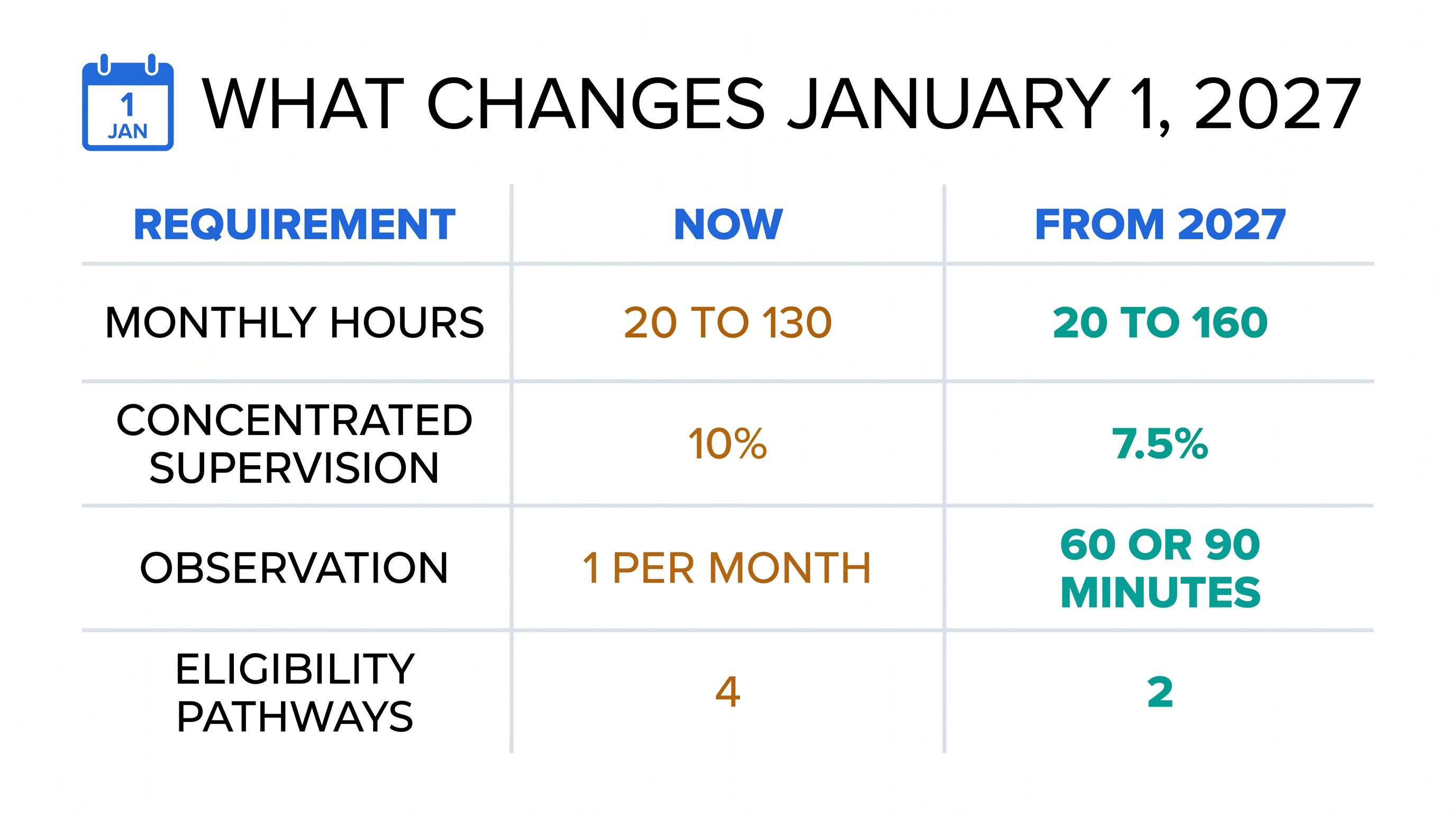
Three implications are worth planning around.
The higher monthly ceiling shortens the fastest possible route. At 160 hours a month, 2,000 hours could theoretically be finished in 12.5 months rather than 15.4. That matters most for trainees in full-time roles racing a five-year window.
Concentrated fieldwork gets cheaper for supervisors. At 7.5% of 1,500 hours, the supervision burden drops from 150 hours to about 113. Organizations that could not justify concentrated supervision under the current 10% rule may be able to justify it in 2027, which is a reasonable thing to raise with a prospective employer now.
The observation requirement becomes a duration, not a checkbox. One brief observation will no longer satisfy the requirement; you will need 60 or 90 cumulative minutes per period depending on your fieldwork type. Note also that the 2027 overview table does not carry forward the four-and-six supervisor-contact counts. Treat the current counts as in force until the BACB says otherwise, and confirm against the Handbook edition current when you apply.
How to evaluate a fieldwork placement before you accept it
Fieldwork is a job, and it is the job that decides whether you reach certification on schedule. Applying the requirements above as screening questions turns a vague offer into a comparable one:
- Which fieldwork type do you support, and can you evidence it? Concentrated fieldwork is a real commitment of supervisor time, not a checkbox on a job ad.
- How many countable hours can I realistically accrue per month? An offer of 40 hours a week is not an offer of 130 countable hours a month once non-countable meetings and admin are removed.
- What share of my week will be unrestricted? If the answer is "you will mostly be running sessions," the 60% rule will become a crisis around month fourteen.
- Who signs my forms, and what is the backup if they leave? Ask for the answer before you need it.
- Has my supervisor completed the 8-hour training, and when? Verify it in the Certificant Registry rather than taking it on faith.
- Is supervision billed to me? Some organizations charge for supervision; others provide it as part of the role. This is a compensation question, and it belongs in the offer conversation.
These questions are easier to ask when you are not the one who applied first. Browse open BCBA-in-training jobs to see how employers describe their supervision offers, and read our analysis of the ongoing BCBA shortage for the leverage picture behind the numbers.
Frequently asked questions
How many fieldwork hours does a BCBA need?
Either 2,000 hours of Supervised Fieldwork or 1,500 hours of Concentrated Supervised Fieldwork, or a combination where Concentrated hours are multiplied by 1.33 and the total reaches 2,000. Under Pathway 4, the postdoctoral experience route, only 500 hours are required; that pathway is being retired for applications submitted on or after January 1, 2027.
How long does it take to get 2,000 hours for BCBA certification?
At the current 130-hour monthly maximum, roughly 16 months of uninterrupted accrual. Most trainees accruing 75 to 100 countable hours a month finish in about 20 to 27 months. All hours must fall within a five-continuous-year window, counted by calendar month.
Can RBT work count toward BCBA fieldwork?
Sometimes, and only if the hours simultaneously satisfy every fieldwork requirement. The BACB cautions that many tasks completed under RBT supervision requirements may not count, and that an RBT supervisor may not qualify as a fieldwork supervisor. Most RBT work is also restricted activity, so it cannot carry the 60% unrestricted requirement on its own.
What happens if my supervisor leaves before signing my forms?
This is the single most damaging fieldwork failure, which is why the BACB requires the supervision contract to state in advance the objective, measurable circumstances under which a supervisor will not sign your Monthly and Final Fieldwork Verification Forms. Keep your own contemporaneous documentation of every session, contact, and observation; you are ultimately responsible for demonstrating that requirements were met.
Do the 2027 changes apply to hours I already earned?
The Handbook is explicit that applicants must meet all requirements at the time they apply, regardless of when their hours were earned. If you will submit your application on or after January 1, 2027, plan against the 2027 requirements and the 2027 verification forms.
The bottom line
The BCBA fieldwork requirements reward trainees who treat them as a project rather than a formality: verify your supervisor before signing, track restricted and unrestricted hours from month one, keep documentation you could hand to an auditor tomorrow, and check the current Handbook rather than a university PDF from 2022. A labor market with 132,307 postings against 8,021 new certifications gives you unusual leverage in choosing where to accrue those hours. Use it at the start, when you are picking the placement, because that is when the choice is still cheap.
Let employers compete for your fieldwork years
Create an anonymous CertifyndABA profile, show the credentials and fieldwork stage you are at, and let employers reach out to you first. Your identity stays private until you choose to respond, so you can ask hard questions about supervision quality and unrestricted-hour access before anyone knows your name.
Create Your Free Profile