


You are scrolling ABA job postings and you keep seeing the same line: "BCBA or QBA required." If you have never heard of a qualified behavior analyst, that phrasing is confusing. If you are a career changer who found a QBA program before you found a BCBA program, it is worse than confusing; it is a $10,000 decision made with almost no independent information available online.
Here is the short version. The QBA is a real, accredited credential from a real certifying board. It is not a fake BCBA. It is also not a substitute for one in most of the country, and the places where it counts are specific enough to name. This guide names them.
What a qualified behavior analyst actually is
The Qualified Behavior Analyst (QBA) is a master's-level credential issued by the QABA Credentialing Board, which was founded in 2012 and focuses on services for autistic clients. It sits above two other QABA credentials: the Applied Behavior Analysis Technician (ABAT) at the entry level and the Qualified Autism Services Practitioner-Supervisor (QASP-S) in the middle.
According to QABA's published requirements, a QBA candidate must hold a master's degree or higher from an accredited university in a related field, complete 270 hours of approved coursework (18 semester credits, including 20 hours of ethics, 20 hours of autism core knowledge, and 20 hours of supervision content), accrue 2,000 supervised fieldwork hours within a seven-year window, and pass the QBA examination. The application and exam fee is $350. The credential renews every two years with 32 continuing education units and a background check.
QABA describes the QBA scope this way: "QBAs provide program planning, assessment, data analysis and direct-care oversight for all aspects of behavior programs," and QBAs "supervise the direct-care instructional staff (ABAT/behavior technicians), mid-tier supervisors (QASP-S), and collaborative care providers." QABA also states that QBAs do not require ongoing supervision. On paper, that is a BCBA-shaped role.
QBA vs. BCBA: the requirements side by side
The two credentials are closer on paper than most people assume. The differences that matter show up later, in who accepts them.
| Requirement | QBA (QABA) | BCBA (BACB) |
|---|---|---|
| Degree | Master's or higher in a related field | Master's or higher; from Jan 1, 2027, either an APBA/ABAI-accredited or recognized program, or a qualifying degree plus behavior-analytic coursework |
| Coursework | 270 hours (18 semester credits) | Behavior-analytic coursework through an accredited, recognized, or verified sequence |
| Fieldwork | 2,000 hours (minimum 1,200 indirect, maximum 800 direct), 20 to 140 hours per month | 2,000 Supervised Fieldwork hours, or 1,500 Concentrated Supervised Fieldwork hours |
| Exam | QBA examination, proctored by Premier Proctoring | 4 hours, 185 multiple-choice questions (175 scored, 10 unscored), at Pearson VUE |
| Cost to certify | $350 application and exam; $225 retake | $245 application plus $125 exam appointment; $140 retake application plus $125 appointment |
| Renewal | Every 2 years, 32 CEUs, background check | Every 2 years, 32 CEUs including 4 ethics and 3 supervision CEUs for those who supervise |
| State licensure | Accepted for behavior analyst licensure in a small group of states, including Texas and North Carolina | Named in licensure rules across the 41 jurisdictions that regulate the profession |
Sources: QABA QBA credential requirements; BACB BCBA Handbook, updated June 2026.
Why "BCBA or QBA" started showing up in job postings
Employers did not broaden their credential language out of open-mindedness. They did it because they cannot fill roles.
Against that demand, the BACB counted 85,587 active BCBAs as of July 1, 2026. That is roughly 1.5 postings for every certified behavior analyst in existence, and the 2010 baseline was 789 postings for the entire year. In high-growth metros and in school districts competing with clinics, hiring managers report far steeper ratios than the national average.
Two other pressures push in the same direction. First, the BCBA pipeline is getting narrower, not wider: starting January 1, 2027, the BACB reduces BCBA eligibility to two pathways, and several current options are discontinued. Second, university extension programs, including at least one major public university, now market QBA coursework directly to career changers, which feeds more QBA holders into the applicant pool.
"BCBA or QBA" is not a statement that the two are equivalent. It is a statement that the employer would rather widen the funnel than leave the caseload uncovered.
Where the qualified behavior analyst credential is actually accepted
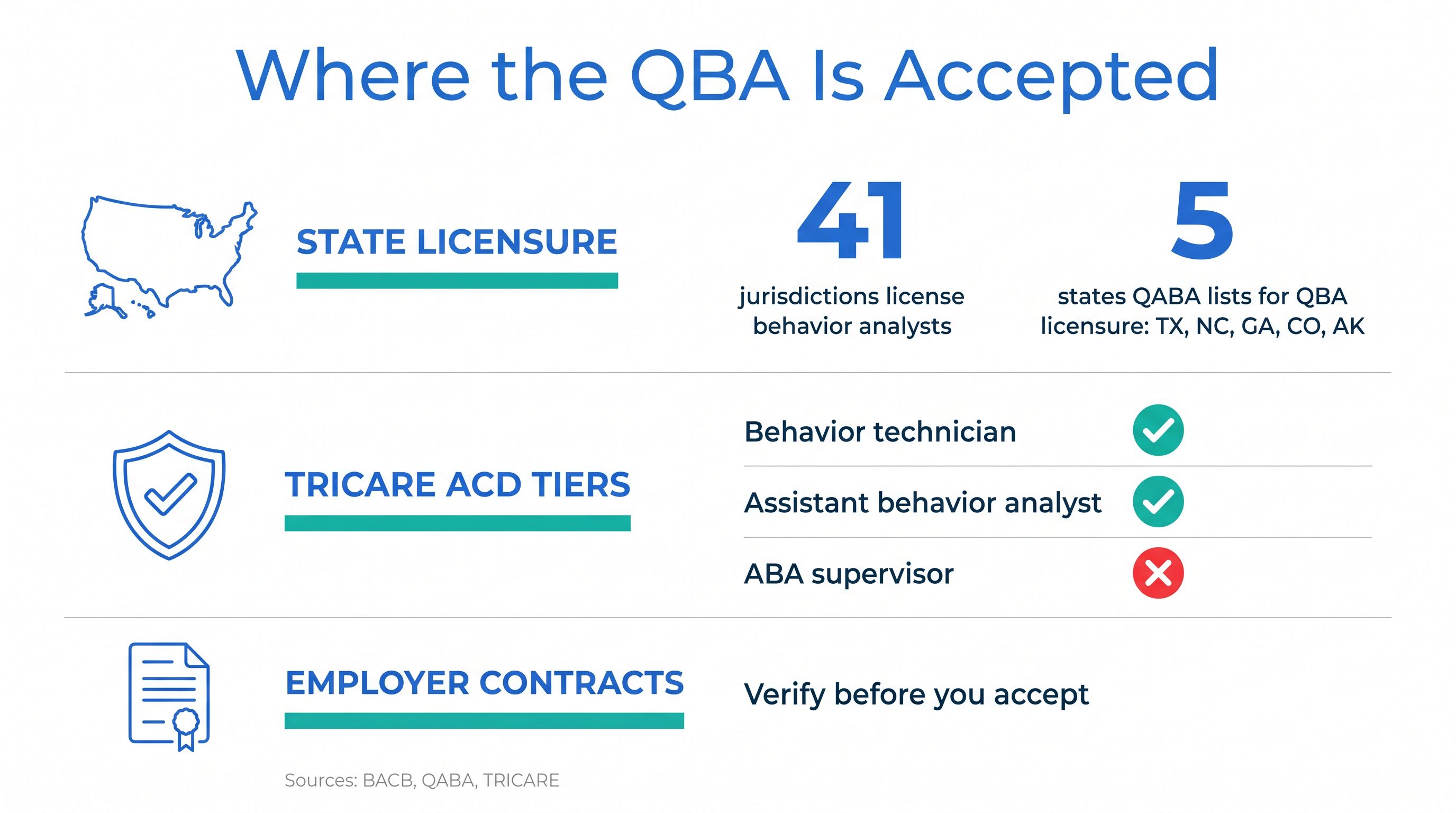
This is the section that decides your job search, and it is the section no one else publishes. Acceptance happens at three independent gates, and you have to clear all three.
Gate 1: State licensure
Forty-one US jurisdictions (40 states plus the District of Columbia) have enacted behavior analyst licensure laws, according to the BACB's licensure table. In most of them, the rule text names the BACB by name.
A small group of states is the exception, and job seekers should know which. QABA's own state recognition page lists Texas, North Carolina, Georgia, Colorado, and Alaska as accepting the QBA at the behavior analyst level. Two of those are straightforward to confirm from the boards themselves.
Texas. On December 6, 2024, the Texas Commission of Licensing and Regulation voted to approve QABA as a certifying entity for behavior analysis licensure under Texas Occupations Code 506.002(2). A current QBA can apply for a Texas Licensed Behavior Analyst (LBA) license; a current QASP-S can apply for the Licensed Assistant Behavior Analyst (LABA) license. The approval took effect immediately.
North Carolina. The North Carolina Behavior Analyst Licensure Board requires "a current copy of the certificate issued by the certifying entity, the nationally accredited Behavior Analyst Certification Board, Inc., (BCBA certification) or its successor, or the nationally accredited Qualified Applied Behavior Analysis Credentialing Board, (QBA certification) or its successor." Both boards are named in the rule, at both license levels.
Virginia shows the other side. Virginia's regulation, 18VAC85-150-60, states that an applicant "shall hold current certification as a BCBA® or a BCaBA® obtained by meeting qualifications and passage of the examination required for certification as a BCBA® or a BCaBA® by the BACB." There is no alternative board. A QBA cannot be licensed in Virginia today, no matter how strong the resume.
The pattern that matters: a certifying board's own recognition list is marketing, and it can run ahead of what a licensing board's rule text actually says. Verify against the rule, not the brochure.
Gate 2: Payers
TRICARE's Autism Care Demonstration is the clearest public example of how a large payer treats these credentials, because its provider application spells out the requirements tier by tier.
- ✓ Behavior technician tier: the RBT credential from the BACB, the ABAT credential from QABA, or the BCAT credential from the Behavioral Intervention Certification Council. QABA is fully accepted here.
- ✓ Assistant behavior analyst tier: BCaBA, Qualified Autism Services Practitioner (QASP), or Licensed Assistant Behavior Analyst. The form asks whether the applicant is "certified by the Behavioral Analyst Certification Board (BACB) or by the Qualified Applied Behavior Analysis Credentialing Board (QABA)." QABA is accepted here too.
- ✕ Authorized ABA supervisor tier: the individual application is titled for BCBA, BCBA-D, and LBA. The certification question reads, "If state does not offer Licensure, are you certified by the Behavioral Analyst Certification Board (BACB)?" QABA is not offered as an answer at this tier.
Read that pattern carefully, because it generalizes. The QBA reaches supervisor-level payer recognition through the state license, not through the credential itself. A Texas QBA who holds an LBA satisfies the "state licensed" prong. A QBA in a state that does not license QABA holders has no path through that door. Commercial insurers and Medicaid programs are generally built around the same BCBA-anchored assumption, and many plan contracts name the BCBA explicitly for treatment-plan authorship and supervision.
Gate 3: The employer's own contracts
Even where a state and a payer both allow a QBA, an individual employer may not. Provider agreements, school district job specifications, and hospital credentialing committees frequently require BCBA certification independently of what the law permits. A posting that says "BCBA or QBA" tells you what the recruiter is willing to consider; it does not tell you what the contracts covering that caseload will bill for.
What each credential pays
There is no independent wage dataset for QBAs. Salary aggregators track "behavior analyst" as a role, not QABA certification as a variable, and QABA does not publish compensation data. That absence is itself informative: pay in this field tracks the license and the billable role, not the certifying body's logo.
The practical consequence is that a QBA in Texas working as a licensed LBA is compensated like a licensed behavior analyst, while a QBA in a non-licensing role is typically paid on a mid-tier supervisor scale. For current BCBA compensation benchmarks, see our BCBA salary by state guide and the BCBA hourly rate breakdown.
How to decide, in four questions
If you are choosing between paths, or evaluating an employer that hires QBAs, answer these in order.
- Which state will you practice in, and does its rule name a board? If your state names only the BACB, the decision is made for you. If you are in Texas, both doors are genuinely open.
- Do you expect to move, or to deliver telehealth across state lines? The BCBA is named in licensure rules across all 41 regulating jurisdictions; the QBA reaches behavior analyst licensure in a handful. If mobility matters to your career, that gap is the whole argument.
- Who pays for your clients' services? If your caseload is TRICARE, Medicaid, or commercial insurance, check the supervisor-tier requirements before you accept a role, not after.
- Do you already hold a qualifying master's degree and fieldwork hours? If yes, the marginal cost of the BCBA over the QBA is small and the option value is large. If you are years away from a behavior-analytic master's, the QBA may be a legitimate interim step toward a supervisory role in the right state.
Verification checklist before you accept an offer
- ✓ Ask which credential the employer will list on billing claims for your caseload, and who signs treatment plans.
- ✓ Ask whether you will be listed as the authorized supervisor of record for technicians, and confirm your credential qualifies you for that under the relevant payer.
- ✓ If you are a BCBA joining a team that includes QBAs, ask how many technicians and mid-tier supervisors will roll up to you. Credential-broadening often concentrates supervision responsibility on the BCBAs who remain.
- ✓ Get the answer in writing in the offer letter. "We are looking into it" is not a credentialing plan.
Frequently asked questions
What is the difference between a QBA and a BCBA?
Both are master's-level behavior analyst credentials with roughly 2,000 hours of supervised fieldwork and a certification exam. The BCBA is issued by the Behavior Analyst Certification Board and is named in licensure rules across the 41 US jurisdictions that regulate the profession. The QBA is issued by the QABA Credentialing Board, is accredited by ANAB, and is accepted for behavior analyst licensure in a small group of states, including Texas and North Carolina.
How much does the QBA cost?
QABA charges $350 for the application and examination, with a $225 retake fee. That figure excludes the 270 hours of required coursework, which is purchased separately from a university or approved provider and is usually the larger expense. Recertification every two years requires 32 CEUs.
Can a QBA supervise RBTs?
QABA's scope statement says QBAs supervise behavior technicians and QASP-S supervisors within the QABA system. Supervision of BACB certificants is governed by the BACB's own rules, and payer-level supervision authority is a separate question again. If supervising RBTs is central to the job, confirm it against the specific payer's provider requirements before accepting.
Is the QBA accepted in my state?
Probably not, and the burden of checking is on you. QABA lists Texas, North Carolina, Georgia, Colorado, and Alaska; Texas and North Carolina are confirmed in the boards' own materials. Everywhere else, read your state board's rule text and look for the phrase "Behavior Analyst Certification Board" and for any language about other nationally accredited certifying entities. Our state licensure directory links to the boards.
Can I convert a QBA into a BCBA?
There is no conversion or reciprocity between the two boards. Becoming a BCBA means meeting the BACB's own degree, coursework, fieldwork, and examination requirements, and those requirements change on January 1, 2027. Some QBA fieldwork may be recognized by a BACB-qualifying experience arrangement only if it was supervised and documented according to BACB standards at the time it was accrued.
The bottom line
The qualified behavior analyst credential is legitimate, accredited, and expanding. It is also, for now, a credential whose job-market value depends almost entirely on geography and payer mix. In Texas and North Carolina it can carry you to a full behavior analyst license. In Virginia it cannot get you licensed at all. At the TRICARE supervisor tier it does not appear without a state license behind it.
If you are already a BCBA, the practical takeaway is different: the postings that say "BCBA or QBA" are a signal about that employer's staffing pressure. Ask what it means for your supervision load before you sign.
Let employers verify your credentials before the interview
On CertifyndABA, your certification and licensure are on your profile from the start, so employers reach out only when your credentials match the role. You stay anonymous until you accept the request, and you never have to explain a credential mismatch three interviews in.
Create Your Free Profile