


Most BCBA cover letter advice on the internet is template-builder content written for any healthcare worker. The result: cover letters that read like every other cover letter in the stack and that clinical directors skim in 30 seconds before flipping to the resume. The data, though, says cover letters still earn interviews. A 2026 Resume Genius survey of 625 US hiring managers found that 83% always or frequently read cover letters and 49% say a strong cover letter convinces them to interview otherwise weak candidates. The trick is writing one that speaks the clinical director's language, not a generic one.
This guide gives BCBAs the 4-paragraph structure that pairs with a strong resume, the BACB-compliant language for representing your certification status, and three copy-ready examples for newly certified BCBAs, mid-career clinic BCBAs, and BCBAs targeting clinical director roles. It also covers the structural alternative worth knowing about before you write your tenth tailored cover letter this month.
Why your BCBA cover letter still matters in 2026
If you have heard that cover letters are dead, the data disagrees. Resume Genius's 2026 survey is the most recent large hiring-manager dataset and it shows the opposite of what most career advice claims. 60% of US companies require cover letters; that number rises to 72% at medium-sized firms and 69% at large ones. 72% of hiring managers expect a cover letter even when the job posting marks one as optional (Resume Genius, 2026). Treat "optional" as "required" and you will be ahead of most applicants.
The BCBA hiring market amplifies this. According to the Lightcast and BACB 2025 employment report, BCBA job postings grew 58% year over year from 2023 to 2024, climbing from roughly 34,000 annual postings in 2020 to more than 103,000 in 2024. More openings means more applicants per role and more competition for the best ones: the remote positions, the clinical director tracks, and the high-paying clinics where your clinical work has room to grow. Your cover letter is one of the only places in the application where you control the narrative around what makes you the right BCBA for one specific clinic.
What clinical directors are not reading for is your passion. They are reading for clinical fit, supervision scope, and one or two outcomes that prove you can run their cases without nine months of ramp time. Write for that reader and the cover letter does its job.
The 4-paragraph BCBA cover letter structure
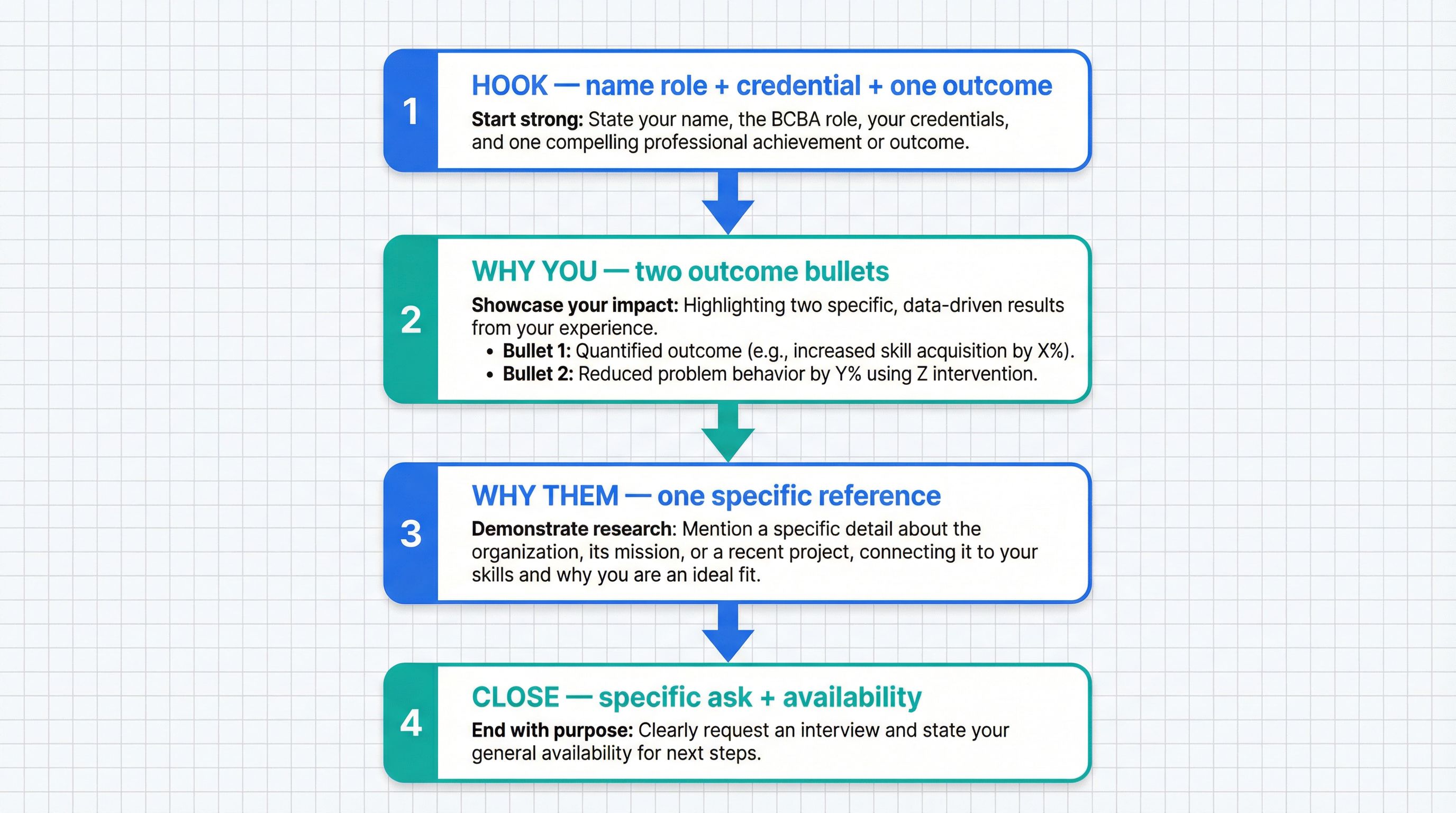
A BCBA cover letter is not a resume in paragraph form. It is a 250 to 350 word essay that surfaces the two outcomes the resume buries, names the role and clinic specifically, and ends with a clear ask. Four paragraphs, one page, white space.
- 1.Paragraph 1: The Hook (3 to 4 lines). Name the role, name your credential and certification date, and lead with a single quantified outcome that maps directly to the posting. Skip "I am writing to apply for..."; the hiring manager already knows.
- 2.Paragraph 2: Why You (4 to 6 lines). Pick two clinical outcomes the resume backs up and translate them into bullets the reader can scan. Lead each bullet with the metric, not the procedure: "64% reduction in problem behavior within 10 weeks via FCT" beats "implemented FCT to reduce problem behavior."
- 3.Paragraph 3: Why Them (3 to 5 lines). Show you read their site or posting. Reference one specific element of their model: caseload structure, payer mix, supervision ratio, parent training program, or how they describe their clinical philosophy. Generic praise reads as template; one specific reference reads as research.
- 4.Paragraph 4: The Close (2 to 3 lines). Make a specific ask. Name the next step you want and your availability. "I would welcome a 20-minute call this week or next to talk through how I would approach your clinic-based caseload" beats "I look forward to hearing from you."
Format the document the same way you format your resume: Arial or Calibri at 10 to 12 point, business-letter header with your contact info in the body of the document (not a header that ATS parsers can miss), and the hiring manager's name when you can find it. Save as PDF with a descriptive filename like Hernandez_Maria_BCBA_Cover_Letter.pdf, or paste the text exactly as written into an ATS text field. If the email allows a body, lead with a 3-to-4-sentence summary and attach the full PDF.
BACB-compliant language for your certification status
How you describe your certification status is not a style choice. The Behavior Analyst Certification Board's January 2023 guidance is explicit, and misrepresentation can put your certification at risk.
Acceptable: "BCBA," "Board Certified Behavior Analyst," "someone who has a BCBA certification," "BCBA certificant," or "BACB certificant." You do not need to use the registered trademark symbol when referring to your own certification.
Not acceptable: "BCBA candidate," "BCBA trained," "BCBA eligible," "pending BACB certification," or "someone who has passed their competency assessment." Any of these can constitute misrepresentation under BACB ethics guidance (BACB, 2023).
For a brand-new BCBA, lead the Hook paragraph with the credential and the certification date so the date is unambiguous: "As a BCBA certified in August 2025..." That single phrasing handles your status, dates the credential, and keeps you on the right side of BACB ethics. If you want a refresher on what is on the registry and how clinical directors verify, see our BCBA certification guide and our BCBA resume guide for parallel resume language.
What clinical directors actually read for
Clinical directors give cover letters about 30 to 60 seconds on the first pass. Assume the reader is skimming and write for that reality. Three things stop the skim:
- Clinical fit. The setting, population, age range, and procedures you have lived inside, named the same way the posting names them. "Clinic-based ABA serving ages 2 to 8 with ASD" beats "experience working with children with autism" every time.
- Supervision scope. Clinical directors are managing humans, not cases. "Currently supervise 6 RBTs across 22 active cases" tells them you understand their org chart and can plug in.
- One signature outcome. The metric that proves you reduce caseload load instead of adding to it. Outcomes that consistently land: independent mand percentage, problem behavior reduction percentage, treatment integrity gains after BST, audit pass rate, and time-to-mastery.
Lead each Why You bullet with the metric, not the procedure. Clinical directors are reading for outcomes; the procedure is the support, not the headline.
The words to avoid are "passionate" and "dedicated." Both signal template, both fail to differentiate, and both lose to a single concrete outcome. Replace "passionate about helping clients with autism" with "raised goal-mastery from 71% to 88% across a 22-case clinic caseload over the last year." The second sentence does the same emotional work and adds proof.
Show clinical-team awareness when it fits the role. For clinic positions, mention SLP and OT collaboration if you have it. For school positions, mention co-designing BIPs with classroom teachers. For in-home roles, mention caregiver-as-mediator outcome data and cultural humility. None of this needs to be a paragraph; one phrase per role is enough to signal that you understand where the BCBA sits in the team.
Tailoring your BCBA cover letter to the job setting
Clinic, school, in-home, telehealth, private practice, and clinical director roles reward different signals in the cover letter just like they do on the resume. One template will not optimize for all of them.
- •Clinic-based BCBA. Lead the Why You paragraph with caseload size, weekly intensity (hours per client), treatment integrity data, and multi-disciplinary collaboration. In Why Them, reference the clinic's authorization model or the way they describe clinical quality.
- •School-based BCBA. Lead with IEP and 504 experience, classroom consultation, teacher coaching, and functional assessment in educational settings. Mention IDEA or ESSA familiarity if relevant.
- •In-home BCBA. Lead with caregiver-training fidelity at follow-up, generalization across environments, and parent-as-mediator outcome data. In-home roles are won on buy-in.
- •Telehealth BCBA. Lead with telepractice platforms (Zoom for Healthcare, Doxy, SimplePractice), HIPAA-compliant documentation, remote observation protocols, and outcome parity vs in-person. Our remote BCBA jobs guide covers what employers ask about most.
- •Private practice or contractor. Lead with insurance credentialing, NPI, billing workflow, and 1099 vs W-2 experience. See independent contractor vs employee for the practical differences.
- •Clinical director. Lead with team size, program-level outcome metrics, audit pass rate, and the systems you built. Reference community outreach or new payer contracts if relevant.
3 BCBA cover letter examples (copy-ready)
Three starter templates that follow the 4-paragraph structure, use BACB-compliant language, and tailor the Why Them paragraph to a specific role. Adapt them to your actual outcomes; do not copy verbatim.
Example 1: Newly certified BCBA (from RBT) applying to a clinic role
Maria L. Hernandez, BCBA
Austin, TX | maria.hernandez@email.com | (512) 555-0102

April 14, 2026

Dr. Lauren Mehta, Clinical Director
Northwood ABA, Austin, TX

Dear Dr. Mehta,

I am applying for the BCBA position at Northwood ABA's Round Rock clinic. As
a BCBA certified in August 2025, I have spent the past three years as an RBT
at Bright Path ABA before moving into supervised fieldwork, where I conducted
14 FBAs and authored 11 BIPs that reduced mean problem behavior 57% across
my cohort within 12 weeks.

Two outcomes from my fieldwork map directly to the caseload structure your
posting describes:
  - Delivered caregiver training to 22 families and reached 80% implementation
    fidelity at the 6-week follow-up, measured via in-home integrity checks.
  - Co-supervised 4 RBT trainees through first-time certification (100%
    first-attempt RBT exam pass rate), using weekly BST and a calibration
    rubric.

What drew me to Northwood specifically is your clinical-team model. Your site
describes a 1:6 BCBA-to-RBT ratio with weekly multi-disciplinary case reviews,
which matches the team structure I trained inside. I would bring a clear
treatment-integrity workflow into that model from day one rather than asking
for six months of ramp time.

I would welcome a 20-minute call this week or next to walk through how I
would approach a starter caseload at the Round Rock clinic. I am available
weekday mornings before 11am and Friday afternoons.

Thank you,
Maria L. Hernandez, BCBA
BACB Cert #1-25-789012
What makes it work: Credential and date are unambiguous in the first sentence. Two fieldwork outcomes are quantified and tied to the role. The Why Them paragraph references the actual clinical model. The close has a specific ask and named availability.
Example 2: Mid-career clinic BCBA moving clinics
David T. Okafor, BCBA
Boston, MA | d.okafor@email.com | (617) 555-0199

April 14, 2026

Ms. Jordan Reyes, Director of Clinical Operations
Harbor Bay Pediatric ABA, Cambridge, MA

Dear Ms. Reyes,

I am applying for the Lead BCBA position at Harbor Bay Pediatric ABA. I am a
BCBA with five years of clinic-based work serving ages 2 to 9 with ASD. Over
the past 18 months I have run a 24-case clinic caseload that reached 88%
goal-mastery and held 100% insurance authorization renewal across two payer
cycles.

Two outcomes feel directly relevant to the role you are hiring for:
  - Implemented FCT with a 2-second prompt delay across my caseload;
    increased independent mands from 28% to 81% and reduced problem behavior
    64% within 10 weeks, with weekly BST for 3 RBTs.
  - Improved RBT procedure integrity from 73% to 94% within 8 weeks of taking
    over team supervision (7 RBTs), using monthly calibration checks and a
    10-item integrity rubric.

What caught my attention about Harbor Bay was your published commitment to
outcome transparency with families and your cross-disciplinary integration
with the SLP and OT teams across both your Cambridge and Somerville sites.
That is the version of clinic-based ABA I want to keep building, and the
team structure where my treatment-integrity work has had its biggest impact.

I would welcome the chance to walk through how I would step into a Lead BCBA
role at the Cambridge site. I can be available for a call most weekday
afternoons.

Thank you,
David T. Okafor, BCBA
BACB Cert #1-20-123456 | LABA-MA
What makes it work: The Hook leads with two numbers. The Why You bullets have full action-verb-plus-procedure-plus-metric-plus-timeframe formatting (drawn from the same outcome formula in our BCBA resume guide). The Why Them paragraph references the clinic's published clinical model, not generic praise.
Example 3: BCBA-D moving to clinical director
Priya S. Raman, BCBA-D
San Diego, CA | priya.raman@email.com | (619) 555-0177

April 14, 2026

Dr. Aaron Whitfield, Chief Clinical Officer
Pacific Coast ABA Group, Irvine, CA

Dear Dr. Whitfield,

I am applying for the Clinical Director position overseeing your Orange
County region. As a BCBA-D with eight years of clinical and leadership
experience, I currently lead 14 BCBAs and 42 RBTs across 3 California clinics.
Over the past 24 months we lifted program-level goal-mastery from 71% to 90%
and held a 100% pass rate across 6 payer audits with no corrective action
plans issued.

Two program-level outcomes map to the regional director scope you describe:
  - Built a 6-week RBT onboarding and BST pipeline that cut average ramp time
    from 9 weeks to 5 weeks and reduced first-year RBT attrition 38%.
  - Owned compliance and payer audit response across 3 sites; standardized
    BIP and treatment-integrity templates that two of our payers adopted as
    reference documentation.

What drew me to Pacific Coast is your published growth into school-district
contracts and your emphasis on community training as a clinical-quality lever
rather than a marketing one. The 14 community trainings I delivered last year
produced two new in-network insurance contracts, which is the same pattern
you describe pursuing in Orange County.

I would welcome a 30-minute conversation about how I would structure the
first 90 days of the regional director role. I am available for a call most
weekday afternoons next week.

Thank you,
Priya S. Raman, BCBA-D
BACB Cert #1-17-654321 | LBA-CA
What makes it work: Leadership metrics sit above clinical metrics. Program-level outcomes (goal-mastery gain, audit pass rate, attrition reduction) prove executive readiness. The Why Them paragraph ties the candidate's actual community work to the org's stated growth strategy.
7 BCBA cover letter mistakes that cost you interviews
- Misrepresenting certification status. "BCBA candidate," "BCBA trained," or "BCBA eligible" violates BACB ethics guidance and is a real risk to your certification.
- Generic "passionate professional" opening. Signals template-builder origin and fails to differentiate. Lead with a number instead.
- Restating the resume in paragraph form. The cover letter's job is to surface the two outcomes the resume buries, not to retell the whole story.
- Skipping the Why Them paragraph. Clinical directors read this paragraph specifically to gauge real interest. Without it, the letter reads like a mass send.
- Sending the same letter to every clinic. 72% of hiring managers expect a cover letter even when the posting marks it optional, and they expect it to be tailored (Resume Genius, 2026).
- Going past one page. A clinical director will stop reading at 350 words. Cut anything that does not advance the case.
- No specific ask in the close. "I look forward to hearing from you" wastes a sentence. Name the next step you want and your availability.
The alternative: skip the cover letter game
There is a structural problem with the cover letter model that no amount of tailoring fixes. You write twenty letters and hear back from two. The strongest cover letter in the world still gets a 30-second skim, and your name, photo, and current employer are visible to every recruiter you send to. Most importantly, your current employer can often tell you are looking, because your name is moving across LinkedIn and job boards in ways that get back.
A reverse marketplace flips this. Employers review anonymous qualification profiles and send you interview requests based on your certifications, supervision scope, specialties, and outcome data. You see the role, the setting, the caseload structure, and the compensation range before you reveal your identity. Your name, photo, and current employer are never visible until you accept an interview. There is no cover letter to write.
Your clinical work is what hiring teams actually want to evaluate. The cover letter exists to surface it; an anonymous profile carries it directly to the people doing the hiring.
This matters most for three groups: BCBAs who are employed today and cannot risk their current organization finding out, BCBAs who want transparent compensation data before they invest in an interview cycle, and BCBAs from backgrounds that routinely face bias in name-and-photo screening.
Let qualified employers reach out to you
Build a verified, anonymous CertifyndABA profile in about 10 minutes. See the role, setting, and compensation range before employers see your name; no cover letter required.
Create Your Free ProfileBCBA cover letter FAQ
Do I really need a BCBA cover letter in 2026?
Yes when the posting asks for one, and usually even when it does not. 72% of hiring managers expect a cover letter even when the posting marks it as optional (Resume Genius, 2026). Treat "optional" as "required" for any role you actually want.
How long should a BCBA cover letter be?
250 to 350 words on a single page. Clinical directors stop reading past that length on the first pass.
Can I use "BCBA candidate" if I have passed the exam but my certification is not active yet?
No. BACB explicitly prohibits that language. Until your certification is active on the BACB Certificant Registry, use "expected BCBA certification: [Month Year]" instead.
Should I include my BACB certification number in the cover letter?
It is optional in the cover letter; the resume is the main place for it. Some BCBAs include it in the signature block to speed verification, which is fine.
Should I write a different cover letter for every clinic?
Yes. The Why Them paragraph must be tailored to the specific clinic, or the letter underperforms the resume it is attached to. The first three paragraphs can carry forward; the third paragraph cannot.
Should I email my cover letter or attach it as a PDF?
Both. If the application is by email, paste a 3-to-4-sentence summary in the body and attach the full PDF. If the ATS provides a text field, paste the full letter exactly as written and skip the attachment.
Do clinical directors care more about the cover letter or the resume?
The resume carries the weight. The cover letter's job is to surface one or two outcomes the resume buries and to show the clinical director you understand their specific clinic, not BCBA work in general.
Should I use AI to write my BCBA cover letter?
AI can draft a structure, but the outcomes and the Why Them paragraph have to be yours. Generic AI-generated cover letters are immediately recognizable to clinical directors who read dozens a week.
Your next step
Three things separate BCBA cover letters that earn interviews from cover letters that get skimmed. First, they follow a 4-paragraph structure that makes the case in 350 words or fewer. Second, they translate clinical work into outcome bullets a clinical director can scan in 30 seconds. Third, they include a Why Them paragraph that proves real research into the clinic, not generic praise.
A concrete action list for this week:
- Pick the two outcomes from your resume that map most directly to the next role you want.
- Draft a 4-paragraph cover letter using the structure above; cap the total at 350 words.
- Read the close out loud. If the ask is not specific, rewrite it until it is.
When the cover letter is where you want it, pair it with our BCBA resume guide, BCBA interview questions guide, questions to ask in your ABA interview, and best BCBA job boards. If you want to know what you should be earning before you go to market, see our behavior analyst salary guide.
Or skip the cover letter cycle entirely. Build an anonymous CertifyndABA profile and let verified employers reach out to you based on your clinical work, not your formatting.