


BCBA stands for Board Certified Behavior Analyst. It is a graduate-level certification in behavior analysis, issued by the Behavior Analyst Certification Board (BACB). A BCBA assesses behavior, designs treatment plans, and supervises the technicians who carry them out. Most BCBAs work in ABA therapy for autism, and the role is one of the hardest in the field for employers to fill.
On October 23, 2026, the BACB listed 82,053 BCBAs in the United States, counting the 3,053 who also hold the doctoral designation. In 2025, US employers posted 132,307 jobs that asked for a BCBA. This guide explains what the letters mean, what a BCBA actually does, how the credential compares to the RBT, BCaBA, and BCBA-D, and what the job market looks like for BCBAs right now.
- BCBA = Board Certified Behavior Analyst. It is a certification from the BACB, not a degree and not, by itself, a state license.
- Requirements: a master's degree, graduate coursework in behavior analysis, 2,000 hours of supervised fieldwork (or 1,500 concentrated hours), and a passing score on the BCBA exam.
- Supply: 82,053 US BCBAs and BCBA-Ds, compared with 275,381 RBTs. That is about 3.4 technicians for every BCBA.
- Demand: 132,307 US job postings asked for a BCBA in 2025, up 28% from 2024. That is about 1.6 postings for every BCBA in the country.
- Pay: the median posted salary in our October 2026 review of 595 employers' BCBA job ads was $89,934.
What does BCBA stand for?
BCBA stands for Board Certified Behavior Analyst. The "board" is the Behavior Analyst Certification Board, a nonprofit that sets the requirements, runs the exam, and keeps the public registry of certificants. Each part of the name tells you something:
- Board Certified means a national board verified the person's education, supervised experience, and exam score. It is not a college degree. A BCBA holds a master's degree in addition to the certification.
- Behavior refers to observable actions: communication, daily living skills, social skills, and challenging behavior such as aggression or self-injury.
- Analyst is the key word. A BCBA's job is to measure behavior, find out why it happens, and design a plan to change it. The BCBA then checks the data to see if the plan works.
The BACB describes the credential this way: "a graduate-level certification in behavior analysis." It also calls BCBAs independent practitioners who can supervise the work of RBTs, BCaBAs, and other professionals who carry out behavior-analytic interventions. That supervision role is what separates a BCBA from almost every other job in ABA.
One spelling note. The official name is Board Certified Behavior Analyst, not "Behavioral Analyst." Employers get this wrong often. In our sample of 688 employers' BCBA job ads, 19 put "Behavioral Analyst" in the job title. It is a small detail, but you should spell your own credential correctly on your resume.
What is a BCBA in ABA therapy?
Applied behavior analysis (ABA) is the treatment approach, and the BCBA is the clinician in charge of it. In a typical ABA program for a child with autism, the work divides like this:
- The BCBA runs the assessment, writes the treatment plan and goals, trains the family, reviews session data, and adjusts the plan. The BCBA also writes the reports that insurance companies require to approve treatment hours.
- The RBT (Registered Behavior Technician) works one-on-one with the child for most of the treatment hours and records data on every session.
- The BCaBA, if the team has one, helps the BCBA with assessment and supervision but must work under a BCBA.
So when people search for a "BCBA therapist," they usually mean the person who leads their child's ABA program. The BCBA does spend time with the child, but most of the direct hours belong to the technician. For a closer look at the daily work, read our guide to what a BCBA does day to day.
Autism services are the largest part of the field, but they are not the only part. BCBAs also work in schools, hospitals, residential programs, and organizational behavior management, where they apply the same methods to workplace performance. Our article on school-based BCBA jobs covers one of the most common alternatives to clinic and in-home work.
BCBA vs RBT vs BCaBA vs BCBA-D
The BACB issues three certifications and one designation. They form a ladder, and each step adds education, supervised experience, and independence.
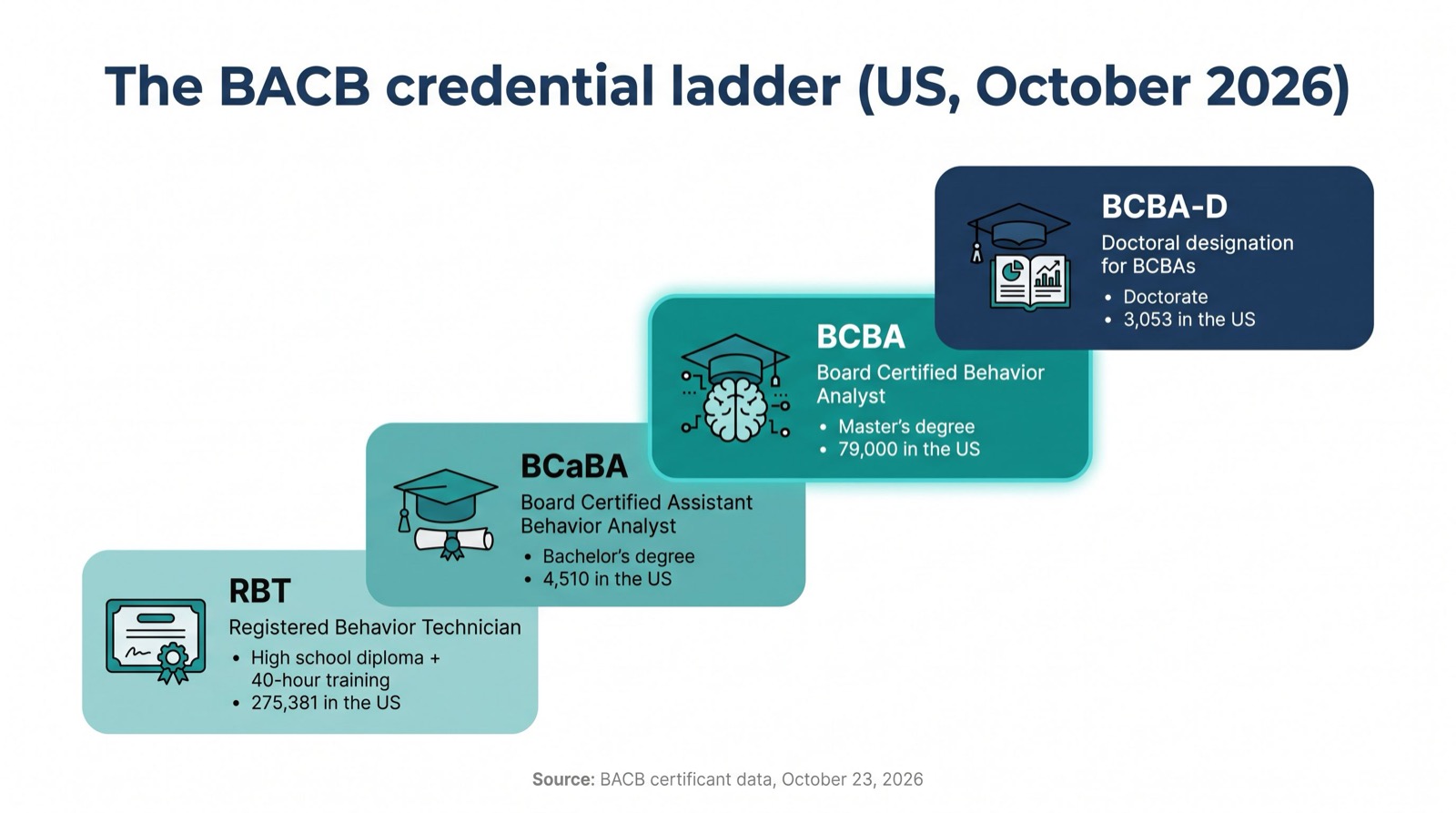
| Credential | Minimum degree | Can practice independently? | US count (Oct 23, 2026) |
|---|---|---|---|
| RBT (Registered Behavior Technician) | High school diploma | No, works under a BCBA or BCaBA | 275,381 |
| BCaBA (Board Certified Assistant Behavior Analyst) | Bachelor's | No, needs BCBA supervision | 4,510 |
| BCBA (Board Certified Behavior Analyst) | Master's | Yes | 79,000 |
| BCBA-D (doctoral designation) | Doctorate | Yes, same practice rights as a BCBA | 3,053 |
Two points confuse many people. First, the BCBA-D is not a separate certification. It is a designation for BCBAs who also hold a qualifying doctorate, and it does not add practice rights. Only 3.7% of US BCBA-level certificants hold it. Our BCBA-D guide covers what it signals. Second, a BCBA is not a doctor. The minimum degree is a master's, and most BCBAs do not have a doctorate.
The gap between the steps matters for hiring. The US has only 4,510 BCaBAs, so in practice most ABA teams go straight from RBT to BCBA. For a full comparison, see RBT vs BCBA and BCBA vs BCaBA.
Is a BCBA a license?
Not by itself. The BCBA is a national certification. A license is permission from a state to practice. According to the BACB, 40 states and the District of Columbia have passed laws that license or otherwise regulate behavior analysts. Colorado is the newest, with a law passed in 2026. In most of those states, the BCBA is the main route to the state license, so the two go together.
If you plan to work in a licensed state, budget for the state application in addition to the BACB fees. Large states without a behavior analyst license law, according to the BACB's list, include California and Florida. Our guide to the licensed behavior analyst credential explains how the state and national systems fit together, and the state licensure guide lists each state's rules.
How do you become a BCBA?
Through the end of 2026, most candidates qualify through one of two routes. Pathway 1 is a master's degree from an accredited behavior analysis program. Pathway 2 is a master's degree in any field plus 315 hours of graduate behavior-analytic coursework. Either way, you also need:
- Supervised fieldwork: 2,000 hours, or 1,500 hours of concentrated fieldwork with more frequent supervision.
- A certification application: $245, paid to the BACB.
- The BCBA exam: 185 questions in four hours, with a $125 appointment fee for each attempt. In 2025, 51% of first-time candidates passed.
Rules change for applications submitted on or after January 1, 2027. Pathways 3 and 4 end, and Pathway 2 coursework is restructured into seven freestanding courses that still total 315 hours. If you are close to applying, check the BACB's 2027 transition guidance first. After certification, you recertify every two years with 32 continuing education units, including 4 in ethics.
The full route, with timelines and costs, is in our guide to how to become a BCBA. For exam preparation, see our BCBA exam pass rate analysis.
Already a BCBA, or close to it?
On CertifyndABA, employers send you interview requests with the role, setting, and pay listed up front. You choose which ones to answer.
Create Your Free ProfileThe BCBA job market: more jobs than BCBAs
The BCBA is in short supply, and the numbers show it. In 2025, US employers posted 132,307 jobs that required or preferred a BCBA, according to the BACB's report with labor market firm Lightcast. That was up 28% from 103,150 in 2024, and demand has grown every year since 2010, when there were 789 such postings.
Against the 82,053 BCBAs and BCBA-Ds in the US today, that is about 1.6 job postings for every BCBA. Read that number with care. Postings are a full year's flow of ads, while the certificant count is a snapshot of people, and many of those BCBAs already have jobs. You will sometimes see a claim that there are two to three jobs for every BCBA. Nationally, the data does not support that. In some states, it does.
| State | 2025 BCBA postings | BCBAs + BCBA-Ds (Oct 2026) | Postings per BCBA |
|---|---|---|---|
| Maryland | 4,751 | 1,378 | 3.4 |
| Kansas | 1,215 | 410 | 3.0 |
| North Carolina | 6,874 | 2,366 | 2.9 |
| Georgia | 6,471 | 2,508 | 2.6 |
| California | 20,258 | 11,344 | 1.8 |
| Texas | 7,792 | 5,832 | 1.3 |
| Florida | 5,537 | 9,840 | 0.6 |
Of the 30 states with the most BCBA postings in the Lightcast report, 10 had two or more postings per BCBA: Maryland, Kansas, North Carolina, Georgia, Nebraska, Missouri, Oregon, Minnesota, Oklahoma, and New Jersey. Florida is the outlier in the other direction. It has the second-largest BCBA workforce in the country but posted fewer BCBA jobs than it has BCBAs. For the full state list and what it means for your search, see our BCBA job outlook.
Supply is growing, but not as fast as demand. Worldwide, the number of BCBAs rose from 74,125 at the end of 2024 to 81,566 at the end of 2025, about 10%. US postings rose 28% in the same year. The pipeline is also narrow at the exam: about half of first-time candidates pass. Meanwhile, every new ABA client needs a BCBA to write and oversee the treatment plan, and the US has about 3.4 RBTs for each BCBA to supervise.
What BCBA jobs look like in 2026
To see what employers actually offer, we read the full text of BCBA job ads from 688 direct employers in October 2026, one ad per employer. Here is what a typical BCBA job looks like:
- Setting: 52% of ads were for clinic or in-home ABA work, and 17% were school-based. Another 6% were in hospitals or residential programs. The rest did not clearly state a setting.
- Pay: across the full October 2026 harvest, the median posted salary was $89,934 a year (595 employers), and the median hourly rate was $75 (355 employers).
- Caseload: few ads stated one, but the 44 that did had a median of about 8 clients.
- Billable hours: 41 ads gave a weekly billable target, with a median of 25 hours.
- Experience: 32% of employers asked for a set number of years, and most of those asked for one or two. Many employers welcome newly certified BCBAs.
- Sign-on bonus: 16% mentioned one. Among the ads that gave an amount, the median was $5,000.
- Flexibility: 20% mentioned part-time options.
The hard part of a BCBA job search is comparing offers, because caseload and billable expectations are rarely in the ad. Only about 6% of employers stated a caseload, and about 6% stated a billable target. Ask about both in your first interview. For pay by state and setting, see our BCBA salary guide, and for current openings, start with our BCBA jobs guide.
Is becoming a BCBA worth it?
For most people who want a clinical career in ABA, yes. The credential takes a master's degree and 2,000 hours of supervised fieldwork, which usually takes one to two years, so it is a real investment. In return, you get a job that employers compete to fill, a median posted salary near $90,000, and the freedom to work in clinics, homes, schools, hospitals, or your own practice.
The trade-offs are also real. The exam is difficult. The role carries responsibility for treatment quality, supervision, and insurance documentation. Burnout is a common topic in the field, and caseload size drives much of it. The best protection is to pick your employer carefully: ask about caseload, billable targets, supervision load, and support for your own professional development before you accept an offer.
Frequently asked questions
What does BCBA stand for?
BCBA stands for Board Certified Behavior Analyst. It is a graduate-level certification in behavior analysis issued by the Behavior Analyst Certification Board (BACB).
What does a BCBA do?
A BCBA assesses behavior, writes behavior treatment plans, supervises RBTs and other staff who carry out the plans, trains caregivers, and uses data to adjust treatment. Most BCBAs work in ABA therapy for autism.
Is a BCBA a doctor?
No. The minimum degree for a BCBA is a master's. BCBAs who also hold a qualifying doctorate can earn the BCBA-D designation, and on October 23, 2026, 3,053 of the 82,053 US BCBA-level certificants held it.
Is a BCBA a therapist?
A BCBA is a clinician who designs and oversees ABA therapy. Families often call the BCBA their child's ABA therapist, but most one-on-one therapy hours are delivered by RBTs under the BCBA's supervision.
How many BCBAs are there in the US?
The BACB listed 82,053 BCBA-level certificants in the United States on October 23, 2026: 79,000 BCBAs and 3,053 BCBA-Ds.
How much does a BCBA make?
The median posted salary in our October 2026 review of 595 employers' BCBA job ads was $89,934 a year. Ads that posted an hourly rate had a median of $75 an hour.
Are BCBAs in demand?
Yes. US employers posted 132,307 BCBA jobs in 2025, up 28% from 2024. That is about 1.6 postings for every BCBA in the country, and more than 2 per BCBA in 10 states.
The bottom line
BCBA means Board Certified Behavior Analyst: a master's-level clinician, certified by the BACB, who designs and supervises behavior-analytic treatment. It is the credential that every ABA program needs and that the field cannot produce fast enough. With about 1.6 job postings per BCBA nationally, and more than twice that in some states, BCBAs have real choice in where and how they work. Use that choice to find a role with a caseload, setting, and pay that fit you.
Let ABA employers come to you
Create a free CertifyndABA profile. Employers send you interview requests with the role, setting, and pay up front, and you decide who to talk to.
Create Your Free ProfileMethodology: US certificant counts are from the BACB's certificant data for the United States, checked on October 23, 2026; the state rows sum exactly to the US totals. Job posting counts are from the BACB's 2025 report with Lightcast, which counts postings that require or prefer the BCBA or BCBA-D; postings per BCBA divide 2025 postings by October 2026 BCBA plus BCBA-D counts. Worldwide year-end counts and exam pass rates are from the BACB's annual certificant report data. Requirements and fees are from the BCBA Handbook (updated June 2026) and the BACB's 2027 transition resources. Job ad figures come from our October 2026 review of BCBA job ads on LinkedIn and SimplyHired, using one randomly chosen ad per direct employer (688 employers). Pay uses every employer in the same harvest that posted it (595 salaried, 355 hourly), taking the midpoint of a posted range and one median per employer.