

The BCBA job outlook has never been stronger. In 2025, employers posted 132,307 positions requiring BCBA certification, yet only 83,586 Board Certified Behavior Analysts hold active credentials in the United States. That gap between supply and demand is not closing; it is widening. For BCBAs weighing their career options in 2026, the data tells a clear story: you are in one of the most sought-after professions in healthcare.
The U.S. Bureau of Labor Statistics projects 17% employment growth for behavioral health roles through 2034, roughly five times faster than the national average. But federal projections only tell part of the story. The real picture emerges when you combine BACB certificant data, Lightcast job posting analytics, and the realities of a field where exam pass rates are declining while demand accelerates.
BCBA Demand by the Numbers
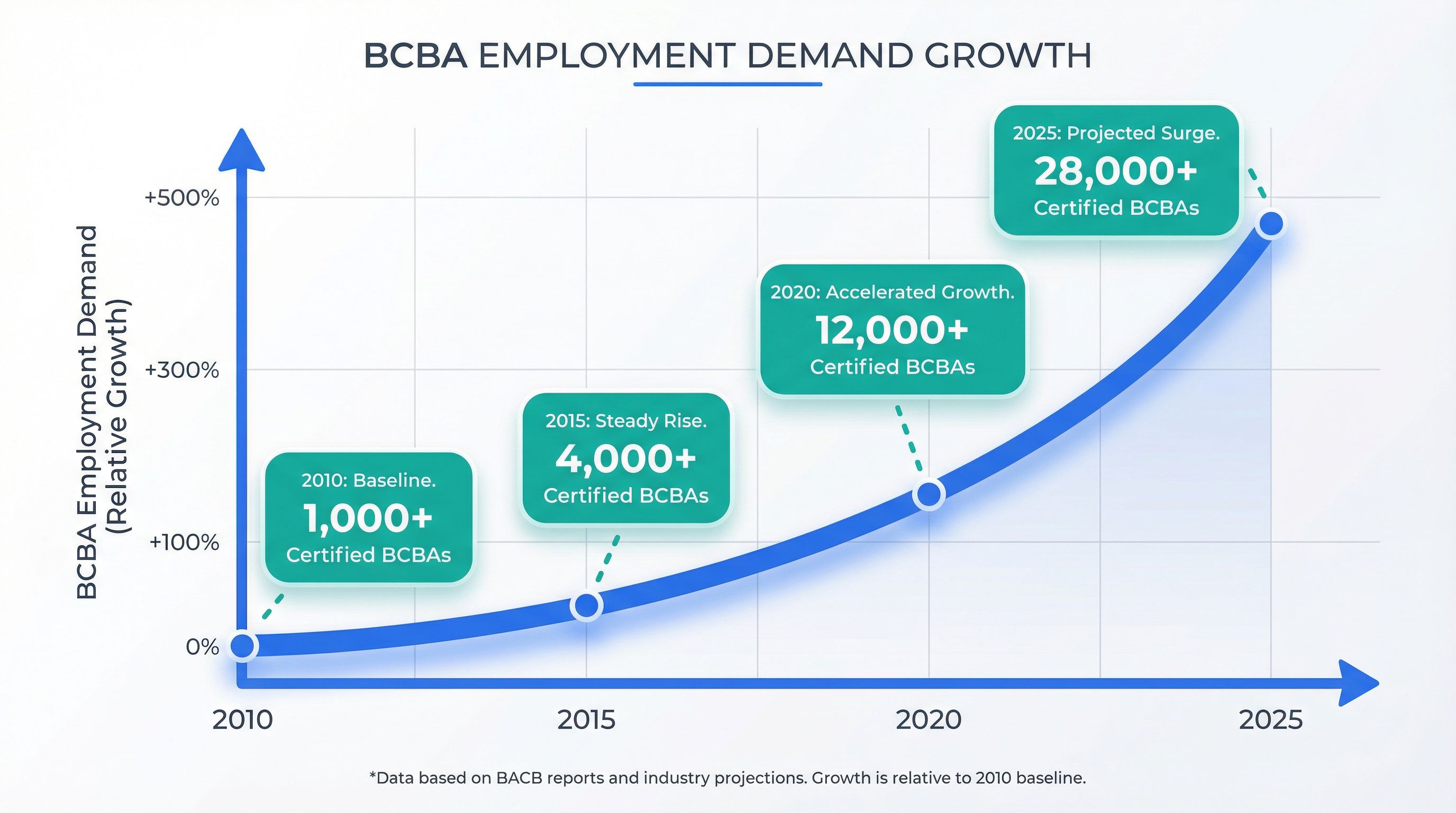
The Behavior Analyst Certification Board partners with Lightcast (formerly Burning Glass) to track BCBA job postings nationwide. The trajectory over the past 15 years is striking.
In 2010, there were just 789 job postings requiring BCBA certification across the entire country. By 2022, that number reached 57,596. Then the growth rate accelerated: postings jumped to 65,300 in 2023, surged 58% to 103,150 in 2024, and climbed another 28% to 132,307 in 2025.
Demand for assistant behavior analysts is growing even faster. BCaBA-related job postings increased 131% from 2023 to 2024, signaling that employers are looking for qualified professionals at every level of the credential hierarchy.
Geographically, five states account for 38% of all BCBA job postings. According to the 2025 Lightcast data, the top states by demand are:
- California (15% of national demand)
- New Jersey
- Texas
- Massachusetts
- North Carolina
However, all 50 states experienced increased demand over the past several years. Some of the fastest growth is happening in less obvious markets: Oregon saw a 291% increase in BCBA postings from 2023 to 2024, Kansas grew 228%, and Washington state grew 133%.
The BCBA Employment Gap: More Jobs Than Professionals
The core challenge facing the ABA field is straightforward: there are far more positions than people to fill them.
As of April 2026, the BACB reports 83,586 active BCBAs in the United States. That same year, employers posted over 132,000 positions. But the real gap is worse than that ratio suggests, because not all certified BCBAs are available for open roles. Many work in supervisory, academic, or research positions. According to workforce analyses, only about 30,000 BCBAs work in direct clinical service, while an estimated 100,000 are needed nationally.
"46% of U.S. counties still lack any BCBA presence, improved from 54% in 2018, but nearly half the country remains underserved."
The pipeline of new professionals is not keeping pace either. The first-time BCBA exam pass rate has dropped from 66% in 2020 to 51% in 2025, according to BACB examination data. While over 21,000 candidates take the exam each year, roughly 8,000 earn certification annually. At that rate, supply will continue to lag behind demand for the foreseeable future.
For families, the shortage has real consequences. Two-thirds of specialty centers report wait times of four months or longer for assessments. More than 15% of families wait over a year. These access barriers are a direct result of having too few qualified practitioners.
What Is Driving BCBA Demand?
Four major factors are fueling the sustained growth in BCBA positions.
Rising autism diagnosis rates. The CDC now estimates that 1 in 36 children (2.8%) are identified with autism spectrum disorder, up from 1 in 44 (2.3%) in 2018. Among young adults ages 26 to 34, diagnosis rates increased 450% over the most recent study period. Each new diagnosis creates potential demand for ABA services and, by extension, qualified behavior analysts.
Universal insurance mandates. All 50 states now mandate insurance coverage for autism and ABA services, giving over 200 million Americans access to ABA through their health plans. This legislative shift transformed ABA from a niche specialty into a mainstream healthcare service, dramatically expanding the employer base.
Expanding practice settings. BCBAs are no longer limited to traditional autism clinics. Schools, hospitals, corporate settings (through organizational behavior management), substance abuse treatment centers, and telehealth platforms all employ behavior analysts. The BLS projects 18% growth specifically in substance abuse behavioral specializations by 2032.
Geographic expansion. Between 2018 and 2021, 266 U.S. counties gained their first BCBA. Rural and underserved areas are actively recruiting, often with competitive incentives. Telehealth has also opened new service delivery models that reduce geographic barriers.
BCBA Career Paths and Salary Potential
The supply-demand imbalance is reflected directly in compensation. BCBA salaries have climbed steadily, and the Economic Research Institute projects the average will reach $88,573 by 2030.
Current salary ranges vary by experience and role:
- ✓ Entry-level BCBA: approximately $65,120 per year
- ✓ Mid-career (1 to 5 years): approximately $71,675 per year
- ✓ Clinical directors: $85,000 to $100,000 per year
- ✓ Traveling behavior analysts: $75,000 to $125,000 per year
- ✓ Advanced and leadership roles: $88,000 to $151,000 per year
The highest-paying states for BCBAs include New Jersey ($95,532 average), Wisconsin ($94,521), Nevada ($91,642), Massachusetts ($91,114), and California ($90,556), according to industry salary surveys.
Beyond clinical practice, BCBAs are building careers in research, university teaching, organizational consulting, and telehealth service delivery. These non-traditional paths often come with lower caseloads and reduced burnout risk; an important consideration in a field where 93% of behavioral health workers report some degree of burnout.
How BCBAs Can Leverage This Job Market
When demand outpaces supply by this margin, the power dynamic shifts. BCBAs do not need to settle for the first offer or accept unsustainable working conditions. Here is how to make this market work in your favor.
Negotiate from a position of strength. You have options that most professionals do not. Push for sustainable caseloads (the recommended range is 10 to 15 clients for solo practitioners), supervision support, continuing education funding, and competitive compensation. Employers who cannot offer these will lose candidates to those who can.
Explore non-traditional settings. There are over 2,300 monthly searches for "remote BCBA jobs" alone. Telehealth, school-based roles, hospital positions, and OBM consulting are all growing rapidly. If your current setting is burning you out, the market supports a change.
Use platforms that reflect your market value. Traditional job boards require you to apply and wait. In a market this favorable, consider reverse job marketplaces where employers find and reach out to you based on your qualifications, not the other way around.
Protect against burnout. A strong job market means nothing if you leave the field entirely. Set boundaries on caseload size, advocate for adequate supervision ratios, and prioritize employers who demonstrate a genuine commitment to staff wellbeing.
The Bottom Line
The BCBA job outlook in 2026 is defined by a fundamental imbalance: too many open positions and too few certified professionals to fill them. With 132,307 job postings in 2025, a 17% projected growth rate through 2034, declining exam pass rates constraining new supply, and nearly half of U.S. counties still without a single BCBA, this employment gap is not closing anytime soon.
For BCBAs, that means job security, salary growth, and the leverage to choose roles that align with your career goals and personal boundaries. The question is not whether opportunities exist; it is whether you are positioned to capture the best ones.
Let Employers Come to You
In a market with more open BCBA positions than professionals, you should not have to chase opportunities. CertifyndABA's anonymous reverse marketplace lets employers send you interview requests based on your qualifications; your identity stays private until you decide to connect.
Create Your Free Profile