

BCBA-D stands for Board Certified Behavior Analyst-Doctoral. It is not a separate certification and it has no exam of its own. It is a designation that a practicing BCBA adds after earning a qualifying behavior-analytic doctorate, and the Behavior Analyst Certification Board (BACB) says plainly that it "does not grant any privileges beyond the BCBA certification" (BACB, BCBA Handbook, 2026).
So why do people chase it? Because the letters signal research training, and a small set of jobs, mostly in universities and academic medical programs, will not consider you without a doctorate. This guide covers what the BCBA-D means, the exact requirements, how many BCBA-Ds there are, and what we found when we analyzed 1,500 job ads to see whether employers pay more for one.
What does BCBA-D mean?
A BCBA-D is a Board Certified Behavior Analyst who also holds a doctoral degree that meets the BACB's behavior-analytic standards. The BACB describes the designation as "merely an addition to the BCBA certification." In practice, that means four things:
- ✓ Same scope of practice. A BCBA-D can do exactly what a BCBA can do: assess, design and supervise behavior-analytic services, and supervise fieldwork. Nothing more.
- ✓ No extra exam. The BACB approves the designation by reviewing your transcript and supporting documents. You pass the BCBA exam once, and that is the only exam.
- ✓ Same maintenance rules. BCBA-Ds meet every BCBA continuing education and recertification requirement. Your certification number and recertification date stay the same when the designation is added.
- ✓ A doctorate alone does not count. A PhD in chemistry or an EdD in leadership will not qualify you on its own. The degree must come from a behavior-analytic program or dissertation, or be followed by postdoctoral behavior-analytic training, as the next section explains.
Some career sites describe the BCBA-D as a higher certification or an advanced license. Both are wrong. If you see a job ad or a recruiter treat it as a separate credential tier, that tells you something about the author, not about the BACB's rules. For how the BCBA itself compares with the assistant-level credential, see our BCBA vs. BCaBA guide.
BCBA-D requirements: three routes
You must already be an active BCBA. Then you meet one of three options from the BCBA Handbook (updated June 2026):
| Option | Degree | Plus | Documents |
|---|---|---|---|
| A: Accredited program | Doctorate from an ABAI-accredited doctoral program | Nothing else | Official transcript |
| B: Nonaccredited program | Doctorate from a qualifying institution with a behavior-analytic dissertation | One of: at least four entirely behavior-analytic courses in the doctoral program of study, formal mentorship by a BCBA faculty member who had completed the 8-hour supervision training, or two peer-reviewed behavior-analytic articles | Transcript, published dissertation abstract, and proof of the chosen extra (syllabi, a mentorship letter, or the articles) |
| C: Postdoctoral respecialization | Doctorate from a qualifying institution, any field | 1,800 postdoctoral hours in ABA under a BCBA (beyond your BCBA fieldwork hours) and two peer-reviewed behavior-analytic articles from that training | Transcript, supervisor attestation letter, the articles |
Option A is the cleanest, but it is narrow. The Association for Behavior Analysis International (ABAI) lists only 11 universities with accredited doctoral programs, including Ohio State, the University of Kansas, the University of Nevada, Reno, Western Michigan and the University of Nebraska Medical Center's Munroe-Meyer Institute. ABAI-recognized programs that are not accredited do not satisfy Option A; those graduates qualify through Option B or C.
For Option B, the published articles do not need first authorship and do not need to be experimental. The mentorship route is the one people trip on: the mentor had to hold the BCBA and have completed the 8-hour supervision training before the mentorship began, and the letter must come on university letterhead.
Option C is the only door for someone whose doctorate is in another field, such as a clinical psychologist who later retrained in behavior analysis. At full-time hours, 1,800 postdoctoral hours is close to a year of work, and the two articles have to come out of that training.
How to apply for the BCBA-D designation
- Get certified as a BCBA first. The designation is added to an active certification. You cannot apply for both at once.
- Submit the BCBA-D Designation Application in your BACB portal under the Applications tab and pay the fee. The handbook does not print the amount; the BACB set it at $105 in its 2018 fee schedule, so confirm the current figure in the portal.
- Only then ask your university to send official transcripts to the BACB. The handbook specifically says not to send them before you apply.
- Wait up to two weeks for review after the BACB has your complete application and payment. Approval arrives by email, and a new certificate follows in four to six weeks.
If the BACB needs more, you get feedback in your portal, and you have until 90 days after you submitted the application to resolve it; after that, you reapply and pay again. Keeping the designation costs slightly more than a plain BCBA: the BCBA-D recertification fee is $290 every two years, compared with $215 for a BCBA. You can also drop the designation at recertification and keep your BCBA.
How many BCBA-Ds are there?
As of September 2026, the BACB registry lists 3,032 BCBA-Ds in the United States and 3,297 worldwide. That is 3.7% of all U.S. BCBAs. The share used to be much higher. In December 2013, BCBA-Ds made up 13.4% of U.S. BCBAs.
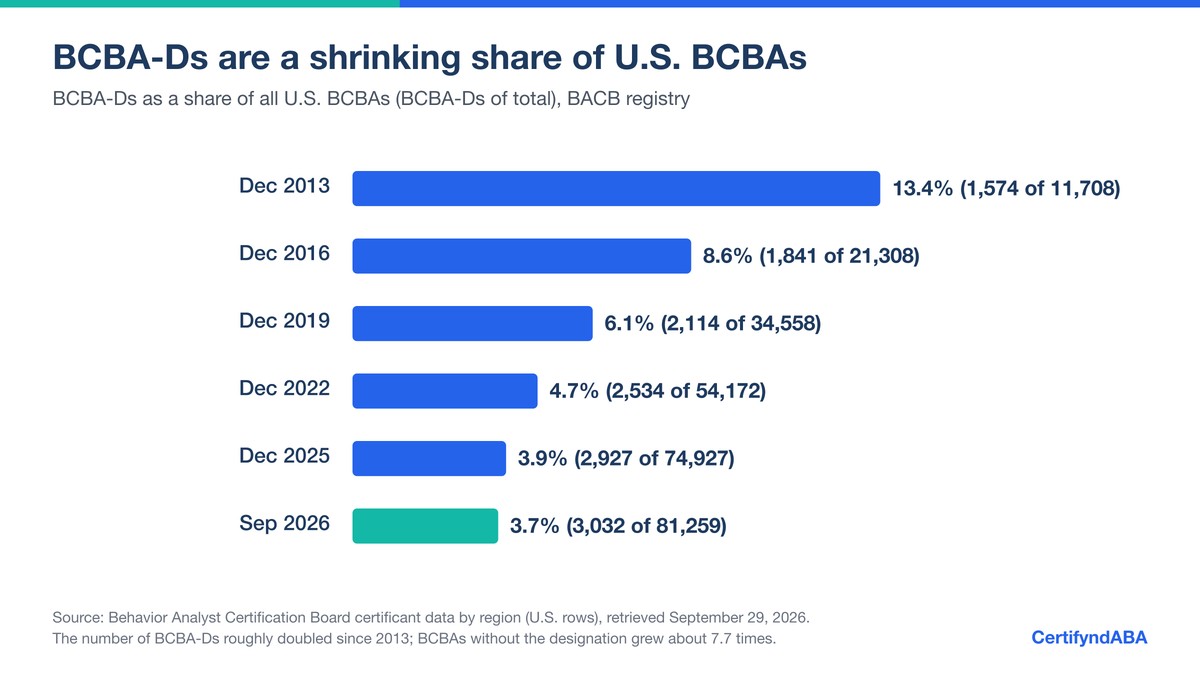
The doctoral group is not shrinking. It grew from 1,574 to 3,032, adding about 80 to 175 people a year. The field simply grew around it: BCBAs without the designation went from 10,134 to 78,227 over the same period, about 7.7 times.
By state, California (354) and Florida (306) have the most BCBA-Ds, followed by Massachusetts (193), New York (179) and New Jersey (166). Among states with at least 1,000 BCBAs, Maryland has the highest doctoral share at 5.4% and Indiana the lowest at 2.0%. Some smaller states run far higher, including Nebraska and West Virginia at about 10.4% and Kansas and Nevada at about 7.5% to 7.6%, each home to an ABAI-accredited doctoral program.
BCBA-D salary: do employers pay more?
No official source reports a BCBA-D salary. Salary sites such as ZipRecruiter and PayScale publish BCBA-D estimates, but those are modeled from mixed data, not from what employers post for doctoral roles. The Bureau of Labor Statistics has no behavior analyst occupation at all, and the BACB's 2026 Lightcast demand report counts "BCBA/BCBA-D" postings together with no doctoral breakout. So we went to the job ads.
On September 29, 2026, we pulled 1,500 unique U.S. postings from SimplyHired and LinkedIn that matched "BCBA-D," doctoral BCBA phrasing or behavior analysis faculty searches, fetched the full description of every posting, sorted them by what the employer actually asked for with a line-by-line rule check, and hand-checked every posting that required or preferred a doctorate. We then compared employer-posted annual pay (median of each employer's median, so large chains count once) with a national baseline of $90,000 from 168 employers hiring staff BCBAs, measured with the same pay filters on September 18.
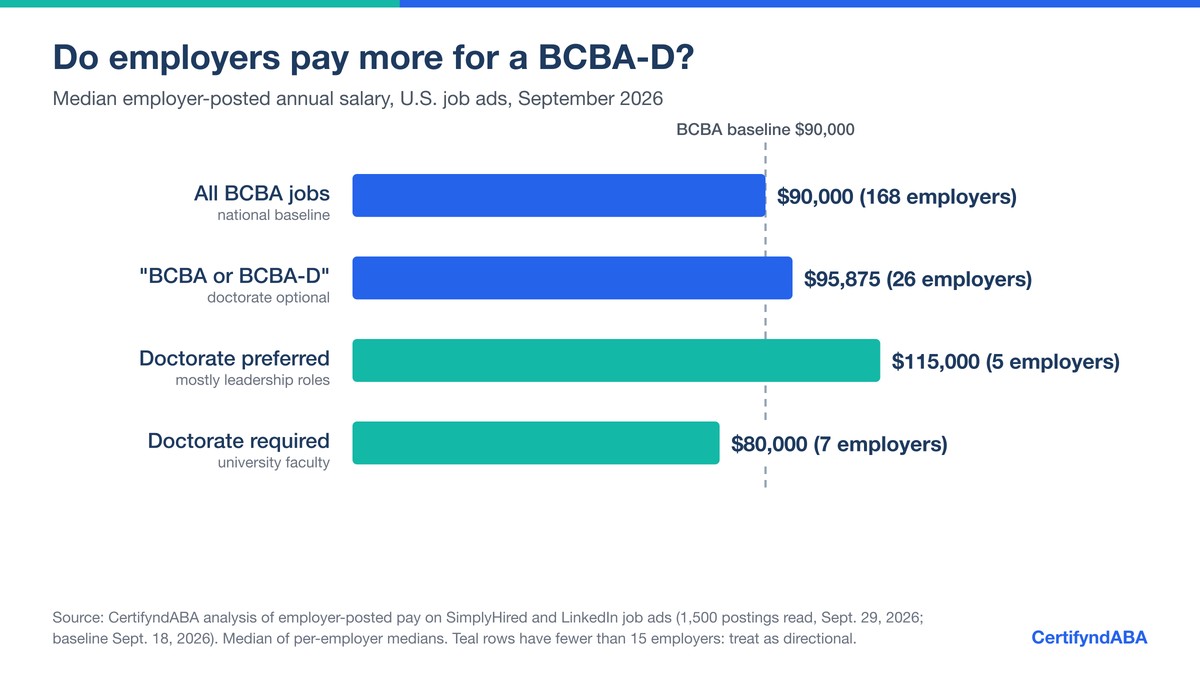
Three findings stand out:
- "BCBA or BCBA-D" is boilerplate. About half of the 317 postings that named the BCBA-D did not ask for it at all; the letters appeared in a founder's bio or a team description. Most of the rest listed it as an equal alternative to the BCBA. Those jobs paid a median of $95,875 across 26 employers, in line with ordinary BCBA and clinical director pay.
- Jobs that require a doctorate posted less, not more. Of 77 postings that required one, 57 were faculty or academic roles. Among the 7 universities that posted pay, the median was $80,000, with a wide range from $52,000 to $174,500. That matches the Bureau of Labor Statistics median for postsecondary psychology teachers, $80,340 in May 2025.
- The higher numbers line up with the job title. The five employers that preferred a doctorate posted a median of $115,000, but they were mostly clinical leadership and program director roles, which pay more for anyone. With samples this small, the job title is a likelier explanation for the pay than the credential.
The honest summary: we found no visible BCBA-D pay premium in employer-posted pay. A doctorate can lead to higher-paying roles, such as directing a program or running a research lab, but we saw no sign in posted pay that the designation by itself raises pay for the same kind of job. If you want to compare clinical offers, our BCBA salary by state data and salary negotiation guide will do more for your pay than the extra letter.
BCBA-D jobs: where the doctorate actually matters
Across the postings we read, a doctorate was a hard requirement in three kinds of roles:
- University faculty. Assistant professor, clinical assistant professor and program director posts in behavior analysis almost always require a doctorate, and many ask for the BCBA-D by name. This is by far the largest group.
- Academic medical and severe behavior programs. Hospital-based programs for severe problem behavior and feeding disorders often want a doctoral-level behavior analyst or psychologist to lead cases and research.
- Psychologist roles. Some autism organizations hire licensed psychologists for diagnostic evaluations. Those jobs require a PhD or PsyD and a state psychology license; the BCBA-D alone does not qualify you.
Where a doctorate was preferred rather than required, the jobs were adjunct and lecturer posts, academic program director roles, clinical director roles, and quality or compliance roles. For everyday clinical work, the BCBA is the working credential. The BACB's 2026 Lightcast report counted 132,307 U.S. postings that required or preferred a BCBA or BCBA-D in 2025, up 28% in a year. That report does not separate doctoral demand, but even in the 1,500 ads we pulled by searching for the BCBA-D and doctoral roles, only 99 required or preferred a doctorate. For a map of those roles, see what a BCBA does and the BCBA job outlook.
Demand in ABA is overwhelmingly for BCBAs. Very few job ads make a doctorate a condition of hiring.
Is the BCBA-D worth it?
The designation itself is cheap. If you already hold a qualifying doctorate and a BCBA, adding the "D" is a small application fee, a transcript request and $75 more at each recertification. It makes your doctoral training visible on the BACB registry, and faculty search committees look for it. For those people, it is an easy yes.
The doctorate is the real decision. The University of Nevada, Reno says its PhD in behavior analysis is "ordinarily achieved in six years" after a bachelor's degree. That is years of lower earnings while BCBA jobs are plentiful. A doctorate makes sense if you want to teach, run a research lab, lead a hospital program, or pursue psychology licensure. It is a weak bet if your goal is a bigger paycheck in clinical ABA, where we saw posted pay vary with job title, setting and location rather than degree level. See the highest-paying BCBA jobs for routes that raise pay without a doctorate.
Frequently asked questions
What does BCBA-D stand for?
BCBA-D stands for Board Certified Behavior Analyst-Doctoral. It is a designation added to BCBA certification for behavior analysts with a qualifying doctoral degree, not a separate certification.
Is there a separate BCBA-D exam?
No. The BACB approves the BCBA-D designation by reviewing your transcript and supporting documents. The only exam is the BCBA exam you pass to become certified.
Do BCBA-Ds make more than BCBAs?
We found no sign of it in posted pay. In a September 2026 review of 1,500 U.S. job ads, jobs listing "BCBA or BCBA-D" posted a median of $95,875 (26 employers), close to the $90,000 median for BCBA jobs. University faculty jobs that required a doctorate posted a median of $80,000, though only 7 of those employers listed pay. The higher figures we saw came with leadership titles. Posted pay does not show individual offers, so a doctorate may still help within a posted range.
How long does it take to become a BCBA-D?
It takes as long as earning a qualifying behavior-analytic doctorate plus BCBA certification. One accredited program, the University of Nevada, Reno, says its PhD ordinarily takes six years after a bachelor's degree. Once you apply, BACB review takes up to two weeks.
Can a BCBA-D diagnose autism?
Not on the strength of the BCBA-D. The designation grants no privileges beyond the BCBA, and diagnosis is generally outside behavior-analytic practice. Washington's licensing law, for example, excludes diagnosis of a mental or physical disorder from the practice of applied behavior analysis. BCBA-Ds who diagnose do so under a separate license, such as a psychology license.
Does any doctorate qualify for the BCBA-D?
No. You need a doctorate from an ABAI-accredited program, a doctorate with a behavior-analytic dissertation plus coursework, mentorship or publications, or a doctorate followed by 1,800 postdoctoral ABA hours and two behavior-analytic publications.
Can a BCBA-D use the title Dr.?
The BACB has no rule on the title. Use of "Dr." follows from your doctoral degree and state law, not from the designation. The BACB Ethics Code does require behavior analysts to represent their credentials accurately.
The bottom line on the BCBA-D
The BCBA-D is a label for a doctorate, not a promotion. It carries the same scope, the same exam and the same rules as the BCBA, and only about 1 in 27 U.S. BCBAs holds it. If your career runs through a university or a research program, it matters. If it runs through clinical ABA, your experience, specialty and negotiating position matter more, and employers are competing hard for BCBAs at every degree level.
Showcase your verified credentials to employers
BCBA or BCBA-D, your certification is in demand. Build a free, anonymous CertifyndABA profile and let employers send you interview requests with pay up front.
Create Your Free ProfileSources
- Behavior Analyst Certification Board. (2026). BCBA Handbook (updated June 2026), BCBA-D designation sections and fees.
- Behavior Analyst Certification Board. Board Certified Behavior Analyst.
- Behavior Analyst Certification Board. BACB certificant data, U.S. rows by region, retrieved September 29, 2026.
- Behavior Analyst Certification Board. (2018). March 2018 newsletter (fee schedule).
- Behavior Analyst Certification Board. Upcoming changes.
- Behavior Analyst Certification Board. (2026). US employment demand for behavior analysts: 2010-2025. Prepared using Lightcast data.
- Behavior Analyst Certification Board. Ethics Code for Behavior Analysts.
- Association for Behavior Analysis International. Accredited programs.
- U.S. Bureau of Labor Statistics. Occupational Employment and Wages, May 2025: Psychology Teachers, Postsecondary (25-1066).
- Washington State Legislature. RCW 18.380.010, definitions.
- University of Nevada, Reno. Behavior Analysis PhD.
- CertifyndABA analysis of employer-posted pay in 1,500 SimplyHired and LinkedIn job postings, September 29, 2026; BCBA baseline from 168 employers, September 18, 2026.