
Indiana has about three-fifths of Ohio's population and more board certified behavior analysts than Ohio does. Ohio has just 12.9 BCBAs for every 100,000 residents, far below the national 22.7, and you might expect a shortage like that to push pay up. It does not appear to have. The best current evidence on the BCBA salary in Ohio is what employers write into their own job postings: a median base salary of about $80,000 across 27 closed salary ranges we read on September 15, 2026, or roughly $82,500 to $85,000 if reposts are counted separately. Indeed's modeled figure for Ohio, $83,594, sits about 9 percent below its figure for the country as a whole, and still about 2 percent below after adjusting for Ohio's lower prices.
So Ohio is short of analysts without paying a premium for them. This guide looks at what sits behind that. We cover what employers are posting by metro, why the published salary figures for Ohio disagree by nearly two to one, and how far the money goes once cost of living is counted. We also look at the state's unusually thin BCBA workforce and at a Medicaid program that pays for ABA without ever having adopted an ABA rate. The certificate you need before you start is covered near the end.
BCBA salary in Ohio: what employers are posting in 2026
On September 15, 2026, we read about 250 BCBA-level job listings in and around Ohio. Many of them were the same job reposted on several boards or in several cities, so we collapsed those into one row each. We counted a pay figure only when the employer stated it: in the job description, on its own careers site, or in the pay field an employer fills in on a job board. We ignored every job-board estimate and every listing from a staffing agency. We left director and lead roles out entirely, and we kept hourly pay, "up to" figures and bonus-inclusive totals out of the median; those are covered below.
That left 27 line BCBA roles from 25 employers that stated a closed annual base range. Their median midpoint is $80,000. The middle half runs from about $77,200 to $85,000. The lowest midpoint was $66,300 and the highest $105,000, and a typical posted band ran from about $75,000 at the bottom to about $87,000 at the top.
The number is reasonably stable. Counting each employer once gives $80,000, and using only figures written into the job description or on the employer's own site gives roughly $79,000 to $80,000. Using only job-board pay fields gives $82,500, slightly higher, for a reason we explain below. The figure moves up to roughly $82,500 to $85,000 if reposts are counted as their own rows, which is how our Indiana and North Carolina salary guides counted, so read Ohio's advertised base pay as about $80,000 to $85,000.
Three limits are worth stating plainly. First, this measures advertised base pay, which is an offer band rather than a workforce average. Second, several of the largest job boards blocked automated reading, so the sample leans on LinkedIn, an Indeed-network mirror site and employers' own career pages. A large employer that posts pay only on the blocked boards could be missing. Third, 27 ranges is a small sample, below the 40 we aim for, so treat the metro figures in particular as directional.
Columbus posts the highest salaries
Columbus has the strongest figure in the state: a median midpoint of $92,500 across seven postings from seven different employers. Cincinnati, counting Ohio-side postings only, comes in at $83,750 across six employers. Cleveland gave us the most rows, 12 roles from 11 employers, at a median of $82,500. Dayton, Akron, Toledo, Youngstown and the smaller cities each produced four postings or fewer, which is too few to support a figure of their own. When a single job was posted in several metros, we counted it once in each.
Setting shows up clearly in the Cleveland numbers. Three of the four lowest midpoints in the state came from Cleveland-area schools: a nonprofit autism school program, a private autism school and a charter school network, with midpoints between $66,300 and $70,702. One of them pays a flat $70,000 for a 10-month school year, with extra pay for summer sessions. School-based roles often run on a school calendar, and they pull northern Ohio's median down. If you are weighing a school-based BCBA job, compare it on a per-month basis.
Hourly roles are a different market
Nine Ohio postings paid BCBAs by the hour, two of them statewide remote roles, with a median midpoint of $60 an hour and midpoints ranging from $45 to $75. Several are part-time, remote or hybrid roles. Do not multiply them by 2,080 hours to get a salary. One Akron-area practice advertised "$38-55/hr" and converted that itself to $79,000 to $114,000 of "annual income," which assumes 2,080 paid hours a year. Our guide to BCBA hourly rates explains how to compare the two kinds of offer.
Read the label: base salary or total compensation
Job-board pay fields in Ohio regularly show something other than base salary, and we logged more than two dozen cases where a field disagreed with the employer's own posting. Four examples show the pattern.
- A field that overstates even the bonus total. A multi-state center chain's Columbus-area posting says "Total Compensation: $70,000 – 108,000, including base salary and achievable bonuses." The job-board pay field on the same ad reads "$77,000 - $119,000 a year."
- Bonus pay presented as salary. A Dayton-area provider's field reads "$70,000 - $101,000 a year." Its posting separates the parts: an annual salary of $70,000 to $77,000 plus an individual bonus of $7,000 to $18,000.
- A range the employer never stated. The Cleveland autism school above pays a flat $70,000 for ten months. The job-board field shows "$60,000 - $70,000 a year."
- A marketing ceiling copied everywhere. One employer posted a single "Up to $104,000" BCBA ad in dozens of Ohio cities. Its Michigan copies say "Up to $140,000" and its Pennsylvania copies "Up to $135,200," which tells you the number is a recruiting line, not a pay band.
Four of the six Ohio total-compensation bands we found start at exactly $70,000. That is a sign the bottom of the range assumes no bonus at all. When an offer quotes a range, ask which part is guaranteed base pay and what you have to bill to earn the rest.
Why published BCBA salaries for Ohio disagree
Search for BCBA pay in Ohio and you will get answers ranging from under $69,000 to over $132,000. Most of that spread comes from sources measuring different things.

| Source | Ohio figure | What it actually measures |
|---|---|---|
| Salary.com (Board Certified Behavior Analyst) | $68,780 | An employer compensation model adjusted for geography |
| Glassdoor | $73,812 | Self-reported total pay, including bonuses, from 142 submissions |
| Employer postings (our harvest) | $80,000 | Median of 27 base salary ranges stated by employers, September 2026 |
| Indeed | $83,594 | A modeled figure from 856 job postings over 36 months |
| ZipRecruiter | $84,684 | A model built from job postings and third-party data |
| BLS proxy | $132,060 | The median for "Psychologists, All Other," a catch-all federal category |
Two patterns stand out. The models built from job postings, Indeed and ZipRecruiter, land a few thousand dollars above what employers write into the postings themselves. That fits the pay-field problems above: a model that reads bonus-inclusive fields as salary may drift high. Salary.com sits well below everyone else. Its 90th percentile for Ohio, $87,006, is only $3,412 above Indeed's typical figure. That does not mean one source is right and the rest are wrong. It means you should know which question each one answers before you bring it into a negotiation. Our BCBA salary negotiation guide covers how to use them.
The federal wage figure does not measure Ohio BCBAs
The Bureau of Labor Statistics has no occupation code for behavior analysts. Sites that quote a government figure for BCBAs usually borrow SOC 19-3039, "Psychologists, All Other." For Ohio that category reports a median of $132,060 in May 2025, which would make it the highest number in the table by more than $47,000.
It is not describing BCBAs. The category counts just 410 jobs in all of Ohio, while the state has 1,538 certified BCBAs, so even if every one of those jobs were held by a behavior analyst it would cover only about a quarter of them. Nationally, 45.2 percent of the jobs in the category sit in the federal executive branch, where the mean wage is $131,860, while offices of other health practitioners, the industry group that includes many ABA clinics, has a mean of $90,720. Ohio's median is also $9,340 higher than its mean, which is a sign that two different groups of workers share one code.
The metro figures make the point sharper. BLS publishes the code for only four Ohio metros, and Cincinnati's $185,390 is the same number at its median, 75th and 90th percentiles, so at least 40 percent of those jobs are recorded at a single wage. If you see $132,000 or $185,000 quoted as Ohio BCBA pay, it came from this category.
Where a BCBA salary in Ohio goes furthest
Ohio is cheaper than the country as a whole. The Bureau of Economic Analysis puts Ohio's price level at 92.8 against a national 100 for 2024, and every Ohio metro sits below the national average. Adjusting the employer-posted figures for local prices shows what each salary buys in average US dollars.
| Area | Employer-posted median | Postings (employers) | Price level (US = 100) | In US-average dollars |
|---|---|---|---|---|
| Columbus | $92,500 | 7 (7) | 95.5 | $96,890 |
| Cleveland | $82,500 | 12 (11) | 93.9 | $87,838 |
| Cincinnati (Ohio-side postings)* | $83,750 | 6 (6) | 95.4 | $87,816 |
| Ohio statewide | $80,000 | 27 (25) | 92.8 | $86,231 |
*Cincinnati's price level covers the full metro area, including its Kentucky and Indiana counties.
Columbus keeps its lead after the adjustment, while Cleveland and Cincinnati come out even. Outside the big three, prices fall further: Dayton sits at 92.7, Toledo at 91.5, Canton at 89.4 and Youngstown at 87.4. A salary that looks ordinary in Youngstown buys noticeably more than the same salary in Columbus. The metro samples are small, though. Indeed's models rank Cleveland slightly ahead of Columbus, so treat the gaps between the big three as directional rather than settled.
Ohio has fewer BCBAs than Indiana
Here is the fact from the top of this article in full. As of September 15, 2026, the Behavior Analyst Certification Board (BACB) counted 1,538 BCBAs living in Ohio. Indiana had 1,860. Ohio has about 11.9 million residents and Indiana about 7 million. Indiana has had more BCBAs than Ohio in every monthly BACB snapshot since January 2013, and both technician counts and an independent job-posting count point the same way.
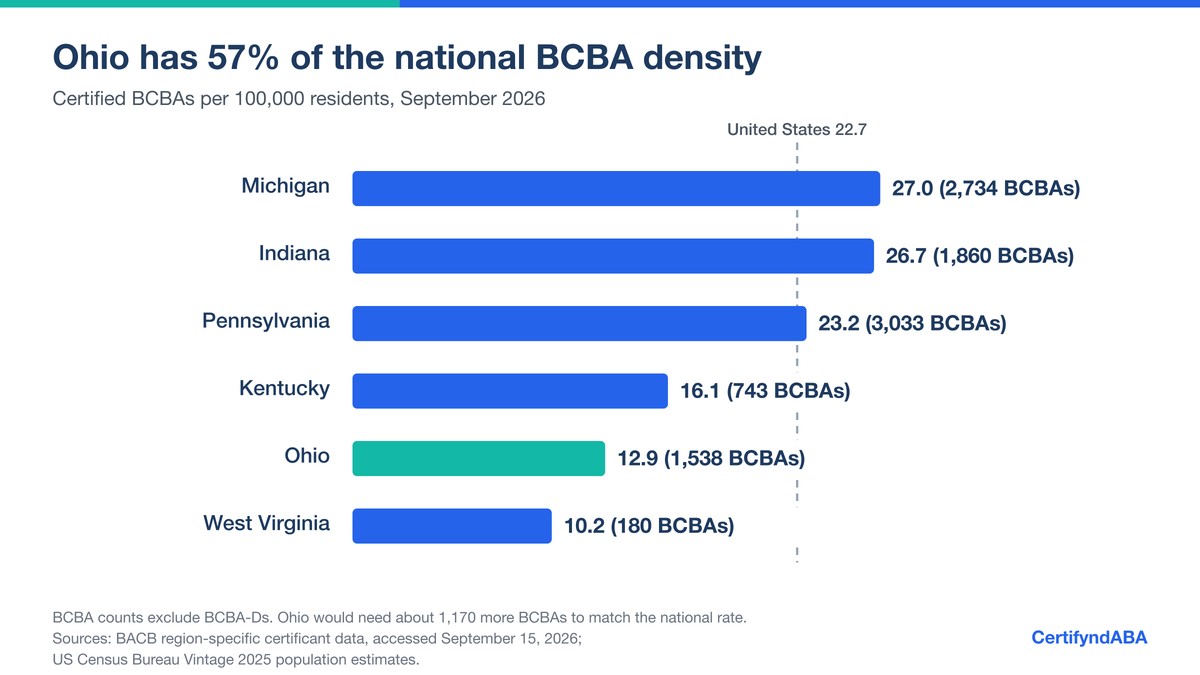
Measured per resident, Ohio has 12.9 BCBAs for every 100,000 people against 22.7 nationally, which ranks it 38th among the 50 states and Washington, DC. Ohio holds 3.48 percent of the US population but only 1.98 percent of its BCBAs. Matching the national rate would take about 1,170 more analysts. The workforce is growing quickly from a small base, up from 292 BCBAs in September 2016, a fivefold increase that outpaced the country. It is still a long way from average. For national context, see how many BCBAs there are.
But this is not a hiring squeeze
A thin workforce usually means employers fighting over every candidate. Ohio's job-posting data says otherwise. The BACB's employment demand report, prepared with the labor market firm Lightcast, counted 1,912 BCBA job postings in Ohio in 2025. That was up 7 percent from 2024, while national postings grew 28 percent.
Divide those postings by the state's certified BCBAs and BCBA-Ds at the end of 2025, and Ohio has about 1.27 postings for every analyst, against 1.77 nationally. That ranks 29th of the 30 states in the report, ahead of only Florida. This is our own calculation, and it compares a year of job ads with a count of certified people, so it is a measure of pressure rather than a count of open jobs. Measured per resident, Ohio had 16 BCBA postings for every 100,000 people, the lowest of all 30 states and well under half the national rate of 39. In 2025 Ohio's supply of analysts actually grew faster than its postings, 11.3 percent against 6.8 percent.
So Ohio is short of analysts and short of advertised demand at the same time. That combination is consistent with pay that shows no scarcity premium even though the state has so few BCBAs: employers do not appear to be bidding hard against each other. Ohio's funding picture, covered next, is a likely part of the reason.
What Ohio Medicaid pays, and why it matters for your offer
BCBA pay is ultimately bounded by what an employer collects for each billable hour, and Medicaid is a major payer for children's ABA. Ohio's program is unusual. Its Medicaid program has never adopted a rule for ABA and has never published an ABA fee schedule. The codes behavior analysts bill, 97151 through 97158, do not appear on the department's fee schedule.
Coverage runs instead through the seven managed care plans, which must cover ABA under the state's autism insurance law and federal child health requirements, according to department guidance issued in June 2018. Rates are negotiated with each plan and are not published. The department drafted ABA rules in 2017, November 2024 and May 2025, and never adopted any of them. The 2024 and 2025 drafts would have paid $27.28 per unit for BCBA protocol modification and $16.04 per unit for technician-delivered therapy. Those rates were never in effect. The department paused the 2025 draft citing projected budget shortfalls, and in July 2026 presented a stricter revision. The revision would require CARF or Joint Commission accreditation for provider organizations and diagnosis by a practitioner independent of the ABA provider. It would also set typical weekly hour ranges and prohibit billing ABA under community behavioral health codes.
Use is growing fast. Members with ABA claims rose from 1,341 in 2020 to 4,569 in 2025, and ABA-coded spending rose from $21.8 million to $99.6 million, according to the same department presentation. It is still small next to Indiana, whose Medicaid program spent $445 million on ABA in 2024, according to a state work group report. Per resident, that is roughly seven to ten times what Ohio Medicaid spent in 2024, depending on whether you include ABA billed under behavioral health codes. The two states define and count these programs differently, so read that as a funding gap that lines up with the workforce gap, not proof that one caused the other.
For a job seeker, the practical point is this. Without a public Medicaid rate, an Ohio employer's ability to pay depends on the contracts it has negotiated with individual plans. That likely makes pay more employer-dependent than in states with a published schedule. And the pending rule could add accreditation costs and close a billing workaround some providers use today. Ask any Medicaid-heavy employer how the July 2026 proposals would affect it.
Commercial insurance sets a floor for care, not for pay
Since April 6, 2017, Ohio law has required fully insured large-group and grandfathered health plans to cover ABA for children under 14 at a minimum of 20 hours a week. That is a floor, not a cap. Plans sold on the individual and small-group market cover ABA for children from birth to age 21 under the state's benchmark plan. No Ohio law sets what insurers must pay for that care. A pending bill, House Bill 453, would require commercial payers to pay at least 100 percent of the Medicaid fee schedule for ABA. As of September 2026 it had three committee hearings and had not passed the House, and there is still no Medicaid ABA fee schedule for it to point to.
The Autism Scholarship caps a third funding stream
Ohio also funds autism services through a state scholarship program. The Autism Scholarship Program paid $160.0 million for 6,016 students across 361 approved providers in fiscal year 2025, according to the Ohio Department of Education and Workforce. The maximum award rose to $34,000 per student for fiscal years 2026 and 2027. That spending covers all scholarship services, not ABA alone, and the program does not require providers to employ a BCBA. But a provider serving scholarship students has to fit behavior analyst supervision and technician hours inside a capped yearly amount per child, which limits the revenue behind those jobs.
Do you need a license to work as a BCBA in Ohio?
Ohio requires a state credential, but it is a certificate rather than a license. The Certified Ohio Behavior Analyst (COBA) certificate is issued by the State Board of Psychology under Ohio Revised Code Chapter 4783. Practicing as a behavior analyst without it can bring a fine and jail time. The requirements are straightforward for a current BCBA.
- A qualifying credential. Active BCBA certification is the usual route. There is a separate equivalence route and a route for people holding a license or certificate from another state.
- A jurisprudence workshop and exam. The Board runs a short workshop on Ohio law by video each month, followed by an exam.
- Background check and references. Fingerprint checks through the state and FBI, plus three reference letters.
- Fees and renewal. A $125 application fee and a $150 renewal every two years, due by August 31 of even-numbered years. Renewal requires 23 hours of continuing education, including 4 in ethics, professional conduct or cultural competency; active BCBAs are treated as having met the requirement.
There are useful exemptions. School employees working within their job do not need the certificate, and neither do technicians supervised by a certified analyst, graduate students, or staff of county developmental disabilities boards. Ohio's credential is also narrower than some states': unlike Texas and North Carolina, Ohio law does not recognize the Qualified Behavior Analyst credential from QABA. Our comparison of the QBA and the BCBA covers what that means. For how states that issue full licenses handle it, see our guide to becoming a licensed behavior analyst. Active COBA certificates grew from 643 in fiscal year 2020 to 1,472 in fiscal year 2025, according to the Legislative Service Commission.
What RBTs earn in Ohio
Across 55 Ohio employers hiring ABA technicians that posted pay, the typical registered behavior technician (RBT) or behavior technician role pays about $21 an hour, with the middle half of employers between about $19.90 and $22.50. The lowest employer averaged $16 and the highest $28. Large multi-site centers tended to sit at the bottom of that range, and smaller in-home providers near the top.
Two details matter more than the median. One provider pays $19 to $21 an hour for billable RBT time but $14 an hour for non-billable training and administrative time, and only the billable rate appears in the job-board field. Another employer's job-board field shows RBT pay as $40,248 to $44,512 a year. Those figures are its $19.35 technician and $21.40 RBT starting rates multiplied by 2,080 hours, not a salary. Ohio has 3.43 RBTs for every BCBA, close to the national 3.50, so supervision loads here are typical rather than heavy.
How to read an Ohio BCBA offer
- Separate base from bonus. If the range is "total compensation," ask for the base figure and the exact billable target behind the bonus.
- Ask for the billable-hours expectation in writing. Ohio postings we read ranged from "25-30 weekly billable hour goals" with caseloads of 6 to 8 clients, to "a maximum of 32 billable hours per week," to a 28-hour week with $75 an hour for extra billable hours. The same salary means very different workloads.
- Ask about payer mix. An employer funded mostly by Medicaid managed care, commercial insurance or scholarship students faces different rate pressure, especially with the July 2026 Medicaid proposals pending.
- Compare in real terms. Adjust a Columbus offer against a Dayton or Youngstown offer for local prices before deciding which pays more.
- Use the pay transparency rules where they exist. Ohio has no statewide law, but since October 27, 2025 Cleveland has required employers with 15 or more employees to include pay ranges in postings for jobs in the city. Columbus has passed a similar rule that becomes enforceable January 1, 2027.
For the broader Ohio job market, see our guide to BCBA jobs in Ohio. For a neighboring state built from employer postings too, see BCBA salary in Indiana. Our BCBA salary in Michigan guide covers that state through published salary estimates, and BCBA salary by state gives the national picture.
Frequently asked questions
How much does a BCBA make in Ohio?
Ohio employers advertise about $80,000 a year in base salary for line BCBA roles, based on the median of 27 employer-posted salary ranges in September 2026, with half falling between about $77,200 and $85,000. Counting reposts separately raises that to roughly $82,500 to $85,000. Published estimates range from $68,780 at Salary.com and $73,812 at Glassdoor, which counts total pay, to $83,594 at Indeed and $84,684 at ZipRecruiter.
Which Ohio city pays BCBAs the most?
Columbus posted the highest employer-stated salaries, with a median midpoint of $92,500 across seven employers, and it stays ahead after adjusting for local prices. Cincinnati came in at $83,750 and Cleveland at $82,500. Samples at the metro level are small, so treat the differences as directional.
Is Ohio a good state for BCBA jobs?
It is a mixed market. Ohio has only 12.9 BCBAs per 100,000 residents, well below the national 22.7, but it also had the fewest BCBA job postings per resident of the 30 states in the BACB's 2025 demand report. Advertised pay is close to Indiana's, and Indeed's modeled Ohio figure sits slightly below its national figure even after adjusting for Ohio's lower prices.
Do you need a license to work as a BCBA in Ohio?
You need a Certified Ohio Behavior Analyst certificate from the State Board of Psychology, which is a certificate rather than a license. Active BCBAs qualify after a jurisprudence workshop and exam, fingerprint checks, three references and a $125 application fee. School employees working within their job are exempt.
How much do RBTs make in Ohio?
About $21 an hour at the typical employer, based on pay posted by 55 Ohio employers hiring ABA technicians in September 2026, with the middle half between about $19.90 and $22.50 an hour. Some employers pay a lower rate for non-billable time, so ask whether the advertised rate covers all hours worked.
Why is the government salary figure for Ohio behavior analysts so high?
The Bureau of Labor Statistics has no occupation code for behavior analysts, so sites borrow "Psychologists, All Other," which reports an Ohio median of $132,060. That category counts only 410 jobs statewide, against 1,538 certified BCBAs, and nationally 45.2 percent of its jobs are in the federal government.
Do Ohio employers have to post salary ranges?
Not statewide. Cleveland has required pay ranges in job postings for positions in the city since October 27, 2025, for employers with 15 or more employees. Columbus has passed a similar rule that becomes enforceable January 1, 2027. Cincinnati and Toledo require employers to share the pay scale only when an applicant asks after a conditional offer.
The bottom line
An Ohio BCBA can expect employers to advertise about $80,000 to $85,000 in base salary, with Columbus near $92,500 and school roles well below the state median. Ohio's low prices make that worth more than it looks, about $86,000 to $92,000 in average US dollars. The state is short of behavior analysts, with a little over half the national density and fewer BCBAs than Indiana. But its employers do not appear to be competing hard for them, and thin ABA funding is a likely part of the reason: a Medicaid program with no published ABA rate, a commercial mandate that sets hours but not payment, and a capped scholarship.
That makes the details of each offer matter more than the state average. Separate base from bonus, get the billable target in writing, ask how the employer is funded, and compare offers in real terms. If the pending Medicaid rule or House Bill 453 changes what Ohio providers are paid, this market could look very different within a year.
See what Ohio employers will actually pay you
On CertifyndABA, employers come to you with the salary on the table. Build an anonymous profile and review real offers from Ohio providers without sending a single application or revealing who you are until you choose to.
Create Your Free Profile