


Ohio has a BCBA market that looks contradictory on paper: roughly 961 open positions on a single job board, statewide pay in the low-to-mid $80,000s, and yet only about 8% of Medicaid-eligible autistic children in the state can actually access ABA therapy. That gap between the need for services and the workforce delivering them is exactly why BCBA jobs in Ohio are plentiful, and why they are likely to stay that way.
This is not a cyclical hiring bump. It is a structural shortage of credentialed providers set against a rising rate of identified autism. Below is the honest picture for 2026: how many BCBAs Ohio has, how many jobs are open, what the work actually pays by metro, what is driving demand, and the one licensing step every BCBA needs before starting.
How Many BCBAs Are in Ohio, and How Big Is the Gap?
Nationally, the Behavior Analyst Certification Board (BACB) counted 85,587 active BCBAs as of July 1, 2026. Ohio holds a meaningful slice of that: aggregated BACB data put the state above 2,000 certified analysts as of 2023, and given the double-digit annual growth in certification nationwide, the 2026 figure is likely in the neighborhood of 2,600 to 2,900. Treat that as an estimate rather than an official count; the BACB publishes national totals more readily than exact state tallies.
On the demand side, Indeed listed roughly 961 behavior analyst BCBA jobs across Ohio at the time of writing. That is one board. ZipRecruiter and multi-board aggregations push the live-openings number higher, and postings churn and repost, so 961 is best read as a floor on active demand rather than a ceiling.
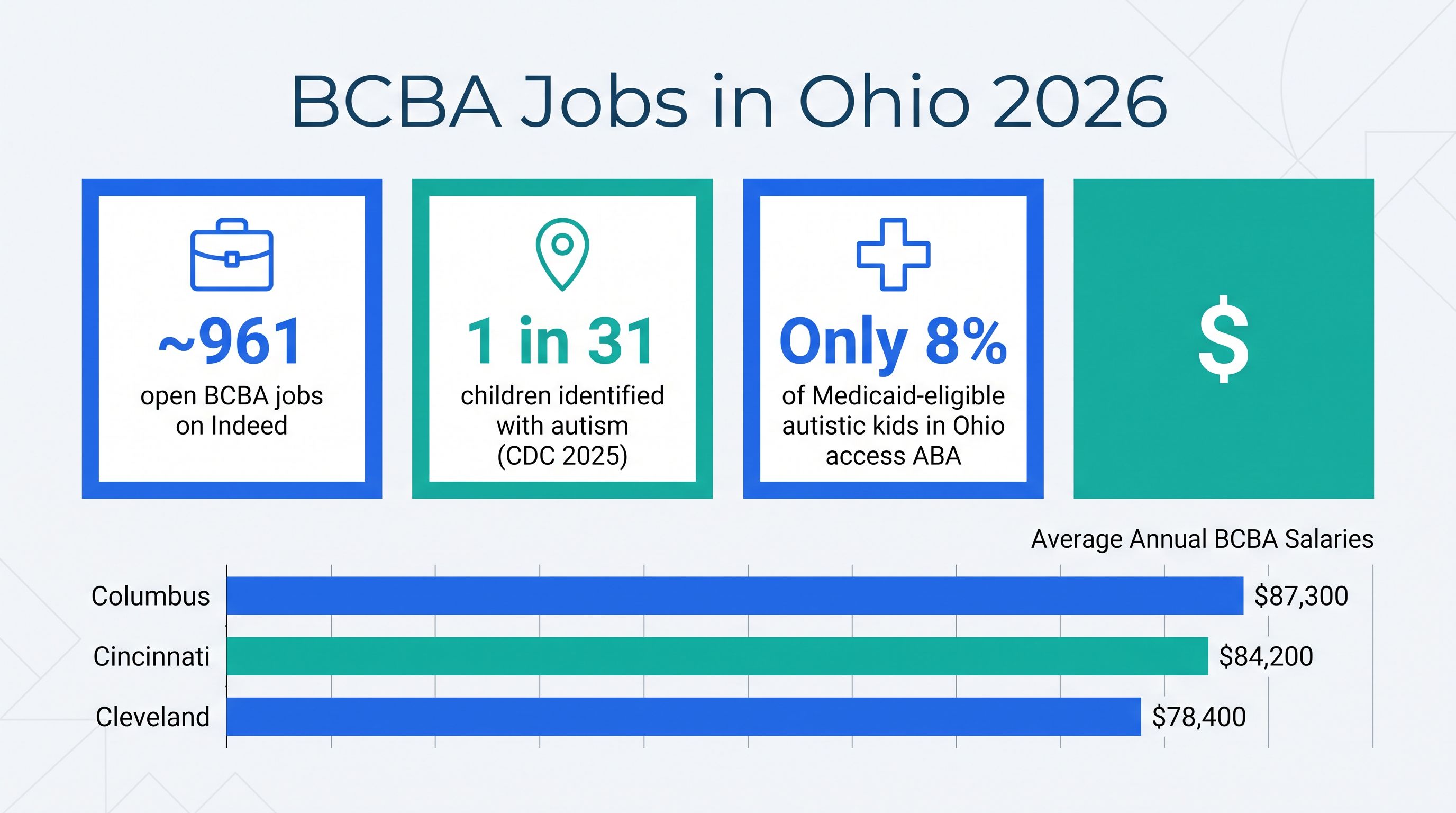
But the raw openings-per-analyst ratio undersells the real gap. The more telling number comes from Ohio's Medicaid data: fewer than 350 of the state's behavior analysts, about 24%, are credentialed with Medicaid. The providers exist; most simply are not reaching the largest population of eligible children. For a job seeker, that translates into leverage, especially if you are willing to carry Medicaid-funded caseloads.
"The shortage in Ohio is not a lack of jobs or a lack of pay. It is a lack of providers reaching the children who qualify for care."
What BCBAs Actually Earn in Ohio (2026)
Start with a caveat that most salary pages skip: there is no federal wage code specific to behavior analysts. The Bureau of Labor Statistics does not track "BCBA" as its own occupation, so every figure you see is an estimate built from job-board postings or survey models, and those methods disagree.
Statewide, ZipRecruiter puts the Ohio BCBA average near $84,700, while Salary.com's survey-based model lands closer to a $70,100 median. That spread is not error; it reflects advertised pay (which skews high) versus modeled survey pay (which skews toward the middle of the distribution). The truth for most BCBAs sits between the two.
| Ohio Metro | Average BCBA Salary | Notes |
|---|---|---|
| Columbus | ~$87,300 | Highest of the big three; fast-growing market |
| Cincinnati | ~$84,200 | Steady clinic and school demand |
| Cleveland | ~$78,400 | Largest single cluster of postings |
By experience, entry-level roles tend to open near $70,000 to $76,000, while experienced analysts and those on a clinical-director track reach $100,000 and up; the statewide 90th percentile sits around $126,000. Sign-on bonuses, billable-hour incentives, and remote or hybrid supervision roles can lift effective compensation beyond the base figure.
Where the Ohio BCBA Jobs Are
The three C's dominate hiring. Columbus is the fastest-growing market and pays the most of the big three. Cleveland carries the largest single cluster of postings, with well over 120 openings on one board at a time. Cincinnati rounds out the top tier with steady clinic and school demand.
Beyond the majors, real demand shows up in Dayton, Toledo, Akron, Canton, and the fast-growing Columbus suburbs. The settings vary widely:
- ✓ Center and clinic-based ABA:the largest employer category statewide.
- ✓ In-home services:common in suburban and mixed markets.
- ✓ School-based roles:district and Educational Service Center (ESC) contracts.
- ✓ Remote and hybrid supervision:a growing slice, useful for reaching rural caseloads.
Rural and Appalachian Ohio remain underserved relative to need. For a telehealth-capable BCBA, that is not a dead zone; it is an opening.
What's Driving BCBA Demand in Ohio
Three forces keep the pipeline full. First, autism identification keeps climbing: the CDC's 2025 ADDM report identified autism in about 1 in 31 eight-year-olds nationally, up sharply over the past decade. More identified children means more authorized ABA hours.
Second, coverage exists on paper. Ohio mandates ASD and ABA coverage, and Medicaid is the largest payer for children's ABA. Third, and most important for job security, that coverage is throttled in practice. According to the Ohio Autism Insurance Coalition, only about 8% of Medicaid-eligible autistic children in the state access ABA. Seven different managed-care plans apply inconsistent authorization rules, and 52% of Medicaid providers have reduced the number of children they serve because of reimbursement delays and heavy authorization scrutiny.
The Ohio License Rule Every BCBA Should Know (COBA)
Ohio requires a state license to practice as a behavior analyst: the Certified Ohio Behavior Analyst, or COBA. It is administered by the Ohio Board of Psychology and was established in 2013 under Ohio Revised Code Chapter 4783. Practicing without it is not permitted, so line it up before your start date.
The good news for most candidates: your national BCBA is the qualifying credential. With verification from the BACB, Ohio deems you to have met its education, supervised-experience, and examination requirements. For a current BCBA, the COBA is a filing and renewal step rather than a new set of exams or fieldwork. Budget time for the application, and confirm current fees and continuing-education rules directly with the Board.
How to Find and Land a BCBA Job in Ohio
The market favors candidates, so use that leverage deliberately:
- 1. Vet employer funding first. Given Medicaid authorization friction, ask how a provider is funded, what the caseload and billable expectations are, and what supervision ratios look like before you commit.
- 2. Target where the gap is widest. Medicaid-credentialed caseloads and telehealth-reachable rural regions offer the strongest leverage and the clearest mission fit.
- 3. Negotiate from the metro data. Benchmark against the Columbus, Cincinnati, and Cleveland figures above, and ask about sign-on, PTO, CE budget, and paid indirect or admin time, not just base salary.
Let Ohio employers come to you
Create an anonymous CertifyndABA profile and receive interview requests from Ohio ABA employers based on your qualifications. Your current employer never sees you looking, and you skip the resume-blasting entirely.
Create Your Free ProfileOhio BCBA Jobs: Frequently Asked Questions
How much do BCBAs make in Ohio?
Estimates range from about $70,100 (Salary.com survey median) to about $84,700 (ZipRecruiter posting average) statewide. Columbus is the highest-paying of the big three metros at roughly $87,300, followed by Cincinnati near $84,200 and Cleveland near $78,400. Because there is no federal wage code for behavior analysts, treat any single figure as an estimate.
Do I need an Ohio license in addition to my BCBA?
Yes. Ohio requires the Certified Ohio Behavior Analyst (COBA) license through the Ohio Board of Psychology. Your national BCBA is the qualifying credential, so with BACB verification the COBA is generally a filing and renewal step rather than new exams or fieldwork.
How many BCBA jobs are open in Ohio?
Roughly 961 behavior analyst BCBA jobs were listed on Indeed statewide at the time of writing. That is a single-board figure and a floor; ZipRecruiter and multi-board totals run higher, and postings repost frequently.
Where are most BCBA jobs in Ohio?
The Columbus, Cleveland, and Cincinnati metros hold the majority of openings, with Cleveland carrying the largest single cluster of postings. Dayton, Toledo, Akron, and Canton are meaningful secondary markets, and rural and Appalachian Ohio are underserved relative to need.
Is Ohio a good state for BCBAs?
On fundamentals, yes. Demand is strong, pay is competitive, and a documented access gap keeps the market durable rather than cyclical. The one real caution is Medicaid reimbursement and authorization friction, which can affect employer stability; vet how any provider is funded before you accept an offer.