

When you are comparing BCBA job offers, the annual salary number only tells part of the story. Your BCBA hourly rate reveals what you actually earn for each hour of clinical work, and in 2026, those rates vary widely. Depending on your experience, employment type, and location, BCBAs earn anywhere from $29 to over $100 per hour.
With 83,586 active BCBAs in the United States and an estimated two to three open positions for every certified analyst, hourly rates are climbing across nearly every market. Whether you are evaluating a W-2 position, weighing a 1099 contract offer, or considering private practice, understanding your true hourly rate is essential for making smart career moves.
Average BCBA Hourly Rate: The National Picture
The average BCBA hourly rate depends on which data source you consult. BCBA-specific salary platforms consistently report higher figures than broad government classifications.
Here is how the major platforms break down:
- PayScale: $48.43/hr average based on 213 BCBA-certified respondents (May 2026), with a reported range of $26 to $82/hr
- Glassdoor: approximately $51/hr ($105,656 annually), including total compensation from employee reports
- ZipRecruiter: $42.82/hr ($89,075 annually) based on aggregated job posting data
- Salary.com: $32/hr median ($66,765 annually); however, this reflects a broader job category rather than BCBA-specific positions
For a comprehensive look at annual figures, see our full BCBA salary guide.
BCBA Hourly Rate by Experience Level
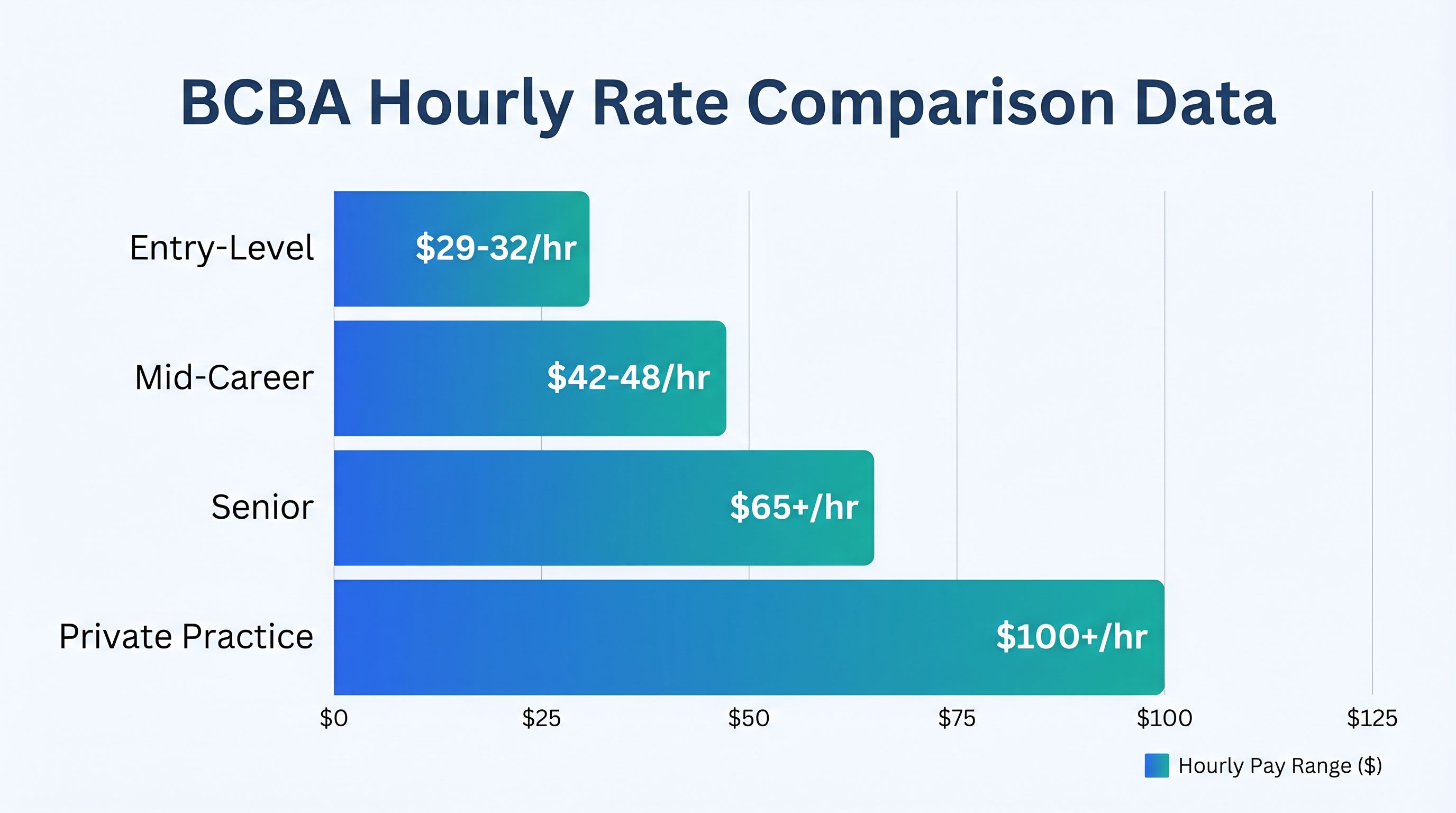
Experience has a dramatic impact on BCBA hourly pay. Senior BCBAs earn roughly double what new graduates make, reflecting the value of supervision capabilities and clinical depth.
| Experience Level | Estimated Hourly Rate | Annual Equivalent |
|---|---|---|
| Entry-Level (<1 year) | $29 - $32/hr | $61,000 - $66,000 |
| Early Career (1-2 years) | $33 - $38/hr | $68,000 - $79,000 |
| Mid-Career (2-4 years) | $42 - $48/hr | $88,000 - $100,000 |
| Experienced (5-8 years) | $49 - $55/hr | $102,000 - $115,000 |
| Senior (8+ years) | $65+/hr | $135,000+ |
Data sources: Salary.com (June 2026), PayScale, and aggregated job posting data.
 \n
\n Even entry-level BCBAs start with strong negotiating leverage thanks to the ongoing employment gap. For more on starting compensation, read our BCBA starting salary breakdown.
W-2 vs. 1099 BCBA Hourly Rates: The Real Comparison
This is where most BCBA hourly rate discussions fall short. A $75/hr contract offer and a $45/hr salaried position might look very different on paper, but after taxes and benefits, they can be surprisingly close in take-home pay.
Typical W-2 hourly rates: $35 to $55/hr. This includes employer-paid benefits like health insurance, retirement contributions, paid time off, and the employer's share of payroll taxes.
Typical 1099 contractor hourly rates: $65 to $90/hr. Contractors must cover their own taxes, insurance, retirement, and continuing education costs.
The biggest difference is self-employment tax. W-2 employees pay 7.65% in payroll taxes while their employer matches that amount. As a 1099 contractor, you pay the full 15.3% yourself (12.4% Social Security plus 2.9% Medicare).
A practical example: A BCBA earning $45/hr as a W-2 employee with a benefits package worth 30% of salary has a total compensation value of roughly $58.50/hr. A 1099 contractor would need to bill $60 to $65/hr to match that after covering self-employment tax, health insurance ($300 to $700/month), retirement contributions, and CEU costs.
For more on the employment structure question, see our guide on BCBA independent contractor vs. employee considerations.
BCBA Hourly Rates by Work Setting
Where you work affects both your hourly rate and how many hours you actually bill. A higher rate with more billable hour expectations does not always mean better take-home pay.
| Work Setting | Hourly Rate (W-2) | Typical Billable Hrs/Wk |
|---|---|---|
| Clinic-Based | $38 - $50/hr | 27 - 30 |
| Home/Community-Based | $40 - $55/hr | 23 - 27 |
| School District | $35 - $48/hr | Varies (10-month contract) |
| Telehealth | $35 - $50/hr | 25 - 30 |
| Hospital/Healthcare | $40 - $55/hr | 25 - 28 |
| Private Practice (Own Clients) | $100+/hr billing rate | 20 - 25 |
According to Passage Health, private practice BCBAs can generate $96,000 to $120,000 in gross annual revenue billing 20 to 25 hours per week at $100+/hr over 48 billing weeks. After overhead, the effective rate is closer to $65 to $80/hr.
The billable hours factor matters more than many BCBAs realize. A $45/hr position requiring 30 billable hours per week leaves little time for documentation, supervision, and professional development. The same rate with 25 billable hours may feel significantly more sustainable. According to Partners ABA, 66% of BCBAs prefer 23 to 28 billable hours per week.
Interested in flexible scheduling? Explore part-time BCBA jobs and telehealth BCBA positions.
BCBA Hourly Rate by State
Geography plays a significant role in BCBA hourly pay, though cost of living often offsets the headline numbers in higher-paying states.
Highest-paying states and metros:
- Washington, DC: $73,923 annually (~$36/hr median per Salary.com)
- California: $73,642 annually (~$35/hr); top metros like San Jose reach $84,000+
- Massachusetts: $72,661 annually (~$35/hr)
- Washington state: ~$100,886 annually (~$49/hr per ZipRecruiter)
- Alaska: $79,220 median per BLS (highest in BLS data)
Top metro areas: San Jose ($84,000+), San Francisco ($83,000+), Oakland ($81,000+), and New York City ($77,000+) according to AppliedBehaviorAnalysisEdu.org.
Keep in mind that these figures reflect W-2 averages. Independent contractors in all states will command rates 25 to 40% higher to compensate for the lack of benefits. For detailed state breakdowns, explore our guides on BCBA salaries in California, Texas, Florida, and New York, or see the full BCBA salary by state comparison.
How to Calculate Your True BCBA Hourly Rate
Your posted hourly rate is not your true hourly rate. Here is a five-step framework to calculate what you actually earn per hour of work.
Step 1: Find your gross hourly rate. If you are salaried, divide your annual pay by 2,080 (40 hours per week times 52 weeks). A $90,000 salary equals $43.27/hr gross.
Step 2: Factor in billable vs. total hours. If you bill 25 hours but work 40, your effective billing rate is 62.5% of your posted rate. Non-billable time includes documentation, team meetings, parent consultations, and drive time.
Step 3: Adjust for employment type. For 1099 contractors, subtract self-employment tax (15.3%), health insurance premiums ($300 to $700/month), retirement contributions, and CEU costs. For W-2 employees, add the value of employer-provided benefits (typically 25 to 35% of salary) to see your total compensation.
Step 4: Account for unpaid work time. Driving between clients, after-hours documentation, and weekend email responses all reduce your effective rate. Track these hours for one month to get an accurate picture.
Step 5: Compare apples to apples. Use this formula to compare a W-2 offer with a 1099 contract:
Real-world example: BCBA A earns $45/hr as a W-2 employee with health insurance, 401(k) matching, and PTO. BCBA B earns $75/hr as a 1099 contractor. After BCBA B pays self-employment tax (~$11.50/hr), health insurance (~$3/hr), and retirement contributions (~$3/hr), the effective rates are closer than the headline numbers suggest. BCBA B nets roughly $57.50/hr but gains more schedule flexibility and a higher earning ceiling.
Why the BCBA Shortage Is Pushing Hourly Rates Higher
The math behind rising BCBA hourly rates is straightforward: there are not enough BCBAs to fill available positions.
The Behavior Analyst Certification Board reports 83,586 active BCBAs as of April 2026. Industry estimates suggest there are two to three open positions for every certified analyst. This gap exists because state insurance mandates for ABA therapy continue expanding, creating demand faster than graduate programs can produce new BCBAs.
The result is a competitive labor market where employers are raising hourly rates, offering sign-on bonuses, providing relocation packages, and adding student loan assistance to attract talent. The 2026 hourly rate floor is higher than 2024 and 2025 levels across most markets. For BCBAs, this translates directly into negotiating leverage; if an offer does not meet your expectations, other employers are likely to compete for your credentials.
Learn more about the supply-demand picture in our analysis of BCBA workforce data, or explore which positions offer the best compensation in our highest-paying BCBA jobs guide.
Getting the BCBA Hourly Rate You Deserve
BCBA hourly rates in 2026 range from $29/hr for new graduates in W-2 positions to $100+/hr for private practitioners. Most mid-career BCBAs earn between $42 and $55/hr as employees.
The most important takeaway: compare offers on total compensation, not just the headline hourly number. Factor in benefits value, billable hour expectations, and employment type before making a decision. And with the ongoing employment gap giving BCBAs significant leverage, always negotiate. For strategies on how to approach that conversation, read our BCBA salary negotiation guide.
See What Employers Are Actually Paying
CertifyndABA is an anonymous reverse marketplace where BCBAs receive interview requests with transparent salary ranges. See real offers from employers before you reveal your identity.
Create Your Free Profile