


Most behavior consultant jobs do not require a BCBA. On October 21, 2026, we read every behavior consultant and behavioral consultant job ad we could find on SimplyHired, one per employer. Of 75 employers, only 7 (9%) required the BCBA and nothing else. Half asked for a master's degree and no credential at all.
That surprises people who assume "behavior consultant" is another name for a Board Certified Behavior Analyst. Sometimes it is. More often, it is a job title that state Medicaid programs and school districts define on their own terms. This guide covers what a behavior consultant does, where the jobs are, what employers require and pay, and how the role fits into a BCBA career.
- 59% of employers were in just two states: Pennsylvania (24) and Indiana (20). Both use "behavior consultant" as a Medicaid service title.
- Only 9% required the BCBA alone. 49% required a master's degree with no license or certification.
- Median posted pay was $36.00 an hour (59 employers posted pay). Contract roles posted $57.50; employee roles posted $31.38.
- The 8 ads that required a BCBA or BCaBA paid a median of $52.50 an hour, against $34.93 for ads that required neither.
What is a behavior consultant?
A behavior consultant assesses why a behavior happens and writes the plan that other people carry out. In most ads, the consultant does the functional behavior assessment, writes the behavior support or treatment plan, trains the family, teachers, or direct staff to use it, and reviews the data to revise it. The consultant is usually not the person in the room every day. That is the job of a behavior technician, behavior interventionist, or direct support professional.
"Behavior consultant" is a job title, not a credential. No national board issues it, and we found no state law that protects it as a title. The BACB issues four credentials (RBT, BCaBA, BCBA, and BCBA-D), and it tells certificants not to invent variations on those marks. So the answer to "Is a behavior consultant a BCBA?" depends on who is hiring:
- ABA agencies often use the title for a BCBA, a BCaBA, or a master's-level clinician on the way to the BCBA.
- Pennsylvania uses it for a Medicaid service for children, which needs a Pennsylvania license, not a BCBA.
- Indiana uses it for a Medicaid waiver service for people with developmental disabilities, which needs a master's degree or a mental health license.
- School districts use it for a district behavior specialist who may hold a teaching license, a school psychology or social work credential, or a BCBA.
Where behavior consultant jobs are
The title is regional. We searched all 50 states and DC with two phrasings and found title-matched ads from 75 employers in 16 states. Two states produced most of them.
| Type of employer | Employers | Median posted pay |
|---|---|---|
| Pennsylvania IBHS providers (children's behavioral health) | 23 | $38.00/hr (n=18) |
| Indiana Medicaid waiver providers (developmental disabilities) | 21 | $56.50/hr (n=17) |
| ABA and autism agencies | 12 | $31.50/hr (n=7) |
| Adult disability and mental health agencies in other states | 12 | $31.01/hr (n=11) |
| Schools, districts, and school consultation teams | 7 | $33.20/hr (n=6) |
One Indiana waiver provider in the table posted from Cincinnati, Ohio, and one Pennsylvania adult-services ad is counted with the adult agencies. Outside Pennsylvania and Indiana, the title showed up in California (8 employers), Vermont (4), Maryland (3), and Massachusetts (3), with one or two each elsewhere.
Pennsylvania: behavior consultant is an IBHS service
Pennsylvania's Intensive Behavioral Health Services (IBHS) regulations, which replaced the older BHRS program, define a "behavior consultation" service for children and youth. The consultant role used to be called the behavior specialist consultant, or BSC, and many ads still pair it with the mobile therapist role. Under 55 Pa. Code § 5240.81(e), a behavior consultant who provides ABA services must be licensed in Pennsylvania as a psychologist, professional counselor, marriage and family therapist, clinical social worker, social worker, behavior specialist, or certified registered nurse practitioner. The license must come with one of three things: a BCaBA-level certification, ABA experience plus ABA coursework, or one year of experience under a BCBA-level supervisor plus 40 hours of approved ABA training.
Not every Pennsylvania ad was for the ABA version of the service. Non-ABA behavior consultation (§ 5240.71) accepts a wider set of qualifications, including a BCBA or a graduate degree in ABA, which is why some Pennsylvania ads list five or six ways to qualify. Nine of the 24 Pennsylvania employers (38%) required a state license at hire. Many others hired master's-level clinicians and offered free supervision toward the LBS, LPC, or LCSW.
Indiana: behavior consultant is a waiver service
Indiana's Medicaid waivers for people with intellectual and developmental disabilities pay for "behavioral support services," and providers call the clinicians who deliver them behavior consultants. The rule, 460 IAC 6-5-4, sets two levels. A Level 1 clinician must be a licensed psychologist with a health service provider endorsement. A Level 2 clinician needs a master's degree in psychology, special education, social work, or counseling, or a license as a marriage and family therapist, clinical social worker, or mental health counselor, and works under a Level 1 clinician. The rule text does not mention the BCBA.
That is why 19 of 21 Indiana waiver ads asked for a master's degree and nothing more. It is also why they paid the most: 11 of the 21 were independent contractor roles paid per billable hour.
Behavior consultant requirements
We hand-coded the minimum credential each employer required at hire. We ignored anything listed only as "preferred."
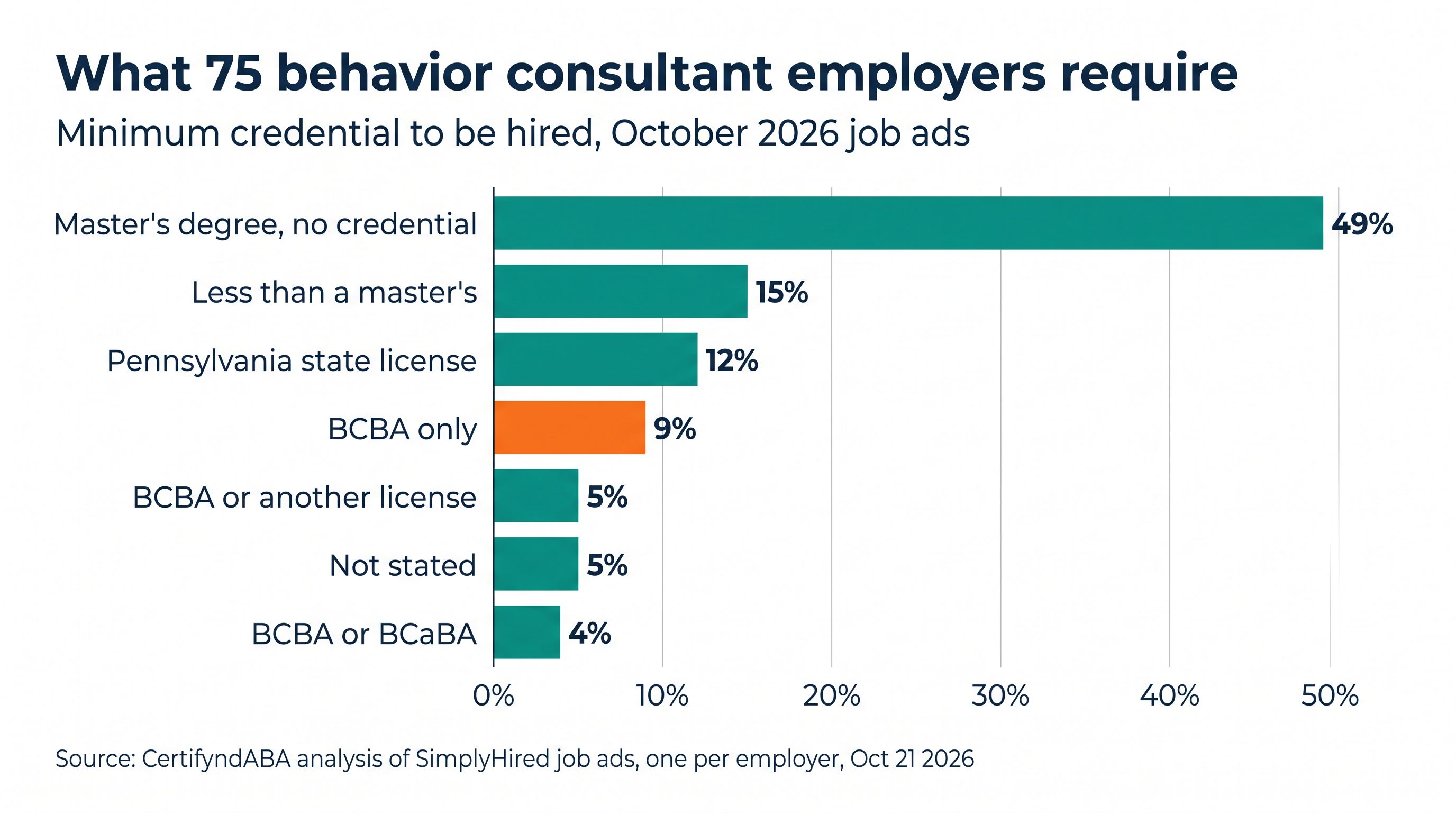
- Master's degree, no credential: 37 employers (49%). Mostly Indiana waiver and Pennsylvania IBHS providers. Several ABA agencies also hire master's-level consultants who are enrolled in BCBA coursework.
- Less than a master's: 11 (15%). Bachelor's-level consultant roles at California ABA agencies, adult disability agencies, and one therapeutic school, plus a Pennsylvania assistant behavior consultant role. One California agency used the title for an RBT job.
- A Pennsylvania license: 9 (12%). All in IBHS, most often the LBS.
- The BCBA alone: 7 (9%). Two Maryland developmental disability agencies, two Massachusetts ABA agencies, a Virginia adult program (BCBA plus a Virginia license), a California residential program, and a Vermont mental health agency.
- The BCBA or another professional credential: 4 (5%). For example, a Maryland agency accepted a BCBA, LCPC, LCSW-C, or registered psychology associate, and an Oregon district accepted a teaching license or a BCBA.
- The BCBA or BCaBA: 3 (4%). Including a New Jersey school consultation team that paid BCaBAs from $40 and BCBAs from $45 an hour.
- Not stated: 4 (5%).
Many ads that did not require a BCBA still preferred one, paid more for one, or offered supervision toward one. If you are a BCBA, you qualify for most of these jobs in practice. The exception is Pennsylvania IBHS, where you also need a Pennsylvania license.
Behavior consultant salary
Of the 75 employers, 59 posted pay. The median was $36.00 an hour, and the middle half of ads fell between $29.00 and $56.50. At 2,080 hours, $36.00 is about $74,880 a year. That figure flatters the field, because the highest rates were contract rates.
A contract rate is not the same as a wage. Seventeen employers, mostly Indiana waiver providers, hired behavior consultants as 1099 independent contractors. One Indiana provider said plainly that it provides no workers' compensation or insurance of any kind, and that the contractor pays the costs of meeting the job's requirements. You are paid for billable hours, so drive time and documentation time may be unpaid. Before comparing a $60 contract rate to a $60,000 salary, read our guide to independent contractor vs. employee BCBA jobs and price in your own liability insurance.
Credentials moved pay in our sample:
- The 5 BCBA-only ads that posted pay had a median of $72.50 an hour. That is a small group, and it included contract rates.
- The 8 ads that required a BCBA or BCaBA had a median of $52.50, against $34.93 for the 44 ads that required neither.
- Some employers posted a ladder. One Pennsylvania IBHS provider posted $30 an hour unlicensed, $35 licensed, and $40 with a BCBA. Another posted $60 an hour with the LBS and $85 with a BCBA.
For comparison, Indeed lists an average base salary of $71,159 a year for behavioral consultants and $92,019 for BCBAs (both updated October 2026). Our own analysis of 595 employers' BCBA job ads found a median of $89,934. A salaried behavior consultant job that does not require the BCBA usually pays well below a BCBA job.
The supply gap behind behavior consultant jobs
Employers write "behavior consultant" ads that accept a master's degree or a state license partly because there are not enough BCBAs to go around. The BACB reported 81,954 BCBAs and BCBA-Ds in the United States on October 21, 2026 (78,907 BCBAs and 3,047 BCBA-Ds). Its Lightcast report counted 132,307 US job postings for behavior analysts in 2025. That is about 1.6 postings for every certificant.
Pennsylvania (5,012 postings for 3,194 BCBAs and BCBA-Ds, or 1.57) and Indiana (2,954 for 1,910, or 1.55) sit near that national average. The gap is wider elsewhere: Maryland had about 3.5 postings per certificant in our mid-October count, and North Carolina about 2.9. Postings are not the same as open positions, since one job can be posted more than once. The direction is clear, though. Demand for behavior-analytic work is larger than the supply of BCBAs, and state programs fill part of the gap with other licensed or master's-level clinicians.
How to become a behavior consultant
- Decide which kind of behavior consultant you want to be. An ABA agency role, a Pennsylvania IBHS role, an Indiana waiver role, and a school district role have different rules.
- Earn a master's degree. Choose ABA, psychology, special education, social work, or counseling. About 7 in 10 employers in our sample required at least a master's degree, directly or through the license or certification they asked for.
- Pick up the state license that the local market needs. In Pennsylvania, that usually means the LBS. In Indiana, an LMHC, LCSW, or LMFT moves you past the master's-only tier.
- Complete BCBA coursework and fieldwork if you want the widest set of options. The BCBA unlocks ABA agency, school, and adult disability roles in many states. Our guide to how to become a BCBA covers the steps, and the fieldwork requirements explain how supervised hours count.
- Ask about supervision before you accept. Many consultant jobs offered free supervision toward the LBS, LPC, LCSW, or BCBA. That benefit is worth real money and time.
Let qualified employers reach out to you
On CertifyndABA, employers send you interview requests that state the role, setting, and pay up front. Your profile stays anonymous until you accept.
Create your free profile →How to read a behavior consultant job ad
Because the title means different things, read past it. Look for five details:
- The funding source. "IBHS," "BHRS," or "mobile therapist" means a Pennsylvania children's behavioral health role. "Waiver," "BDDS," or "behavior management" means a developmental disability role. "Insurance" or "autism" usually means an ABA agency.
- Who writes the plan. If the ad says you work "under the direction of the BCBA" and present data to the BCBA, it is closer to a senior technician or case manager role.
- Employee or contractor. Look for "1099," "independent contractor," or "per billable hour."
- Pay by credential. If the employer posts a ladder, you can see what a license or a BCBA is worth there.
- Supervision. Free supervision toward a license or the BCBA is one of the most common benefits in these ads.
Related roles have their own guides: behavior specialist, behavior interventionist, and BCBA jobs.
Frequently asked questions
What does a behavior consultant do?
A behavior consultant assesses challenging behavior, writes a behavior support or treatment plan, trains families, teachers, or staff to use it, and reviews data to update it. Most consultants supervise the people who carry out the plan day to day.
Is a behavior consultant a BCBA?
Not always. "Behavior consultant" is a job title, and the BCBA is a BACB certification. In our sample of 75 employers, only 7 required the BCBA alone and 49% required a master's degree with no credential.
How much do behavior consultants make?
The median posted pay in our October 2026 sample was $36.00 an hour. Contract roles posted a median of $57.50 an hour without benefits, and employee roles posted $31.38.
What do you need to be a behavioral consultant?
Usually a master's degree in ABA, psychology, special education, social work, or counseling. Pennsylvania IBHS roles also need a Pennsylvania license, and some ABA agencies, schools, and disability agencies require a BCBA.
Is there demand for behavior consultants?
Yes. The BACB's Lightcast report counted 132,307 US postings for behavior analysts in 2025, about 1.6 for every BCBA or BCBA-D in October 2026. Many employers hire master's-level behavior consultants to help fill that gap.
The bottom line
Behavior consultant jobs are real, plentiful in a few states, and open to more people than BCBA jobs are. Most need a master's degree; Pennsylvania adds a state license; and the best-paid roles are contract work without benefits. If you want the most choice and the highest pay in this field, the BCBA is still the credential that moves the number. Use a behavior consultant job to get there, and pick one that pays for your supervision.
Let qualified employers reach out to you
Create a free CertifyndABA profile. Employers send you interview requests with the role, setting, and pay up front, and you decide who to talk to.
Create Your Free ProfileMethodology: On October 21, 2026, we searched SimplyHired for "behavior consultant" and "behavioral consultant" in every state and DC, and kept postings whose title contained either phrase (183 unique postings). We selected one posting per employer at random, merged one employer that posted under two names, and dropped two dog-training ads, which left 75 employers in 16 states. We read each full description and hand-coded the minimum credential required at hire, the type of employer, and whether the role was an independent contractor position. Pay is the posted rate or salary; annual salaries were converted at 2,080 hours, so school-year salaries look lower per hour than they are. The BCBA comparison comes from our October 2026 analysis of 595 employers' BCBA job ads. Certificant counts are from the BACB's US certificant data on October 21, 2026, and state posting counts are from the BACB's 2025 Lightcast report.