


A behavior interventionist is a frontline professional who carries out a behavior plan with a student or client, one-on-one or in a classroom, and collects the data that shows whether the plan is working. The plan itself is usually written by a BCBA, a school psychologist, or a behavior specialist. Most behavior interventionist jobs are in schools, and most do not require any certification at all.
That last point surprises people, so we checked it against the job ads. On October 19, 2026, we pulled every SimplyHired posting with "behavior interventionist" or "behavioral interventionist" in the title, in all 50 states and DC. We kept one ad per employer and read the full description of each. That left 112 employers in 29 states. This guide reports what those employers require, what they pay, and how the role connects to the RBT and BCBA credentials.
- Median posted pay is $23.67 an hour, or about $49,234 a year full time.
- 65% of employers are schools, districts, or school-based programs. Only 25% are ABA or autism providers.
- 79% of ads never mention the RBT credential. Only 2 of 112 require it before you start.
- Ads that require a bachelor's degree pay a median of $26.00 an hour, against $22.47 for ads that ask for a high school diploma.
What is a behavior interventionist?
A behavior interventionist works directly with a child, teen, or adult whose behavior gets in the way of learning or daily life. The job is hands-on. You are usually the person in the room when the plan is used. Typical duties in the ads we read:
- Carry out the plan. Use the strategies in a student's behavior intervention plan: prompting, reinforcement, replacement skills, and de-escalation.
- Collect data. Record how often a behavior happens, what came before it, and how the person responded.
- Support the classroom or session. Work one-on-one, in small groups, or as a classroom support so a student can stay in class.
- Respond to crises safely. About a quarter of the ads (26 of 112) name a crisis-prevention program such as CPI, Safety-Care, or Mandt, either as a requirement or as training after hire.
- Report to the team. Share data and notes with the teacher, case manager, or supervising BCBA, who revises the plan.
"Behavior interventionist" is a job title, not a license or certification. No national board issues it. Two jobs with the same title can sit at very different levels: one may be a paraprofessional role that needs a high school diploma, and another may be a salaried district position that needs a teaching license. Some ABA companies use the title as another name for an RBT or behavior technician.
Where behavior interventionist jobs are
We sorted each employer by the setting its ad described. Schools dominate the title.
| Setting | Employers | Share | Median posted pay |
|---|---|---|---|
| Schools, districts, school-based programs | 73 | 65.2% | $23.62/hr (n=52) |
| ABA and autism services (home, clinic) | 28 | 25.0% | $23.38/hr (n=24) |
| Mental health, residential, and disability services | 10 | 8.9% | $25.00/hr (n=7) |
| Other | 1 | 0.9% | n/a |
Pay barely moves by setting. A school job and an ABA clinic job with this title pay about the same per hour. The differences are in the schedule and the benefits: school jobs follow the school calendar, and many come with district health and retirement plans.
The title is also regional. California (22 employers), Vermont (18), and Idaho (12) produced 46% of our sample. In Vermont, every behavioral interventionist ad we found was school-based, often posted by a school district or by a community mental health agency that staffs schools. Idaho employers used the title across schools, ABA providers, and mental health agencies, and two Idaho ads accepted the state's habilitative intervention credential as a way to qualify.
Behavior interventionist requirements
We hand-coded the minimum education each ad required, ignoring anything listed only as "preferred."
| Minimum education required | Employers | Share | Median posted pay |
|---|---|---|---|
| High school diploma or GED | 31 | 27.7% | $22.47/hr (n=28) |
| Some college, associate degree, or a paraprofessional test | 17 | 15.2% | $23.02/hr (n=12) |
| Bachelor's degree | 36 | 32.1% | $26.00/hr (n=25) |
| Master's degree (or enrolled) | 4 | 3.6% | too few to report |
| Not stated | 24 | 21.4% | $23.67/hr (n=17) |
The "some college" group is mostly school paraprofessional rules. Many districts accept an associate degree, 48 college credits, or a passing score on a state paraprofessional test such as ParaPro. Seven school ads (6.3%) went the other way and required a teaching license or a comparable professional license, such as school social work or counseling. Those are teacher-level jobs with the interventionist title.
Is an RBT required?
Usually not. Of 112 employers, 88 (78.6%) never mention the Registered Behavior Technician credential. Among the 24 that do:
- 2 (1.8%) require an active RBT before you start work.
- 8 (7.1%) require you to finish the 40-hour RBT training or earn the RBT within a set time after hire, from two weeks to six months, most often 30 to 90 days.
- 8 (7.1%) list the RBT as preferred or as one of several ways to qualify.
- 4 (3.6%) offer paid RBT training as a benefit without requiring it.
- 2 mention it in other ways, such as pay tiers by credential.
The split follows the setting. ABA providers bill insurance for direct therapy, and many insurers expect a credentialed technician such as an RBT, so the ABA ads are the ones that name it. School districts hire under their own paraprofessional and classified-staff rules, and most of them never mention the RBT at all.
- Be at least 18 and have at least a high school education or the equivalent.
- Pass a criminal background check and an abuse registry check within 180 days before you pay for the application.
- Complete a 40-hour training that meets the 2026 curriculum, over no fewer than 5 and no more than 180 days.
- Pass an Initial Competency Assessment within 90 days before you apply, then pass the RBT exam.
- Pay a $65 application fee to the BACB and a $45 exam appointment fee to Pearson VUE.
After certification, an RBT needs supervision for at least 5% of service hours each month, and recertifies every two years starting in 2027. Our RBT certification guide covers each step.
Behavior interventionist salary
Of the 112 employers, 84 posted pay. The median was $23.67 an hour, and the middle half of ads fell between $21.73 and $26.00. The 10th and 90th percentiles were $20.25 and $31.00. Annual salaries were converted at 2,080 hours, so school-year salaried jobs look slightly lower per hour than they are.
That median is higher than the $19.68 an hour that Indeed lists as the national average base pay for interventionists (updated June 15, 2026). The two figures measure different things. Indeed's figure covers a broader set of interventionist roles and includes reported salaries, while ours comes only from current ads with this exact title.
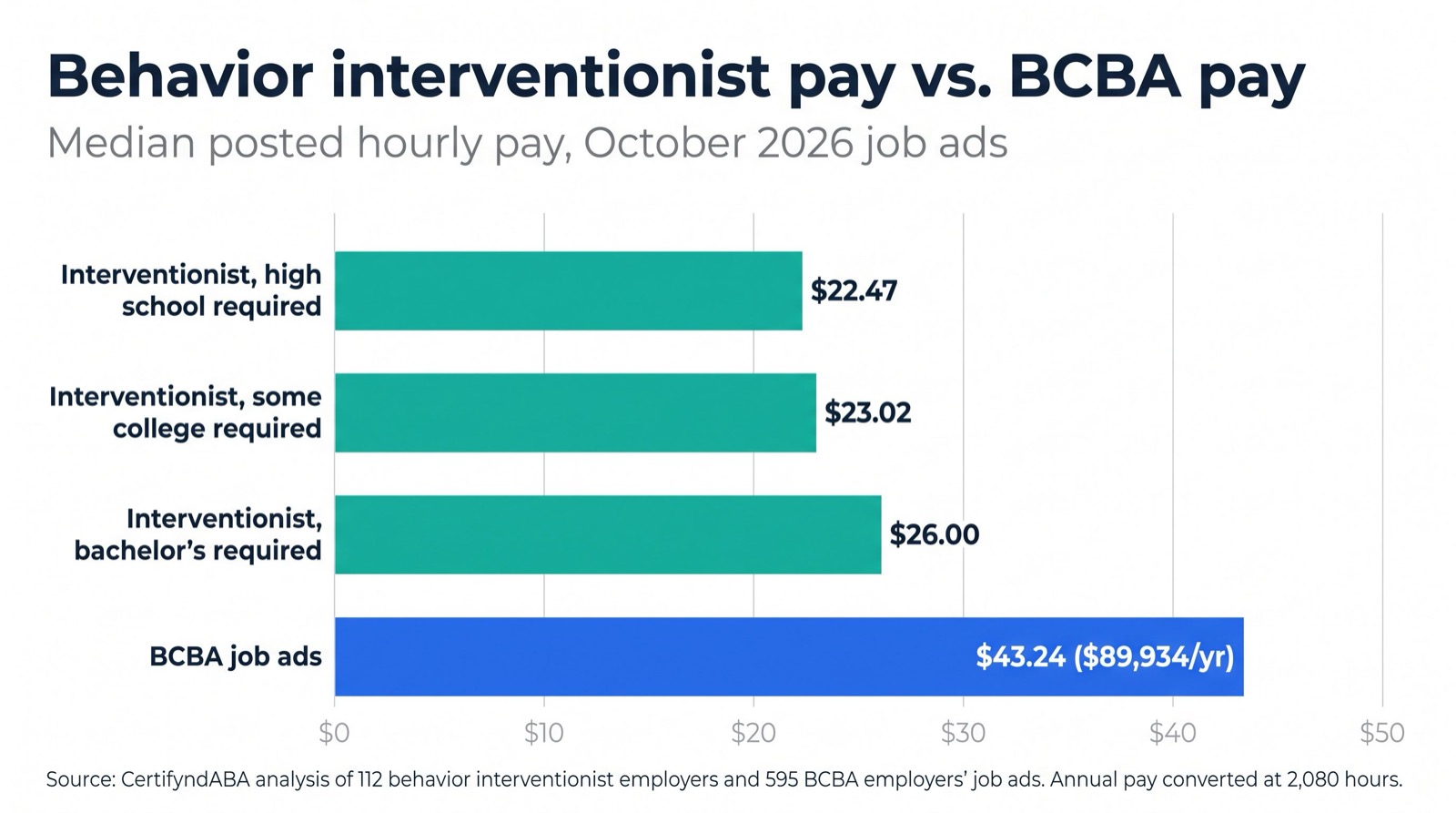
Three things moved pay in our sample:
- Education. Bachelor's-level ads paid $26.00 an hour at the median, $3.53 more than high-school-level ads ($22.47).
- Not location as much as you would think. California ads paid a median of $22.97 (n=20), close to the $23.69 median elsewhere (n=64).
- Not the RBT on its own. Ads that train you into the RBT after hire paid a median of $23.00 (n=7), close to the $23.85 median for ads that never mention it (n=62). Only two ads required an RBT at hire, too few to compare.
For comparison, our October 2026 review of 595 employers' BCBA job ads found a median posted salary of $89,934, about $43 an hour at 2,080 hours. A full-time behavior interventionist at the median earns a little over half of that. See our BCBA salary report for the full breakdown, and our RBT salary guide for technician pay.
Behavior interventionist vs. RBT
The two overlap, but they are not the same thing. One is a job title. The other is a national credential.
| Behavior interventionist | RBT | |
|---|---|---|
| What it is | A job title set by each employer | A BACB certification |
| Where | Mostly schools (65% in our sample) | Mostly ABA providers that bill insurance |
| Entry requirement | Varies from a high school diploma to a teaching license | 18+, high school, 40-hour training, competency assessment, exam |
| Supervision | Set by the employer; a BCBA in 17% of our ads | At least 5% of service hours each month |
| Portable? | No; the next employer may define it differently | Yes; it is verifiable in the BACB registry |
Some interventionists are also RBTs, and the RBT is a portable way to show ABA employers what your interventionist experience covered. For the next step up, see RBT vs. BCBA.
How to become a behavior interventionist
- Check the minimum for your target setting. School jobs often need an associate degree, college credits, or a paraprofessional test. ABA jobs often accept a high school diploma and train you.
- Get crisis-prevention and first aid training. CPI or Safety-Care and CPR come up again and again in school ads. Many employers provide them after hire.
- Get experience with children or people with disabilities. Paraprofessional, camp, childcare, and direct support work all count in these ads.
- Consider the RBT. It is required in only a small share of interventionist ads, but it opens up the ABA side of the market and transfers between employers.
- Apply with the job ad's own words. Use our RBT resume guide and RBT interview questions; both fit interventionist roles well.
From behavior interventionist to BCBA
Some people use a behavior interventionist job as their way into behavior analysis, and the field has room for them to move up. The BACB's live certificant data for the United States, pulled October 19, 2026, lists 274,385 RBTs and 81,819 BCBAs and BCBA-Ds. That is about 3.4 RBTs for every BCBA. The BACB's Lightcast report counted 132,307 US job postings for BCBAs in 2025, about 1.6 postings per active BCBA or BCBA-D. That is a year of postings, which can include reposts, set against a count of people, so it is a rough signal of demand rather than a count of open jobs.
The interventionist ads, though, rarely build the path up. Only 3 of 112 employers (2.7%) said the job offers supervised BCBA fieldwork hours. Nine (8.0%) offered tuition reimbursement, loan repayment, or tuition discounts. Thirty (26.8%) mentioned a BCBA at all, and 19 (17.0%) said the role works under or alongside one.
If you plan to become a BCBA, ask about the path before you accept a job:
- Is there a BCBA on the team? Without one, no fieldwork supervision is possible on the job.
- Will the BCBA supervise fieldwork, and at what cost? Some employers supervise free, while outside supervisors often charge by the hour. Our remote BCBA supervision guide has current rates.
- Will your duties count? Under BACB rules, at least 60% of fieldwork hours must be unrestricted activities, such as assessment and program design, rather than direct delivery of the plan. Ask whether the job includes that work. Our guide to restricted vs. unrestricted hours explains the split.
- Is there tuition help? One child and family services agency in our sample offered up to $21,000 in tuition reimbursement.
Our step-by-step guide to becoming a BCBA covers the degree, coursework, fieldwork, and the 2027 rule changes. If you already have a master's, a behavior specialist role is often the next rung, since many of those jobs write the plans that interventionists carry out.
How to read a behavior interventionist job ad
- Find the setting first. School, clinic, home, or residential changes your schedule, your benefits, and whether the RBT matters.
- Separate "required" from "preferred." In our sample, many ads listed a bachelor's degree as preferred but required only a high school diploma.
- Check the hours. Many school jobs run on the school calendar only; a few in our sample listed a 183- or 185-day contract. ABA jobs can be part-time with split shifts.
- Look for paid drive time and mileage if the job moves between homes or schools; 17 ads mentioned one or both. One ad stated that billable, non-billable, and drive time all pay the same rate.
- Look for who supervises you. A named BCBA, a case manager, or a school psychologist each points to a different kind of job.
Frequently asked questions
What does a behavior interventionist do?
A behavior interventionist carries out a behavior plan with a student or client, collects behavior data, helps prevent and calm crises, and reports progress to the teacher, case manager, or supervising BCBA. Most interventionists do not write the plan.
How much does a behavior interventionist make?
The median posted pay in our sample of 112 employers was $23.67 an hour, or about $49,234 a year full time. Half of the ads paid between $21.73 and $26.00 an hour.
Do you need a degree to be a behavior interventionist?
Not always. In our sample, 27.7% of employers required only a high school diploma, 15.2% required some college or a paraprofessional test, and 32.1% required a bachelor's degree. Bachelor's-level ads paid more.
Is a behavior interventionist the same as an RBT?
No. An RBT is a BACB certification, and behavior interventionist is a job title. Only 2 of the 112 ads we reviewed required an active RBT at hire, and 78.6% did not mention the credential.
Is behavior interventionist a good path to becoming a BCBA?
It can be, if the job includes a BCBA who will supervise your fieldwork. Only 2.7% of the ads we reviewed offered fieldwork hours, so ask before you accept.
The bottom line
"Behavior interventionist" is mostly a school job title, paid in the low to mid $20s an hour, and open to people without a degree or a credential. The ads that pay more ask for more education, and the biggest pay jump in this field comes later, at the BCBA. If that is your goal, choose the interventionist job that puts a BCBA next to you and counts your hours.
Let qualified employers reach out to you
Create a free CertifyndABA profile. Employers send you interview requests with the role, setting, and pay up front, and you decide who to talk to.
Create Your Free ProfileMethodology: On October 19, 2026, we searched SimplyHired for "behavior interventionist" and "behavioral interventionist" in every state and DC, with a deeper national and California pass, and kept postings whose title contained either phrase (251 unique postings). We selected one posting per employer at random and merged employers that posted under two names, which left 112 employers in 29 states. We read each full description and hand-coded the minimum required education and every mention of the RBT credential. Setting was assigned from the ad text. Pay is the posted rate or salary; annual salaries were converted at 2,080 hours, and rates outside $12 to $80 an hour were dropped. The BCBA comparison comes from our October 2026 analysis of 595 employers' BCBA job ads. Certificant counts are from the BACB's US certificant data on October 19, 2026.