


A behavior specialist is a professional who assesses why challenging behavior happens and writes the plan that changes it, usually in a school, a disability services agency, a mental health program, or an ABA practice. Outside Pennsylvania, "behavior specialist" is a job title, not a license. That one fact explains why two behavior specialist jobs can differ by $30,000 a year and by a full graduate degree.
To see what the title actually means in 2026, we read the job ads. We pulled every posting titled "behavior specialist" or "behavioral specialist" from SimplyHired in all 50 states and DC on October 16, 2026, kept one ad per employer, and read the full description of each. That left 343 employers in 45 states. This guide reports what those employers require, what they pay, and where a BCBA fits.
- Median posted pay is $53,040 a year, or $24.00 an hour for hourly ads.
- Only 3.5% require a BCBA. Another 15.7% accept or prefer one as one route among several.
- Ads where a BCBA counts pay a median of $74,649; ads with no BCBA route pay $50,658.
- Half the employers (49%) are schools, districts, or education agencies.
What is a behavior specialist?
A behavior specialist works on behavior that gets in the way of learning, safety, or independence. The core tasks are the same across most settings:
- Assess. Observe, collect data, and complete a functional behavior assessment to find out what the behavior does for the person.
- Plan. Write a behavior intervention plan or behavior support plan with replacement skills and prevention strategies.
- Train. Coach teachers, direct support staff, or parents to carry out the plan consistently.
- Monitor. Graph the data, check that the plan is followed, and revise it when progress stalls.
Pennsylvania's regulation defines the role in one line: a behavior specialist "designs, implements or evaluates a behavior modification intervention component of a treatment plan" (49 Pa. Code § 18.522). What changes from job to job is who the clients are, who supervises you, and how much independence the employer gives you.
The title also covers different levels of work. Some employers use "behavior specialist" for a master's-level clinician who writes plans. Others use it for a frontline role that carries out plans someone else wrote. In our sample, 29 employers (8.5%) described a role that works under a BCBA or toward BCBA certification, and several ABA companies used it as another name for an RBT position.
Where behavior specialist jobs are
We sorted each employer by the setting its ad described. Schools dominate.
| Setting | Employers | Share | Median posted pay |
|---|---|---|---|
| Schools, districts, education agencies | 168 | 49.0% | $55,735 (n=115) |
| Mental and behavioral health | 76 | 22.2% | $47,155 (n=54) |
| ABA and autism services | 54 | 15.7% | $54,475 (n=47) |
| Intellectual and developmental disability services | 43 | 12.5% | $55,000 (n=36) |
Source: CertifyndABA analysis of 343 employers' behavior specialist ads on SimplyHired, October 16, 2026. Two employers fit no category. Pay counts only ads that posted a figure; hourly pay is annualized at 2,080 hours.
School roles often go by "district behavior specialist," "special education behavior specialist," or "school behavior specialist," and many follow the school calendar. Disability services roles often sit inside Medicaid waiver programs, where the state sets the qualifications. Oregon, for example, accepts a behavior professional with a BCBA and 1 year of positive behavior support experience, a master's and 1 year, or a bachelor's and 3 years (Oregon ODDS qualification standards, 2024). Ohio's waiver rule, effective December 1, 2024, ties its specialized tier to a master's degree plus a license (Ohio Admin. Code 5123-9-41).
Behavior specialist requirements: what employers ask for
Because the title is unregulated in most states, the employer sets the bar. Here is the highest degree each ad mentioned:
- Master's degree: 130 employers (37.9%)
- Bachelor's degree: 109 employers (31.8%)
- High school diploma or associate degree: 34 employers (9.9%)
- No degree stated: 70 employers (20.4%)
Credentials vary even more. School districts most often want a teaching or special education license, a school psychologist or social work credential, or a BCBA, and they usually accept any one of them. Mental health employers lean on clinical licenses such as LPC, LCSW, or LMFT. One Texas charter network titled its post "Behavior Specialist - Non-BCBA," which tells you how many different jobs share this name.
Of the 78 ads that stated a number of years, 42 (54%) asked for 1 or 2 years of experience. About 1 in 7 (14.3%) asked for crisis prevention training such as CPI or Safety-Care.
Pennsylvania is the exception: the Licensed Behavior Specialist (LBS)
Pennsylvania is the one state where "behavior specialist" is a licensed profession. The State Board of Medicine issues the Licensed Behavior Specialist (LBS) license, which grew out of the state's 2008 autism insurance law, Act 62. The Pennsylvania Department of Education states that behavior specialists need this Department of State license, not an education certificate.
Under 49 Pa. Code § 18.524, an LBS applicant needs all of the following:
- A master's degree or higher in psychology, special education, social work, speech therapy, occupational therapy, professional counseling, behavior analysis, nursing, or a related field.
- At least 1 year of experience with functional behavior assessments of individuals under 21, including writing and carrying out behavior plans.
- At least 1,000 hours of in-person clinical experience with individuals with behavioral challenges, or 1,000 hours in a related field with individuals with autism.
- 90 hours of coursework in evidence-based practice, split across ethics (3), autism (18), assessment (16), instructional strategies (16), crisis intervention (8), comorbidity and medications (8), family collaboration (5), and skill deficits (16).
There is no exam. The state lists a $75 application fee and a $75 biennial renewal, plus child abuse recognition training. A BCBA does not convert to an LBS automatically, but the regulation lets BACB continuing education credits and master's coursework count toward the 90 hours, so most BCBAs already meet much of it on paper.
The license shows up in the ads. Of the 38 Pennsylvania employers in our sample, 19 mentioned the LBS by name. If you plan to work in Pennsylvania, see our Philadelphia BCBA jobs guide for how local employers combine the two credentials.
Behavior specialist salary
The middle half of posted behavior specialist salaries runs from $45,760 to $67,642. Ads that pay by the hour have a median of $24.00, which lines up with Indeed's national average of $23.79 an hour for behavior specialists (updated October 12, 2026). PayScale reports an average base salary of $52,354 (February 2026).
The spread inside the title is large, and two things explain most of it: the degree the employer asks for and whether a BCBA counts.
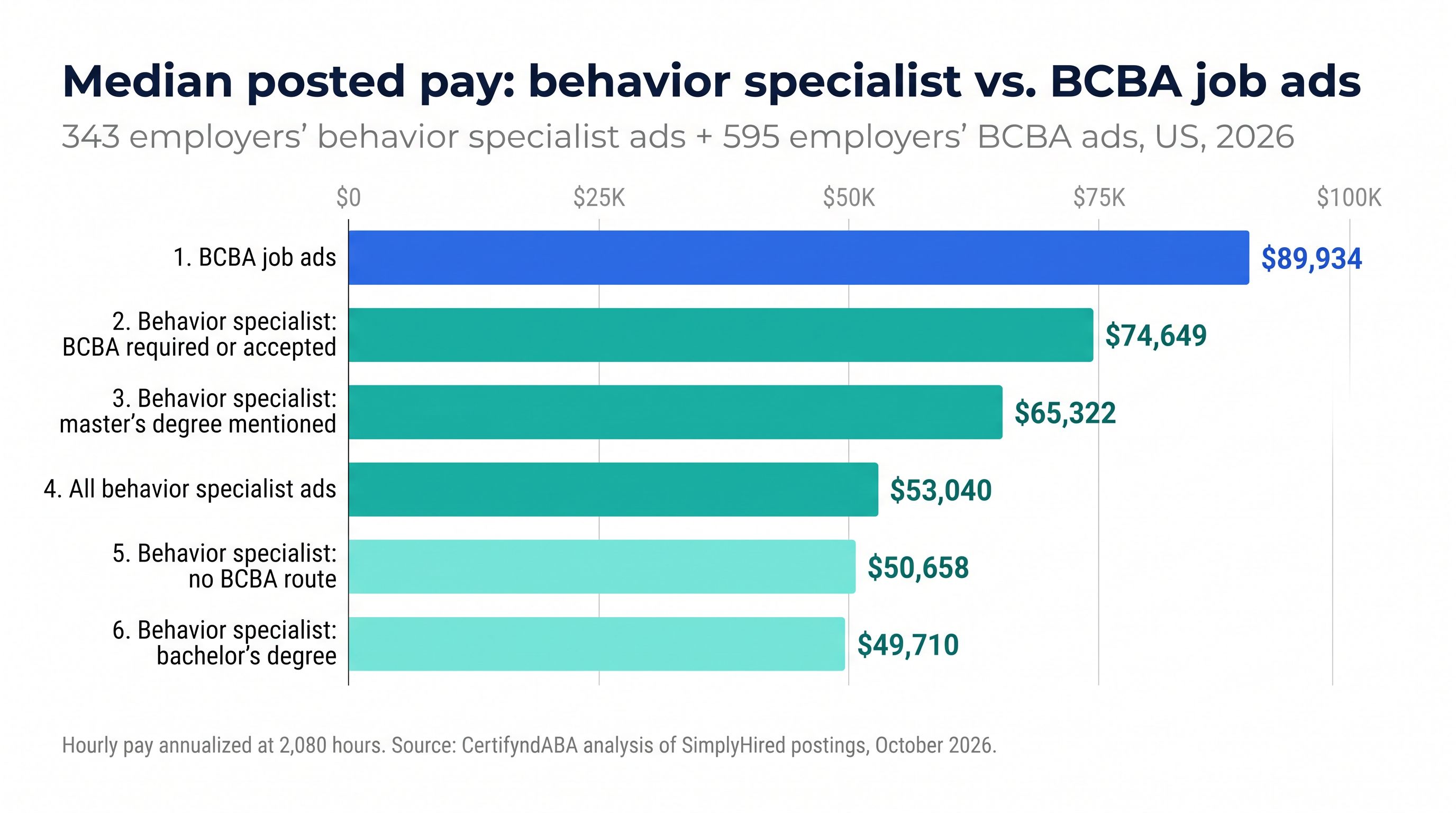
- BCBA required or accepted (46 ads with pay): median $74,649
- Master's degree mentioned (96): median $65,322
- No BCBA route (207): median $50,658
- Bachelor's degree is the highest mentioned (86): median $49,710
The few ads that require a BCBA outright posted a median of $81,250, but only 10 of them listed pay, so treat that figure as a rough signal. For comparison, the median across 595 employers' BCBA job ads in our 2026 BCBA salary analysis was $89,934.
Behavior specialist vs. BCBA
A BCBA is a national certification with set requirements. A behavior specialist is a role that a BCBA, a special education teacher, a counselor, or a bachelor's-level staff member might hold.
| Behavior specialist | BCBA | |
|---|---|---|
| What it is | A job title (a state license only in Pennsylvania) | A certification from the Behavior Analyst Certification Board |
| Who sets the bar | The employer, a state waiver program, or Pennsylvania's board | The BACB, plus state licensure in 40 states and DC |
| Education | High school to master's, depending on the ad | Graduate degree, behavior-analytic coursework, supervised fieldwork |
| Exam | None (including the PA LBS) | BCBA certification exam |
| Median posted pay | $53,040 (343 employers) | $89,934 (595 employers) |
| Supervises others | Sometimes; many roles are supervised by a BCBA | Yes; BCBAs supervise RBTs and trainees |
The BACB reports 78,741 BCBAs and 3,046 BCBA-Ds in the United States (BACB certificant data, October 2026). Employers posted 132,307 jobs requiring BCBA certification in 2025, up 28% from 2024 (BACB and Lightcast, 2026). That is about 1.6 postings for every US certificant nationally, and about 3 or more in the tightest states: Maryland (3.5), Kansas (3.0), and North Carolina (2.9). When a school or agency cannot find a BCBA, a broadly written behavior specialist post lets it hire a teacher, counselor, or bachelor's-level clinician for the same behavior work. That is one reason only 3.5% of these ads require the BCBA.
Should a BCBA apply for behavior specialist jobs?
Sometimes, yes. The 66 employers that require or accept a BCBA are real BCBA jobs under another name, and school ones often follow the school calendar. The risk is taking a role written for a bachelor's-level hire and its pay. Use these checks before you apply:
- Read the qualifications, not the title. If the ad lists "BCBA, LBA, or master's with experience," you are the strongest version of the candidate it describes.
- Check who writes the plans. If the job says you will "implement plans written by the BCBA," it is a technician-level role.
- Compare the posted pay to BCBA pay. Our BCBA ad median is $89,934; a school behavior specialist post at $55,000 is not a lateral move unless the benefits close the gap.
- Ask about supervision duties. Some districts want a BCBA to supervise RBTs or paraprofessionals; that is worth more.
- Check your state license. In a licensure state, your behavior-analytic work still falls under your behavior analyst license, whatever the job title says. See our guide to licensed behavior analysts.
For the full range of school roles, see our school-based BCBA jobs guide, or browse the broader market in BCBA jobs in 2026.
How to become a behavior specialist
The path depends on the level of role you want.
- Entry level (bachelor's or less): Start in a direct role such as RBT, paraprofessional, or direct support professional. Then move to a behavior specialist job that carries out plans. Earning the RBT credential helps in ABA settings; see RBT vs. BCBA.
- Plan-writing roles (master's): Earn a master's in special education, psychology, counseling, social work, or behavior analysis, and get 1 to 2 years of experience with assessments and behavior plans. In Pennsylvania, add the LBS requirements above.
- Top of the pay range (BCBA): Complete behavior-analytic coursework, supervised fieldwork, and the BCBA exam. Our step-by-step guide to becoming a BCBA covers the 2027 rule changes. Several behavior specialist employers in our sample offered BCBA fieldwork supervision or tuition help, which makes the role a practical stepping stone.
Frequently asked questions
What does a behavior specialist do?
A behavior specialist assesses challenging behavior, writes a behavior support or intervention plan, trains staff or families to use it, and tracks data to see if it works. The setting is usually a school, a disability services agency, a mental health program, or an ABA practice.
How much does a behavior specialist make?
The median posted pay in 343 employers' behavior specialist ads was $53,040 a year in October 2026, or $24.00 an hour for hourly ads. Ads that required or accepted a BCBA had a median of $74,649.
Is a behavior specialist the same as a BCBA?
No. A BCBA is a national certification. Behavior specialist is a job title that a BCBA, a teacher, a counselor, or a bachelor's-level clinician might hold. Only 3.5% of the behavior specialist ads we reviewed required a BCBA.
Do you need a license to be a behavior specialist?
Only in Pennsylvania, where the State Board of Medicine issues the Licensed Behavior Specialist (LBS) license. In other states, the employer or a state program sets the qualifications.
What degree do you need to be a behavior specialist?
It depends on the job. In our sample, 37.9% of employers mentioned a master's degree, 31.8% a bachelor's, and 9.9% a high school diploma or associate degree. Master's-level ads paid a median of $65,322.
Can a BCBA work as a behavior specialist?
Yes. About 1 in 5 behavior specialist ads (19.2%) required or accepted a BCBA, and those paid the most. Check that the role includes plan writing and pay close to BCBA rates before you accept.
The bottom line
"Behavior specialist" covers everything from a $40,000 frontline role to an $88,000 clinical position; those are the 10th and 90th percentiles of posted pay in our sample. The title will not tell you which one you are looking at; the qualifications and the posted pay will. If you hold a BCBA, the ads that name it are worth a close look, and the ones that do not are usually priced for someone else.
Let the right behavior jobs find you
Create a free CertifyndABA profile and let qualified employers reach out to you with the role, the setting, and the pay up front. You decide who to talk to.
Create Your Free ProfileMethodology: On October 16, 2026, we searched SimplyHired for "behavior specialist" and "behavioral specialist" in every state and DC, kept postings whose title contained the phrase (536 unique postings), and selected one posting per employer at random (343 employers in 45 states). We read each full description and hand-coded every mention of a BCBA. "Accepted" means the BCBA was one of several qualifying credentials or was preferred. Pay is the posted salary or rate; hourly pay is annualized at 2,080 hours; figures outside $25,000 to $250,000 were dropped. The BCBA comparison comes from our October 2026 analysis of 595 employers' BCBA job ads.