


The BACB Ethics Code is the rulebook for every BCBA and BCaBA, and most of it plays out at work, not in a lab. Caseload size, billing, client handoffs when you quit, and what happens when an employer investigates you are all covered by specific standards. In 2025 the BACB Ethics Department processed 1,454 Notices of Alleged Violation, according to the February 2026 BACB Newsletter. This guide explains what the Code requires on the job, which violations the BACB actually substantiates, and how to use the Code when you choose your next employer.
What Is the BACB Ethics Code?
The official name is the Ethics Code for Behavior Analysts. It applies to BCBAs, BCaBAs, people who have applied for those certifications, and Authorized Continuing Education providers. It took effect on January 1, 2022 and replaced the Professional and Ethical Compliance Code, which was in force from 2016 through 2021. RBTs follow a separate document, the RBT Ethics Code (2.0).
If you searched for a "BACB ethics code 2026" edition, there is none. The BACB Ethics Codes page lists one edit to the current Code, a glossary definition of "assent" added on September 6, 2021, and the BACB has not announced a replacement. The 2022 Code is the one you are held to today.
The Code has four core principles and 85 numbered standards in six sections:
| Section | Standards | What it covers at work |
|---|---|---|
| Core principles | 4 | Benefit others; treat others with compassion, dignity, and respect; behave with integrity; ensure your competence |
| 1. Responsibility as a Professional | 16 (1.01 to 1.16) | Truthfulness, scope of competence, multiple relationships, gifts, responding to the BACB and employers |
| 2. Responsibility in Practice | 19 (2.01 to 2.19) | Treatment quality, confidentiality, documentation, billing accuracy, informed consent |
| 3. Responsibility to Clients and Stakeholders | 16 (3.01 to 3.16) | Service agreements, advocating for the right service level, continuity, discontinuing and transitioning services |
| 4. Responsibility to Supervisees and Trainees | 12 (4.01 to 4.12) | Supervision rules, supervisory volume, delegation, feedback, ending supervision |
| 5. Responsibility in Public Statements | 11 (5.01 to 5.11) | Advertising, testimonials, social media |
| 6. Responsibility in Research | 11 (6.01 to 6.11) | Research review, consent, data, credit |
Why the Ethics Code Matters More in a Tight Job Market
The demand for BCBAs keeps outrunning supply, and that gap is where most workplace ethics problems start. The BACB counted 83,059 BCBAs and BCBA-Ds in the 50 states and Washington, DC in November 2026, up from 74,340 a year earlier. Job postings that required or preferred BCBA certification reached 132,307 in 2025, a 28% increase over 2024, according to the BACB and Lightcast report US Employment Demand for Behavior Analysts: 2010 to 2025.
Postings are not the same as open seats, since one job can be posted more than once over a year. Still, the ratio explains the pressure many BCBAs describe: large caseloads, many supervisees, and steady billing targets. The Code does not set a caseload number, but it gives you specific standards to point to when the workload threatens client care. For the full demand picture, see our analysis of BCBA job openings in 2026.
The BACB Ethics Code Standards That Come Up at Work
These are the standards that most often decide what you can say yes or no to in an ABA job. The quotes and summaries come from the Code itself.
Caseloads and supervisee volume (4.03 and 3.12)
Standard 4.03, Supervisory Volume, says you take on only as many supervisees or trainees as you can supervise effectively. You must weigh your client demands, current supervisee caseload, and time on an ongoing basis. When you reach your limit, the Code tells you to document that self-assessment and "communicate the results to their employer or other relevant parties." Standard 3.12 adds that you advocate for the appropriate amount and level of service and oversight each client needs.
In practice, a short written note to your manager that you are at capacity, with your reasons, is not insubordination. It is what the Code asks you to do.
Billing and productivity targets (1.01 and 2.06)
Standard 2.06 requires accurate bills and reports. You do not bill nonbehavioral services under an authorization for behavioral services, and when you find a billing error you inform the relevant parties, correct it, and document what you did. Standard 1.01 goes further for anyone in a leadership role: behavior analysts "do not create professional situations that result in others engaging in behavior that is fraudulent or illegal or that violates the Code." A clinical director who sets targets that can only be met by padding notes is exposed under 1.01.
New populations and services (1.05)
Employers short on staff sometimes assign a BCBA to an age group, diagnosis, or procedure they have not trained in. Standard 1.05 says you work in a new area only after documented study, training, supervised experience, consultation, or co-treatment. Otherwise you refer or transition the client to someone competent.
Gifts and relationships (1.11, 1.12, 1.14)
The gift limit is $10 in value, and you must tell clients and stakeholders about it at the start of services (1.12). You avoid multiple relationships with clients and colleagues and document how you resolve any that arise (1.11). Romantic or sexual relationships with former clients or stakeholders are barred for at least two years after the professional relationship ends (1.14).
Leaving a job (3.14, 3.15, 3.16, 4.11, 4.12)
This is the standard set most BCBAs meet only when they resign. Standard 3.14 lists relocation and leave as planned interruptions and requires timely efforts to keep services going. Standard 3.16 requires a written transition plan with target dates, transition activities, and responsible parties. Standards 4.11 and 4.12 do the same for your supervisees and trainees, so their fieldwork hours are not stranded.
The stakes are real. The BCBA Handbook (updated November 2026) lists "leaving a position without ensuring continuity of services" as an ethics violation you must self-report to the BACB. In the BACB education system from 2019 to 2021, improper discontinuation or transition of services was first on the list of issues for which BCBAs and BCaBAs received coaching, feedback, or required actions.
What You Must Self-Report Within 30 Days
Standard 1.16 requires you to follow the BACB self-reporting rules, and the BCBA Handbook sets the deadline: no more than 30 days after you become aware of a critical event. Several of those events involve your employer directly:
- ✓An employer investigation. Any investigation by an employer in response to an alleged violation of a BACB ethics standard. Do not wait for it to finish.
- ✓A termination for an ethics violation. Termination by an employer in response to a violation of any BACB ethics standard.
- ✓Audits that end in repayment. A routine billing or quality audit that results in repaying overbilled money plus a penalty above $2,500.
- ✓Your own violations. Any violation of a Code standard, including leaving a job without arranging continuity of services or failing to keep proper billing records.
Failure to respond to the BACB by a deadline leads to automatic suspension of certification, and the BACB publishes the suspension with your name, according to its Ethics Codes page. If you are unsure whether something counts, the Handbook says the best course is to self-report.
What the BACB Actually Enforces
The BACB published its most recent detailed breakdown in A Summary of Ethics Violations and Code-Enforcement Activities: 2019 to 2021. Those cases were judged under the old 2016 code, so the categories do not map one to one onto today's standard numbers, but the patterns hold. From 2019 to 2021, 1,263 Notices met the criteria for processing. The BACB declined 325 after reviewing the response, routed 762 to the disciplinary system, and routed 152 to the education system.
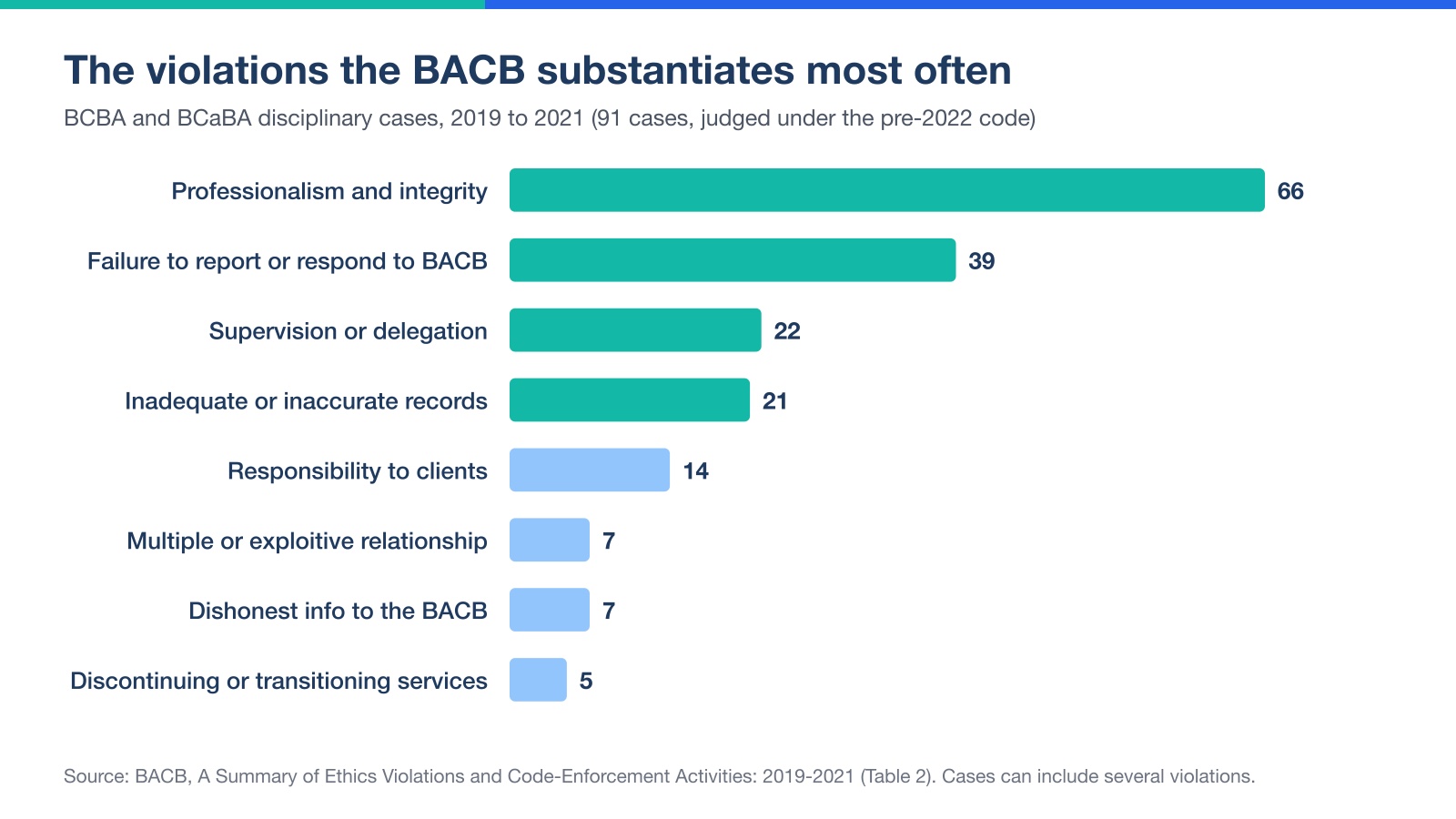
Among the 91 BCBA and BCaBA disciplinary cases, professionalism and integrity led with 66 substantiated violations, followed by failure to report or respond to the BACB (39), inadequate supervision or delegation (22), and inaccurate records (21). Several of the top four are workplace issues: supervising too many people, delegating without checking competence, and documentation that does not match the billing.
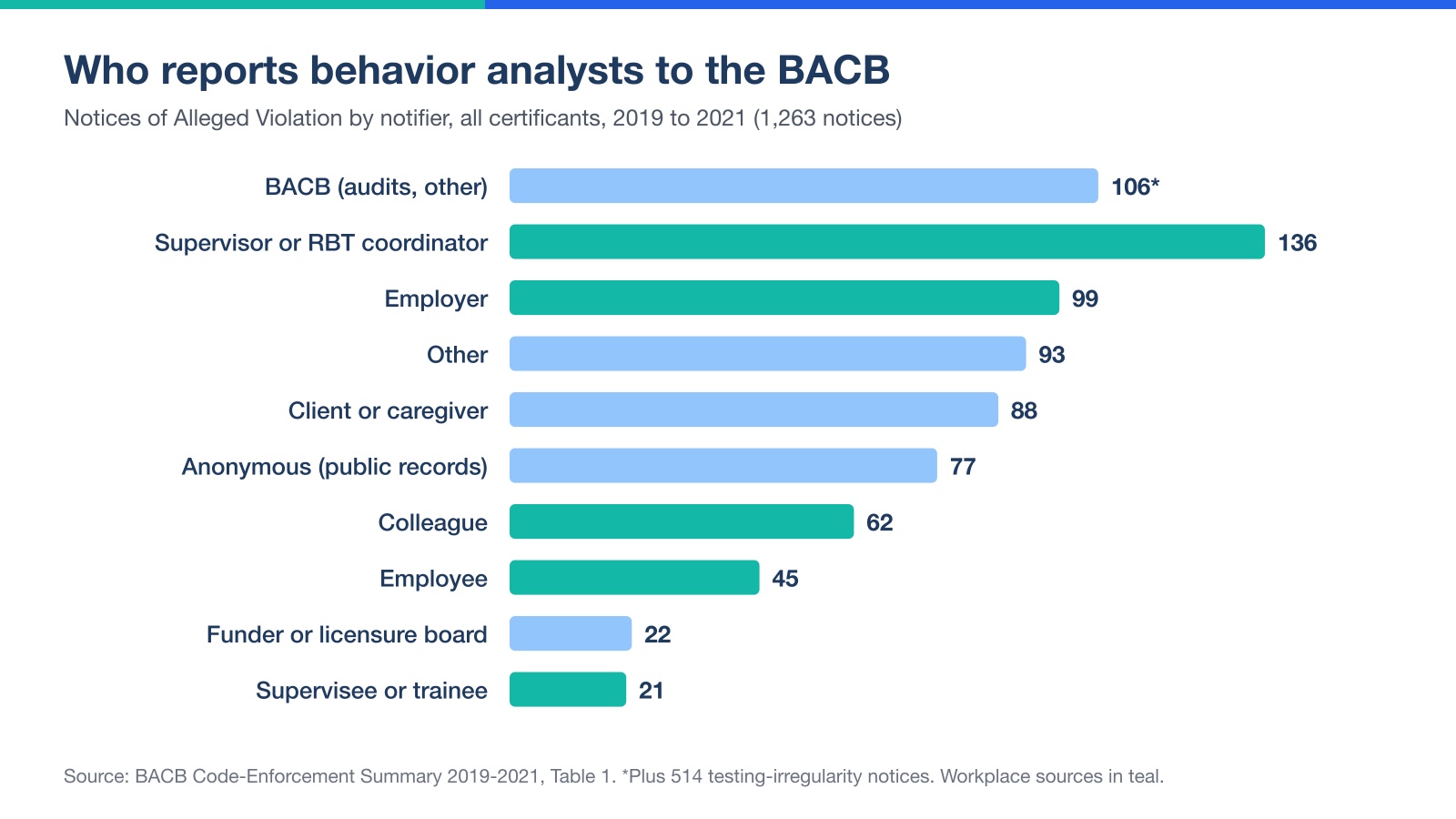
The same report shows who files the notices. Excluding 514 notices tied to testing irregularities in one area, the BACB itself filed 106. Supervisors and RBT Requirements Coordinators filed 136, employers 99, colleagues 62, employees 45, and supervisees or trainees 21. Together, workplace sources filed 363 of the 749 notices not tied to the testing irregularities, about half.
Consequences for BCBAs and BCaBAs over those three years included 78 sanctions (27 mandatory supervision, 26 revocations or invalidations, 14 practice restrictions, 11 suspensions) and 140 corrective actions, such as writing a policy, mandatory mentorship, or extra continuing education. Volume has grown since: the Ethics Department processed 1,454 notices in 2025 alone and issued final decisions in 22 days on average, according to the February 2026 BACB Newsletter. The BACB may count notices differently across reports, so compare the two figures with care.
Licensure: The Ethics Issue Hiding in Remote Jobs
Thirty-nine US states regulate behavior analysts through title acts, practice acts, or both, according to the BACB December 2025 Newsletter. The BACB warns that practicing or supervising without a required license is both a legal problem and an ethics violation. It matters most for telehealth and remote supervision: you may need a license in the state where your client or trainee is, not only where you live. Before you accept a remote role that crosses state lines, ask which licenses the employer expects you to hold and who pays for them.
How to Use the BACB Ethics Code in Your Job Search
Because BCBAs are in demand, you can screen employers as hard as they screen you. These interview questions map directly to Code standards:
| Ask the employer | Standard it protects |
|---|---|
| What is the typical caseload and supervisee count for this role, and can I decline new cases when I am at capacity? | 4.03 Supervisory Volume; 3.12 Advocating for Appropriate Services |
| Who reviews session notes and claims before they are billed, and how are billing errors corrected? | 2.06 Accuracy in Service Billing and Reporting; 1.01 Being Truthful |
| Will I be assigned populations or procedures I have not trained in, and what training comes with them? | 1.05 Practicing within Scope of Competence |
| What happens to my clients and supervisees if I leave or take leave? Is there a written transition policy? | 3.14 to 3.16; 4.11 and 4.12 |
| Do I need a license in each state where I would serve clients or supervise remotely, and who pays for it? | 1.02 Conforming with Legal and Professional Requirements |
| Does the company carry professional liability coverage for clinicians, or should I buy my own? | Not a Code requirement, but it protects you if a client complaint follows you |
Vague answers to the first two questions are a warning sign. For more ways to judge an employer, read our guide to the best ABA companies to work for and our breakdown of BCBA liability insurance. If an offer is strong but the caseload is not, our BCBA salary negotiation guide covers how to negotiate workload along with pay.
When Your Employer Asks for Something the Code Prohibits
The Code does not give you a script, but it gives you a process. It says to address concerns directly with the person involved when that seems likely to resolve the issue and will not put you or others at undue risk. It also says to document the steps you take and the outcomes. Anything that places a client at direct and immediate risk of harm goes to the relevant authorities first, before the BACB or a licensure board.
For less urgent dilemmas, the Code lays out an 11-step decision-making process. The first steps are to define the issue and the risk of harm, identify everyone involved, confirm the facts, check your own biases, and find the relevant core principles and standards. Then you consult colleagues or research, list possible actions, pick the one most likely to resolve the concern, act on it, and evaluate the result.
Keep your continuing education current while you are at it. BCBAs need 32 CEUs per 2-year cycle, including 4 in ethics, and 3 in supervision if they supervise, per the BCBA Handbook. Our list of free BCBA CEUs includes ethics options, and the BCBA supervisor guide covers the 8-hour supervision training.
Frequently Asked Questions
Is there a new BACB Ethics Code for 2026?
No. The Ethics Code for Behavior Analysts that took effect on January 1, 2022 is still the current code in November 2026. The BACB revision history lists one edit, a glossary definition of assent added in September 2021, and the BACB has not announced a replacement.
How many standards are in the BACB Ethics Code?
The Ethics Code for Behavior Analysts has four core principles and 85 standards in six sections: responsibility as a professional (16), responsibility in practice (19), responsibility to clients and stakeholders (16), responsibility to supervisees and trainees (12), responsibility in public statements (11), and responsibility in research (11).
How many ethics CEUs do BCBAs need?
BCBAs need 32 continuing education units in each 2-year recertification cycle. At least 4 must be in ethics, and BCBAs who supervise need 3 in supervision, according to the BCBA Handbook (updated November 2026).
Can I report my ABA employer to the BACB?
The BACB says it does not have separate jurisdiction over organizations or corporations. A Notice of Alleged Violation names an individual certificant or applicant. Concerns about a company itself usually go to a state licensure board, a funder, or another regulator.
Do RBTs follow the BACB Ethics Code for Behavior Analysts?
No. RBTs follow the separate RBT Ethics Code (2.0), which also took effect on January 1, 2022. BCBAs who supervise RBTs must review that code with them.
The Bottom Line
The BACB Ethics Code holds you, not your employer, responsible for caseloads you accept, bills you sign, and clients you hand off. The standards that matter most at work are 4.03 on supervisory volume, 2.06 on billing, 1.05 on competence, and 3.14 to 3.16 on continuity and transitions. The BACB enforcement data show that supervision, records, and reporting failures are where BCBAs get into trouble. In a market with about 1.8 postings per BCBA, you have the leverage to choose an employer that makes compliance easy.
Choose an employer that respects your ethics
CertifyndABA is an anonymous reverse job marketplace. Showcase your verified credentials, set the caseload and pay you want, and let employers send you interview requests. Your identity stays private until you accept.
Create Your Free Profile