


The 8 hour supervision training BCBA requirement is the shortest credential in applied behavior analysis and the one with the widest reach. One course, taken once, is what stands between a certified BCBA and every oversight role the BACB recognizes: supervising trainees, supervising RBTs, supervising BCaBAs, assessing RBT competency, and delivering the RBT 40-hour training.
It is also the requirement the field explains worst. Search for it and you get course sales pages. What you rarely get is a straight answer to the questions BCBAs actually ask: which roles need it, whether it expires, how it differs from the supervision CEUs on your recertification, and what changes when the 2027 standards take effect.
This guide answers those questions using the BACB's own current documents, then puts the requirement in context. Supervisor capacity is not administrative trivia. It is the rate limiter on the entire ABA labor market.
What the 8-Hour Supervision Training Actually Is
The 8-hour supervision training is a one-time course built on the BACB's Supervisor Training Curriculum Outline (2.0). It covers the learning objectives, tasks, and considerations involved in building an effective supervisory relationship.
Three details matter more than the curriculum itself, and they are the ones most commonly missed.
The BACB does not teach the course. As the BACB states, this training "may be provided by any Authorized Continuing Education (ACE) Providers." The board sets the curriculum and verifies completion; independent ACE Providers deliver it. That is why the search results for this requirement are dominated by vendors.
Eligibility begins at upload, not at completion. The BCBA Handbook is precise on this point. Supervisors must "complete an 8-hour supervision training ... and upload the certificate to their BACB portal account before signing a supervision contract." Finishing the course on a Friday does not make you eligible on Friday. Logging the certificate does.
Your eligibility is public. Once the certificate is on file, the BACB Certificant Registry displays the statement "Completed supervision training on DATE." The BACB describes that date as "the date the certificant became eligible to provide supervision," and it explicitly tells trainees to look it up: "Trainees should confirm the date on which the supervisor completed the training before signing a supervision contract."
Which Roles Require the 8-Hour Supervision Training
The BACB groups oversight into four roles: supervisor, attestor, assessor, and trainer. They do not carry identical requirements, and the differences are not intuitive. The BCBA Handbook publishes a matrix of additional requirements by role; here it is in full.
| Role | 8-Hour Supervision Training | Ongoing CEUs in Supervision | No Multiple Relationship | Consulting Supervisor |
|---|---|---|---|---|
| Attesting RBTs | No | No | Yes | No |
| Assessing RBTs (competency assessments) | Yes | No | Yes | No |
| Training RBTs (RBT 40-hour training) | Yes | No | Yes | No |
| Supervising RBTs | Yes | Yes | Yes | No |
| Supervising BCBA and BCaBA trainees in your first year of certification | Yes | Yes | Yes | Yes |
| Supervising BCBA and BCaBA trainees after your first year | Yes | Yes | Yes | No |
| Supervising BCaBAs | Yes | Yes | Yes | No |
Source: BACB, Board Certified Behavior Analyst Handbook (updated June 2026), Overview of Additional Requirements by Role.
Two patterns are worth pulling out of that grid.
First, attesting RBTs is the only oversight role with no training requirement at all. Confirming a candidate's age, education, background check, and abuse registry check is administrative verification, so the BACB gates it on the relationship restriction alone.
Second, assessing and training RBTs require the 8-hour training but not the ongoing supervision CEUs. Running a competency assessment or delivering the 40-hour training is a discrete event; supervising is a continuing relationship, and only continuing relationships trigger the recurring CEU obligation.
The Full Supervisor Eligibility Checklist
The 8-hour training is necessary but not sufficient. To supervise fieldwork, the BCBA Handbook requires that you meet one of these two profiles:
- ✓ An active BCBA with no current disciplinary sanctions, certified for at least one year, and meeting the ongoing supervision CEU requirement; or
- ✓ An active BCBA with no current disciplinary sanctions, certified for less than one year, meeting the ongoing supervision CEU requirement, and receiving monthly consultation from a qualified consulting supervisor.
Newly certified BCBAs are not shut out. You can supervise in your first year, provided you have a consulting supervisor giving you monthly consultation. That structure exists precisely so the field does not lose a year of supervisory capacity from every new cohort.
Beyond the two profiles, the handbook adds obligations that apply to every supervisor:
- ✓ Complete the 8-hour supervision training and upload the certificate to your BACB portal account before signing a supervision contract.
- ✓ Ensure you are not "related to, subordinate to, employed by, or in a multiple relationship (e.g., personal or business relationship) with the trainee during the fieldwork period." One carve-out applies: compensation the trainee pays you for supervision services does not count as employment.
- ✓ Abide by the Ethics Code for Behavior Analysts, including the Responsibilities to Supervisees and Trainees section.
That last point carries teeth. The handbook notes that a Notice of Alleged Violation "may be submitted against a supervisor for not providing supervision in accordance with these requirements." Supervision is not a favor you extend to a colleague; it is regulated professional conduct with an enforcement path attached.
One legacy provision is worth knowing if you are auditing older fieldwork. A supervisor may also have been a licensed, registered psychologist certified by the American Board of Professional Psychology, or a non-certified Verified Course Sequence Instructor prior to January 1, 2026. Hours accrued under those supervisors remain usable toward fieldwork requirements until December 31, 2031.
8-Hour Training vs. 3 Supervision CEUs: The Distinction Everyone Gets Wrong
This is the single most-confused point in the requirement, and getting it wrong can cost you your certification at recertification time.
The 8-hour supervision training happens once, ever. It does not expire and does not need to be retaken.
The supervision CEUs recur every cycle. The BCBA Handbook states it plainly: "As a BCBA, you are required to obtain 32 continuing education units (CEUs) within each 2-year recertification cycle, including 4 CEUs in ethics and 3 CEUs in supervision (for supervisors)."
Note the number. It is 3 supervision CEUs, not 4. A figure of 4 circulates widely in secondary sources and is wrong; the ethics requirement is 4, the supervision requirement is 3.
| 8-Hour Supervision Training | Supervision CEUs | |
|---|---|---|
| Frequency | Once, before you first supervise | 3 CEUs in every 2-year recertification cycle you supervised in |
| Trigger | Intent to take on any supervisory, assessor, or trainer role | Having supervised an RBT, BCaBA, or trainee at any point in the cycle |
| Where it is recorded | Certificate uploaded to your portal; date shown on the Certificant Registry | Entered in the Continuing Education tab of your portal before your recertification date |
| Consequence of missing it | You are not eligible to supervise; hours may be jeopardized | You cannot recertify |
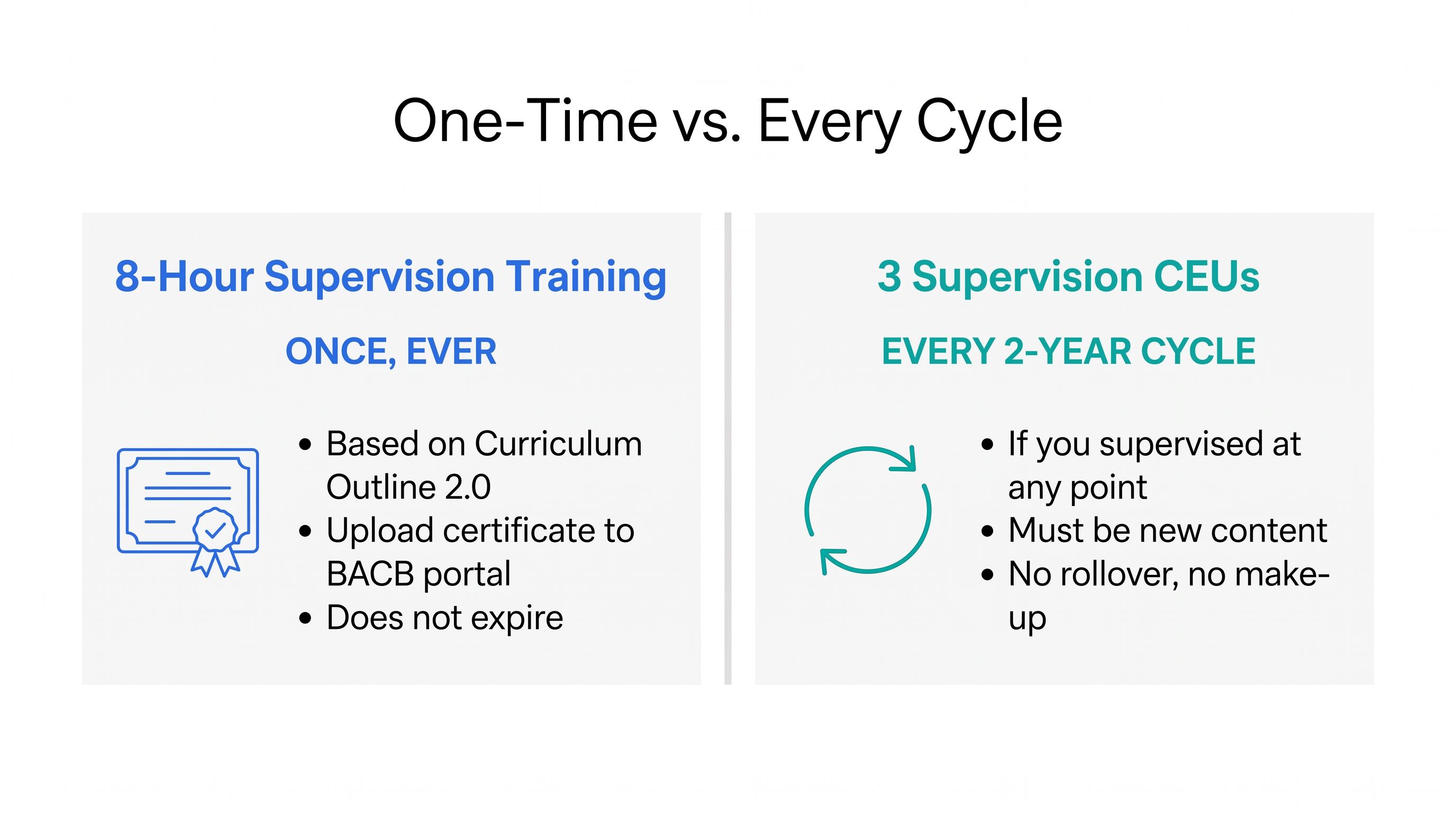
Three traps sit inside the CEU rule.
The trigger is broader than most people assume. The handbook says BCBAs "who have supervised the ongoing practice of RBTs or BCaBAs on record or trainees pursuing BCBA or BCaBA certification at any point during their recertification cycle must obtain and enter 3 supervision CEUs to recertify." Covering a colleague's RBT for a single month, twenty-two months ago, triggers the full requirement.
You cannot recycle the 8-hour course. A common plan is to retake the supervision training each cycle and count it. The handbook closes that door: "Repeating CE activities of any CEU type does not provide new or expanded knowledge or skills and, therefore, does not meet BACB certification requirements." Your supervision CEUs must be new content, behavior-analytic in nature, and cover effective supervision practices described in the Supervisor Training Curriculum Outline (2.0) and the Nature of Supervision section.
There is no grace period and no rollover. CEUs cannot be made up after your recertification date, and surplus CEUs from one cycle do not carry into the next.
"One month of covering a colleague's caseload two years ago is enough to make three supervision CEUs the difference between recertifying and expiring."
Where to Take the 8-Hour Supervision Training, Including Free Options
Because any ACE Provider may deliver the training, the market ranges from free workshops to bundled university programs. The BACB maintains an ACE Provider Directory listing providers who may offer it; that directory is the authoritative starting point.
A free option exists and is widely used. The Autism Partnership Foundation offers an 8-hour supervision workshop at no cost, built on the Supervisor Training Curriculum Outline (2.0). One condition applies: as the foundation notes, "you must be a BCBA or BCaBA in order to submit a certificate for BACB purposes." Anyone may take the course for learning; only certificants can use the certificate to establish eligibility.
Paid options from university and vendor ACE Providers typically bundle CEUs with the course, which is their main practical advantage. Before you pay, confirm three things:
- ✓ Current ACE Provider status. Verify the provider against the BACB directory rather than trusting a badge on a sales page.
- ✓ Explicit alignment to Curriculum Outline 2.0. Courses built on the superseded outline do not satisfy the requirement.
- ✓ Whether CEUs are included, and in which category. Your documentation has to state the CEU category clearly. If a course grants general CEUs, they will not fill your supervision requirement.
Then budget for the step after the course. Upload the certificate to your portal the same week. Eligibility starts at the upload, and a trainee checking the registry will see the date.
Why Supervisor Capacity Is the Real Bottleneck in ABA Hiring
The 8-hour training looks like paperwork until you look at the arithmetic behind it.
Demand for behavior analysts has grown every year since 2010. In its 2026 report with labor market analytics firm Lightcast, the BACB counted 132,307 US job postings in 2025 that required or preferred BCBA or BCBA-D certification, a 28% increase over the 103,150 postings in 2024. In 2010, the same count was 789.
That ratio deserves an honest caveat. Job postings are not the same as unfilled vacancies, and a single employer can post the same role repeatedly across multiple boards. The figure is a measure of demand pressure, not a headcount of empty chairs. Even read conservatively, though, it describes a market where employers are competing hard for a pool that is not growing fast enough to meet them.
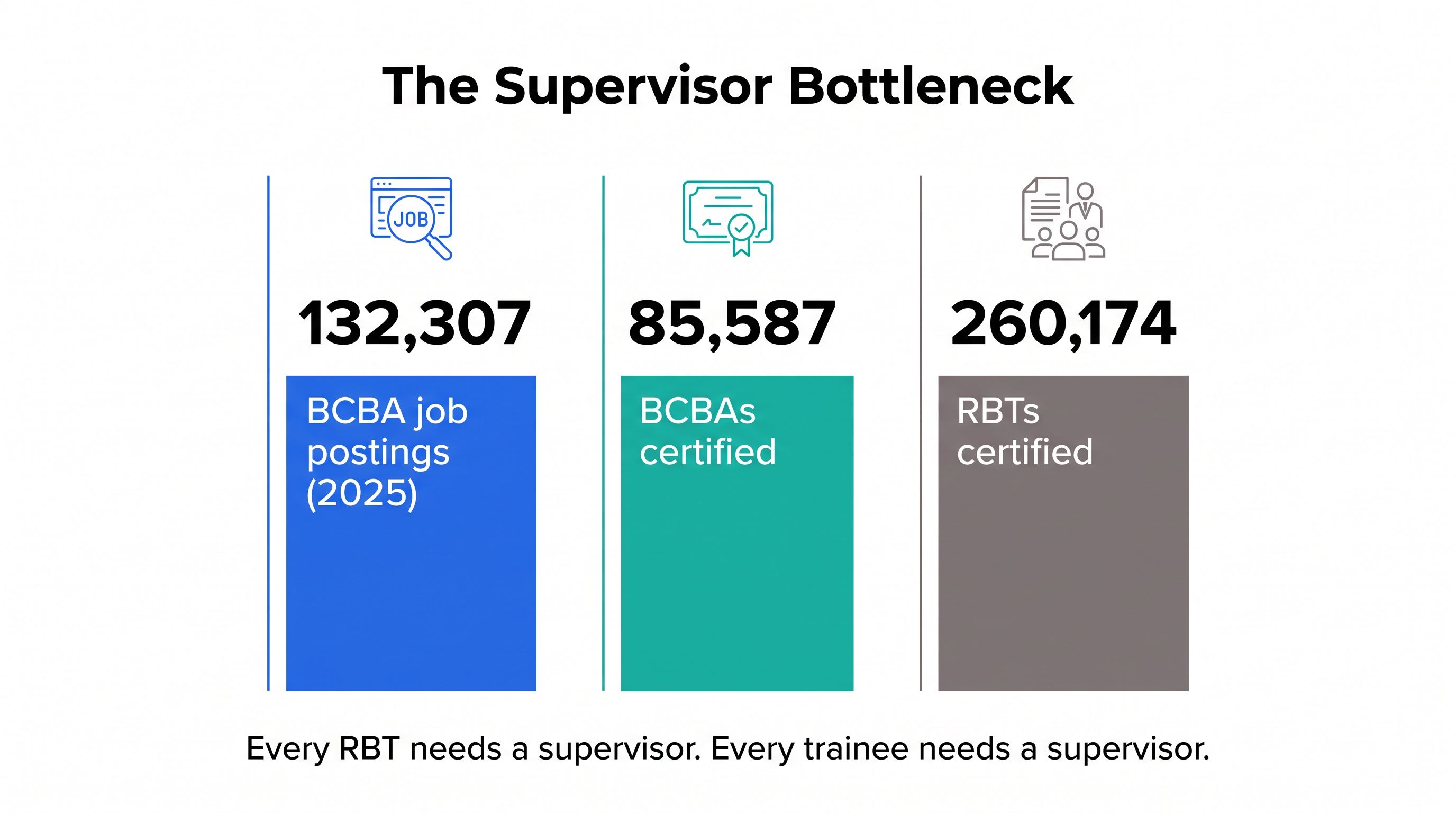
Then add the constraint that rarely makes it into shortage coverage. There were 260,174 RBTs certified as of July 1, 2026, roughly three for every BCBA. And per the RBT Handbook, an RBT's ability to work at all depends on supervision: "If at any time you do not have a qualified RBT Supervisor or RBT Requirements Coordinator, you may not practice, and your certification will be considered inactive." Each of those RBTs needs ongoing supervision for a minimum of 5% of the hours they spend providing behavior-analytic services each calendar month.
So supervisor-qualified BCBAs carry two loads at once. They are the reason a quarter of a million RBTs can legally deliver services, and they are the only route through which new BCBAs enter the field, since every trainee's fieldwork must be signed off by a BCBA who has completed the 8-hour training. The pipeline that would close the gap runs entirely through the same scarce pool that the gap is already straining.
The pressure is not spread evenly. Five states accounted for 38% of 2025 demand:
| State | 2024 Postings | 2025 Postings | Change |
|---|---|---|---|
| California | 19,578 | 20,258 | +3% |
| New Jersey | 5,154 | 8,139 | +58% |
| Texas | 5,889 | 7,792 | +32% |
| Massachusetts | 6,132 | 7,315 | +19% |
| North Carolina | 4,228 | 6,874 | +63% |
Source: BACB (2026). US Employment Demand for Behavior Analysts: 2010-2025. California alone accounted for 15% of 2025 demand.
The sharpest growth came from smaller markets: South Carolina rose 102% year over year, Utah 94%, Nebraska 81%, and Missouri 76%. Those are the states where a supervisor-qualified BCBA has the most negotiating room, because local supply had no time to adjust.
One more trend tightens the squeeze. Demand for BCaBAs fell in 2025, to 10,717 postings from 14,479 in 2024. Since BCaBAs can supervise RBTs, a shrinking BCaBA market pushes more oversight work onto BCBAs specifically.
What Changes for Supervisors on January 1, 2027
The BACB's 2027 requirements take effect for applications submitted on or after January 1, 2027. The headline for supervisors is reassuring: the eligibility criteria do not change. The 8-hour training and the supervision CEU requirement carry forward exactly as written today.
What changes is the work itself.
| Requirement | Current (2022 standards) | From January 1, 2027 |
|---|---|---|
| Supervision, Concentrated Supervised Fieldwork | 10% of hours | 7.5% of hours |
| Supervision, Supervised Fieldwork | 5% of hours | 5% of hours (unchanged) |
| Fieldwork hours per supervisory period | Minimum 20, maximum 130 hours | Minimum 20, maximum 160 hours |
| Supervisor-trainee contacts | 4 contacts (Supervised); 6 contacts (Concentrated) | Replaced by cumulative observation minutes |
| Observation of trainee with client | 1 observation per supervisory period | 60 cumulative minutes (Supervised); 90 cumulative minutes (Concentrated) |
| Individual vs. group supervision | At least 50% individual | At least 50% individual (unchanged) |
| Unrestricted activities | At least 60% of total hours | At least 60% of total hours (unchanged) |
| Verification forms | Current M-FVF and F-FVF | 2027 M-FVF and F-FVF, in Individual Supervisor and Multiple Supervisors versions |
Source: BACB (2026). 2027 BCBA Requirements, updated February 2026.
Read as a whole, the 2027 package asks for less supervision time on paper and more documentation discipline in practice. A drop from 10% to 7.5% on concentrated fieldwork frees real hours, and a 160-hour monthly ceiling lets a trainee move faster. The shift from counting four or six contacts to logging cumulative observation minutes cuts the other way; it is harder to reconstruct at month end if you were not tracking it as you went.
Eligibility also narrows on the trainee side. From 2027, only two pathways to BCBA certification remain: Pathway 1, a degree from an APBA-accredited or ABAI-accredited or recognized program, and Pathway 2, behavior-analytic coursework. Pathways 3 and 4 are retired, and Pathway 2 itself is scheduled for removal in 2032. Supervisors advising trainees on timing should know that a complete application submitted before January 1, 2027 is evaluated under the current standards.
Turning Supervisor Status Into Job-Search Leverage
Most BCBAs treat the 8-hour training as compliance. Employers treat it as capacity.
An ABA organization cannot staff RBTs without supervisor-qualified BCBAs, cannot grow a trainee pipeline without them, and cannot bill for services an unsupervised RBT delivers. When you complete the training and log it, you stop being only a clinician on the org chart and become part of the infrastructure that lets the business operate.
Make that visible. Your completion date is already public on the Certificant Registry, so there is nothing to protect by leaving it off your profile, and it preemptively answers a question every hiring manager has.
Then use it as a filter. Supervision is where good ABA employers and bad ones separate most clearly, and it is worth asking directly:
- ✓ How many supervisees does each supervisor carry, and is there a cap?
- ✓ Is supervision time scheduled and compensated, or expected on top of a full billable caseload?
- ✓ Who pays for the 8-hour training and the recurring supervision CEUs?
- ✓ If I am in my first year of certification, who serves as my consulting supervisor?
- ✓ How will the 2027 documentation changes be supported, in systems and in protected time?
The biggest red flag is an employer who wants your supervisor status without funding the time it requires. Sellers, Valentino, Landon, and Aiello (2019) surveyed 284 BCBAs actively supervising trainees and documented exactly this territory: the gap between what the BACB requires and what supervisors can deliver under real caseload conditions. Earlier work by Sellers, Valentino, and LeBlanc (2016) offers a useful evaluation frame, recommending that supervisors establish an effective supervisory relationship, use a structured approach with defined competencies, evaluate the effects of their own supervision, integrate ethics and professional development, and maintain the professional relationship after certification.
If an employer cannot describe how they support those five things, the answer tells you what supervision will actually look like there.
Frequently Asked Questions
Do I have to retake the 8-hour supervision training every recertification cycle?
No. The 8-hour supervision training is a one-time requirement and does not expire. What recurs is the separate obligation to earn 3 supervision CEUs in each 2-year cycle during which you supervised.
Can a BCaBA complete the 8-hour training and supervise?
A BCaBA may supervise RBTs after completing the 8-hour training, but only a BCBA may supervise BCBA or BCaBA trainees accruing fieldwork toward certification.
Can I supervise during my first year as a BCBA?
Yes. You must be an active BCBA with no current disciplinary sanctions, meet the ongoing supervision CEU requirement, and receive monthly consultation from a qualified consulting supervisor.
Does the 8-hour training count toward my 32 CEUs?
It depends on the ACE Provider. Many bundle CEUs with the course, but the number and category vary. Confirm before you enroll, and note that repeating the same course in a later cycle will not satisfy your supervision CEUs.
Is there a free 8-hour supervision training for BCBAs?
Yes. The Autism Partnership Foundation offers an 8-hour supervision workshop at no cost, based on the Supervisor Training Curriculum Outline (2.0). You must hold BCBA or BCaBA certification to submit the certificate for BACB purposes.
How does a trainee verify that I am eligible to supervise?
Through the BACB Certificant Registry, which displays "Completed supervision training on DATE" for eligible certificants. That date is when your eligibility began.
What happens if I supervise without meeting the requirements?
A Notice of Alleged Violation may be filed against you with the BACB Ethics Department. Your trainee's hours may also be at risk in an audit, which is why the handbook directs trainees to verify your training date before signing a supervision contract.
The Eight Hours That Change Your Market Position
Stripped to essentials, becoming a BCBA supervisor is a short list. Complete one 8-hour training built on the Supervisor Training Curriculum Outline (2.0). Upload the certificate to your BACB portal before you sign a supervision contract. Meet the eligibility profile, either a year of certification or a consulting supervisor. Then earn 3 supervision CEUs in every cycle you supervise in, and never satisfy them by repeating the same course.
What that short list buys is disproportionate. With 132,307 job postings chasing 85,587 certificants, and 260,174 RBTs whose ability to practice depends on having a supervisor on record, the constraint on this profession is not interest in the work. It is the number of people qualified to bring the next cohort through. That capacity is built eight hours at a time.
Showcase your verified credentials to employers
Supervisor-qualified BCBAs are the scarcest asset in ABA staffing. On CertifyndABA, your credentials and supervision status are visible to employers while your identity stays private until you choose to respond. Employers come to you.
Create Your Free Profile