


A behavior intervention plan is only as effective as the assessment behind it and the team that implements it. Whether you are a BCBA developing your first independent plan or an RBT preparing to implement one on the floor, understanding every component of a BIP is a core clinical skill that shapes outcomes for clients and defines your professional value.
This guide covers everything ABA professionals need to know about writing, implementing, and monitoring behavior intervention plans: the essential components backed by research, a step-by-step writing process, a clinical example, and the common mistakes that undermine even well-intentioned plans.
What Is a Behavior Intervention Plan?
A behavior intervention plan (BIP) is a written, data-driven document that outlines strategies to reduce challenging behaviors and teach functionally equivalent replacement skills. Every effective BIP is rooted in a Functional Behavior Assessment (FBA) that identifies why a behavior occurs; specifically, what function it serves for the individual.
A BIP is not a one-size-fits-all behavior chart. It is a living document tailored to one person, built on objective data, and revised as that data evolves.
For BCBAs, developing effective BIPs is a direct application of the BACB Ethics Code, which requires behavior-analytic assessments before intervention, reinforcement-based approaches as the first line of treatment, and informed consent from clients or guardians. For RBTs, BIP implementation is explicitly part of the RBT Task List competency areas covering behavior reduction and skill acquisition.
The FBA Foundation: Why Every BIP Starts with Assessment
You cannot write a function-based behavior intervention plan without assessment data. The FBA identifies the antecedents that trigger a behavior, the consequences that maintain it, and the function it serves. Skipping this step means guessing at interventions, which is neither ethical nor effective.
Three assessment approaches are commonly used, each with different levels of rigor:
Indirect assessment involves interviews with caregivers, teachers, or the individual, along with standardized rating scales like the Functional Assessment Screening Tool (FAST) or Questions About Behavioral Function (QABF). These are efficient but rely on recall, which introduces bias.
Descriptive assessment uses direct observation methods such as ABC (Antecedent-Behavior-Consequence) data collection, scatterplot analysis, and narrative recording. This captures behavior in real-time, natural settings.
Experimental analysis (functional analysis) systematically manipulates environmental variables to confirm the function of behavior. It is the most rigorous method but requires controlled conditions and trained staff. The Practical Functional Assessment (PFA), developed by Hanley and colleagues, has gained traction as a less intrusive alternative that pairs assessment with intervention from the start.
Every behavior serves at least one of these functions. The entire BIP hinges on correctly identifying which one. A plan designed for escape-maintained behavior will fail if the actual function is attention. This is why the FBA is non-negotiable.
7 Essential Components of a Behavior Intervention Plan
Research published in Behavior Analysis in Practice surveyed practicing BCBAs and found that target behavior definitions and replacement behavior definitions were rated the highest-priority components of a behavior plan, each scoring 4.0 out of 5.0 (Foran & Hoerger, 2018). Prevention, skill-building, and reactive procedures also scored 4.0.
Here are the seven components every effective BIP should include:
1. Identifying Information. Client name, date of birth, plan effective date, author, and supervising BCBA. This establishes accountability and traceability.
2. Operational Definition of Target Behavior. Define the behavior in observable, measurable terms. Include examples and non-examples so anyone reading the plan can reliably identify the behavior. "Aggression" is not operational; "striking another person with an open or closed hand on any body part" is.
3. Hypothesized Function. State the function identified through the FBA, including the evidence supporting it. Use a four-term contingency format: given [setting event/MO], when [antecedent], the client [behavior], which results in [consequence/function].
4. Antecedent Interventions. Environmental modifications that reduce the likelihood of the target behavior occurring. Examples include visual schedules, demand fading, choice boards, transition warnings, and environmental rearrangement. These are proactive, not reactive.
5. Replacement Behaviors. The skills you are teaching instead of the challenging behavior. These must be functionally equivalent; they need to access the same reinforcer as the target behavior. Functional Communication Training (FCT) is the most common approach: if the behavior is escape-maintained, teach the client to request a break appropriately.
6. Consequence Interventions. Reinforcement strategies for the replacement behavior and planned responses to the target behavior. This includes the reinforcement schedule (DRA, DRO, or DRI), the delivery method, and the fading plan. The BACB Ethics Code requires reinforcement-based approaches before any consideration of punishment procedures.
7. Crisis and Safety Protocols. For behaviors that pose a risk to the client or others, the plan must specify safety procedures, including de-escalation steps, who to contact, and when to implement emergency interventions. This component is often overlooked but critical for high-risk cases.
How to Write a Behavior Intervention Plan: Step by Step
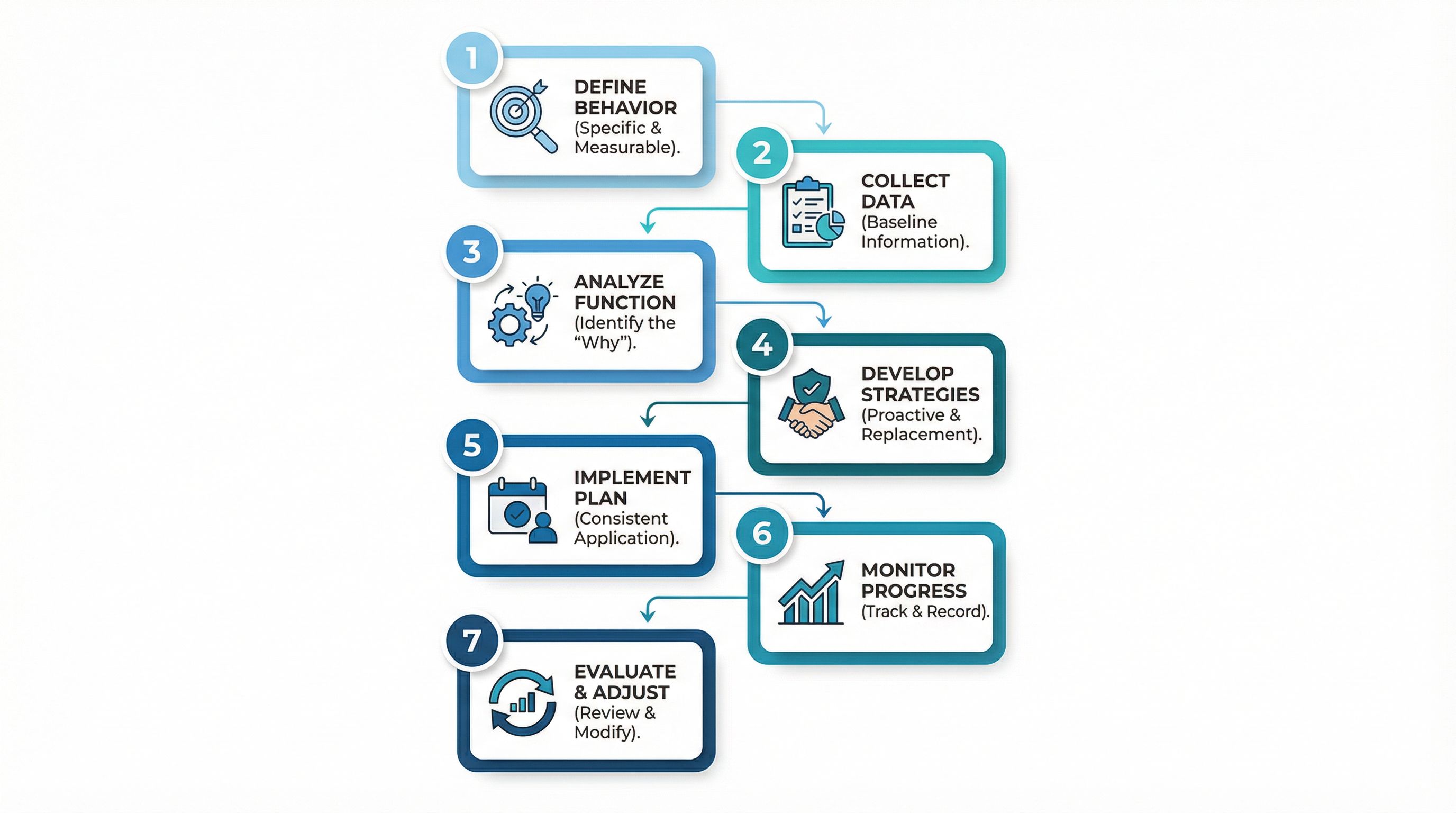
With the FBA complete and the function identified, follow these steps to build the plan:
Step 1: Obtain informed consent. Before implementing any behavior-change program, the BACB Ethics Code requires documented consent from the client or their authorized representative. Explain the plan's rationale, procedures, risks, and expected outcomes in accessible language.
Step 2: Define target behaviors operationally. Write definitions that pass the "stranger test": could someone unfamiliar with the client read the definition and accurately identify the behavior? Include onset, offset, and intensity criteria where relevant.
Step 3: Select replacement behaviors. Choose behaviors that match the function, are within the client's current skill repertoire (or can be prompted), and are likely to be reinforced in the natural environment. A replacement behavior that only works in a clinical setting has limited value.
Step 4: Design antecedent modifications. Based on the triggers identified in the FBA, build proactive strategies into the environment. If transitions trigger problem behavior, add visual transition warnings. If task difficulty is an antecedent, implement demand fading or intersperse easy and difficult tasks.
Step 5: Build the reinforcement system. Specify the reinforcer, the schedule of reinforcement, the delivery protocol, and the plan for thinning the schedule over time. An effective reinforcement system is the backbone of behavior change.
Step 6: Write crisis procedures. If applicable, define the threshold for crisis intervention, the de-escalation sequence, and the documentation requirements. Not every BIP needs a crisis section, but any plan targeting dangerous behavior does.
Step 7: Establish data collection and review schedule. Specify what data will be collected (frequency, duration, latency, interval), who collects it, how often it is graphed, and how often the team reviews it. Without this, the BIP becomes a static document rather than a dynamic tool.
Step 8: Train the implementation team. A well-written plan means nothing if the people implementing it do not understand it. Provide training to all RBTs, teachers, and caregivers involved. Conduct role-plays and check for treatment fidelity before going live.
BIP Example: Elopement Maintained by Escape
Consider Marcus, a 9-year-old who leaves his assigned area (elopement) during academic tasks. The FBA included a caregiver interview, two weeks of ABC data collection, and a scatterplot analysis. All three data sources converged on a single function: escape from difficult or non-preferred academic tasks.
Operational definition: Elopement is defined as Marcus leaving his designated area (moving more than 3 feet from his assigned seat or workstation) without adult permission during structured activities.
Function statement: When presented with non-preferred academic tasks (especially written assignments), Marcus elopes from his work area, which results in a delay or removal of the task demand.
Antecedent interventions: (1) Provide a visual task checklist breaking assignments into 3-5 minute segments. (2) Offer a choice of task order when possible. (3) Intersperse preferred activities between non-preferred tasks. (4) Provide a 2-minute warning before transitions to demanding tasks.
Replacement behavior: Marcus will request a break by handing a "break card" to the nearest adult (Functional Communication Training). Initially, break requests are honored every time to build the response.
Consequence interventions: DRA schedule: break requests are reinforced with a 2-minute break, then gradually faded (increase work interval from 3 minutes to 5, then 8, then 12). Elopement results in a neutral redirect back to the work area with minimal attention; the task demand remains in place.
Data collection: Frequency count of elopement episodes and break card usage, collected daily. Data graphed weekly. Team review every two weeks, with plan modifications if elopement has not decreased by 25% within the first four weeks.
"Essential components act to standardize the structure of the behavior plan, not the structure of the behavior plan contents or procedures." — Foran & Hoerger (2018)
5 Common BIP Mistakes and How to Avoid Them
1. Writing a BIP without a proper FBA. This leads to non-function-based interventions that address the topography of behavior rather than its cause. Fix: always complete an FBA (at minimum, indirect + descriptive) before writing the plan.
2. Selecting replacement behaviors that do not match the function. Teaching a child to "use your words" will not reduce escape-maintained behavior if the words do not actually result in escape. Fix: ensure every replacement behavior accesses the same reinforcer as the target behavior.
3. Over-relying on punishment procedures. The BACB Ethics Code requires behavior analysts to use reinforcement-based strategies as the primary approach. Punishment should only be considered when reinforcement alone has been insufficient and the behavior poses significant risk. Fix: build your plan around reinforcement first, and document why punishment is necessary if included.
4. Failing to train the implementation team. Research consistently shows that treatment fidelity is the single largest predictor of BIP success. The Child Mind Institute notes that 80-90% implementation consistency is the benchmark for effective execution. Fix: schedule formal training sessions, conduct fidelity checks, and provide ongoing feedback to all implementers.
5. Not setting a data review schedule. A BIP without regular data review is a shelf document. If nobody is looking at the data, nobody knows whether the plan is working. Fix: build review dates directly into the plan. Weekly graphing and bi-weekly team reviews is a reasonable default for most cases.
Monitoring Effectiveness: When to Maintain, Modify, or Overhaul
Data collection is not the finish line; it is the starting point for clinical decision-making. After collecting baseline data and implementing the BIP, use visual analysis to evaluate three dimensions of the data: level (the average), trend (the direction), and variability (the consistency).
Maintain the plan when data show a clear downward trend in the target behavior and an upward trend in the replacement behavior, with low variability. The plan is working; let it run.
Modify specific components when data show some progress but the trend has plateaued, or variability is high. Re-examine the antecedent interventions, check whether the reinforcer is still effective, and assess treatment fidelity. Often the issue is implementation consistency rather than plan design.
Overhaul the plan when data show no meaningful change after 4-6 weeks of consistent implementation, or the target behavior is increasing. This usually signals a problem with the function hypothesis. Go back to the FBA and reassess.
BACB Ethics and Behavior Intervention Plans
BIP development sits at the intersection of clinical skill and ethical obligation. Several sections of the BACB Ethics Code directly govern how behavior analysts approach this work:
- ✓ Informed consent must be obtained before implementing any behavior-change program, including a clear explanation of procedures, risks, and expected outcomes.
- ✓ Least restrictive procedures must be prioritized. Reinforcement-based approaches come first; restrictive or punishment procedures require additional justification and oversight.
- ✓ RBT scope of practice: RBTs implement BIPs but do not develop them independently. Supervisors must verify RBT competency before assigning punishment or restrictive procedures.
- ✓ Ongoing monitoring is required. Behavior analysts must document conditions, actions taken, and outcomes throughout the intervention.
Understanding these ethical requirements is not optional; it is fundamental to responsible practice. For those pursuing or maintaining BCBA certification, BIP-related ethics questions are a recurring exam topic.
Frequently Asked Questions
Who can write a behavior intervention plan?
BCBAs and BCaBAs can independently develop BIPs. RBTs contribute to the process through data collection and implementation feedback but do not write plans independently. In school settings, BIPs are typically developed by a team that includes a behavior analyst, special education staff, and the family.
What is the difference between a BIP and a Behavior Support Plan?
A BIP is a formal, data-driven document based on a Functional Behavior Assessment. A Behavior Support Plan (BSP) is a less formal proactive support, often used at Tier 2, that may not involve a formal FBA. BIPs are required under IDEA for students whose behavior impedes learning; BSPs are not legally mandated.
How long does a BIP take to show results?
Most well-implemented BIPs show initial trend changes within 2-6 weeks. However, meaningful, sustained behavior change may take several months depending on the complexity of the behavior, the consistency of implementation, and whether the function was correctly identified.
What should I do if a BIP is not working?
First, assess treatment fidelity: is the plan being implemented correctly and consistently? If fidelity is strong but data show no improvement after 4-6 weeks, reassess the function hypothesis through additional FBA data collection. The most common reason a BIP fails is an incorrect or incomplete function identification.
Is a BIP required for an IEP?
Under the Individuals with Disabilities Education Act (IDEA), if a student's behavior impedes their learning or the learning of others, the IEP team must consider the use of positive behavioral interventions and supports. When a student has a pattern of behavior that has led to disciplinary actions, an FBA and BIP are required.
Build Your ABA Career on Strong Clinical Skills
Behavior intervention plan development is one of the most valued clinical competencies in ABA. Employers consistently look for practitioners who can conduct thorough assessments, write function-based plans, and use data to drive decisions. Whether you are an RBT building foundational skills on the path to BCBA or a seasoned analyst refining your approach, strong BIP skills distinguish you in a competitive field.
Your Clinical Expertise Deserves Visibility
CertifyndABA lets you showcase specialized skills like BIP development, FBA, and FCT on an anonymous profile. Employers see your qualifications and reach out to you; no job applications required.
Create Your Free Profile