

If you hold a BCBA credential, the search for BCBA jobs in Dallas looks less like a competition and more like a bidding war for your time. Dallas-Fort Worth is one of the largest and fastest-growing behavior-analysis markets in the country, and there are consistently more open roles than there are analysts to fill them. This guide breaks down why demand is so high, what BCBAs actually earn in Dallas, where the jobs are, the Texas licensure step you cannot skip, and how to run a smart, private search.
In the Dallas-Fort Worth metroplex, a single national job board routinely lists around 145 open BCBA positions at any given time, and that is only a slice of the true demand. The story behind those listings is a national shortage that Texas feels more sharply than almost anywhere else.
Why BCBA Demand in Dallas Is So High
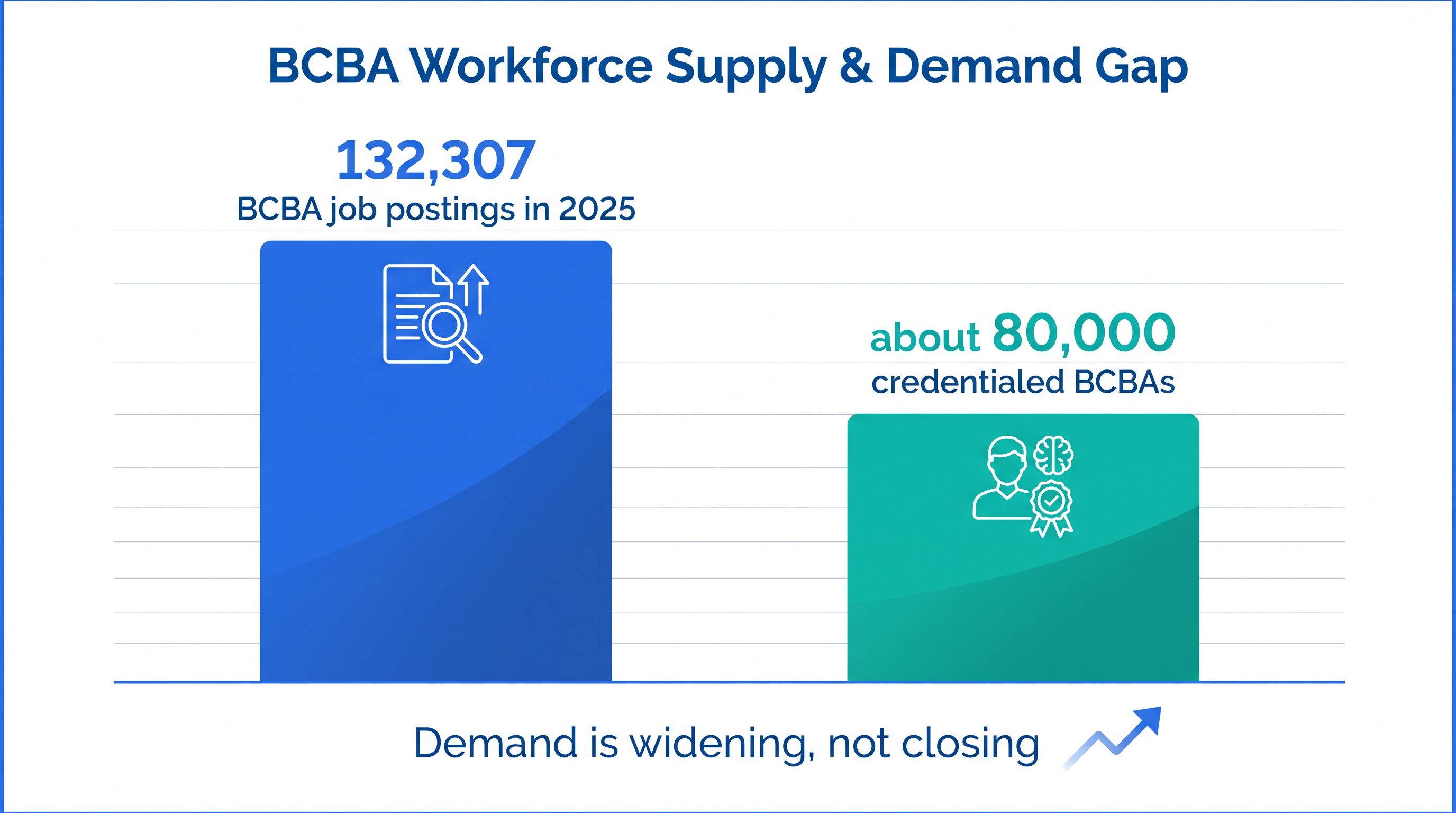
The Dallas job market is a local symptom of a national imbalance. According to labor-market data from Lightcast, compiled for the Behavior Analyst Certification Board (BACB), employers posted 132,307 job listings requiring a BCBA or BCBA-D credential in 2025, a 28 percent jump over the prior year. Postings for the credential have grown at a compound annual rate of roughly 44 percent since 2017.
Set that against supply. Only about 80,000 BCBAs hold active credentials in the United States, and more than half of all U.S. counties still have no practicing behavior analyst at all. The gap between open roles and available analysts is widening, not closing, driven by rising autism identification rates, expanding insurance mandates, and a certification pipeline that simply cannot keep pace. You can read the fuller national picture in our breakdown of the BCBA shortage in 2026.
Texas sits near the center of that demand. It ranks third nationally for BCBA job-posting volume and is among the top five states that together account for roughly 38 percent of all demand in the field. It is also the second-largest ABA market in the country by population, with booming metros in Dallas-Fort Worth, Houston, Austin, and San Antonio. A local accelerant made 2025 even hotter: on September 1, 2025, Texas Medicaid raised its ABA billing codes by roughly 11.5 percent, and providers responded by expanding across the metroplex.
In Texas, there are roughly two to three open BCBA roles for every certified analyst who is actively job hunting.
For a credentialed analyst, that ratio changes everything. You are not hoping to be noticed; you are deciding which offer to take. The rest of this guide is about turning that leverage into the right job, not just any job.
BCBA Salary in Dallas: What You Can Actually Earn
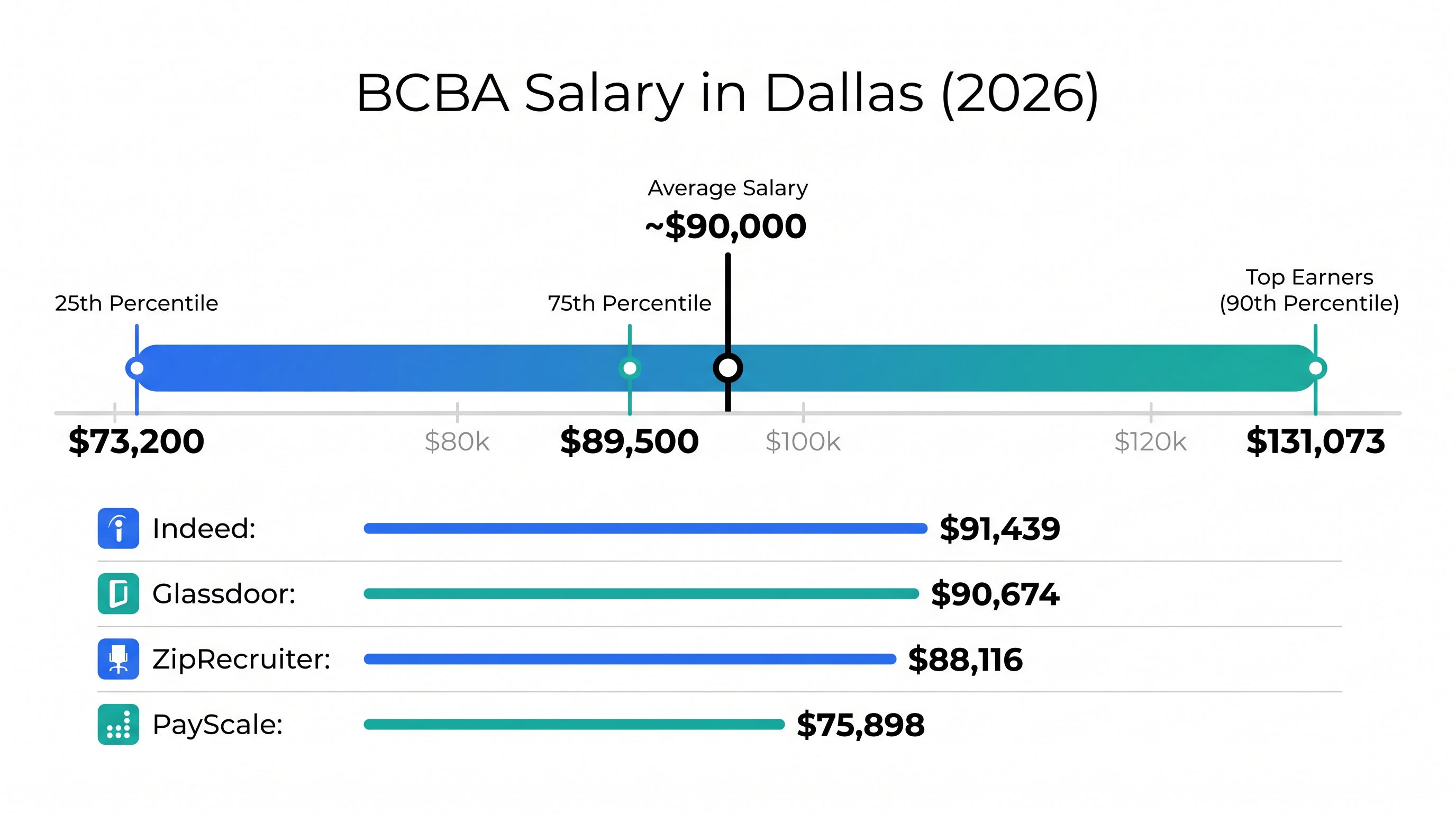
Pay for BCBA jobs in Dallas is strong and clusters tightly across the major salary trackers. Indeed reports an average of $91,439 per year, Glassdoor puts the Dallas-Fort Worth average at $90,674, and ZipRecruiter lands at $88,116 (about $42 an hour). PayScale is lower at roughly $75,898, but its data skews toward early-career and self-reported figures. Taken together, a realistic Dallas average sits around $88,000 to $91,000.
| Source | Average BCBA Salary (Dallas) |
|---|---|
| Indeed | $91,439 |
| Glassdoor (DFW) | $90,674 |
| ZipRecruiter | $88,116 (~$42/hr) |
| PayScale | $75,898 (early-career skew) |
The spread matters as much as the average. ZipRecruiter data shows most Dallas BCBA salaries running from about $73,200 at the 25th percentile to $89,500 at the 75th, with top earners near $131,073 at the 90th percentile. Dallas and Austin both tend to pay roughly 5 to 10 percent above the Texas state average, and clinical directors or senior supervisors regularly clear six figures, with total compensation in the $100,000 to $120,000 range.
Two Texas-specific factors sweeten those numbers. First, Texas has no state income tax, so a $90,000 salary in Dallas takes home more than the same figure in a high-tax state. Second, a competitive market means signing and relocation bonuses, flexible scheduling, and stronger benefits are all on the table. For the full statewide picture, see our BCBA salary in Texas guide.
Where the Jobs Are: DFW Employers and Settings
Center-based ABA providers do most of the hiring in Dallas-Fort Worth. National and regional groups with a strong DFW footprint include Action Behavior Centers (with locations in Mesquite, Duncanville, Irving, and beyond), Behavioral Innovations, BlueSprig, InBloom Autism Services, Therapy and Beyond, The Helm ABA, Rainbow ABA, and Easterseals. Beyond the big names, dozens of smaller clinics and independent practices compete for the same analysts.
The work itself comes in several forms, and each has a different rhythm:
- ✓ Center-based: The largest share of openings, with structured hours and on-site RBT teams.
- ✓ In-home: More driving across the metroplex, but flexible scheduling and close family involvement.
- ✓ School-based: District contracts and campus roles that follow the academic calendar.
- ✓ Telehealth and hybrid: Remote supervision and parent training, often blended with in-person hours.
The metroplex advantage is density. Dallas County and Tarrant County together form one of the largest concentrations of behavior analysts in Texas; Tarrant County alone counted roughly 406 licensed analysts as of April 2025. That means a single search can reach dozens of employers without ever relocating, and it makes lateral moves and promotions realistic. The typical ladder runs from BCBA clinician to senior or lead BCBA, then clinical supervisor, clinical director, and regional director; in a fast-growing market like Dallas, those steps come sooner than in a saturated one. If you are weighing culture and caseload, our guide to the best ABA companies to work for is a useful starting point.
Texas Licensure: You Need an LBA, Not Just Your BCBA
Here is the step out-of-state analysts most often overlook. To practice in Dallas, your BACB certification alone is not enough; Texas requires a state-issued Licensed Behavior Analyst (LBA) credential through the Texas Department of Licensing and Regulation (TDLR).
The requirements are straightforward: hold an active BCBA or BCBA-D certification, submit an application to TDLR, and renew every two years for a fee of about $165. There is no separate state exam beyond the BACB exam you have already passed. As of December 2024, Texas also recognizes the QABA QBA credential as a second pathway to the LBA. For the full checklist, see our Texas ABA licensure resource.
How to Land the Best BCBA Job in Dallas
When the market favors you, the goal shifts from getting hired to getting hired well. Use the leverage to vet employers as carefully as they vet you.
Ask pointed questions in every interview: How large is the caseload? What are the billable-hour expectations? What is the RBT-to-BCBA ratio, and how is RBT turnover? What administrative and clinical support will you have? Our list of BCBA interview questions can help you prepare both sides of that conversation.
Watch for red flags: vague answers about caseload, no dedicated RBT staffing, pressure to hit unrealistic billable targets, or no mentorship structure for newer analysts. In Dallas, you can afford to walk away from a role that raises them. And because multiple offers are realistic here, you have room to negotiate; our salary negotiation guide shows how to turn the shortage into better pay, bonuses, and scheduling.
There is also a smarter way to run the search itself. Instead of blasting your resume across job boards and hoping the right clinics notice, you can let verified Dallas-area employers come to you. That is exactly how CertifyndABA works: you create a free, anonymous profile, and employers send you interview requests based on your qualifications, with your identity staying private until you choose to respond. No resume spam, and no risk of tipping off your current employer while you look.
Frequently Asked Questions
How much do BCBAs make in Dallas?
Most Dallas BCBAs earn between about $73,000 and $131,000, with an average near $88,000 to $91,000 across Indeed, Glassdoor, and ZipRecruiter. Clinical directors and senior supervisors commonly exceed six figures.
Are BCBAs in demand in Dallas?
Very much so. Texas ranks third nationally for BCBA demand, and Dallas-Fort Worth is one of its hottest metros; there are roughly two to three open roles for every analyst actively job hunting. See our data on BCBA job openings for the national context.
Do I need a Texas license to work as a BCBA in Dallas?
Yes. You need a Licensed Behavior Analyst (LBA) credential from TDLR in addition to your BACB certification. Renewal is every two years for about $165, and there is no extra state exam.
What is the fastest way to get hired in Dallas?
Get your LBA license in motion, target center-based providers that hire at volume, and let employers reach out to you through an anonymous profile rather than applying one listing at a time. You can also compare nearby markets in our Texas jobs guide and Houston jobs guide.
Does Dallas pay more than Houston or Austin?
Dallas and Austin both run roughly 5 to 10 percent above the Texas state average and are broadly comparable to Houston. Dallas also benefits from no state income tax, which improves take-home pay at the same salary.
The Bottom Line on BCBA Jobs in Dallas
For BCBAs, Dallas is close to a best-case market: strong pay around $88,000 to $91,000, a deep bench of employers, fast paths to leadership, and a national shortage that keeps tilting the field toward the candidate. The hard part in Dallas is not finding a job; it is choosing the right one and protecting your privacy while you look. Vet employers, use your leverage, and let the offers come to you.
Let Dallas employers compete for you
Create a free, anonymous CertifyndABA profile and verified Dallas-area employers will send you interview requests based on your qualifications. Your identity stays private until you decide to respond.
Create Your Free Profile