

In 2025, employers posted over 132,000 positions requiring BCBA certification. Only 83,586 Board Certified Behavior Analysts hold active credentials in the United States. That ratio; roughly 1.6 open jobs for every certified BCBA; means the typical BCBA job description is not a take-it-or-leave-it offer. It is a negotiation starting point.
Yet most BCBAs scan job postings the same way they did when positions were scarce: skimming for salary range and location, then applying to whatever looks reasonable. That approach leaves value on the table. A BCBA job description tells you far more than duties and pay. It reveals how an employer thinks about caseloads, clinical autonomy, supervision, and work-life balance; if you know where to look.
This guide breaks down every component of a standard BCBA job description, explains how postings differ across work settings, and identifies the red flags and green flags that predict whether a role will lead to professional growth or burnout.
Anatomy of a BCBA Job Description
Understanding the standard building blocks of a BCBA job description helps you compare opportunities systematically rather than reacting to whichever posting has the best headline.
Job Title Variations
The title itself signals scope and seniority. "BCBA" or "Board Certified Behavior Analyst" indicates a standard clinical role. "Senior BCBA" or "Lead BCBA" typically means a higher caseload with mentorship responsibilities. "Clinical Supervisor" or "Clinical Director" suggests administrative and oversight duties beyond direct client work. Pay attention to these distinctions; they shape your daily experience more than the salary line does.
Required Qualifications
Nearly every BCBA job description lists the same baseline requirements:
- Active BCBA certification through the Behavior Analyst Certification Board
- Master's degree in applied behavior analysis, psychology, education, or a related field
- State licensure or registration where applicable (requirements vary by state)
- CPR/First Aid certification (common in clinical and school-based settings)
Preferred Qualifications
This is where employers differentiate. Common preferred qualifications include 1 to 3 years of post-certification experience, familiarity with specific populations (pediatric autism, adult developmental disabilities, behavioral health), supervisory experience with RBTs, and proficiency with specific data collection platforms like CentralReach or Catalyst. Note which preferences are genuine requirements in disguise and which are truly optional; vague language like "experience preferred" often means "required but we're flexible because of the shortage."
Compensation
BCBA salaries vary widely by geography, setting, and employer type. According to the most recent salary data, the national median falls between $80,000 and $95,000, with significant variation by state. Job descriptions that omit salary ranges entirely are increasingly a red flag; transparency signals confidence in the offer.
Core BCBA Duties and Responsibilities
While the specific language varies, virtually every BCBA job description includes these core responsibilities. Understanding each one helps you gauge how much clinical versus administrative work a role actually involves.
Assessment and Evaluation
Conducting functional behavior assessments (FBAs) is the foundation of BCBA clinical work. This involves direct observation, caregiver and teacher interviews, and standardized assessment tools to identify the function of challenging behaviors. Job descriptions that emphasize "comprehensive assessments" typically expect 2 to 4 hours per evaluation, while those mentioning "brief assessments" may indicate higher volume with less depth.
Treatment Planning
Developing individualized behavior intervention plans (BIPs) with measurable, observable goals is a core BCBA duty. Plans incorporate evidence-based strategies including positive reinforcement, prompting hierarchies, shaping, and functional communication training. Strong job descriptions mention dedicated planning time; weaker ones assume this work happens "between sessions."
RBT Supervision
Most BCBA roles include direct and indirect supervision of Registered Behavior Technicians. Insurance and funding sources typically require 10% to 20% BCBA oversight of RBT direct service hours. For example, if a client receives 30 hours per week of RBT-delivered therapy, the BCBA provides 3 to 6 hours of supervision for that case alone. When you see a caseload number in a job description, multiply by this supervision ratio to estimate your actual weekly commitment.
Data Analysis and Treatment Modification
Ongoing data collection, graphing, and analysis drive treatment decisions in ABA. BCBAs review behavioral data regularly to determine whether interventions are effective, adjust strategies based on trends, and document progress for insurance authorization renewals.
Caregiver Training
Parent and caregiver training is a standard BCBA responsibility. Teaching families to implement behavioral strategies consistently across environments is one of the strongest predictors of positive client outcomes. Job descriptions that specifically allocate time for caregiver training signal a quality-focused employer.
Additional Responsibilities
Other common duties include collaborating with multidisciplinary teams (educators, speech-language pathologists, occupational therapists, physicians), maintaining documentation for insurance compliance, and completing continuing education. The BACB requires 32 CEUs per two-year certification cycle. Employers that offer CEU stipends and dedicated professional development time are investing in your long-term growth.
How BCBA Job Descriptions Vary by Work Setting
The same "BCBA" title looks very different depending on where you work. Each setting has distinct scheduling patterns, caseload structures, and job description language worth understanding.
Clinic-Based
Clinic-based BCBA job descriptions emphasize structured schedules, team collaboration, and center-based programming. You typically work set hours in a dedicated treatment facility, supervise multiple RBTs simultaneously, and participate in group supervision meetings. These roles often mention "collaborative environment" and "treatment room management." Caseloads tend to be moderate because clients come to you, reducing travel time.
Home-Based
Home-based or in-home BCBA roles involve traveling to client residences. Job descriptions for these positions emphasize reliable transportation, mileage reimbursement policies, and geographic coverage areas. The flexibility of scheduling is a draw, but commute time between clients can eat into your day. Look for whether the posting accounts for drive time in its billable hour expectations.
School-Based
School-based BCBA job descriptions focus on IEP collaboration, classroom behavior support, and educator training. These roles typically follow the academic calendar, offering summers and school holidays off. Postings mention skills in transition planning, crisis intervention protocols, and partnership with special education teams. For more on this path, see our guide to school-based BCBA jobs.
Telehealth
Remote and telehealth BCBA positions have grown rapidly. Job descriptions for virtual roles list technology requirements (reliable internet, HIPAA-compliant platforms), specify which states you must be licensed in, and describe virtual supervision models for RBTs. These roles often offer the most schedule flexibility but require strong self-management skills.
Red Flags and Green Flags in BCBA Job Descriptions
Not all job descriptions are created equal. The language an employer uses reveals their priorities. Here is what to watch for.
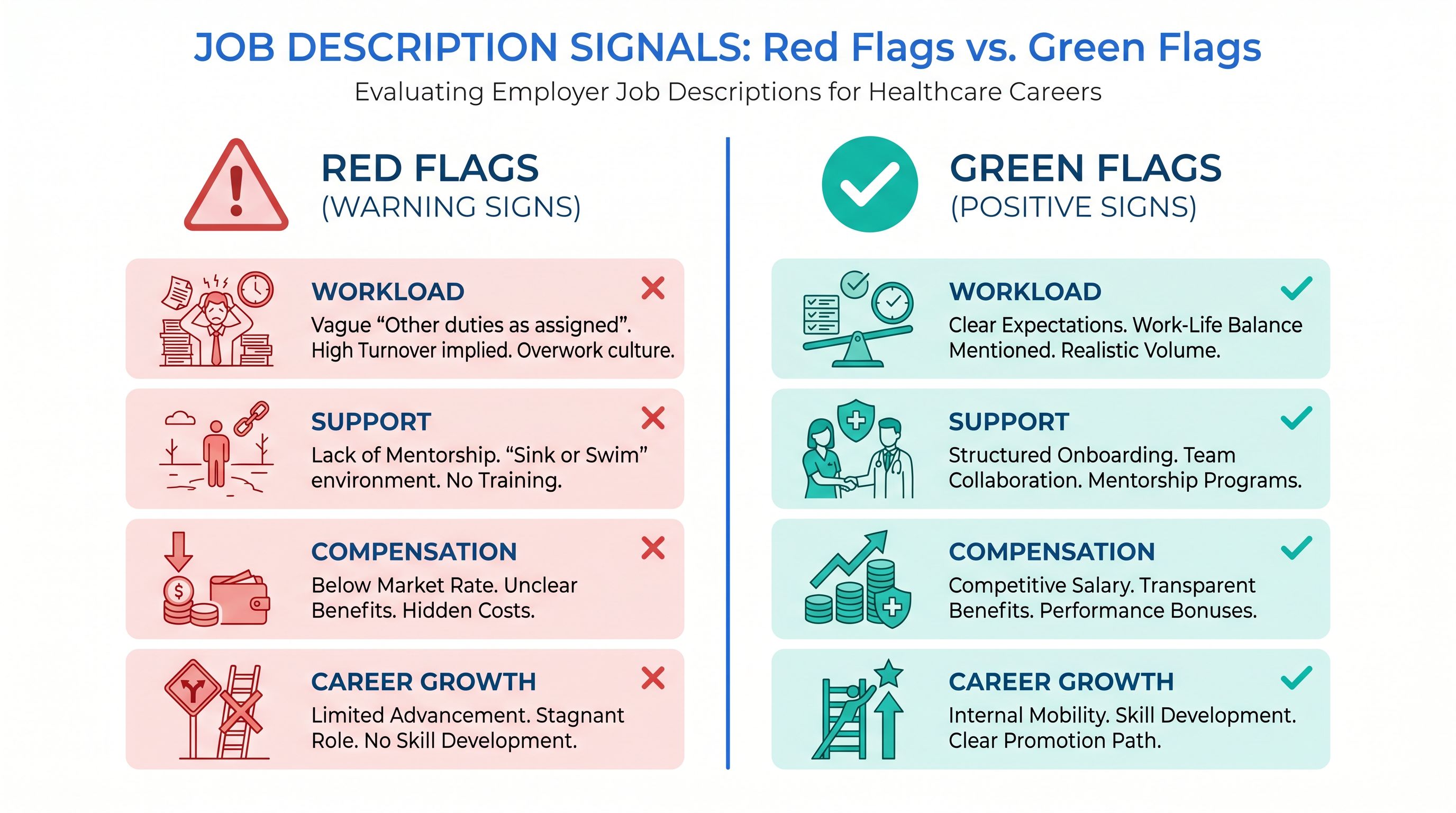
Red Flags
- ✗ Unrealistic billable hour expectations. Postings requiring 30 or more billable hours per week leave almost no time for treatment planning, documentation, or supervision prep. Sustainable billing is 25 to 27 hours maximum.
- ✗ Significantly above-market salary. A salary $15,000 to $20,000 above market rate often signals unsustainable workload expectations. Companies offering inflated pay typically expect proportionally more output.
- ✗ Vague duty boundaries. Language like "other duties as assigned" without clear role boundaries is a warning. This phrase often translates to taking on administrative, intake, or marketing tasks that fall outside clinical scope.
- ✗ No mention of onboarding or mentorship. "Hit the ground running" without structured support means you are expected to manage a full caseload from day one. New BCBAs especially should look for ramp-up periods.
- ✗ Excessive caseloads. Postings advertising caseloads of 20 to 30 or more clients with minimal administrative support should raise immediate concerns about quality of care and sustainability.
Green Flags
- ✓ Specific caseload caps. The best employers set clear limits: 10 to 15 cases during ramp-up for new BCBAs, with a maximum of 18 to 20 at full capacity. This signals intentional workload management.
- ✓ Structured mentorship. A defined onboarding timeline with assigned clinical supervision shows the employer invests in retention, not just recruitment.
- ✓ Paid administrative time. Job descriptions that explicitly build non-billable time into the schedule for treatment planning, documentation, and caregiver communication reflect realistic clinical expectations.
- ✓ CEU stipends and professional development. Employers that fund continuing education and provide time for conferences invest in your growth beyond the minimum BACB requirement.
- ✓ BCBA-led clinical team. Organizations where BCBAs hold leadership positions tend to prioritize ethical practice, reasonable caseloads, and clinical quality over revenue metrics.
Why the BCBA Shortage Gives You Leverage
The numbers tell a clear story. According to BACB certificant data, there are 83,586 certified BCBAs in the U.S. as of early 2026. Research from TYGES Healthcare estimates the field needs approximately 362,500 BCBAs to meet current demand; nearly five times the existing workforce.
The shortage is not evenly distributed. Massachusetts has 55.1 BCBAs per 100,000 residents while Wyoming has just 7.5. Nearly half of U.S. counties have no BCBA at all. The Bureau of Labor Statistics projects 17% growth in behavioral health roles through 2034; five times faster than the national average.
What does this mean for you? It means you can afford to be selective. Instead of applying to every open position and hoping for the best, you can evaluate each BCBA job description against your own priorities: caseload sustainability, compensation, clinical autonomy, professional development, and work-life balance. The market supports that approach.
This leverage extends to salary negotiation as well. When an employer knows you have options, conversations about caseload caps, PTO, CEU budgets, and supervision models become collaborative rather than one-sided.
Your Next Step: Let Employers Come to You
You now know what a strong BCBA job description looks like and how to spot the warning signs of a role that leads to burnout. With the current workforce shortage, you do not have to settle for positions that show red flags.
The next step is putting yourself in a position where the right employers find you, rather than spending hours scrolling through job boards and wondering what each posting really means.
Let Qualified Employers Reach Out to You
CertifyndABA flips the job search. Create an anonymous profile highlighting your skills and preferences. Employers who meet your standards send interview requests; you decide who sees your name.
Create Your Free Profile