


If you are searching for how to become a BCBA without a degree, here is the honest answer first: you can't. Every route to the Board Certified Behavior Analyst (BCBA) credential requires a master's degree or higher. What you can do, starting this month and with only a high school diploma, is get hired in applied behavior analysis (ABA), earn your first credential and let an employer help pay for the degrees that come next.
This guide lays out what the Behavior Analyst Certification Board (BACB) actually requires at each level, what changes on January 1, 2027, and what 132 employers are offering people who start at the bottom of the ladder. Some pages that rank for this search describe "non-degree routes" to the BCBA. Those routes do not exist in the BACB's current handbook, so plan around the degree, not around a shortcut.
Can You Become a BCBA Without a Degree?
No. The BCBA Handbook (updated November 2026) lists a master's degree or higher as the first requirement in every eligibility pathway. Experience, a bachelor's degree or years as a technician do not replace it. Through December 31, 2026, the BACB offers four BCBA pathways, and all four start with a graduate degree. Starting January 1, 2027, only two remain:
- Pathway 1: a master's or higher from an APBA-accredited program, or from an ABAI-accredited or recognized behavior analysis program (Tier 1, 2a or 2b).
- Pathway 2: a master's or higher in any field, plus 315 hours of graduate behavior-analytic coursework from a university with a Pathway 2 Program Contact.
Pathway 3 (faculty teaching and research) and Pathway 4 (postdoctoral experience) close to new applications on January 1, 2027. Neither was ever a no-degree option; both required a graduate degree too. The BACB has also announced that Pathway 1 becomes the only BCBA pathway in 2032, which is covered in our guide to BCBA Pathway 2.
The useful part of Pathway 2 is that your master's does not have to be in behavior analysis. A master's in education, psychology or another field counts once you add the 315 coursework hours. So the question "can I skip the degree" has a better cousin: "how do I get the degree while working and getting paid in the field?"
The Three BACB Credentials and What Each One Requires
The BACB certifies three levels. Only the first one is open to someone with no college degree.
| RBT | BCaBA | BCBA | |
|---|---|---|---|
| Degree | None; high school diploma, age 18+ | Bachelor's or higher | Master's or higher |
| Training or coursework | 40-hour training plus an initial competency assessment | 225 hours of behavior-analytic coursework (or an ABAI-accredited bachelor's) | 315 hours of graduate coursework (or an accredited master's) |
| Supervised hours | None before certifying; ongoing supervision once working | 1,300 fieldwork hours (1,000 concentrated) | 2,000 fieldwork hours (1,500 concentrated) |
| Other | Background and abuse registry check | Works under BCBA supervision | Independent practitioner |
| BACB fees | $65 application + $45 exam appointment | $175 application + $125 exam appointment | $245 application + $125 exam appointment |
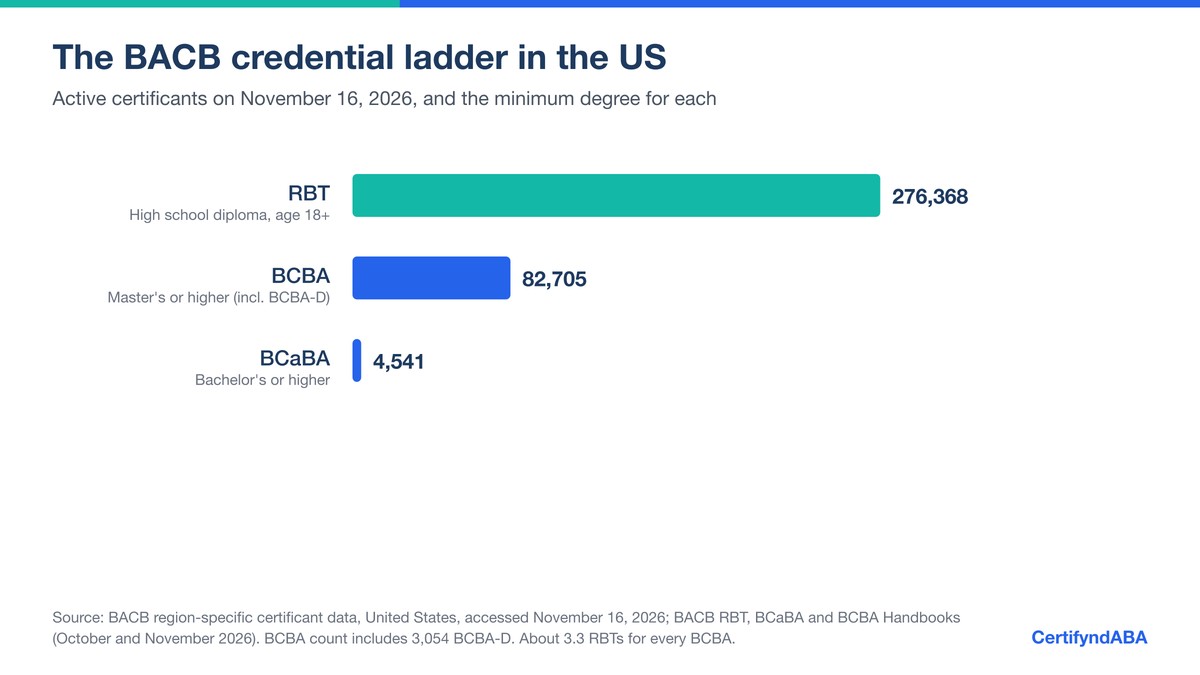
| Active in the US (Nov 16, 2026) | 276,368 | 4,541 | 82,705 (incl. 3,054 BCBA-D) |
Sources: BACB RBT, BCaBA and BCBA Handbooks (October and November 2026 editions); BACB region-specific certificant data, accessed November 16, 2026. Fees exclude state licensure, tuition and supervision costs.
Notice the size of each tier. The US has about 3.3 RBTs for every BCBA (276,368 against 82,705). The BCaBA is the smallest credential by far, and many people skip it and go straight from RBT to BCBA. Our BCBA vs BCaBA comparison covers when the middle step is worth it.
Why Employers Will Help You Get There
Employers want more BCBAs than exist. The BACB's labor-market report with Lightcast counted 132,307 US job postings for BCBAs in 2025, up 28% from 103,150 in 2024. Against 82,705 active US BCBAs today, that is about 1.6 postings a year for every certificant. That figure is a full year of postings set against a headcount, so it overstates open jobs on any single day. You may see claims of "two to three jobs for every BCBA" elsewhere; the current arithmetic does not support that, but it still points to a real shortage.
A one-day snapshot tells the same story. On November 16, 2026, a national SimplyHired search for "BCBA" returned 27,879 results, about 34 ads for every 100 BCBAs. Keyword counts include some duplicates and adjacent roles, so treat that as a rough ratio.
That shortage is why the cheapest path to a BCBA often runs through an ABA employer. A clinic that cannot hire enough BCBAs has a reason to grow its own from the technicians it already trusts. For more on the size of the gap, see the BCBA shortage in 2026.
What 132 Entry-Level ABA Job Ads Offer People Without a Degree
To see what the first rung looks like in practice, we read the full text of one entry-level ad from each of 132 employers in 38 states. The ads were registered behavior technician, behavior technician and ABA therapist postings on SimplyHired on November 16, 2026. We coded each ad by hand for its education rule and for any help it offered toward the next credential.
- ✓Most do not ask for a degree. Of the 91 ads that stated a minimum, 73 (80%) asked for a high school diploma or equivalent. Only 7 (8%) required a bachelor's. Another 6 asked for some college, and 3 accepted either an RBT card or a bachelor's. The other 41 ads stated no education rule at all.
- ✓A diploma is enough to earn the typical rate. The median posted rate was $24.50 an hour across 108 ads that listed an hourly figure (middle half $22.50 to $26.88). Ads with a high-school minimum also had a median of $24.50.
- ✓Some pay for your first credential. 16 employers (12%) said they provide or pay for the 40-hour RBT training or certification.
- ✓About one in five advertises help toward the BCBA. 29 employers (22%) named at least one of these: tuition help (21 employers), free BCBA fieldwork supervision (6), or a named path or program to the BCBA (8).
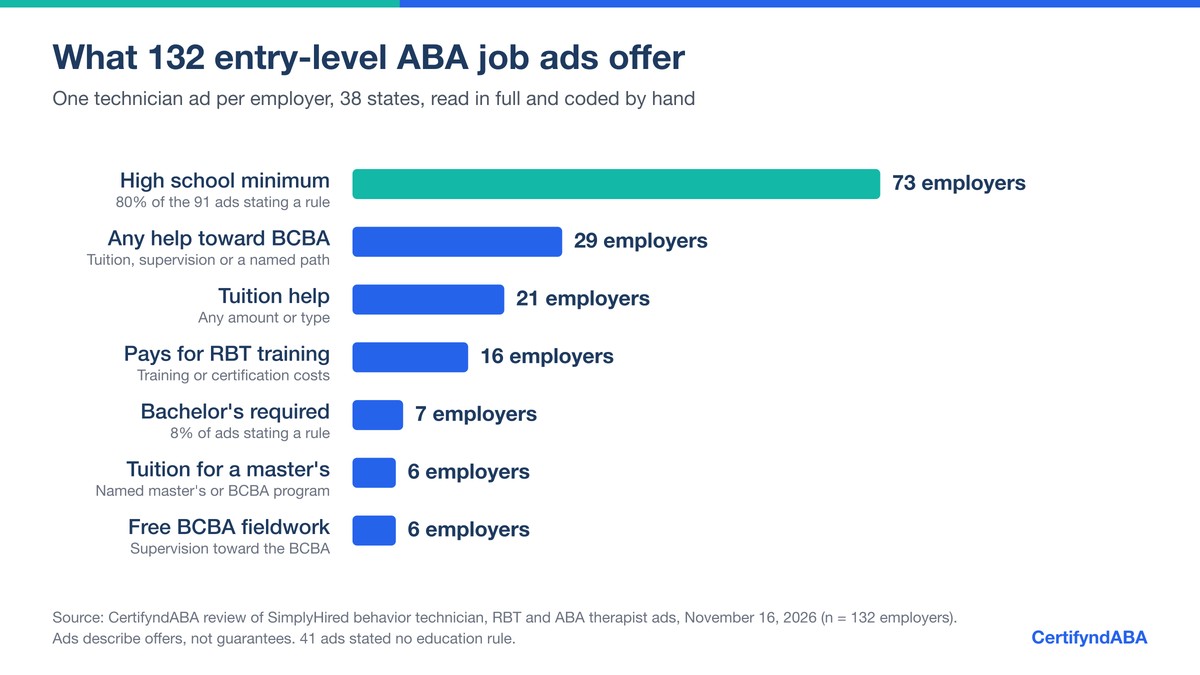
The tuition money is real but uneven. Only 6 of the 132 ads tied tuition support directly to a master's or BCBA program. Ally Behavior Centers offered up to $21,000 toward a master's after six months on the job. Stride Autism Centers offered full reimbursement of RBT costs plus up to $10,000 toward a master's in ABA. Autism Learning Partners listed up to $2,500. Most of the other 15 tuition mentions were a single line in a benefits list with no amount; one listed up to $9,000 without saying what it covers.
The degree is not optional, but who pays for it often is. Ask about it in the interview, not after you accept.
How to Become a BCBA Without a Degree Today: The Step-by-Step Ladder
If you are starting with a high school diploma, this is the shortest legitimate route. Each step pays you while you work toward the next one.
Step 1: Get hired as a behavior technician and earn the RBT
You need to be at least 18, hold a high school diploma, complete a 40-hour training, pass an initial competency assessment with a qualified assessor, pass a criminal background and abuse registry check, and pass the RBT exam. Many employers hire you first and put you through the training, so you do not need to pay for it before you apply. Our RBT certification guide walks through each step, and behavior technician jobs shows where the openings are.
Step 2: Finish a bachelor's degree while you work
Any bachelor's works for the BCBA route, because Pathway 2 accepts a master's in any field and the master's program sets its own admission rules. Psychology, education or a related major makes graduate admission easier and may let you take behavior-analytic courses early. Part-time RBT shifts can fit around college classes, and some ads in our sample pitched the job to students directly. If you want a credential at this stage, the BCaBA requires a bachelor's, 225 coursework hours and 1,300 fieldwork hours.
Step 3: Enroll in a master's or coursework program and start fieldwork
Choose an accredited master's (Pathway 1) or a master's plus a coursework sequence from a university with a Pathway 2 Program Contact. From 2027, a Pathway 2 degree earned in less than one calendar year will not qualify. Compare programs by exam outcomes; the 2025 first-time pass rate for BCBA candidates from university programs was 51%, and it varies widely by school. Our online BCBA programs guide breaks this down.
Step 4: Turn your job into supervised fieldwork
Your RBT hours do not count automatically. Fieldwork can start only after you begin qualifying coursework, find a qualified BCBA supervisor and sign a supervision contract. You need 2,000 hours (or 1,500 concentrated), no more than 130 hours a month, completed within five years. At least 60% must be unrestricted activities such as assessment, program writing and data analysis, so a schedule that is all direct therapy will not get you there. That is why free supervision from an employer is worth so much; independent supervisors often charge by the hour. See restricted vs unrestricted hours for details.
Step 5: Apply and pass the BCBA exam
Once your degree, coursework and hours are complete, apply to the BACB ($245) and schedule the exam ($125). Check whether your state also requires a behavior analyst license. Our full guide to becoming a BCBA covers the application in detail.
How to Pick an Employer That Will Help You Become a BCBA
Because only a minority of ads offer real support, ask specific questions before you accept a technician job:
- Do you pay for the RBT training, application and exam, and do you pay me for training hours?
- Do you offer tuition help, how much per year, and do I have to stay a set time or repay it if I leave?
- Will a BCBA here supervise my fieldwork for free, and can I get unrestricted hours on paid time?
- How many of your current BCBAs started here as technicians?
Get any tuition or supervision promise in writing. Our list of questions to ask in an ABA interview has more.
Frequently Asked Questions
Can I become a BCBA with just a bachelor's degree?
No. A bachelor's qualifies you for the BCaBA, not the BCBA. Every BCBA pathway requires a master's degree or higher.
Does my master's have to be in applied behavior analysis?
No. Under Pathway 2, a master's in any field from a qualifying institution works, as long as you also complete 315 hours of graduate behavior-analytic coursework. Pathway 2 is scheduled to close in 2032, when Pathway 1 becomes the only route.
Do my hours as an RBT count toward the BCBA?
Only if they meet fieldwork rules. You must have started qualifying coursework, have a qualified supervisor and a signed contract, and log the hours properly. At least 60% of your total hours must be unrestricted activities.
What ABA jobs can I get without a degree?
Behavior technician and RBT roles. In our review, 80% of entry-level ads that stated a minimum asked only for a high school diploma, with a median posted rate of $24.50 an hour.
How long does it take to become a BCBA with no degree?
Plan on five to six years or more: a bachelor's, a master's of at least one calendar year, and 2,000 fieldwork hours that can overlap the master's.
Start the climb with an employer that invests in you
On CertifyndABA, RBTs and future BCBAs build one anonymous profile and employers send interview requests with pay up front. You choose who sees your name.
Create Your Free ProfileMethod: CertifyndABA pulled national SimplyHired searches for "behavior technician," "registered behavior technician," "RBT" and "ABA therapist" on November 16, 2026, kept technician-titled ads, picked one ad per employer at random (132 employers, 38 states) and read each full ad. Education rules and benefits were coded by hand. Ads describe offers, not guarantees; confirm terms with the employer.