


Behavior technician jobs are the easiest way into ABA therapy, and most employers will train you. On October 26, 2026, we pulled one behavior technician job ad from each of 660 employers across all 50 states. The median posted pay was $23 an hour. In the full ads we could read, only 24% required an active RBT certification on day one.
There is a catch behind those open doors. Every behavior technician has to be supervised, and the BCBAs who do that supervision are the scarcest people in the field. This guide covers what a behavior technician does, what the job pays, what employers actually require, and why the BCBA shortage decides how many of these jobs exist and how good they are.
- Median posted pay was $23.00 an hour (middle half: $20.50 to $26.00). The median starting rate, the low end of each posted range, was $20.00.
- Of 106 full ABA ads we hand-coded, 24% required an active RBT at hire. Another 17% let you start without it and earn it within a deadline, usually 60 to 90 days.
- Ads that required the RBT at hire paid a median $25.00 an hour, against $22.00 for ads that did not.
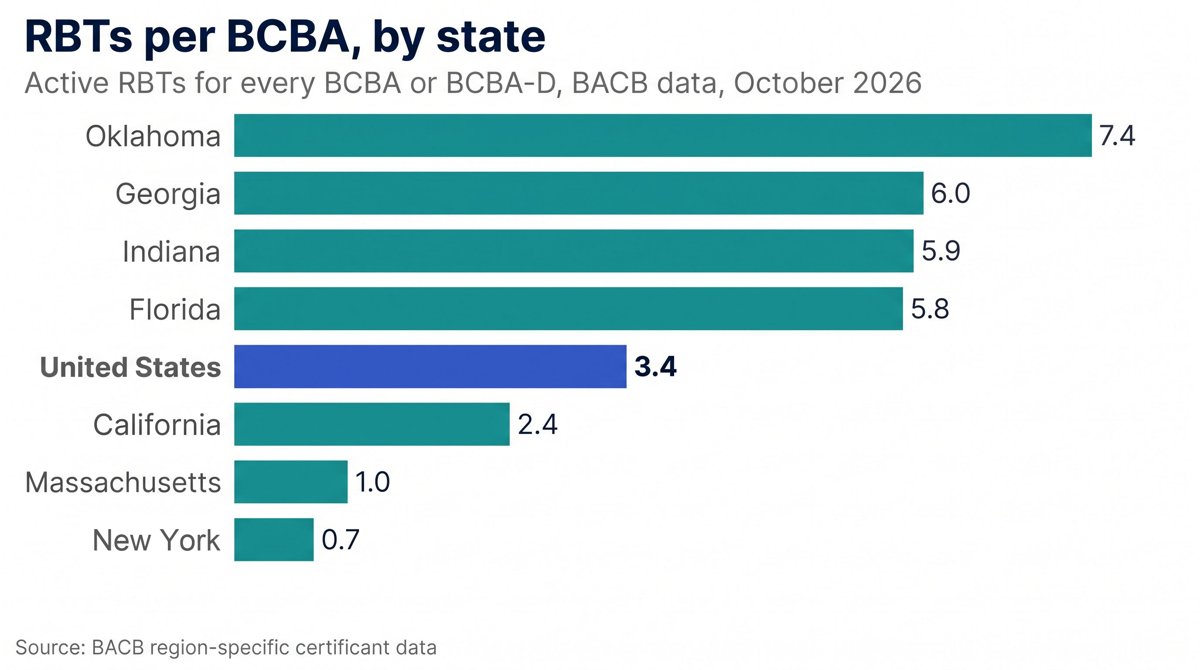
- The US has 275,175 RBTs and 82,115 BCBAs (including BCBA-Ds), about 3.4 RBTs per BCBA. In Oklahoma it is 7.4. In New York it is 0.7.
What is a behavior technician?
A behavior technician is the person who delivers ABA therapy one-on-one, usually to a child with autism. The BCBA assesses the client and writes the treatment plan. The behavior technician carries out that plan in sessions, often 2 to 4 hours long, at home, in a clinic, or at school.
A typical session includes running teaching trials, prompting and reinforcing new skills, following the behavior plan when challenging behavior happens, and recording data on every target. The BCBA uses that data to change the plan. If you want a detailed task list, our RBT job description guide breaks it down.
Behavior technician vs. RBT
"Behavior technician" is a job title. Registered Behavior Technician (RBT) is a credential from the Behavior Analyst Certification Board (BACB). Most employers use the two names for the same job, and 69% of the ads in our sample (458 of 660) had "RBT" or "registered" in the title. That is why many employers hire you as a behavior technician and then require you to earn the RBT within a few months.
Other titles for the same work include ABA therapist, behavior therapist, and behavior interventionist. In our analysis of 250 behavior therapist ads, 78% were this same front-line ABA role.
Behavior technician pay in 2026
Of the 660 employers, 596 (90%) posted pay. After we set aside open-ended figures like "up to $30," 555 ads had a usable rate. We used the midpoint of each posted range and converted the few annual salaries at 2,080 hours.
| Measure | Hourly pay |
|---|---|
| Median posted pay (midpoint of range, 555 employers) | $23.00 |
| Middle half of employers | $20.50 to $26.00 |
| Median starting rate (low end of range, 560 employers) | $20.00 |
| Ads titled RBT or registered behavior technician (389) | $23.50 |
| Ads titled behavior technician only (166) | $22.00 |
About 82% of employers posted a midpoint of $20 an hour or more, 35% posted $25 or more, and 7% posted $30 or more. Indeed's salary page puts the average behavior technician at $21.58 an hour (updated October 18, 2026), close to our starting-rate figure. At $23 an hour, a full 40-hour week works out to about $47,840 a year. Most technicians do not bill 40 hours, though, so ask any employer how many hours you can realistically expect.
Pay by state
Pay tracked local wages. Among states with at least 12 employers in our sample, the highest medians were Maryland ($28.00, 12 employers), Colorado ($27.00, 19), Hawaii ($26.75, 14), Virginia ($26.00, 15), and New Jersey ($26.00, 19). The lowest were Louisiana ($17.00, 12), Alabama ($18.25, 12), Wisconsin ($19.00, 14), and Kentucky ($19.50, 19). These are small samples, so treat a $1 gap between two states as noise. For RBT pay by experience and state, see our RBT salary guide.
Benefits beyond the hourly rate
We hand-coded the full text of 106 ABA ads for benefits. Half (53) offered health insurance, usually for full-time staff only. Forty-eight (45%) said the 40-hour RBT training was paid or free, and 13 (12%) paid the RBT application or exam fee. Twenty-two (21%) paid for drive time or mileage between home sessions. Nine (8%) offered a sign-on bonus, and only eight (8%) guaranteed hours or a salaried pay model.
That last number is the one to watch. Technician pay is usually by the billable hour, so when a client cancels, you can lose the income. An employer that guarantees hours or pays for cancellations is worth a lower posted rate.
Behavior technician requirements
The job itself has a low bar. SimplyHired tagged 619 of the 660 ads (94%) as entry level, and the most common education tag was a high school diploma or GED (397 ads, 60%). Only 95 ads (14%) listed a bachelor's degree. In the 106 full ads we read, 65 (61%) set a high school diploma as the minimum, and only 3 required a bachelor's degree.
The practical requirements show up more often than the academic ones:
- A car: 252 ads (38%) listed reliable transportation, and 171 (26%) listed a driver's license. In-home jobs mean driving between families.
- A clean background check: 237 ads (36%) listed one. The RBT credential requires a criminal background check and an abuse registry check.
- Experience with children: 307 ads (47%) listed it, but this can be babysitting, coaching, camp, or classroom work. Only 38 ads explicitly said no experience was needed.
- A second language: 42 ads (6%) listed Spanish, usually as a plus.
Do you need the RBT before you apply?
Usually not. Here is when the 106 ABA employers wanted the RBT:
| RBT requirement in the ad | Employers | Median pay |
|---|---|---|
| Active RBT required at hire | 25 (24%) | $25.00 (n=23) |
| Start without it, earn it after hire | 18 (17%) | $21.75 (n=18) |
| RBT preferred, or "RBT or willing to obtain" | 35 (33%) | $21.88 (n=32) |
| RBT not mentioned, or ad says it is not needed | 28 (26%) | $22.00 (n=23) |
Three in four employers would hire you without the credential. When an ad set a deadline, it was 30 to 90 days: eight ads stated one, and four of those said 90 days. Holding the RBT before you apply is still worth about $3 an hour at the median, and it widens the list of jobs open to you.
Planning to go from technician to BCBA? Let employers come to you
On CertifyndABA, employers send you interview requests that state the role, setting, and pay up front. Your profile stays anonymous until you accept.
Create your free profile →How to get RBT certified
The BACB's RBT Handbook (updated June 2026) sets these requirements. Many employers walk new hires through all of them.
- Meet the basics. You must be at least 18 and have at least a high school education.
- Pass the checks. Complete a criminal background check and an abuse registry check, each no more than 180 days before you pay for your application.
- Complete the 40-hour training. It must take no less than 5 days and no more than 180 days. Employers, universities, and online programs offer it.
- Pass the Initial Competency Assessment. After the training, a qualified assessor watches you perform the core tasks. This must happen no more than 90 days before you apply.
- Apply and pay. The 2026 application fee is $65, paid to the BACB.
- Pass the exam. The exam appointment costs $45 at Pearson VUE. You have one year from approval to take it. In 2025, 75% of first-time RBT test takers passed.
That is $110 in BACB and exam fees, before training. The BACB is also moving the RBT from annual renewal to a 2-year recertification cycle, phased in starting in 2026, with a $50 recertification fee and 12 hours of professional development per cycle. Our RBT certification guide covers the exam content in detail.
The BCBA bottleneck behind every behavior technician job
Here is the part most job guides skip. An RBT cannot practice alone. The BACB requires every RBT to receive supervision for at least 5% of their service hours each calendar month, with at least two real-time, face-to-face contacts per month and at least one observation of a session. A technician who delivers 120 hours of therapy in a month needs at least 6 hours of supervision that month.
Under the handbook, an RBT supervisor must be a BCBA or a BCaBA, and there are only 4,514 BCaBAs in the US. In practice, almost every behavior technician job depends on a BCBA having time to supervise. And BCBAs are the bottleneck of the whole field.
The numbers
As of our check of the BACB's US certificant data on October 26, 2026, the US had:
- 275,175 Registered Behavior Technicians
- 79,060 BCBAs and 3,055 BCBA-Ds (82,115 combined)
- 4,514 BCaBAs
That is about 3.4 RBTs for every BCBA. Demand for BCBAs keeps rising faster than supply. The BACB's Lightcast report counted 132,307 US job postings asking for a BCBA or BCBA-D in 2025, up 28% from 2024. That is about 1.6 postings per certified BCBA in a single year. Postings are a yearly flow, not a count of open jobs on one day, but the direction is clear: employers want more BCBAs than exist. We cover the full picture in our BCBA shortage report.
The RBT pool, by contrast, is growing quickly and turning over quickly. Worldwide, the BACB counted 160,041 RBTs at the end of 2023, 196,579 at the end of 2024, and 246,109 at the end of 2025. In 2024, the BACB certified 82,681 new RBTs, but the total rose by only 36,538. By our arithmetic, about 46,000 RBT certifications ended that year, through lapses, people leaving the field, and people moving up to a higher credential. The BACB does not publish an attrition figure, so treat that as an estimate.
Where technicians outnumber BCBAs most
The ratio varies hugely by state, and it tells you something about the jobs there. Florida alone has 57,332 RBTs, 21% of the US total, but only 12% of the country's BCBAs, a ratio of 5.8. Oklahoma (7.4), Georgia (6.0), Indiana (5.9), Texas (5.5), and North Carolina (5.5) are also high-ratio states. In those markets, ABA runs on large technician teams, and a BCBA there may supervise many technicians at once.
At the other end, New York has 0.7 RBTs per BCBA and Massachusetts has 1.0. Those states have fewer RBTs than BCBAs, which points to staffing models that rely less on the BACB technician credential. If you live in a low-ratio state, read each ad closely: the role may go by a different title, or it may be a school or agency job that never mentions the RBT.
Why this matters to you as a technician
- Supervision quality varies. In a high-ratio market, ask how many technicians your supervisor oversees and how often they will observe you. The 5% rule is a minimum.
- Hours depend on BCBA capacity. An employer can only staff as many cases as its BCBAs can oversee. When a BCBA leaves, cases can pause, and so can your hours.
- The shortage is your opportunity. The scarce role is the BCBA, not the technician. Technicians who move up are filling the gap employers struggle with most.
From behavior technician to BCBA
Many technicians use the job as a first step toward the BCBA, and employers know it. In the 106 full ads we coded, 31 (29%) offered concrete help toward the next step, such as tuition assistance, BCBA fieldwork supervision, or a stated career ladder. The BACB path runs from a bachelor's degree to a master's degree with verified coursework, supervised fieldwork, and the BCBA exam. Our RBT to BCBA timeline walks through each stage, and our fieldwork guide covers the hours.
The pay jump is large. Indeed's salary data put the average BCBA at $92,005 a year (October 2026), nearly double what a full-time technician earns at our median rate. See our RBT vs. BCBA comparison for the full side-by-side.
How to find a good behavior technician job
- Search under every title. Use behavior technician, RBT, ABA therapist, behavior therapist, and behavior interventionist. Employers use them interchangeably.
- Target employers that train. If you do not have the RBT yet, look for ads that pay for the 40-hour training and the exam fee. In our sample, 45% paid for the training.
- Get the RBT if you can. Ads that required it at hire paid $25.00 an hour at the median, against $22.00 for the rest.
- Ask about hours, not just rate. Ask how many billable hours a typical technician works, whether there is cancellation pay, and whether drive time is paid.
- Ask about supervision. Ask how many technicians each BCBA supervises and how often you will be observed. Good supervision makes you better and keeps you safer.
- Ask about the ladder. If you want to become a BCBA, ask whether the employer offers fieldwork supervision or tuition help. Nearly 3 in 10 ads in our sample did.
For interview preparation, see our RBT interview questions and RBT resume guide.
Frequently asked questions
What does a behavior technician do?
A behavior technician delivers ABA therapy one-on-one, usually with children with autism, by carrying out a treatment plan written by a BCBA. The work includes teaching skills, responding to challenging behavior, and recording session data.
How much do behavior technicians make?
In our October 2026 sample of 555 employers that posted pay, the median was $23.00 an hour, and the middle half paid between $20.50 and $26.00. The median starting rate was $20.00 an hour.
Can I be a behavior technician without a degree?
Yes. In the full ads we read, 61% required only a high school diploma or GED, and only 3 of 106 required a bachelor's degree. The RBT credential also requires only a high school education.
Do I need to be an RBT to work as a behavior technician?
Not always to start. Only 24% of the ABA ads we coded required an active RBT at hire. Another 17% required it within a deadline after hire, usually 60 to 90 days, and many employers pay for the training.
How long does it take to become a behavior technician?
You can be hired in a few weeks. RBT certification takes longer: the 40-hour training must span at least 5 days, followed by a competency assessment, the BACB application review, and the exam. Many people finish within a few months.
What is the highest pay for a behavior technician?
About 7% of employers in our sample posted a midpoint of $30 an hour or more. Higher rates went to technicians who already held the RBT and to high-wage states such as Maryland, Colorado, and Hawaii.
Is behavior technician a good job?
It is a good entry point into ABA with steady demand and low barriers to entry. The main drawbacks are hourly pay tied to billable sessions and variable supervision quality. It is strongest as a step toward the BCBA, the role the field is shortest on.
Let qualified employers reach out to you
Create a free CertifyndABA profile. Employers send you interview requests with the role, setting, and pay up front, and you decide who to talk to.
Create Your Free ProfileMethodology: On October 26, 2026, we searched SimplyHired for "behavior technician" in all 50 states and DC, three result pages per state, and kept postings whose title contained "behavior technician" or "behavioral technician" (1,417 unique postings). We picked one posting per employer at random, which left 660 employers in 50 states. Pay, education tags, and job types come from SimplyHired's structured listing fields; pay is the midpoint of a posted range, with annual salaries converted at 2,080 hours and open-ended "from" or "up to" figures excluded. We then fetched the full text of the sampled ads, but the site began blocking requests after 110 ads. We hand-coded those 110 ads, kept the 106 that were ABA technician roles, and recorded when the RBT was required, minimum education, and benefits. The 106-ad results are a subsample, so treat their percentages as approximate. Certificant counts are from the BACB's US region data as of October 26, 2026; RBT year-end totals, new certifications, and pass rates are from the BACB's annual report data (worldwide); posting counts are from the BACB's 2025 Lightcast report; RBT requirements and fees are from the BACB RBT Handbook (updated June 2026).