


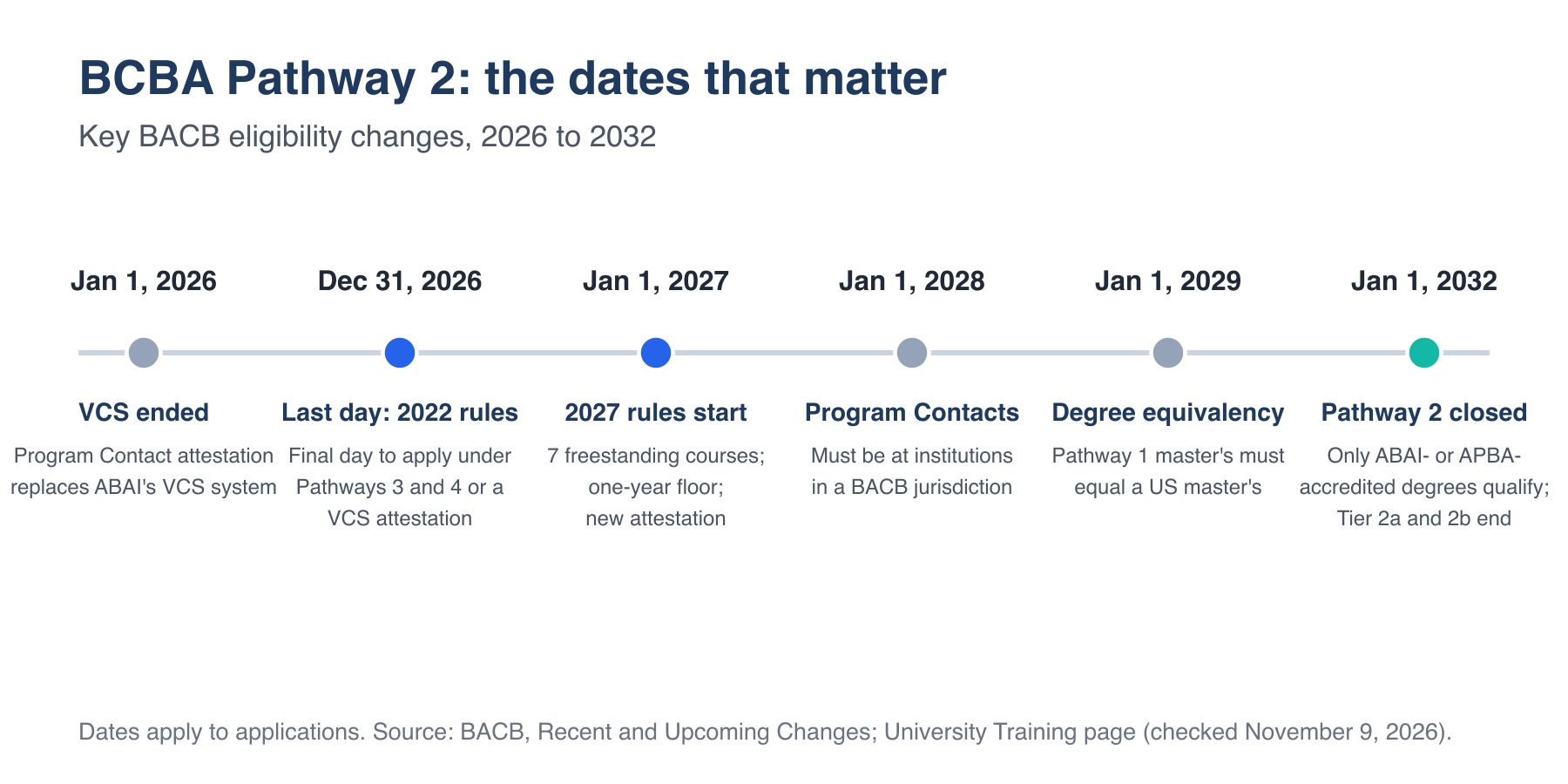
BCBA Pathway 2 is the coursework route to certification: a master's degree in any field, 315 hours of graduate behavior-analytic coursework, supervised fieldwork, and the exam. Its rules change on January 1, 2027, and the BACB plans to close it on January 1, 2032. Those dates matter well beyond exam candidates, because 96% of the first-time BCBA exam candidates in the BACB's latest program report trained outside an ABAI-accredited or recognized degree program.
What is BCBA Pathway 2?
Through December 31, 2026, the BACB has four eligibility pathways. Pathway 1 is a degree from an accredited or recognized program. Pathway 2 is the behavior-analytic coursework route. Pathways 3 and 4 are for long-serving faculty and postdoctoral applicants, and both end on January 1, 2027. Under the current BCBA Handbook, Pathway 2 requires:
- A master's degree or higher in any field from a qualifying institution, earned at any time.
- 315 hours of behavior-analytic coursework at the graduate level, for academic credit, with a C or better (or a pass), completed within 10 years of the year you apply.
- Supervised fieldwork: 2,000 hours, or 1,500 concentrated hours.
- A passing score on the BCBA exam.
One piece of older advice is now wrong. ABAI's Verified Course Sequence (VCS) system ended on January 1, 2026. Now a Pathway 2 Program Contact must attest to your coursework. That person must be an active BCBA or BCBA-D who holds a full-time faculty post in the department and has BACB approval; an adjunct cannot sign. If you took no courses in that person's program, they cannot sign for you either. A VCS Coordinator attestation that was on record by December 31, 2025 stays usable only until December 31, 2026.
BCBA Pathway 2 in 2027: what changes on January 1
The total stays at 315 hours, but the structure changes. The BACB's transition guide compares the two sets of rules:
| 2022 coursework rules (apply before 2027) | 2027 coursework rules |
|---|---|
| Philosophical Underpinnings; Concepts and Principles: 90 hours, with 45 in one freestanding course | Basic Principles of Behavior: 45 hours, 1 freestanding course Theory and Philosophy: 45 hours, 1 freestanding course |
| Measurement, Data Display, and Interpretation; Experimental Design: 45 hours, 1 freestanding course | Research Methods: 45 hours, 1 freestanding course |
| Behavior Assessment: 45 hours Behavior-Change Procedures; Selecting and Implementing Interventions: 60 hours | Behavior Assessment and Intervention: 90 hours, 2 freestanding courses |
| Personnel Supervision and Management: 30 hours | Organizational Behavior Management: 45 hours, 1 freestanding course |
| Ethics Code and Professionalism: 45 hours, 1 or more freestanding courses | Ethics: 45 hours, 1 freestanding course |
Three other changes catch people out:
- The one-year floor. From 2027, neither the Pathway 2 degree nor the coursework can be completed in less than one calendar year. That means three consecutive primary semesters, four consecutive primary quarters, or 12 consecutive months. The BACB's February 2026 newsletter explains why: 12 applicants from one university finished a full master's in a single quarter, and 47 at another finished in three months or less.
- A separate attestation. A 2022 attestation cannot be used on a 2027 application, even when the courses meet the 2027 rules. Your Program Contact has to file a 2027 attestation.
- Fieldwork. For 2027 applications, concentrated supervision drops from 10% to 7.5%, the monthly cap rises from 130 to 160 hours, and observation moves from a monthly count to cumulative minutes (60 per month for supervised fieldwork, 90 for concentrated). The rules that apply are the ones in force when you submit your application. The BACB recommends keeping both 2022 and 2027 forms if your date is uncertain. Our fieldwork guide has the details.
Which Pathway 2 rules apply to you
| Your situation | What applies |
|---|---|
| You will apply, and meet every requirement, before January 1, 2027 | 2022 coursework and fieldwork rules, with a 2022 attestation |
| You finished 2022-rule coursework but will apply in 2027 or later | 2027 rules. Check each freestanding course with your advisor; you may need extra courses, such as standalone Theory and Philosophy or a 45-hour OBM course |
| You are still accruing fieldwork and unsure of your date | Plan to meet both sets of fieldwork rules and complete both forms each month |
| You will start a program after 2026 and apply by the end of 2031 | Pathway 1 or Pathway 2 under the 2027 rules |
| You will apply in 2032 or later | Pathway 1 only, with a degree from an ABAI- or APBA-accredited program |
Pathway 2 ends in 2032: what that means
The BACB's university page is direct: from January 1, 2032, applicants must use Pathway 1, and only ABAI- or APBA-accredited degrees will qualify. Three details are easy to miss.
- ABAI recognition stops counting. Tier 2a and 2b programs qualify for Pathway 1 today. They will not from 2032.
- Stand-alone certificates lose their route after 2031. A certificate works today as Pathway 2 coursework added to a master's. Pathway 1 requires an accredited master's degree or higher, and APBA does not accredit stand-alone certificate programs.
- Accreditation has to line up with your degree. Your transcript must show the degree was conferred during the dates the program held accreditation. "Applying for accreditation" is not the same thing.
Reading the BACB's wording, December 31, 2031 is the last possible day to apply under Pathway 2. Working back, 2,000 fieldwork hours at 20 hours a week takes about two years. As a cautious planning date for a two-year program with 20-hour weeks, fall 2029 leaves little slack, and fall 2028 leaves room for a delay. Faster fieldwork could allow a later start. We found no published BACB answer on what happens to an application filed in 2031 if the exam comes later, so ask the BACB before cutting it close.
The 2032 Pathway 2 cutoff is a supply question
The BACB's 2025 pass-rate report shows how much of the training pipeline sits outside accreditation. It covers 8,558 of the 9,955 people who first took the exam in 2025. These are candidates with an accredited or Tier 2a/2b degree, or with all their Pathway 2 coursework from one program. We totaled its program table:
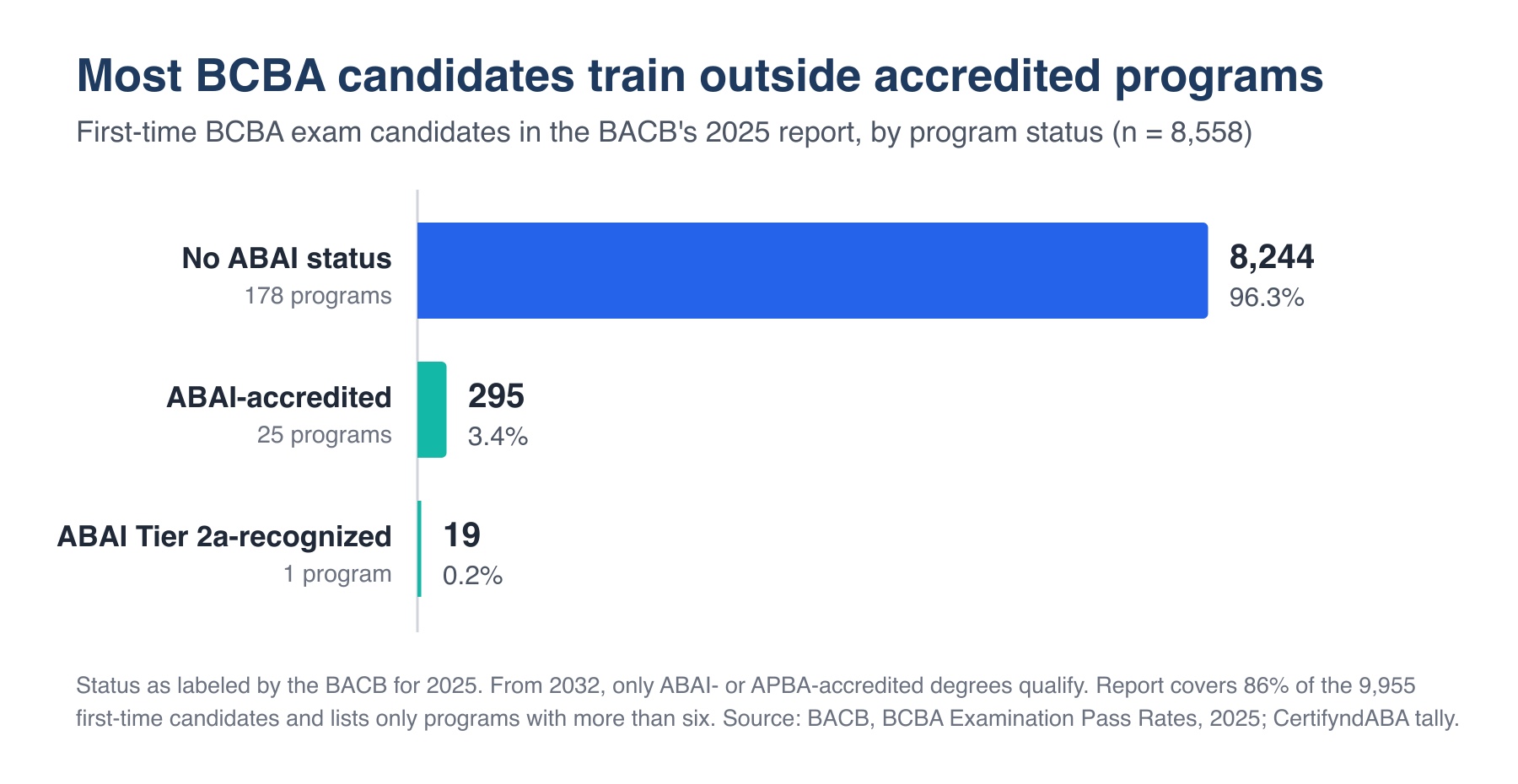
The 25 ABAI-accredited programs had 295 first-time candidates (3.4%), and the one Tier 2a program had 19. The other 178 programs had 8,244. Applying each program's pass rate, we estimate that accredited programs produced about 229 of the roughly 4,314 first-time passers in the report, or 5%. The 10 largest programs alone had 5,446 candidates, and none held ABAI status in the report. Two of them are stand-alone certificates, with 975 candidates between them.
This does not mean 96% of future BCBAs will disappear, because programs can get accredited before 2032. As of November 9, 2026, here is where that stands:
- ABAI: 39 universities hold accredited master's programs. Thirteen more master's programs are seeking first-time accreditation in ABAI's public queue: four under review and nine at the eligibility stage. Five of those nine filed since late September 2026. None of the 10 largest programs is listed in either place, although Florida Tech's separate campus master's programs are accredited. Some large programs are moving toward ABAI recognition instead: Capella's and West Florida's M.S. programs are under review, and Arizona State's is eligible to apply. Recognition helps until 2032, when it stops counting.
- APBA: this newer accreditor opened applications on January 20, 2026. It describes a remote review of about three months, with fees of $7,000 to $8,500, and no minimum pass rate; low pass rates shorten the accreditation cycle instead. Its public list shows one program, Pepperdine University's M.S. in ABA. We found no public list of APBA applicants, so large programs may be applying without any notice.
ABAI-accredited programs did post higher results: a mean first-time pass rate of 79.3%, against 53.2% for all other reported programs. That gap may partly reflect who enrolls and how selective these small programs are, so it does not prove accreditation alone raises scores.
Postings outnumber certificants, but the ratio mixes a yearly flow with a point-in-time count, so it signals demand without measuring a shortage; our BCBA shortage analysis goes deeper. If big online programs earn accreditation in time, 2032 could pass quietly. If they do not, the number of new BCBAs each year could fall sharply while employers are still competing for them. The next few years of accreditation decisions will tell us which, and a 2031 application rush is plausible either way.
Do employers care which BCBA pathway you used?
Almost never, going by what they publish. We re-read our sample of 688 direct employers' BCBA job ads, one ad per employer, collected in late September 2026:
- 0 named Pathway 1, 2, 3, or 4 as a BCBA eligibility route.
- 0 listed ABAI or APBA as a requirement.
- 9 asked for BACB-approved or verified coursework.
- 5 mentioned an accredited behavior analysis program or degree, none naming an accreditor.
Ads are not the full hiring process, and some employers may screen differently. What the ads do show is the screen most employers advertise: an active BCBA credential in good standing, plus a state license where one applies. Which pathway you took is not part of it.
The route matters more before you certify. If you want a BCBA-in-training job, ask how the employer will handle 2027 fieldwork tracking, including observation minutes, and whether supervisors will complete both sets of forms for trainees who may apply either side of January 1.
What to do about Pathway 2 now
- Pick your likely application date. It decides which rules apply, more than when you earned your hours.
- Compare your transcript with the table above. Do it course by course, with your advisor, and look for missing freestanding courses.
- Confirm your program has an approved Program Contact. A former VCS Coordinator also needed new approval.
- Track both fieldwork standards if your date could fall on either side of January 1, 2027.
- If you are choosing a program, ask for its accreditation status, its accreditor, and its plan for 2032 in writing. Check the BACB pass rates for online programs too.
- If you are planning from scratch, start with how to become a BCBA and confirm any date against the handbook, because the BACB updates it often.
Frequently asked questions
Is BCBA Pathway 2 going away?
Yes. The BACB says that starting January 1, 2032, Pathway 1 will be the only eligibility pathway for BCBA certification. Pathway 2 stays open for applications until then, under updated coursework rules from January 1, 2027.
Can I use any master's degree for BCBA Pathway 2?
Yes, in any field, if it comes from a qualifying institution. For applications from January 1, 2027, the degree cannot have been earned in less than one calendar year. You also need the 315 hours of qualifying behavior-analytic coursework, fieldwork, and a passing exam score.
Does the Verified Course Sequence still exist?
No. ABAI's VCS system ended on January 1, 2026. Pathway 2 now uses a Coursework Attestation from an approved Program Contact. A VCS Coordinator attestation on record by December 31, 2025 can be used only until December 31, 2026.
Will Pathway 2 ending affect people who are already BCBAs?
The BACB describes the 2032 change as a rule for people applying for certification. Its published changes do not ask current BCBAs to requalify through an accredited degree. You still need to meet the recertification rules in force for you.
Is Pathway 1 or Pathway 2 better for getting a job?
Our sample of 688 employers' job ads gives no sign that either route is preferred; none named a pathway. The difference shows up earlier: accredited programs post higher average first-time pass rates, and only an accredited degree qualifies from 2032.
The bottom line on BCBA Pathway 2
Pathway 2 remains open for five more years, but it gets stricter in January and closes at the end of 2031. If you are in the middle of it, the next step is a course-by-course check against the 2027 table. If you have not chosen a program yet, ask about accreditation first. Once you are certified, the job market cares about your active credential, not the route you took to earn it.
Your credential is what employers are looking for
Create an anonymous CertifyndABA profile and let verified employers send you interview requests. They see your qualifications first; your name stays private until you accept.
Create Your Free ProfileMethod: candidate counts come from the program tables in the BACB's 2025 pass-rate report, which lists programs with more than six first-time candidates and includes programs outside the United States. The report labels ABAI status only, and the 2025 status may differ from today's; the 178-program group includes Pepperdine (70 candidates), which APBA has since accredited. The BACB does not publish first-time candidates by pathway, and 1,397 candidates are outside the report. Four accredited programs' counts span 2024 and 2025 because of low volume. Estimated passers multiply each program's candidates by its rounded pass rate. Job-ad counts come from one ad per direct employer in a sample collected in late September 2026, and we read each match in context. Accreditation lists were checked on November 9, 2026.