

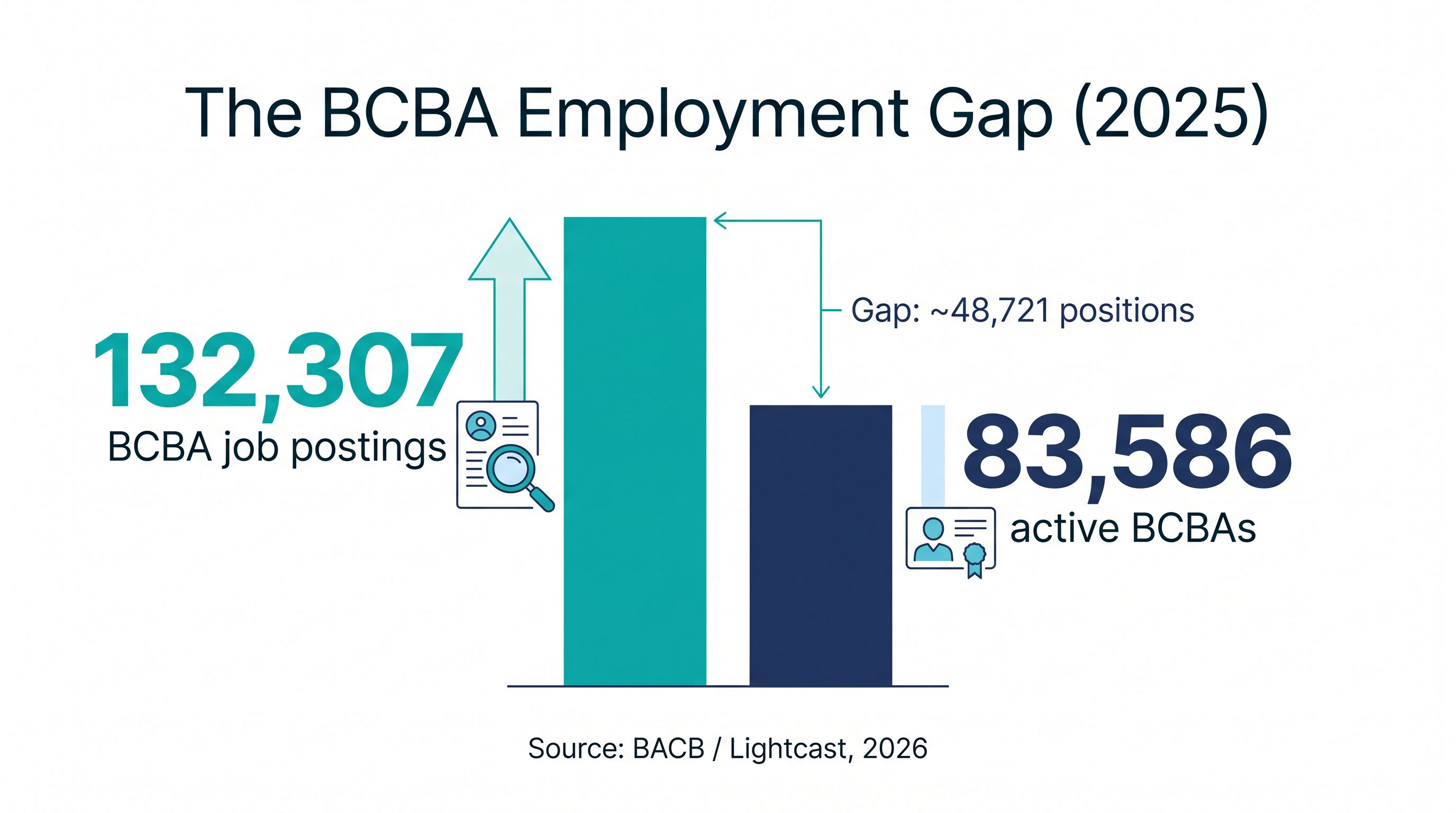
In-home is where most applied behavior analysis actually happens, and the BCBAs who run those cases are in shorter supply than ever. If you are weighing in-home BCBA jobs in 2026, the numbers are firmly on your side: employers posted 132,307 BCBA and BCBA-D roles in 2025, while only 83,586 BCBAs hold active certification. That gap shapes your pay, your options, and your leverage at the offer table.
This guide breaks down what in-home BCBA work involves, what it pays, the honest tradeoffs, where the jobs are concentrated, and how to get hired without broadcasting your search.
What In-Home BCBA Jobs Actually Involve
An in-home BCBA does the same core clinical work as a center-based behavior analyst; the setting is what changes. You design and supervise individualized treatment plans, carry a full caseload, and take responsibility for clinical outcomes. You conduct assessments, write programs, analyze data, and supervise the registered behavior technicians (RBTs) delivering direct therapy in the family's home.
The defining difference is direction of travel. Instead of families coming to a clinic, you go to them. Sessions are built around household routines, which means your week is a mix of in-person supervision visits, parent training, and program writing you can often complete remotely. Coordination is heavier than in a clinic: you work alongside parents, school teams, and other providers who are all part of the child's day.
That structure rewards behavior analysts who are comfortable working independently and who can read a real-world environment quickly. There is no clinic director down the hall; you are the clinical authority in the room.
Why In-Home Demand Is Surging in 2026
Demand for behavior analysts has risen every single year since 2010. According to the Behavior Analyst Certification Board's 2026 employment report, produced with labor-market firm Lightcast, BCBA and BCBA-D job postings climbed from 65,366 in 2023 to 103,150 in 2024 and then to 132,307 in 2025, a 28% jump in a single year.
Employers posted roughly 1.6 BCBA roles for every active BCBA in the country. For the BCBAs actually on the market, the ratio is far higher.
Two forces sit behind the surge. The CDC now identifies about 1 in 36 children (2.8%) with autism spectrum disorder, and all 50 states mandate insurance coverage for ABA services. That combination has pushed millions of families toward care. In-home demand grows fastest because home-based delivery removes access barriers: it reaches rural families, very young children, and clients who cannot tolerate a clinic environment.
How Much Do In-Home BCBAs Make?
Base pay for in-home BCBA jobs tracks center-based roles closely. Across the United States, BCBA salaries generally fall between $66,000 and $120,000 or more, depending on experience and location. Entry-level analysts with zero to one year of experience tend to land in the $66,000 to $99,000 range, while experienced BCBAs with ten or more years often earn $79,000 to $127,000 or higher.
In-home work adds one line item center-based roles usually do not: mileage reimbursement for gas, tolls, and vehicle wear. Independent and 1099 in-home practitioners frequently bill around $100 per hour or more. When you compare offers, look closely at how the employer treats drive time. Pay that covers only billable session hours can quietly shrink a strong-looking rate once you add up travel between homes.
- ✓Confirm whether drive time is paid, and at what rate.
- ✓Ask for the mileage reimbursement rate in writing.
- ✓Separate billable hours from total worked hours before judging the rate.
For precise figures, compare our BCBA hourly rate guide and BCBA salary by state breakdown.
The Real Pros and Cons of In-Home Work
In-home delivery has genuine clinical advantages. Skills generalize faster when they are taught in the environment where they will be used, so toilet training, self-care, and mealtime goals tend to stick. Parents observe your techniques and practice them between visits, and family involvement is one of the strongest predictors of long-term progress. You also see authentic behavior that a clinic simply cannot reproduce, including problem behavior tied to specific rooms or routines.
The tradeoffs are just as real. You absorb commute time and track mileage across a wider territory. Home environments are variable and unpredictable; layouts, distractions, and family dynamics differ at every stop. You work without the on-site backup a clinic provides. None of this is a dealbreaker, but it should shape which offers you take.
Where the In-Home BCBA Jobs Are
Demand is national, but it concentrates. In 2025, five states drove 38% of all BCBA demand: California led with 20,258 postings, followed by New Jersey (8,139), Texas (7,792), Massachusetts (7,315), and North Carolina (6,874), according to the BACB and Lightcast. California alone accounted for 15% of national demand.
The fastest-growing markets are worth watching if you are open to relocation or already live there. South Carolina postings grew 102% year over year, Utah 94%, Nebraska 81%, and Missouri 76%. In-home roles tend to be strongest where families are spread out or clinic access is limited, which often means suburban and rural territories rather than dense city centers.
To see what is open in your area, start with our BCBA jobs near me guide, and explore adjacent options like part-time BCBA roles and the broader behavior analyst job market.
How to Get Hired for In-Home BCBA Roles
The hiring market favors you, so be selective. On your resume, foreground parent-training experience, naturalistic teaching, and any history managing a dispersed caseload; those signals matter more for in-home roles than clinic throughput numbers.
Then vet the employer as hard as they vet you. Ask about caseload size, the geographic radius you would cover, supervision ratios, and the scheduling and administrative support behind each case. Watch for red flags: a vague mileage policy, an unrealistic service area, or no paid time off in a travel-heavy role. A strong in-home employer answers these questions clearly and in writing.
In a market with this much demand, you do not have to chase listings one by one. You can let qualified in-home employers come to you.
Let in-home employers reach out to you
CertifyndABA is an anonymous reverse marketplace where verified employers send you interview requests based on your qualifications. Build a free profile, set your preferences, and field in-home offers without revealing your identity or tipping off your current employer.
Create Your Free ProfileThe Bottom Line on In-Home BCBA Jobs
In-home BCBA jobs offer competitive pay plus mileage, meaningful clinical work in the environment where skills matter most, and real tradeoffs around travel and autonomy you should weigh before signing. With employers posting 132,307 roles in 2025 against just 83,586 active BCBAs, the leverage in this market belongs to you. Use it to find an in-home role that fits your life, not just your license.