

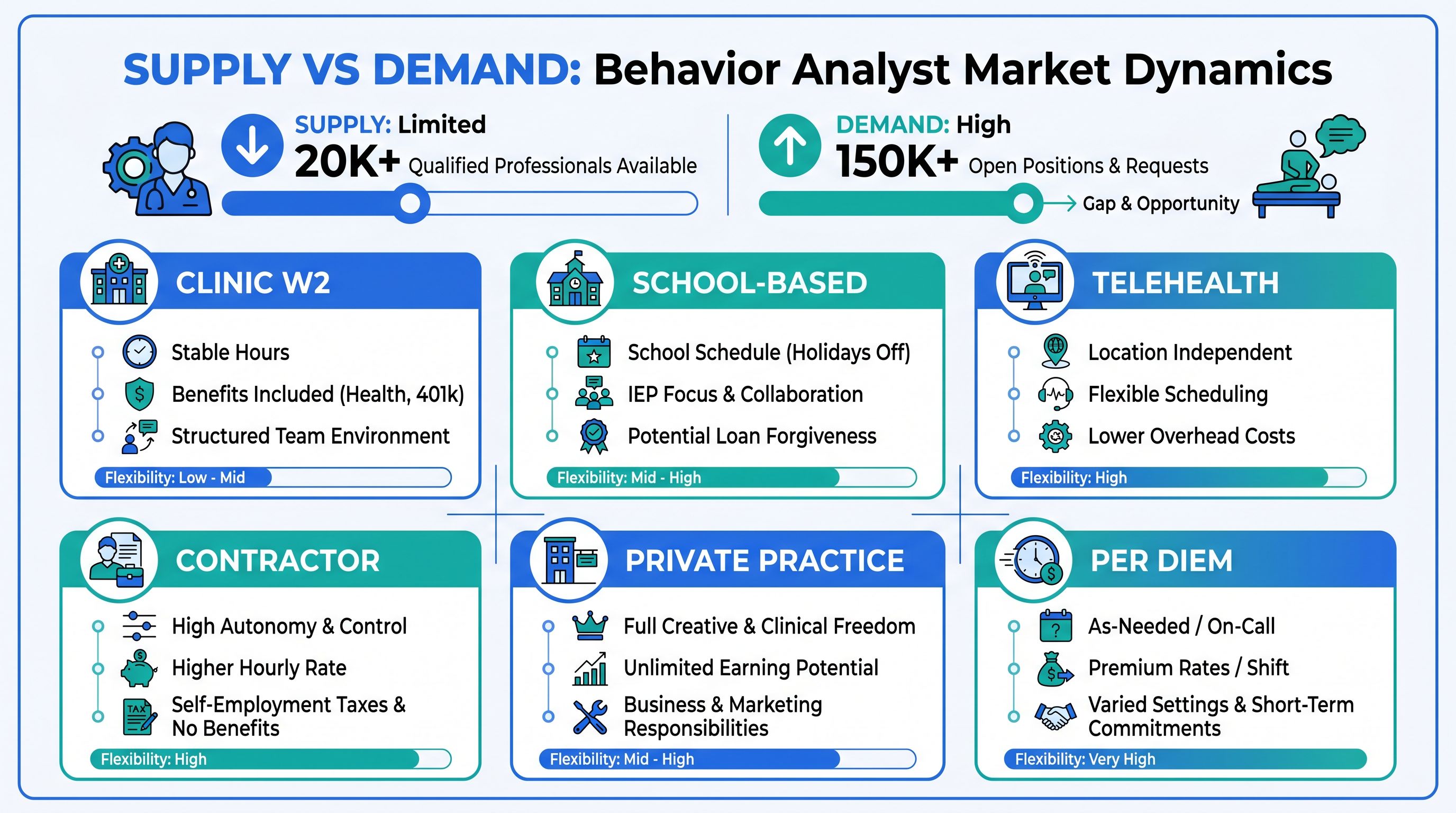
There are more part-time BCBA jobs available right now than at any point in the history of behavior analysis. According to the BACB's Lightcast labor market report, employers posted 132,307 positions requesting BCBA certification in 2025, while only 83,586 BCBAs held active credentials as of April 2026. That means roughly 1.6 open positions exist for every certified BCBA in the country. For behavior analysts exploring part-time work, this supply-demand gap is not just a statistic; it is direct leverage to negotiate the schedule, setting, and compensation you want.
This guide breaks down the types of part-time BCBA positions available, what they pay, where to find them, and how to evaluate whether a flexible arrangement fits your career goals.
Why Part-Time BCBA Jobs Are Everywhere in 2026
The BCBA shortage is structural, not temporary. It is driven by forces that will take years to resolve, which means part-time positions are not going away.
Demand for BCBAs grew 28% from 2024 to 2025, building on a 58% surge the year before. The Bureau of Labor Statistics projects 17% job growth for behavior analyst roles through 2034, more than four times faster than the national average. Meanwhile, supply cannot keep pace: the BCBA exam pass rate dropped from 66% in 2020 to 51% in 2025, creating a bottleneck in the pipeline of new certificants.
The shortage is even more severe in certain regions. A TYGES Healthcare analysis of ABA care deserts found that Wyoming has just 7.5 BCBAs per 100,000 residents, compared to 55.1 in Massachusetts. States like Mississippi, Montana, and Oklahoma all fall below 10 per 100,000. In these areas, clinics and schools are not just open to part-time BCBAs; they are actively recruiting anyone willing to take a partial caseload.
Telehealth has further expanded the landscape for part-time work. BCBAs can now conduct parent training, supervision sessions, and assessments remotely, serving clients in underserved areas without relocating. With proper multi-state licensure, a part-time remote BCBA in Massachusetts can serve families in Montana.
Types of Part-Time BCBA Positions
Part-time BCBA jobs come in several distinct employment models. Each offers a different balance of flexibility, income stability, and administrative burden.
Clinic-Based W2 Employee
Structured hours, typically 15 to 25 per week, with a predictable schedule set by the clinic. Many organizations offer prorated benefits including health insurance, PTO, and 401(k) matching even for part-time employees. This model suits BCBAs who want reduced hours without sacrificing the stability of traditional employment.
School-Based Part-Time
School districts frequently contract BCBAs on a part-time basis to consult on behavior intervention plans, support IEP development, and train staff. These roles follow the school calendar, which can mean summers off. The trade-off is that school-based positions tend to pay less per hour than clinical settings.
Telehealth and Remote Positions
Remote BCBA jobs have grown rapidly since 2020. Part-time telehealth roles focus on parent training, RBT supervision, and assessment reviews conducted via video. These positions offer geographic flexibility and eliminate commute time, but require strong documentation habits and comfort with virtual service delivery. Our telehealth BCBA jobs guide covers this setting in depth.
Independent Contractor (1099)
Contract work offers the highest gross hourly rates, typically $60 to $105 per hour. However, 1099 BCBAs handle their own self-employment taxes (15.3%), health insurance, liability coverage, and business expenses. This model provides maximum schedule control but demands business management skills alongside clinical ones. For a detailed breakdown of the tax and benefits tradeoffs, see our guide to BCBA independent contractor vs. employee.
Private Practice
Building your own caseload means setting your own rates, hours, and clinical approach. Private practice BCBAs control every aspect of their work, but the ramp-up period can be slow and the administrative load is significant. Many BCBAs start a private practice on the side while maintaining a part-time W2 role for stability.
Per Diem / PRN
Fill-in work at clinics as needed, on a day-by-day or week-by-week basis. Per diem positions are the most flexible option but offer the least income predictability. They work best as supplemental income or for BCBAs testing whether a particular setting is a good fit.
Part-Time BCBA Salary: What to Expect
Compensation for part-time BCBA work varies significantly by employment model, geography, and experience level. Understanding the true cost of each arrangement matters more than comparing hourly rates alone.
According to ZipRecruiter data from late 2025, the average part-time BCBA earns $42.82 per hour as a W2 employee. The 25th percentile starts around $35.58 per hour, while the 75th percentile reaches $43.51. Top earners in high-cost-of-living markets or specialized roles can exceed $55 per hour as W2 employees.
Independent contractors command significantly higher gross rates, typically $60 to $105 per hour. But the math is more nuanced than it appears. After accounting for self-employment tax (15.3% on net earnings), health insurance premiums ($400 to $800 per month for individual coverage), liability insurance, and business expenses, a $75 per hour 1099 rate often nets out to roughly the same take-home as a $45 per hour W2 position with benefits.
Geography also matters. BCBAs in Massachusetts and California can expect W2 part-time rates of $50 to $65 per hour, while states like Mississippi and Wyoming typically range from $30 to $40 per hour. However, those lower-paying states also have the most acute shortages, which gives BCBAs stronger negotiating leverage on other terms like schedule flexibility, remote work options, and signing bonuses. See our BCBA salary by state breakdown for the full data.
At 20 to 25 hours per week, most part-time BCBAs earn $45,000 to $70,000 annually as W2 employees, or $60,000 to $100,000 or more as 1099 contractors.
How to Find Part-Time BCBA Jobs
The strongest job search strategy in a candidate-driven market is to let employers come to you. But combining active and passive approaches produces the best results.
ABA-Specific Platforms
Start with platforms designed for behavior analysts. CertifyndABA operates as an anonymous reverse marketplace: you create a profile highlighting your qualifications, settings, and schedule preferences, and employers send you interview requests based on fit. You never reveal personal information until you accept. The ABAI career center and state ABA association job boards also list positions specifically for credentialed behavior analysts.
General Job Boards
Indeed currently lists over 10,000 part-time BCBA positions nationwide. ZipRecruiter and Glassdoor are also strong sources. Use filters for "part time" combined with "BCBA" or "Board Certified Behavior Analyst," and set up alerts so new postings arrive in your inbox automatically.
Direct Outreach and Networking
Many part-time openings never make it to a job board. Clinics frequently fill flexible roles through referrals and direct inquiries. Reach out to local ABA providers, even if they are not advertising part-time positions. BCBA networking groups on Facebook and LinkedIn are also valuable for hearing about opportunities before they are formally posted.
Negotiate from Strength
With 1.6 open positions per BCBA nationally, you hold significant leverage. Do not accept the first offer without exploring your options. Negotiate on schedule, hourly rate, remote work days, caseload size, and CEU reimbursement. Our BCBA salary negotiation guide covers specific tactics. Employers know that losing a BCBA candidate means starting a search that could take months.
Pros and Cons of Part-Time BCBA Work
Part-time work is not the right choice for every BCBA. Here is an honest look at what you gain and what you give up.
Advantages
- ✓ Burnout prevention. A 2025 ABA Resource Center report found that 58% of BCBAs have considered leaving the profession due to stress. Reducing hours can be the difference between staying in the field and walking away from it. For more on this topic, see our piece on BCBA burnout prevention.
- ✓ Time for professional growth. Part-time schedules create space for CEU coursework, conference attendance, research, or pursuing a doctoral degree.
- ✓ Diversified experience. Holding two part-time roles in different settings (clinic plus school, or in-person plus telehealth) broadens your clinical skills faster than a single full-time position.
- ✓ Potentially higher total pay. Combining a W2 part-time role with 1099 contract work can yield higher annual income than a single full-time salary, especially if you can access benefits through the W2 position.
Drawbacks
- × Benefits gaps. Not all part-time positions include health insurance. If your hours fall below the employer's benefits threshold, you will need to source coverage independently, which can cost $400 to $800 per month.
- × Schedule complexity. Juggling multiple part-time employers means coordinating separate schedules, documentation systems, and supervision requirements.
- × Multi-state licensure. If you take telehealth clients across state lines, you may need to maintain licenses in multiple states, each with its own fees and renewal requirements.
- × Limited advancement. Part-time employees may have fewer opportunities for promotion into clinical director or leadership roles within a single organization.
"The BCBA shortage is not just a statistic. It is your leverage to design a career that fits your life."
Who Should Consider Part-Time BCBA Work?
Part-time positions are a particularly strong fit for BCBAs returning from parental or medical leave, those pursuing advanced degrees, semi-retired professionals who want to stay clinically active, and newer BCBAs looking to gain experience across multiple settings before committing to a specialty. BCBAs building a private practice on the side also benefit from maintaining a part-time W2 role for income stability during the ramp-up period.
Your Career, Your Schedule
The numbers tell a clear story: with 132,307 job postings competing for 83,586 credentialed professionals, BCBAs are in a position to choose how, where, and how much they work. Whether you want a structured 20-hour clinic schedule, a remote telehealth caseload, or the autonomy of contract work, the market supports it.
The key is knowing what you want and being willing to negotiate for it. In a field where employers routinely wait months to fill a single BCBA position, your time and expertise are valuable on any schedule.
Stop Scrolling Job Boards. Let Employers Find You.
On CertifyndABA, you create an anonymous profile with your credentials, preferred settings, and schedule availability. Employers review your qualifications and send interview requests directly to you. No personal information is shared until you decide to accept.
Create Your Free Profile