


If you are weighing BCBA vs LCSW, here is the short answer. A Board Certified Behavior Analyst (BCBA) earns more in job ads and sees far more job ads per credential holder. A licensed clinical social worker (LCSW) can diagnose, treat a much wider range of mental health conditions and bill Medicare on their own. In our November 2026 count, employers listed about 33 job ads for every 100 BCBAs, against about 7 for every 100 clinical social workers.
Both careers start with a master's degree and end with a supervised-hours requirement and a national exam. After that, they lead to very different jobs. This guide compares pay, demand, the training path and day-to-day scope, then shows how the BCBA stacks up against two other common choices: psychologist and speech-language pathologist (SLP).
BCBA vs LCSW at a Glance
| BCBA | LCSW | |
|---|---|---|
| Credential | National certification from the BACB; many states also require a behavior analyst license | State license issued by a social work board |
| Degree | Master's with behavior-analytic coursework | MSW from a CSWE-accredited program |
| Supervised hours | 2,000 fieldwork hours (1,500 concentrated), can overlap the degree | 900+ field hours in the MSW, then post-degree supervised hours that vary by state (1,500 to 3,000 in the four states below) |
| Exam | BCBA exam: 51% first-time pass rate for university program candidates (2025) | ASWB Clinical: 75.7% first-time pass rate (2025) |
| Exam and application fees | $245 application + $125 exam | $260 exam, plus state license fees |
| Median advertised salary | $89,934 | $70,000 |
| Job ads per 100 holders | About 33 | About 7 |
| Core work | Behavior assessment, treatment plans and supervision of RBTs, mostly in autism services | Diagnosis and psychotherapy for mental health conditions, plus case management |
Sources: BACB BCBA Handbook and 2025 university pass-rate report; ASWB exam pass rates and fees; CertifyndABA review of SimplyHired postings. Salary and ad figures are explained in the sections below.
BCBA vs LCSW Salary
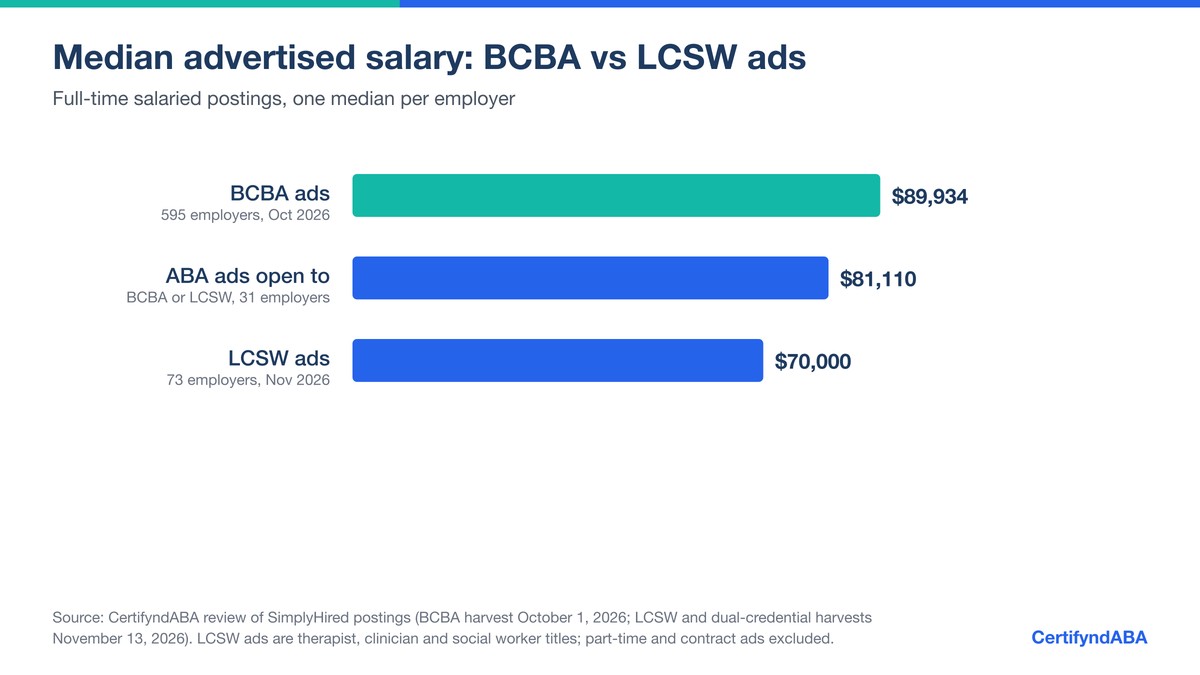
The pay gap is real, and it shows up in job ads. We reviewed full-time, salaried postings on SimplyHired and took one median per employer, so a single large employer cannot skew the result.
- BCBA ads: a median of $89,934 across 595 employers (October 2026). The middle half ran from $82,500 to $97,500.
- LCSW ads: a median of $70,000 across 73 employers (November 2026), for therapist, clinician and social worker titles that ask for an LCSW. The middle half ran from $63,500 to $84,000.
- ABA ads open to either credential: a median of $81,110 across 31 employers. Half of these ads sit in just three states: Pennsylvania, New York and California.
Government data points the same way. The Bureau of Labor Statistics (BLS) reports a May 2025 median of $67,880 for healthcare social workers and $60,280 for mental health and substance abuse social workers. Those BLS groups include social workers without a clinical license, so they run lower than LCSW-only pay. The BLS does not track BCBAs as a separate occupation, which is why we use job-ad data for both sides.
One caveat cuts the other way. An LCSW in private practice who takes cash clients or bills insurance directly can earn above the ad median. That path is open to BCBAs too, but ABA is usually delivered by a team, so BCBAs who go independent may end up running a small agency. For more detail on the BCBA side, see our full BCBA salary report.
Which Career Has More Jobs? The Demand Gap
Raw ad counts look similar. On November 13, 2026, SimplyHired listed 27,255 open ads that mention "BCBA" and 20,092 that mention "LCSW." The difference is how many people compete for them.
The Association of Social Work Boards (ASWB) estimates about 463,000 licensed social workers in the US, 59% of them at the clinical level. That works out to roughly 273,000 clinical social workers. The BACB lists 82,627 US BCBAs and BCBA-Ds. Divide the open ads by those counts and BCBAs see about 33 ads per 100 credential holders, while clinical social workers see about 7.4.
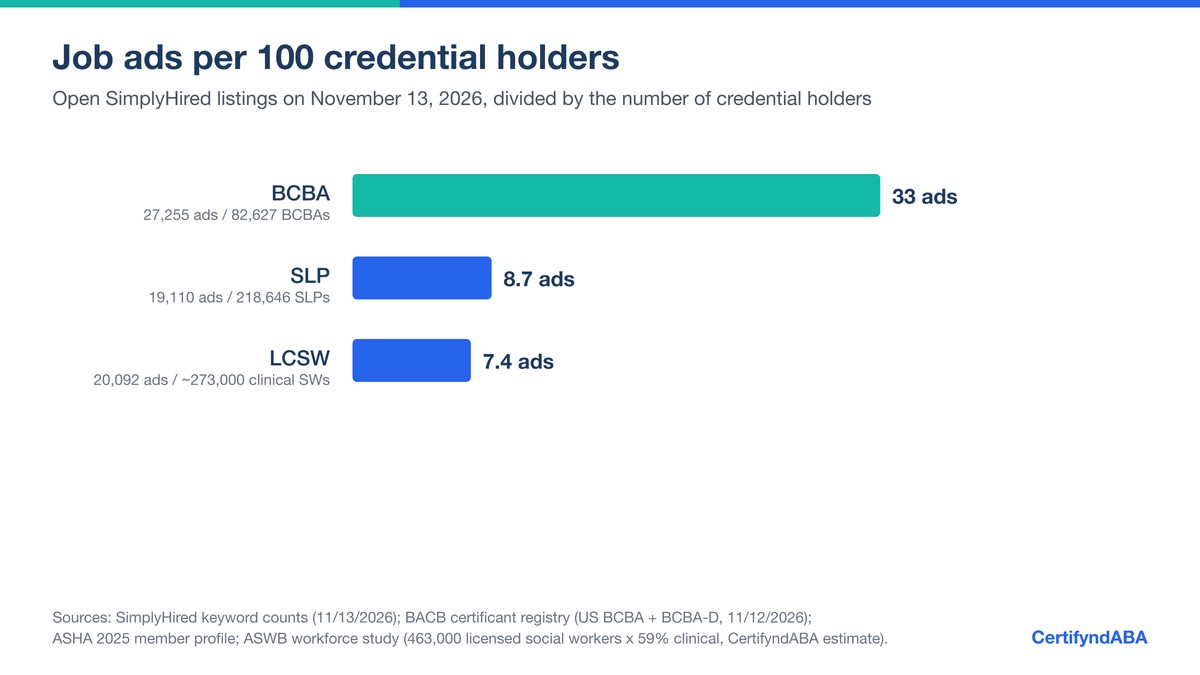
Treat these as rough ratios, not exact openings. A keyword count catches any ad that mentions the credential, including RBT ads that name a supervising BCBA and therapist ads that accept an LCSW or another license. Duplicate listings exist on both sides. Because both counts come from the same site on the same day with the same method, the comparison still holds up.
The longer-term numbers agree. According to the BACB and Lightcast, employers posted 132,307 job ads requiring or preferring a BCBA in 2025, up 28% from 2024. The BLS projects 6% growth for all social workers from 2025 to 2035, with 10% for the mental health and substance abuse group. Social work is a steady field with a large workforce. Behavior analysis is a smaller field where demand still outruns supply. We cover that gap in depth in our BCBA shortage report.
Social work has about three clinical license holders for every BCBA, yet the two fields post a comparable number of job ads.
Education and Training: How Each Path Works
The BCBA path
You need a master's degree, a set of behavior-analytic courses, 2,000 hours of supervised fieldwork (or 1,500 concentrated hours) and a passing score on the BCBA exam. Many students complete fieldwork while still in their program, so a full-time student can sometimes apply within about two to three years of starting a master's. The exam is a real hurdle: only 51% of first-time candidates from university programs passed in 2025, according to the BACB's university pass-rate report. For applications on or after January 1, 2027, you qualify with either an accredited or recognized degree, or a master's plus behavior-analytic coursework that meets the 2027 requirements and is attested by the university. Our step-by-step BCBA guide and BCBA certification cost breakdown cover the details.
The LCSW path
An MSW from a program accredited by the Council on Social Work Education (CSWE) usually takes two years full time and includes at least 900 hours of field education. After graduation, you work under supervision before you can sit for the clinical license. The hours depend on the state:
- California: 3,000 hours over at least 104 weeks
- Texas: 3,000 hours and 100 supervision hours over at least 24 months
- New York: at least 2,000 client contact hours over three to six years
- Florida: 1,500 direct client hours and 100 supervision hours
The ASWB Clinical exam costs $260, and 75.7% of first-time takers passed in 2025. Counting the post-degree supervision, in the states above it takes about four years or more from the start of an MSW to an LCSW.
Scope of Practice: What Each Professional Actually Does
BCBAs assess behavior, write and adjust treatment plans, train families and supervise Registered Behavior Technicians (RBTs) who deliver much of the direct therapy. Many BCBAs work with autistic children, though the field also covers schools, adult services and organizational behavior management. Diagnosing autism or mental health conditions is outside the BCBA role.
LCSWs can diagnose and treat mental health conditions, provide psychotherapy and run case management in hospitals, clinics, schools and community agencies. Medicare recognizes clinical social workers as independent providers for mental health services under Section 1861(hh) of the Social Security Act. That makes the LCSW a more portable license if you want to work with adults, older clients or in general mental health.
The two jobs meet in a small corner of the market. Only 388 of the 27,255 BCBA ads we counted also mention the LCSW, about 1.4%. About 63% of the unique ads in that set carry behavior-related titles, such as behavior consultant and behavior support roles, and some states let either credential fill them. Our guide to behavior consultant jobs explains how those titles work.
BCBA vs Psychologist vs SLP
People comparing BCBA and LCSW often look at psychology and speech-language pathology too. Here is how they line up, using BLS data for May 2025 and the BLS 2025 to 2035 projections.
| Career | Typical degree | Median pay | Projected growth |
|---|---|---|---|
| BCBA | Master's + 2,000 fieldwork hours | $89,934* | Not tracked by BLS |
| Clinical and counseling psychologist | PhD or PsyD | $100,580 | 12% |
| Speech-language pathologist | Master's + 36-week Clinical Fellowship | $97,870 | 17% |
| School psychologist | Specialist degree (60 credits) + 1,200-hour internship | $95,990 | 1% |
| Healthcare social worker | MSW for clinical roles | $67,880 | 8% |
| Mental health and substance abuse social worker | MSW for clinical roles | $60,280 | 10% |
*BCBA figure is the median advertised salary from our review of 595 employers; all other figures are BLS May 2025 medians, which include all earners in the occupation.
Psychologists and SLPs earn more on paper, but the comparison is not like for like. A clinical psychologist needs a doctorate (PhD or PsyD), which takes far longer than a master's. SLPs have the strongest projected growth of the group, yet they also have a big workforce: ASHA counted 218,646 SLPs at the end of 2025, and SimplyHired listed 19,110 SLP ads on our count date. That is about 8.7 ads per 100 SLPs, close to the LCSW figure and far below the BCBA figure.
For a closer look at nearby credentials inside ABA, read RBT vs BCBA and BCBA vs BCaBA.
BCBA or LCSW: Which Should You Choose?
Choose the BCBA if you like structured, data-driven work, want to work with children and families, and want strong pay and bargaining power early in your career. With more job ads per credential holder, you may have more room to negotiate salary, caseload and schedule. The trade-off is a narrower scope. Many jobs sit in autism services, and moving into general mental health would mean a second credential.
Choose the LCSW if you want to provide therapy, work across a wide range of ages and conditions, or keep the option of a solo private practice that bills Medicare and commercial plans. You will likely start at lower pay and compete with more people for each role, but the license travels across more settings.
Some clinicians hold both. A dual credential fits roles that blend behavior support with mental health treatment, such as adult developmental disability services or dual-diagnosis programs. If you are already an LCSW, our guide to BCBA jobs outside of autism shows where behavior analysis reaches beyond early intervention.
Frequently Asked Questions
Do BCBAs make more than LCSWs?
In job ads, yes. Our review found a median advertised salary of $89,934 for BCBA jobs and $70,000 for jobs that ask for an LCSW. LCSWs in private practice can earn more than the ad median.
Is it harder to become a BCBA or an LCSW?
The BCBA exam has the lower first-time pass rate: 51% of first-time candidates from university programs passed in 2025, against 75.7% for the ASWB Clinical exam. The LCSW often takes longer overall, because states require supervised hours after the MSW; California, Texas, New York and Florida range from 1,500 to 3,000.
Can an LCSW become a BCBA?
Yes. An LCSW already has a master's degree, so the main steps are behavior-analytic coursework, 2,000 supervised fieldwork hours (or 1,500 concentrated) and the BCBA exam. Many LCSWs complete a verified course sequence while still working.
Can a BCBA diagnose autism or provide therapy for anxiety?
No. BCBAs assess and treat behavior, but diagnosis is outside the BCBA role. Diagnosis is done by physicians, psychologists and, for mental health conditions, licensed clinicians such as LCSWs.
Which has better job security, BCBA or LCSW?
Both are in demand, but BCBAs see more job ads per credential holder. We counted about 33 job ads for every 100 BCBAs and about 7 for every 100 clinical social workers in November 2026.
The Bottom Line on BCBA vs LCSW
The BCBA vs LCSW choice comes down to the work you want to do. The BCBA pays more in job ads, often takes less time to earn and puts you in a market with more job ads per credential holder. The LCSW opens a wider scope of clinical practice and more settings, at lower typical pay and with more competition. If behavior analysis fits how you like to work, the numbers are on your side.
Put Your BCBA Credential to Work
With about 33 job ads for every 100 BCBAs, employers are looking for you. Create a free CertifyndABA profile, show your verified credential and let qualified ABA employers reach out with real salary ranges.
Create Your Free Profile