


If you are a BCBA, the ABA CPT codes you bill change on January 1, 2027. The code set grows from 10 codes to 14. Code 97155 narrows to directing a technician, a new code (97173) covers sessions you run yourself, and another new code (97180) can cover some data review and protocol work that has not been separately reportable under CPT. No payer rate for 97180 has surfaced yet, and that is the number that could change your job.
This guide explains each code in plain English, what moves in 2027, what your billable hour brings in, and what to ask an employer before you sign an offer. The code details come from the American Medical Association's 2027 CPT set as published by the ABA Coding Coalition and from the Coalition's supplemental guidance, not from billing vendors.
ABA CPT codes in 2027: the full list
Every code below is billed in 15-minute units. The Coalition's supplemental guidance applies the standard CPT time rule: 8 to 22 minutes counts as one unit, and under 8 minutes is not reportable. The descriptions are our plain-English summaries, so use the CPT book for the exact wording.
| Code | Delivered by | What it covers in 2027 |
|---|---|---|
| 97151 | QHP | Behavior identification assessment, including scoring and the report or treatment plan |
| 97152 | Technician | Supporting assessment, face to face with the patient |
| 97148 + 97149 (new) | 2 technicians, plus add-on for more; QHP on site | Supporting assessment of harmful behavior in a customized setting |
| 97180 (new) | QHP, personally | Non-face-to-face work: data review, protocol decisions, discharge planning, patient-specific technician training |
| 97153 | Technician | One-to-one treatment by protocol |
| 97154 | Technician | Group treatment by protocol, 2 or more patients |
| 97159 + 97160 (new) | 2 technicians, plus add-on for more; QHP on site | Treatment of harmful behavior in a customized setting |
| 97155 (revised) | QHP | Directing a technician, with analysis, while face to face with the patient |
| 97173 (new) | QHP | One-to-one treatment with analysis, delivered by the QHP |
| 97156 | QHP | Family guidance with analysis, with or without the patient present |
| 97157 | QHP | Multiple-family group guidance, without patients present |
| 97158 | QHP | Group treatment with analysis |
QHP means qualified health care professional. The Coalition's crosswalk lists BCBAs, BCBA-Ds, BCaBAs, licensed behavior analysts and licensed assistant behavior analysts, along with other credentialed professionals whose scope includes ABA. For the harmful-behavior codes, on site means immediately available to join the session, and telehealth may meet that where the payer allows. State law and payer policy still decide who can bill what. Our BCBA vs BCaBA comparison covers the difference between the two credentials.
What 97155 means now, and what changes
Today, 97155 is a dual-use code. It covers treatment with protocol modification by the BCBA, which may include directing a technician at the same time. In 2027, the Coalition's guidance is direct: 97155 "is no longer a dual-use code." It applies only when you direct a technician with the patient present, and it is always reported alongside a technician-delivered code such as 97153.
That leads to three practical rules:
- Technician present and you are directing: report 97155 while the technician reports 97153. One person cannot report both at the same time.
- You run the session alone and analyze the response: report 97173. It cannot be billed concurrently with 97155.
- You cover for an absent technician and only follow the protocol: report 97153. Some payers require a modifier when a higher-level provider delivers it.
"Analysis" replaces "protocol modification" throughout the code set. Analysis means you observe the response and decide whether targets or protocols need to change. You do not have to change anything to report it, but you do have to document it.
CPT code 97180: the change that could reshape BCBA jobs
Under the current codes, the Coalition says, indirect work is generally not billable outside the assessment code 97151. Data review and protocol revision are bundled with direct services, although some payers allow other billing codes for this work. Code 97180 gives part of that work its own CPT line on a claim. Writing the initial treatment plan or a reassessment report stays with 97151.
The time is summed by patient for a 7-day period, such as Sunday through Saturday, and reported together on one claim line. Each date still has to be documented individually. The Coalition's example is five hours for one patient in a week, reported as 20 units. The code does not cover everything a BCBA does away from the client, as this comparison shows.
| Reportable with 97180 | Not reportable with 97180 |
|---|---|
| Reviewing and analyzing a patient's data and session notes | Writing session notes |
| Deciding whether to change targets, goals or protocols, and making the changes | Audits and internal quality checks |
| Deciding whether more assessment is needed and building those protocols | Setting up a treatment space or gathering materials |
| Developing a clinical discharge or transition plan | Payer notices, records transfers and other administrative discharge work |
| Training technicians on a specific patient's protocols, without the patient present (only your time is billed) | General training on concepts, safety or HR policy; care coordination |
Two limits matter. You cannot report 97180 and 97151 on the same day for the same patient. Families may also see cost sharing for 97180, depending on the health plan, even in a week with no face-to-face session. Authorization is another open question: the guidance says there is no prescribed formula, and it points to the Council of Autism Service Providers' average of 1 to 2 hours of QHP activity for every 10 hours of technician treatment, across all QHP codes.
What ABA CPT codes pay: a BCBA's billable hour
A code is not a price. Medicare sets no national rate for these codes, and the July proposed rule keeps all of them priced by each contractor through 2027. The final rule was not published when we checked on November 4, 2026. Rates are set by payer, so we pulled 97155 from eight payers' own fee schedules.
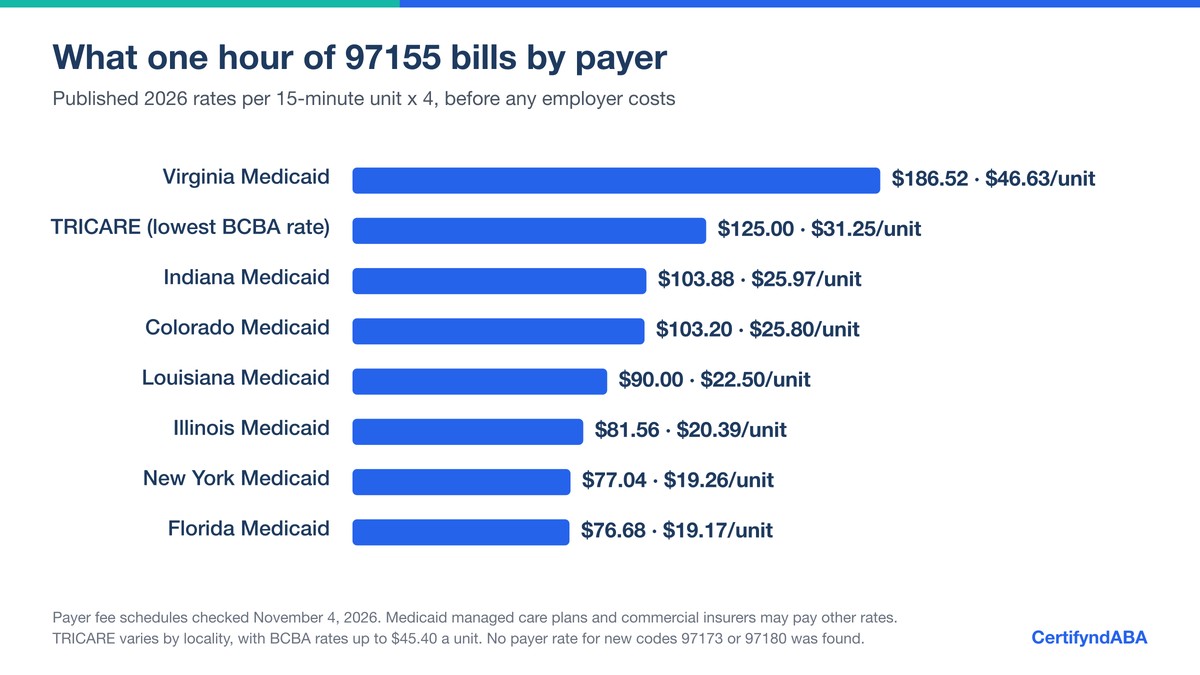
Read this as gross billing, not profit or salary. These schedules do not show what managed care plans or commercial insurers pay, and managed care covers most Medicaid members in several of these states. Louisiana's and Virginia's rate rows date to 2022 and 2021, and Indiana's rate falls again, to $24.93 a unit, on April 1, 2027.
The spread still gives you useful context for an offer. BCBA job ads with hourly pay had a median of $80 in the November 3 sample behind our BCaBA salary report, and those ads mix employees, contractors and per-billable-hour pay. Across these eight schedules, an hour of 97155 bills between about $77 and $187. That $80 figure tops the billing rate only at the bottom of the range, in the New York and Florida fee-for-service files. Both states also use managed care for Medicaid, so providers there may see other rates.
Your billable hour is also only part of the employer's revenue. In Illinois, the Medicaid rate is $13.00 a unit for 97153 and $20.39 for 97155; in Colorado, $17.20 and $25.80. When you direct a technician, both codes can be reported for the same time. For the wider view of the two roles, see RBT vs BCBA.
What BCBA job ads say about billable hours
Most ads say little about any of this. We reread our sample of 688 direct employers, one BCBA ad each, live on job boards on October 1, 2026.
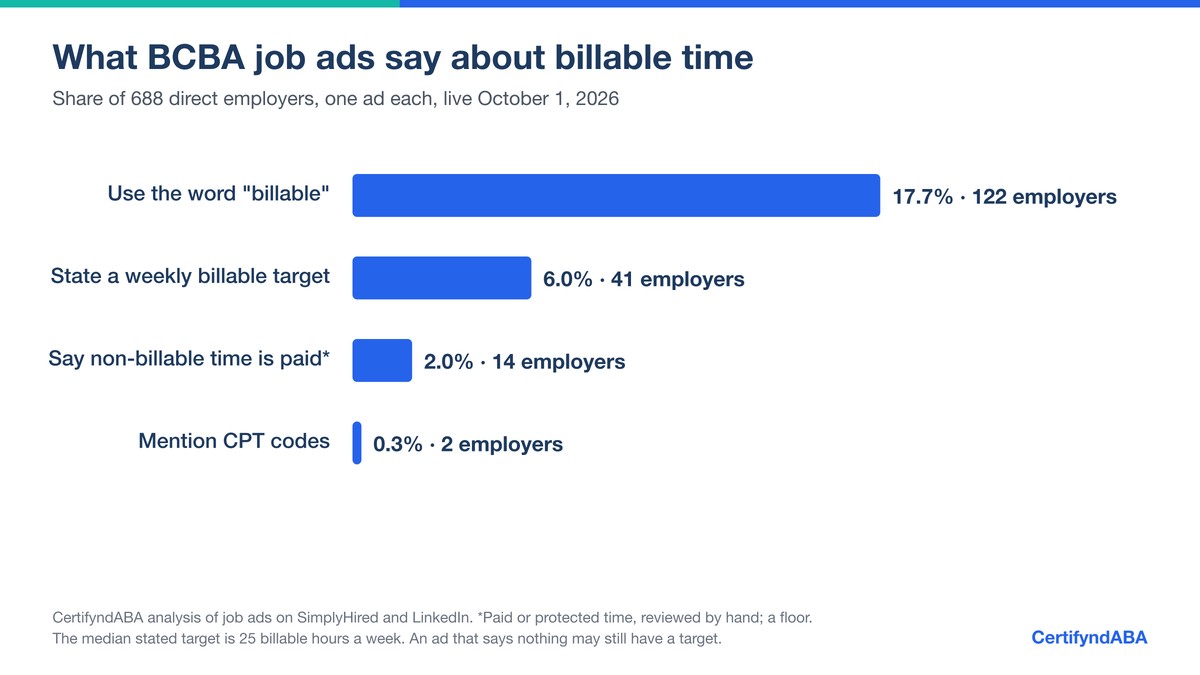
Among the 41 employers that stated a weekly target, the median was 25 billable hours and the range was 20 to 32. On a 40-hour week, a 25-hour target leaves about 15 hours for everything else. One ad spelled it out as 27 billable hours and 13 non-billable hours. Another quoted $48 to $60 per billable hour and said that was not a flat rate for every scheduled hour, so the same number can mean very different pay.
Only 2 of the 688 ads mentioned CPT codes. Ads will not tell you how an employer plans to handle 97180, so you have to ask. Our guide to BCBA jobs covers what else these ads leave out.
Questions to ask an employer before January
Nobody can promise how 97180 will play out yet. We searched for 2027 notices from TRICARE, UnitedHealthcare/Optum, Aetna, Cigna, Anthem, Blue Cross Blue Shield plans and state Medicaid agencies on November 4 and found no published rate or coverage policy for it. That does not mean none exists; contracts are often private. An employer should still be able to tell you its plan. Add these to your interview questions:
- Does 97180 count toward my billable target? If it does, the target might feel lighter. If the target goes up to absorb it, you may be doing the same work with more documentation.
- Which of your main payers have confirmed coverage of 97180 and 97173? A plan that depends on one payer's answer is a different job from one with a signed rate.
- If I am paid per billable hour, what do I earn on 97180? Get the rate for direct and non-face-to-face codes in writing. Ask what pays for work 97180 excludes, such as session notes.
- How will I log 97180 time? Each date needs its own record, so the system matters. Ask who audits the entries.
- Who writes the code on a session I run alone? A solo session moves from 97155 to 97173. Ask how notes will capture the analysis and what happens if a payer rejects the new code in January.
- How do authorizations crossing January 1 work? The Coalition tells providers to ask each payer whether existing authorizations convert or need a new request. A gap can affect your caseload and any bonus tied to hours.
Demand gives you room to ask. The BACB's Lightcast report counted 132,307 US postings in 2025 that required or preferred BCBA or BCBA-D certification, and the registry listed 82,347 US BCBAs and BCBA-Ds in November 2026. That is about 1.6 postings per certificant, though it compares a year of postings with a later headcount. Postings are not openings, and the ratio varies widely by state. Use the negotiation guide if an answer falls short. If you work as a 1099 contractor or plan to open a practice, also read contractor vs employee and how to start an ABA practice, because the payer homework then becomes yours.
Frequently asked questions
What are the CPT codes for ABA therapy?
From January 1, 2027, the ABA CPT codes are 97148, 97149, 97151, 97152, 97153, 97154, 97155, 97156, 97157, 97158, 97159, 97160, 97173 and 97180. All are reported in 15-minute units. Through December 31, 2026, the set is 97151 through 97158 plus the temporary codes 0362T and 0373T.
What is CPT code 97155?
From 2027, 97155 is direction of a technician with analysis by a physician or other qualified health care professional, face to face with a patient. It is always reported with a technician-delivered code. Until then, it also covers treatment with protocol modification delivered by the BCBA alone.
What is CPT code 97153?
97153 is one-to-one adaptive behavior treatment by protocol, delivered by a technician face to face with one patient, billed per 15 minutes. It remains the core technician code in 2027. A BCBA who fills in and only follows the protocol also reports 97153, subject to payer modifier rules.
What is the difference between 97155 and 97173?
97155 is for directing a technician with the patient present. 97173 is for a qualified professional delivering one-to-one treatment with analysis directly. The two cannot be reported concurrently. 97173 is new on January 1, 2027.
Can a BCBA bill for treatment planning in 2027?
Partly. CPT code 97180 covers data review, protocol decisions, discharge or transition planning and patient-specific technician training done away from the client. It does not cover writing session notes, audits or general training. Writing the initial treatment plan or a reassessment report belongs to 97151, and 97151 and 97180 cannot be reported on the same day for the same patient. A code does not guarantee payment, because each payer decides coverage and rates.
How much does 97180 pay?
We found no published payer rate as of November 4, 2026. The proposed Medicare rule leaves pricing to contractors, and other payers set their own rates. Check each payer's fee schedule or contract, and confirm the rate before you count on it in an offer.
How we built this guide
Code rules come from the ABA Coding Coalition's billing codes page, 2027 crosswalk, supplemental guidance and October 2026 provider suggestions, read on November 4, 2026. Rates come from each payer's published schedule: TRICARE (effective May 1, 2026), Illinois, New York, Florida, Colorado, Indiana, Louisiana and Virginia fee-for-service files. Hourly figures multiply the 15-minute rate by four. Virginia is the licensed behavior analyst tier in its outpatient rows, dated December 2021, and TRICARE is the lowest BCBA rate in its locality table. Job ad figures come from a sample of 688 direct employers collected October 1, 2026, on SimplyHired and LinkedIn, using text searches, with hand review of ads that describe non-billable pay; a few employers appear under more than one name. This guide is general information, not billing or legal advice. CPT is a registered trademark of the American Medical Association.
Know how a job really works before you share your name
Billable targets and pay structures vary widely, and most ads leave them out. Create an anonymous profile and let employers send you interview requests, with your details hidden until you accept.
Create Your Free Profile