


ABAI accredited programs used to be a nice extra on a graduate school brochure. That changes on January 1, 2032, when the BACB will accept only applicants whose master's degree comes from a program accredited by ABAI or APBA. As of November 24, 2026, the ABAI Accreditation Board lists 39 universities with accredited master's programs (37 of them in the US), 11 with accredited doctoral programs, and 8 with accredited bachelor's programs. APBA, the newer accreditor, lists one: Pepperdine University.
Below is the full US list of ABAI accredited programs at the master's level, matched to each program's 2025 BCBA exam result from the BACB. We also show where the accredited programs are, and where they are not, compared with the states that post the most BCBA jobs.
What ABAI Accreditation Means for a BCBA Program
The Association for Behavior Analysis International (ABAI) accredits degree programs that meet its standards for curriculum, faculty, outcomes, resources, and public disclosure. Since January 1, 2022, an ABAI-accredited degree meets the BACB's degree and coursework requirements for BCBA certification under Pathway 1, according to the ABAI Accreditation Board. You still need supervised fieldwork and a passing exam score.
Three details trip people up:
- ✓Accreditation belongs to a program, not a university. ABAI states that accreditation "does not extend to all campuses or formats" where a degree is offered. A university can have an accredited on-campus degree and a non-accredited online one.
- ✓"Recognized" is not "accredited." ABAI also keeps a separate list of Tier 2a to 4b recognized programs. Those programs are not accredited, and the 2032 rule names accreditation.
- ✓A verified course sequence is not accreditation either. Pathway 2 lets you combine a qualifying degree with separate behavior-analytic coursework. The BACB plans to retire Pathway 2 in 2032; our BCBA Pathway 2 guide covers the timeline.
The Full List of ABAI Accredited Master's Programs in the US
The table lists every US university with an ABAI-accredited master's program, grouped by state. Where a university has more than one accredited program, the count is shown. The last column gives the program's 2025 first-time BCBA exam result from the BACB's 2025 university pass-rate report. "Not reported" usually means six or fewer first-time candidates, or that the program was accredited after 2025.
| State | University | ABAI-accredited master's programs | 2025 first-time BCBA exam result (BACB) |
|---|---|---|---|
| Alabama | Auburn University | 1 | 8* candidates, 100% |
| Alabama | Jacksonville State University | 1 | Not reported |
| Alaska | University of Alaska Anchorage | 1 | Not reported (accredited Feb. 2026) |
| California | California State University, Fresno | 1 | Not reported (accredited Aug. 2026) |
| California | California State University, Los Angeles | 1 | 9 candidates, 78% |
| California | California State University, Sacramento | 1 | Not reported |
| Florida | Florida Institute of Technology | 2 | Orlando 8, 75%; Melbourne 6, 67% |
| Florida | Florida International University | 1 | Not reported |
| Florida | Florida State University, Panama City | 1 | 12 candidates, 83% |
| Florida | Rollins College | 1 | Not reported |
| Florida | University of Florida | 1 | Not reported |
| Florida | University of South Florida | 1 | 7 candidates, 86% |
| Illinois | Southern Illinois University | 1 | 7 candidates, 71% |
| Illinois (multi-campus) | The Chicago School | 3 | Online 43, 60%; Chicago campus 17, 53% |
| Kansas | University of Kansas | 2 | On campus 6*, 100% (online program accredited Jan. 2026) |
| Louisiana | McNeese State University | 1 | Not reported |
| Maryland | University of Maryland, Baltimore County | 1 | 11 candidates, 91% |
| Massachusetts | Regis College | 2 | Online 11, 82%; on campus 11, 55% |
| Massachusetts | Salem State University | 1 | 9 candidates (hybrid), 67% |
| Massachusetts | Simmons University | 2 | On campus 12, 75% (online program accredited Feb. 2026) |
| Massachusetts | University of Massachusetts, Lowell | 1 | Not reported (accredited Aug. 2026) |
| Michigan | Western Michigan University | 1 | 8 candidates, 75% |
| Minnesota | St. Cloud State University | 2 | 22 candidates (on campus and online), 100% |
| Missouri | University of Missouri, Columbia | 1 | Not reported |
| Montana | Montana State University Billings | 1 | Not reported |
| Nevada | University of Nevada, Reno | 2 | Not reported |
| New Jersey | Caldwell University | 1 | 8* candidates, 75% |
| New York | Hunter College | 1 | Not reported (accredited Sept. 2026) |
| New York | Teachers College, Columbia University | 1 | 12 candidates, 67% |
| North Carolina | University of North Carolina Wilmington | 1 | 6 candidates, 100% |
| Ohio | Ohio State University | 1 | Online 9*, 44% |
| Pennsylvania | Pennsylvania State University, Harrisburg | 1 | Not reported |
| Rhode Island | Salve Regina University | 1 | 15 candidates, 93% |
| Texas | University of Houston, Clear Lake | 1 | 13 candidates, 100% |
| Texas | University of North Texas | 1 | 12 candidates, 100% |
| Texas | University of Texas at San Antonio | 1 | 13 candidates, 85% |
| West Virginia | West Virginia University | 1 | Not reported |
Sources: ABAI Accreditation Board accredited-program list and 2026 board decisions, checked November 24, 2026; BACB, BCBA Examination Pass Rates for University Training Programs 2025 (updated 10/2026). The BACB reports only programs with more than six first-time candidates. * = candidates pooled across 2024 and 2025 because of low volume. Outside the US, Oslo Metropolitan University (Norway) and Veracruzana University (Mexico) also hold accredited master's programs.
Two patterns stand out. First, these programs are small. The 25 accredited programs in the BACB's 2025 report had 295 first-time candidates between them; the largest, The Chicago School's online M.S., had 43. Second, the list is concentrated: Florida has 6 universities and Massachusetts has 4, while 28 states and Washington, D.C. have none.
Accredited doctoral and bachelor's programs
ABAI lists 11 universities with accredited doctoral programs: Caldwell University, Florida Institute of Technology, Ohio State University, Teachers College at Columbia University, University of Florida, University of Kansas, the University of Nebraska Medical Center's Munroe-Meyer Institute, University of Nevada, Reno, University of North Carolina Wilmington, West Virginia University, and Western Michigan University. If you are weighing a PhD, our BCBA-D guide looks at what the doctorate does and does not change in the job market.
Eight universities hold accredited bachelor's programs: Eastern Connecticut State University, Florida Institute of Technology, Konrad Lorenz University (Colombia), Oslo Metropolitan University (Norway), University of Alaska Anchorage, University of Florida, University of Nevada, Reno, and West Virginia University. An accredited bachelor's degree applies to the BCaBA credential, not the BCBA.
Do ABAI Accredited Programs Have Higher Pass Rates?
Yes, on average. In the BACB's 2025 report, the mean first-time pass rate was 79.3% for ABAI-accredited programs, compared with 53.2% for the 179 other reported programs. The national first-time pass rate in 2025 was 51%, the first year on the sixth-edition test content outline. Weighted by candidates, the accredited group came in at about 78%, by our calculation from the BACB table.
Accredited programs passed 79.3% of first-time candidates in 2025; the other reported programs passed 53.2%. The gap was 26.1 points (BACB, 2025).
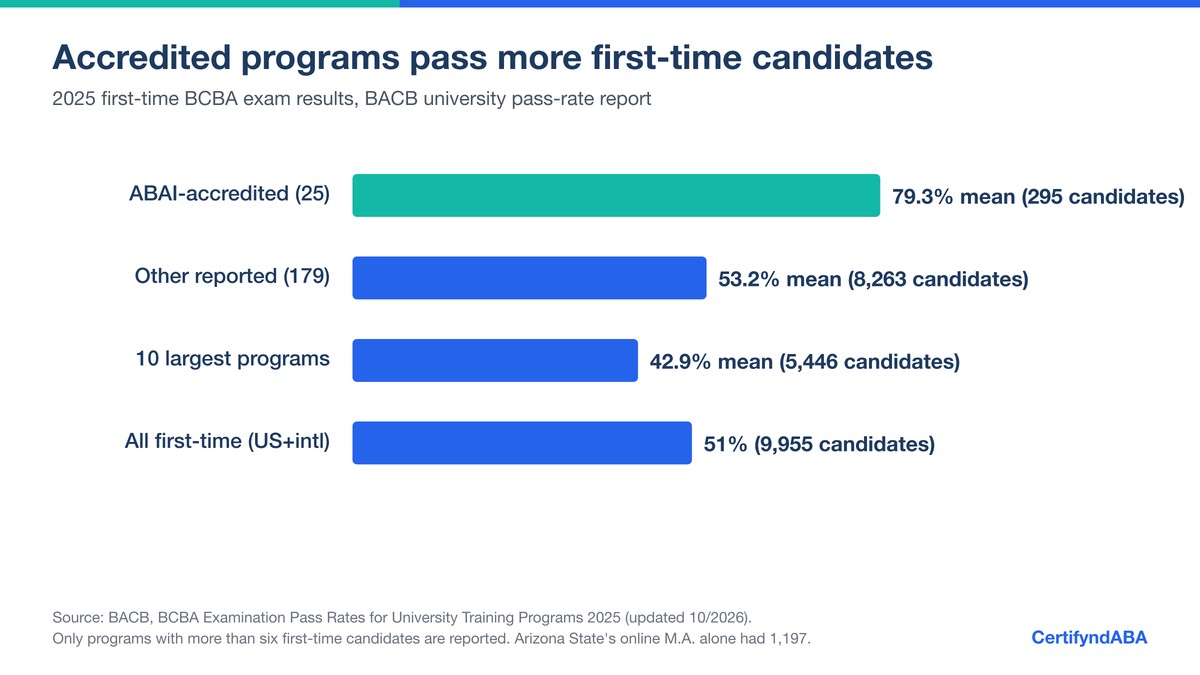
Read the gap with care. Accredited programs are small, many admit selectively, and the BACB cautions that pass rates are "not rankings, endorsements, or guarantees." Results also vary inside the accredited group. Six programs passed 100% of their candidates, while Ohio State's online M.A. (44%, pooled over two years), The Chicago School's Chicago campus (53%), and Regis College's on-campus M.S. (55%) were close to the national rate. For the full program-by-program picture, including the large online programs, see our BCBA exam pass rate guide and our review of online BCBA programs.
ABAI Accredited Online Programs
Online is where most BCBA candidates study, and it is where accredited options are thinnest. Based on the ABAI list, its 2026 board decisions, and the BACB report, these accredited master's programs are offered online or partly online:
- ✓The Chicago School, M.S. in Applied Behavior Analysis (online): 43 first-time candidates in 2025, 60% passed
- ✓St. Cloud State University, M.S. in Applied Behavior Analysis (on campus and online): 22 candidates, 100%
- ✓Regis College, M.S. in Applied Behavior Analysis (online): 11 candidates, 82%
- ✓Ohio State University, M.A. in Educational Studies, Special Education (ABA) (online): 9 candidates over 2024 and 2025, 44%
- ✓Salem State University, M.S. in Behavior Analysis (hybrid): 9 candidates, 67%
- ✓Simmons University, M.A. in Behavior Analysis (online), and University of Kansas, M.A. in Applied Behavioral Science (online): both newly accredited in early 2026, so no exam data yet
The largest online programs in the country are not on this list. Arizona State University's online M.A. alone had 1,197 first-time candidates in 2025, about four times as many as all 25 reported accredited programs combined (BACB, 2025). If you plan to apply for certification in 2032 or later, confirm the exact program and format on the ABAI list before you enroll.
Programs Applying for ABAI Accreditation
The list is growing. In 2026 so far, the ABAI board granted first-time accreditation to master's programs at Hunter College (September), California State University, Fresno and the University of Massachusetts, Lowell (August), and the University of Alaska Anchorage, plus the online programs at Simmons and Kansas. It deferred a decision on Endicott College's online M.S. and denied Ouachita Baptist University's M.S. in July.
ABAI's public queue, checked November 24, 2026, shows these master's programs seeking accreditation:
- Under review for initial accreditation: Philadelphia College of Osteopathic Medicine (hybrid), Temple University (on campus), and The Chicago School's DC and SoCal campuses (hybrid).
- Found eligible to apply: Daemen University, Middle Tennessee State University, Northern Michigan University, Northeastern University, Queens College CUNY (online), Rowan University, Saint Louis University (on campus and online), SUNY Downstate Health Sciences University (online), and Texas State University.
"Eligible to apply" does not mean accredited. Some programs have sat at that stage for years; Rowan's request dates to 2023 and Texas State's to 2022. APBA does not publish an applicant list, so programs may also be applying there without notice.
Where BCBA Jobs Are, and Where Accredited Programs Are Not
BCBA demand keeps outrunning supply. Employers posted 132,307 jobs requiring or preferring a BCBA or BCBA-D in 2025, up 28% in a year, according to the BACB and Lightcast. The BACB's own certificant data shows about 83,000 BCBAs and BCBA-Ds in the US in November 2026. Because many states with heavy hiring have no accredited program at all, the 2032 rule matters for local supply as well as national supply.
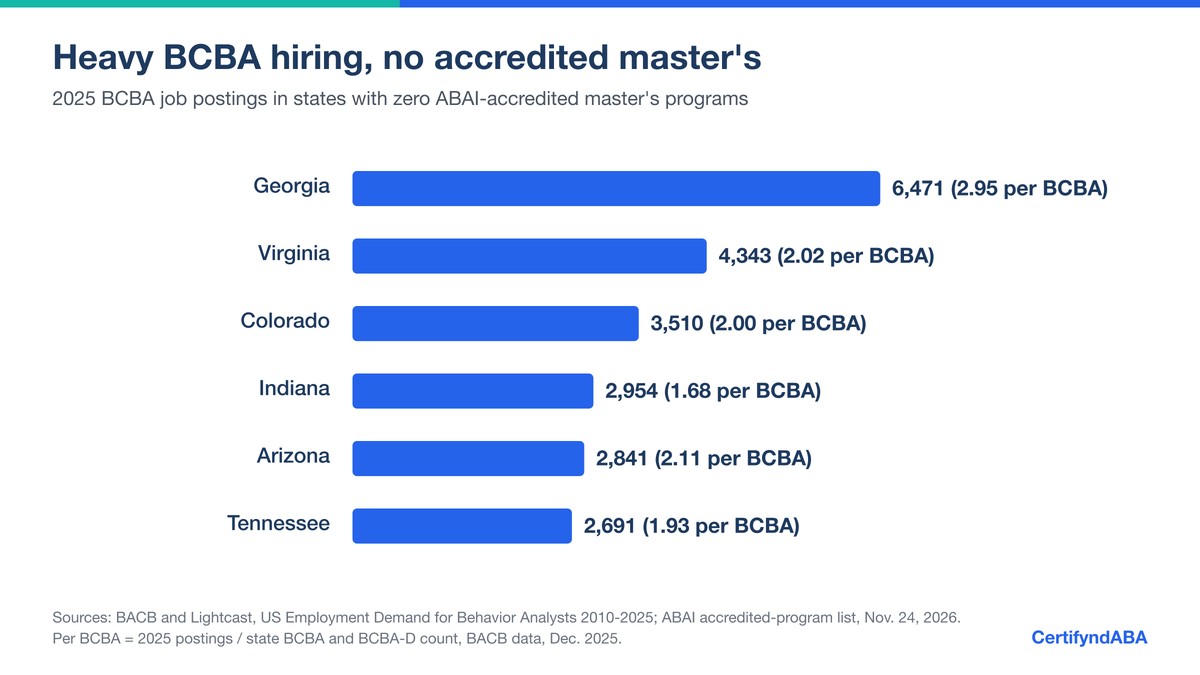
| State | 2025 BCBA job postings | Postings per BCBA | Universities with an ABAI-accredited master's |
|---|---|---|---|
| Georgia | 6,471 | 2.95 | 0 |
| Virginia | 4,343 | 2.02 | 0 |
| Colorado | 3,510 | 2.00 | 0 |
| Indiana | 2,954 | 1.68 | 0 |
| Arizona | 2,841 | 2.11 | 0 |
| Tennessee | 2,691 | 1.93 | 0 |
| Maryland | 4,751 | 3.84 | 1 |
| North Carolina | 6,874 | 3.50 | 1 |
| New Jersey | 8,139 | 2.17 | 1 |
| Pennsylvania | 5,012 | 1.70 | 1 |
| Massachusetts | 7,315 | 1.85 | 4 |
| Florida | 5,537 | 0.65 | 6 |
Postings: BACB and Lightcast, US Employment Demand for Behavior Analysts 2010-2025. Postings per BCBA: our calculation, 2025 postings divided by the state's BCBA and BCBA-D count in BACB certificant data at December 2025. A posting is not the same as an unfilled seat.
Georgia, Virginia, Colorado, Indiana, Arizona, and Tennessee posted more than 22,000 BCBA jobs between them in 2025 and have no university with an ABAI-accredited master's program. Florida, with the most accredited universities, had the fewest postings per BCBA of any state in the Lightcast top 30. We cannot say the programs cause that; Florida also has a large BCaBA and RBT workforce that takes on some of the work. The national picture is that the reported accredited programs produced 3.4% of 2025 first-time candidates, and our Pathway 2 analysis works through what that means for BCBA supply after 2031. For the job side, see our breakdown of BCBA job openings.
Do Employers Care Whether Your Program Was Accredited?
Not in what they publish. When we read 688 direct employers' BCBA job ads in September 2026, one ad per employer, none named a certification pathway and none listed ABAI or APBA as a requirement. Five mentioned an accredited program or degree without naming an accreditor. A November 2026 pass over 282 BCBA listings on SimplyHired found no ad that mentioned ABAI. What employers screen for is an active BCBA credential, plus a state license where one applies.
Accreditation helps you before the job search, not during it. It satisfies the coursework requirement in one package, its programs pass the exam at higher rates on average, and after 2031 it will be the only door to the BCBA. Once you hold the credential, your pay and offers depend on your market, setting, and experience. Our BCBA salary guide covers those factors.
How to Choose Among ABAI Accredited Programs
- Check the exact program on the ABAI list. Match the degree name, campus, and format. Accreditation of one format does not cover another.
- Work back from your application date. If you will apply for BCBA certification in 2032 or later, only an ABAI- or APBA-accredited master's qualifies. If you will apply by the end of 2031, Pathway 2 is still open.
- Look up the program's BACB pass rate. Use several years where they exist, and note the candidate count; a 100% rate from six people tells you less than 85% from 40.
- Ask how fieldwork works. Accreditation covers coursework, but you still need supervised fieldwork hours. Ask whether the program places students or expects you to find a supervisor.
- Compare cost and timing. Accredited programs are often on campus and smaller. Weigh relocation and tuition against the exam and 2032 benefits.
For the full route from degree to credential, see our guide on how to become a BCBA.
Frequently Asked Questions
How many ABAI accredited programs are there?
As of November 24, 2026, ABAI lists 39 universities with accredited master's programs (47 programs counting universities with more than one), 11 universities with accredited doctoral programs, and 8 with accredited bachelor's programs. Thirty-seven of the master's universities are in the US.
Is an ABAI accredited program required to become a BCBA?
Not yet. Until the end of 2031, you can qualify through Pathway 2 with a qualifying degree and behavior-analytic coursework. From January 1, 2032, the BACB will require a master's or higher from an ABAI- or APBA-accredited program.
Are there ABAI accredited online programs?
Yes, but few. They include The Chicago School's online M.S., Regis College's online M.S., Ohio State's online M.A., St. Cloud State's on-campus and online M.S., and the online programs at Simmons University and the University of Kansas, both accredited in early 2026.
What is the difference between ABAI and APBA accreditation?
Both count for the 2032 BCBA rule. ABAI has accredited programs for decades and lists dozens. APBA, the Association of Professional Behavior Analysts, is a newer accreditor, and its public list showed only Pepperdine University's M.S. in Applied Behavior Analysis on November 24, 2026.
Do I need to redo my degree if I am already a BCBA?
No. The 2032 requirement applies to new applicants. Current BCBAs keep their certification by meeting the recertification requirements.
The Bottom Line on ABAI Accredited Programs
ABAI accredited programs are a short list today: 37 US universities at the master's level, mostly small and on campus, with higher average pass rates than the rest of the field. In 2032 they, together with APBA's single program so far, become the only route to the BCBA. If your application date falls in 2032 or later, verify accreditation before you pay a deposit. If you are already certified, the gap between BCBA supply and the 132,307 jobs posted in 2025 is likely to stay wide, which keeps the advantage with you.
Put your credential where employers can find it
CertifyndABA is an anonymous reverse job marketplace. Build a free profile around your verified credentials, and employers send you interview requests. Your identity stays private until you accept.
Create Your Free Profile