


If you are a board certified behavior analyst in metro Atlanta, the hardest part of your job search is not finding an opening. It is choosing between them. At any given time the major job boards list several hundred BCBA roles across the Atlanta area, and the pool of certified analysts to fill them is far thinner than the demand. That imbalance puts you, the candidate, in the driver's seat.
This guide breaks down the 2026 landscape for BCBA jobs in Atlanta: how deep the employment gap really runs, what you can expect to earn, which settings are hiring hardest, what Georgia licensure requires, and how to turn a candidate's market into the right role rather than just any role.
How Big Is the Atlanta BCBA Employment Gap?
Start with the national picture, because it sets the tone for every local market. According to the Behavior Analyst Certification Board's US Employment Demand for Behavior Analysts report, produced with labor-market analytics firm Lightcast, U.S. job postings requesting BCBA certification reached 132,307 in 2025, up from 103,150 the year before. Demand has climbed every single year since 2010, when there were just 789 such postings. Annual demand jumped 58% from 2023 to 2024 alone.
Now compare that to supply. The BACB reports roughly 83,586 BCBAs worldwide as of early 2026, with about 94% based in the United States; that is close to 78,900 U.S. analysts. When six-figure posting counts chase a workforce that size, the math lands at roughly two to three open roles for every available BCBA.
Atlanta reflects that national squeeze at the metro level. Glassdoor lists roughly 535 BCBA and behavior-analyst positions across the Atlanta area, with several hundred filtering to "BCBA" specifically. Georgia's long-term projections point the same direction: statewide employment in the behavior-analysis category is expected to grow 21.7% between 2022 and 2032, generating about 720 openings a year, and metro Atlanta already accounts for roughly 5,510 of the state's 8,680 professionals in this field. Fewer analysts and rising demand is exactly the setup that pushes employers to compete.
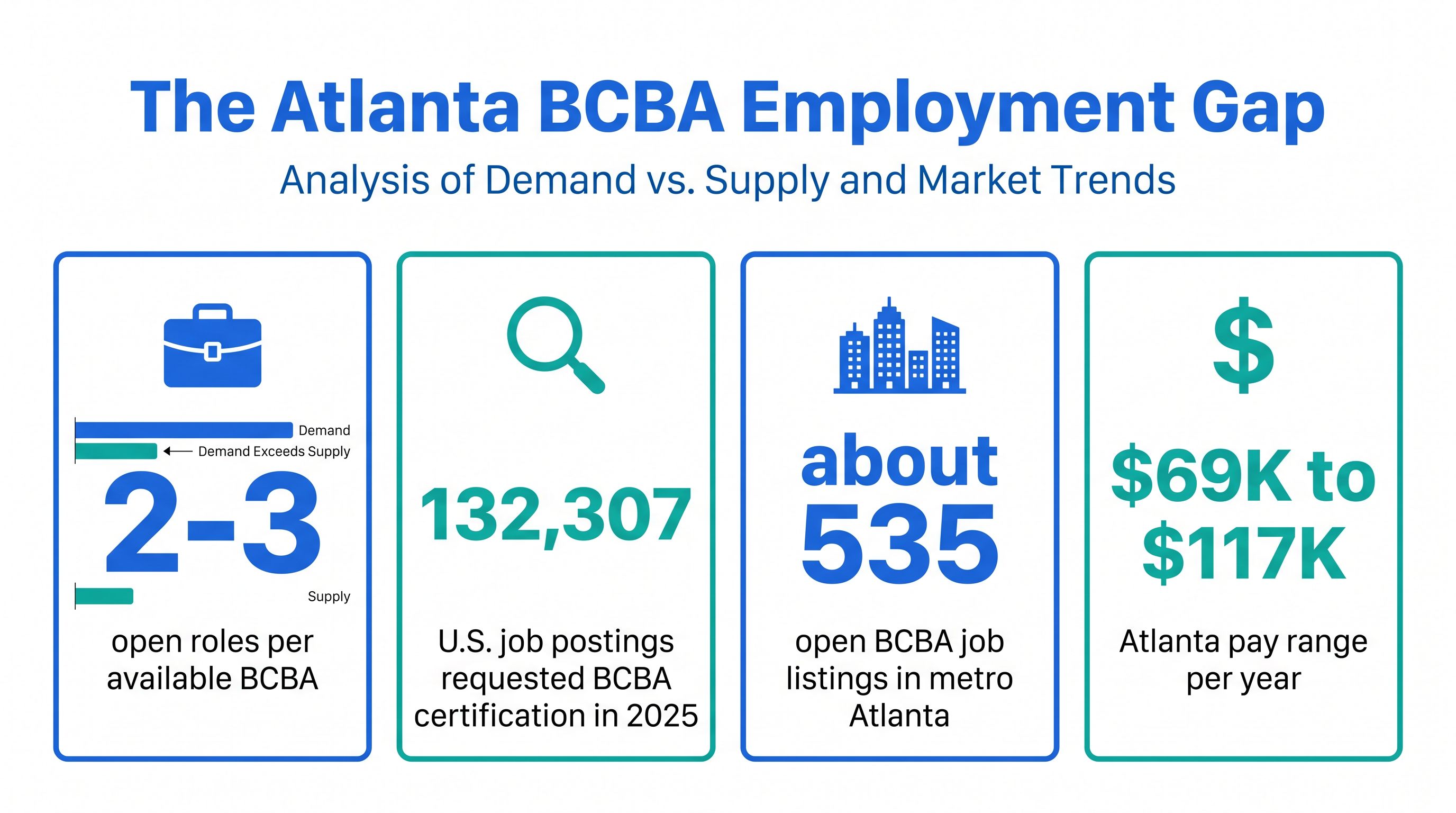
In a market this tight, the question is rarely whether you can find a BCBA job in Atlanta. It is which employer earns your yes.
For the state-wide view behind these metro numbers, see our BCBA jobs in Georgia guide and the broader 2026 BCBA shortage breakdown.
BCBA Salary in Atlanta: What You Can Actually Earn
Atlanta pay depends heavily on which number you look at, so it helps to understand why the estimates diverge. Government-style wage surveys report base salary only, while job boards often blend base pay with bonuses, stipends, and 1099 contract rates. Here is how the major sources stack up for 2025 and 2026:
- ✓ ZipRecruiter: average around $85,660 per year (about $41 per hour), with most roles between $71,200 and $87,000 and top earners near $127,419.
- ✓ Indeed: average around $95,817 per year for a board certified behavior analyst in Atlanta.
- ✓ Glassdoor: median total pay around $116,844 per year, a figure that folds in bonuses and additional compensation.
- ✓ Salary.com: average base around $69,180 per year (about $33 per hour), reflecting base-only methodology.
State wage data lands lower and more conservative: a metro Atlanta median near $58,990, with the 90th percentile around $96,320. Read together, the honest takeaway is a wide band. A new BCBA can reasonably expect the high-$60,000s to mid-$70,000s in base pay, while experienced analysts, supervisors, and clinical directors push well past $100,000 once bonuses and total compensation are counted.
The tight market also shows up directly in offers. Active Atlanta postings advertise $85,000 to $120,000 for full-time roles, sign-on bonuses as high as $20,000, relocation packages up to $15,000, and telehealth rates of $80 to $100 per hour. Those incentives exist because employers cannot fill seats fast enough. For a deeper state-level comparison, see our BCBA salary in Georgia guide.
Where the Atlanta Jobs Are: Settings and Employers
Demand in Atlanta is not concentrated in one setting. It is spread across the full range of ABA service models, which gives job seekers real choice in how and where they work:
- • Center-based clinics: National and regional providers run early-intervention and school-age centers throughout the metro and are among the most active hirers.
- • In-home and community services: Roles that supervise RBTs delivering care in family homes, often with flexible scheduling and mileage or travel stipends.
- • School-based and district contracts: Positions supporting IEP teams and classroom behavior support, frequently on a school-year calendar.
- • Telehealth and hybrid roles: Georgia-licensed remote supervision and assessment work, useful if you want to cut a long metro commute.
Geography matters too. The listings are not only intown; strong demand shows up across the suburbs, including Marietta, Alpharetta, Sandy Springs, Lawrenceville, and Decatur. Role types range from direct clinical BCBA and clinical supervisor to clinical director, assessment-only, and part-time or contract positions. If you want a rapid path into leadership, note that the same shortage fueling this demand is also fast-tracking supervisory and director roles for analysts with a few years of experience.
Georgia Licensure: What You Need to Work in Atlanta
BCBA certification through the BACB is the foundation, but it is not the whole requirement. Georgia licenses behavior analysts through the Georgia Behavior Analyst Licensing Board, administered under the Secretary of State. To practice in Atlanta you need both your national certification and an active state license, so factor the licensure step into your timeline when you plan a move or a first job.
Demand here is also propped up by insurance. Georgia's autism insurance mandate, known as Ava's Law, requires coverage for ABA therapy, which keeps a steady stream of authorized cases flowing to providers and, in turn, keeps them hiring. That policy backdrop is a big reason metro Atlanta demand has stayed durable rather than cyclical. For the specifics on credentials, applications, and renewals, see our Georgia ABA licensure requirements resource.
How to Land the Right Atlanta BCBA Job, Not Just Any Job
When employers are competing for you, the smart move is to raise your standards, not just collect offers. Use your leverage to screen for the things that actually determine whether a role is sustainable:
- ✓ Caseload and billable expectations: Ask for specific numbers. A vague answer here is a red flag.
- ✓ Supervision ratios and admin support: How many RBTs will you oversee, and who handles scheduling and billing?
- ✓ Ethics culture and clinical autonomy: Will you have the room to practice in line with the BACB ethics code?
- ✓ Total compensation: Base pay, bonus structure, PTO, and benefits together, not just the headline number.
Two of our guides pair well with this step: the questions to ask in an ABA interview and the best ABA companies to work for in 2026. And because demand is on your side, do not skip negotiation; our BCBA salary negotiation guide shows how to translate market leverage into a better offer.
This is also where CertifyndABA changes the dynamic. Instead of spraying your resume across a dozen boards and waiting, you build one anonymous profile that highlights your credentials, specialties, and location preferences. Vetted Atlanta employers then send you interview requests, often with pay ranges attached, and your identity stays private until you choose to accept. In a candidate's market, that flips the search so the right employers come to you.
Frequently Asked Questions
How many BCBA jobs are there in Atlanta?
Live job boards show several hundred openings at any given time; Glassdoor lists roughly 535 BCBA and behavior-analyst positions across metro Atlanta, with a few hundred filtering to "BCBA" specifically. That volume tracks the national gap, where 132,307 U.S. postings requested BCBA certification in 2025 against roughly 78,900 U.S. analysts (BACB / Lightcast).
How much does a BCBA make in Atlanta?
Estimates range widely by source and methodology: ZipRecruiter reports an average near $85,660, Indeed around $95,817, and Glassdoor a median total pay near $116,844, while base-only surveys land closer to $69,180 and state wage data shows a metro median near $58,990. New BCBAs typically start in the high-$60,000s to mid-$70,000s, while experienced analysts and directors clear $100,000 with bonuses.
Do I need a license to work as a BCBA in Atlanta?
Yes. Beyond your national BACB certification, Georgia requires a state license issued by the Georgia Behavior Analyst Licensing Board to practice. Plan for the licensure step in your job-search timeline, especially if you are relocating.
Where are the highest-paying BCBA jobs in Atlanta?
Clinical-supervisor and clinical-director roles sit at the top of the salaried range, with top earners near $127,419. Telehealth and hourly contract work can also pay $80 to $100 an hour, and the tight market means sign-on bonuses up to $20,000 and relocation packages appear regularly in listings.
The Bottom Line for Atlanta BCBAs
Metro Atlanta is one of the clearest examples of the national ABA employment gap playing out locally. Hundreds of open roles, a certified workforce too small to fill them, salaries that stretch from the high-$60,000s into six figures with bonuses, and demand spread across clinics, homes, schools, and telehealth. The leverage is real, and it is yours.
The analysts who win in this market are the ones who treat the search as a selection process rather than a scramble. Set your standards, ask hard questions, and let the demand work for you.
Let Atlanta employers come to you
Create a free, anonymous CertifyndABA profile and receive interview requests from vetted Atlanta ABA employers, with pay ranges up front. Your details stay private until you decide to respond.
Create Your Free Profile