

A BCBA internship is a paid or unpaid position where a graduate student in behavior analysis earns the supervised fieldwork hours required to sit for the BCBA exam. The Behavior Analyst Certification Board (BACB) never uses the word "internship." Its term is supervised fieldwork, and the person earning the hours is a trainee. Employers, universities and job boards use "BCBA intern," "BCBA trainee," "student analyst" and "BCBA-in-training" for the same thing.
The label matters less than what the job actually gives you. To find out, we read the full descriptions of 362 U.S. job ads for BCBA interns and trainees from 87 employers in 30 states, all live on job boards on September 30, 2026. This guide covers what those ads pay, what they promise about supervision, the BACB rules that decide whether your hours count, and how to tell a real BCBA internship from an RBT job with a nicer title.
What a BCBA internship is, in BACB terms
Before you can apply for the BCBA exam, you need a qualifying master's degree, the required behavior-analytic coursework, and a block of supervised fieldwork: 2,000 hours of Supervised Fieldwork or 1,500 hours of Concentrated Supervised Fieldwork, which requires a higher share of supervision (BACB, BCBA Handbook, June 2026). A BCBA internship is simply a job or placement where you earn those hours under a qualified supervisor.
Three BACB rules shape every internship, whatever it is called:
- ✓ Hours start with graduate coursework. You can begin counting fieldwork only after you have started qualifying graduate-level behavior-analytic coursework and signed a contract with a qualified supervisor. Undergraduates generally cannot earn BCBA fieldwork, which is why most undergrad "ABA internships" are really behavior technician jobs.
- ✓ The BACB does not care whether you are paid. Nothing in the handbook requires fieldwork to be paid, unpaid, or done at an employer. You and your supervisor need a formal relationship with the clients you serve: the same organization, service contracts with the client, or a contract with the organization.
- ✓ Your supervisor has to qualify before you start. The supervisor must be an active BCBA who has uploaded an 8-hour supervision training certificate to the BACB portal before signing your contract. A BCBA certified less than a year also needs a monthly consulting supervisor. You can check the training date in the BACB's public Certificant Registry.
Our BCBA fieldwork requirements guide covers supervision percentages and contact rules in detail. This article focuses on the job side: what BCBA internships pay and how to pick one.
How much do BCBA interns make?
Most BCBA internships are hourly jobs, and they pay about the same as registered behavior technician (RBT) work. Only 53% of the ads we read listed usable pay, so these figures come from the 191 postings that did:
| Role type | Median posted pay | Middle half of employers | Employers |
|---|---|---|---|
| Trainee roles with case-management duties | $26.71/hr | $24.56 to $29.09 | 20 |
| All hourly trainee and intern roles | $25.00/hr | $22.50 to $27.50 | 53 |
| RBT-style roles with "future BCBA" language | $24.00/hr | $22.50 to $26.50 | 36 |
| Salaried full-time trainee roles | $51,500/yr | $46,366 to $57,500 | 11 |
For comparison, our September 2026 read of RBT ads found a median of $24.50 an hour across 279 employers, and certified BCBA salaries had a median of $90,000 across 168 employers (see our RBT vs. BCBA comparison). So a BCBA internship pays roughly RBT wages. That RBT figure came from a separate read with a slightly different method, so treat the comparison as approximate. Case-management roles had a higher median when each employer counts once, but the samples are small and the gap disappears when you count individual ads instead (a $25.00 median for case-management ads against $26.00 for RBT-style ads), so do not expect a reliable premium. The salaried figure rests on only 11 employers, so treat it as a rough signal rather than a benchmark.
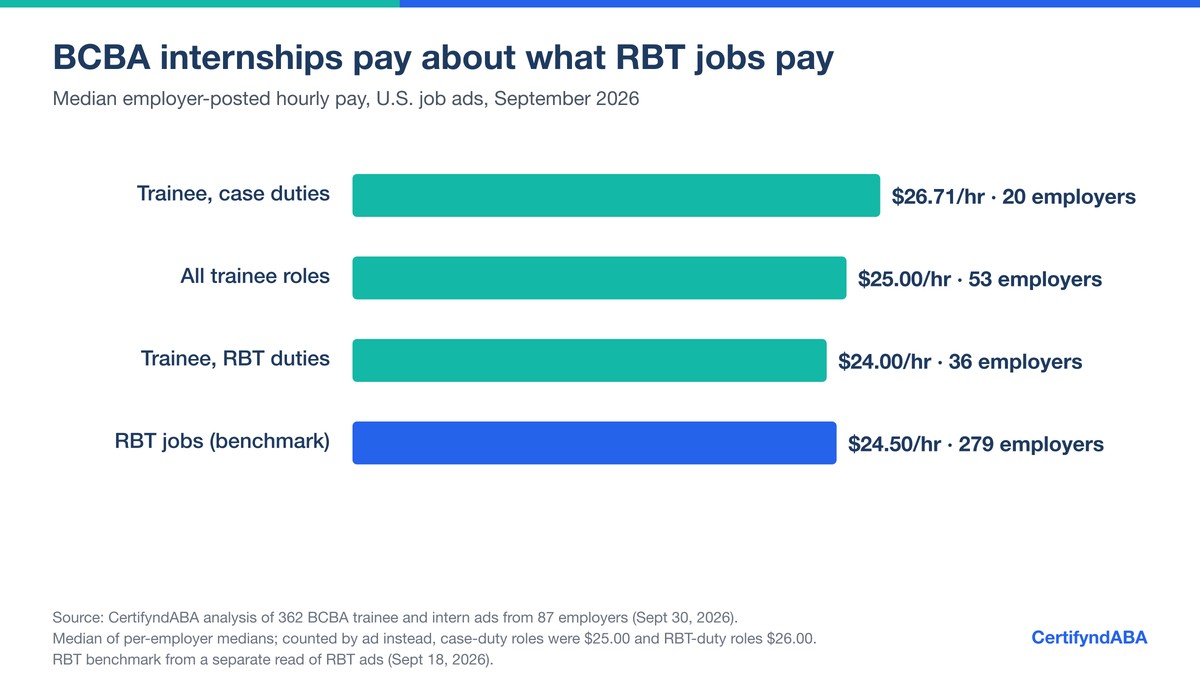
The practical takeaway: the pay difference between two internships is usually a dollar or two an hour, while the gap between intern pay and the $90,000 median for salaried BCBA jobs is tens of thousands of dollars a year. An internship that gets you to the exam three months sooner is worth far more than one that pays $1.50 an hour more. See our BCBA starting salary guide for what the first certified job pays.
Paid vs. unpaid BCBA internships
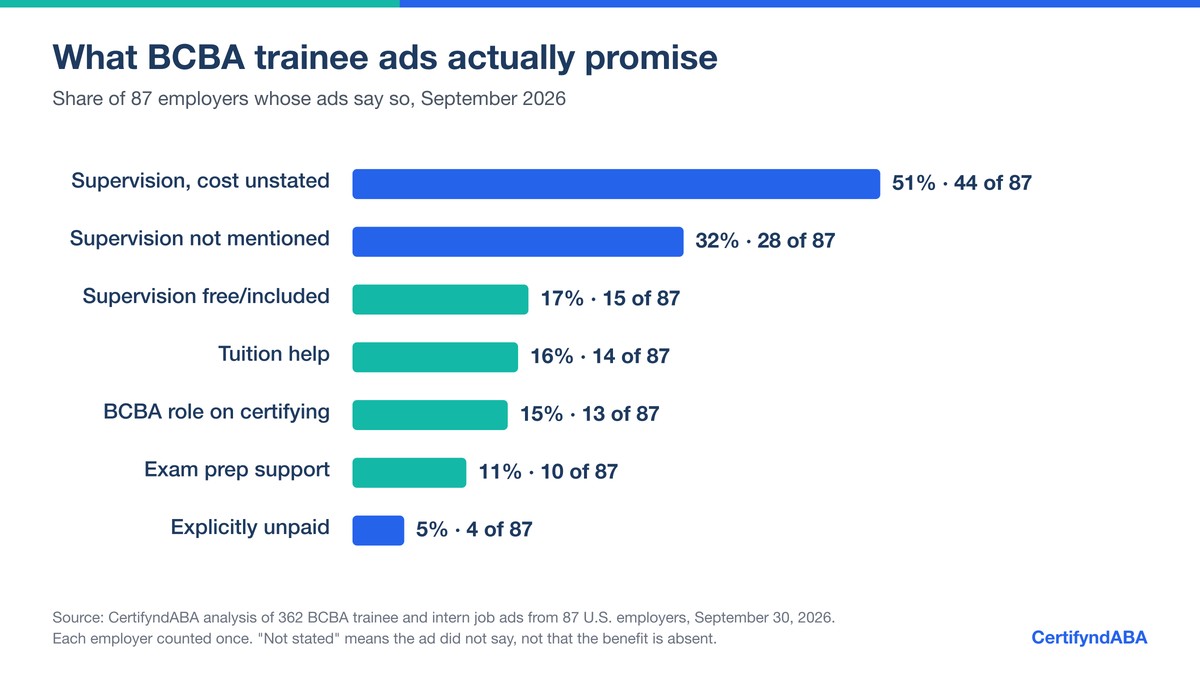
Unpaid BCBA internships exist, but they are rare on job boards. Only 4 of the 87 employers in our sample, about 5%, said outright that the role was unpaid. One described itself as "an unpaid internship designed to fulfill BACB supervised fieldwork requirements." Unpaid placements arranged directly through university programs would not show up in job ads, so the real share is probably somewhat higher.
Whether an unpaid internship is legal is a labor-law question, not a BACB one. For for-profit employers, the U.S. Department of Labor applies a "primary beneficiary" test with seven factors (Fact Sheet #71). They include whether the internship is tied to your formal education through coursework or academic credit, whether it follows the academic calendar, whether its training resembles an educational setting, and whether your work complements rather than displaces paid employees. No single factor decides the outcome. The same fact sheet notes that unpaid internships at public agencies and nonprofit charities, where the intern volunteers without expecting to be paid, are generally permissible.
In practice, watch for a mismatch. If a for-profit ABA company bills insurance for sessions you deliver, relies on you to cover a caseload, and has no link to your university program, several of those factors point toward employee status. This article is not legal advice; ask why the role is unpaid, and talk to your program's fieldwork coordinator, your state labor department or an employment lawyer before you accept.
Who pays for supervision?
This is one of the most practical questions a trainee faces, and the BACB does not answer it. The handbook sets no price for supervision and does not say who pays. It does allow trainees to pay a supervisor directly: it states that "compensation paid to the supervisor by the trainee for supervision services" does not count as the supervisor being employed by the trainee. Independent supervision is therefore permitted, which is the usual fallback when a workplace has no BCBA with room to supervise.
Here is what the ads said about supervision, counting each employer once so that large chains do not dominate the numbers:
- ✓ 17% said supervision was free or included. The strongest ads said so plainly: "No-cost supervision hours! No deductions from pay or claw backs for the dedicated supervision time."
- ✓ 51% said supervision was provided but did not state the cost or whether supervision meetings happen on paid time.
- ✓ 32% did not mention supervision at all, even though the title advertised a trainee or intern role.
No ad stated a supervision fee. That does not mean no employer charges one; employers that charge rarely advertise it. Watch for two quieter versions of the same thing: a "clawback" clause that makes you repay supervision costs if you leave before a set date, and supervision meetings scheduled outside your paid hours. Ask about both in writing.
The BACB Ethics Code is relevant here. Standard 1.13 bars behavior analysts from coercing or exploiting people they supervise, and the code's definition of a conflict of interest names financial considerations that can compromise judgment in supervision. An employer who controls both your paycheck and the signature on your monthly fieldwork forms holds real power, so get supervision terms, costs and any repayment conditions into your contract before you start.
Real BCBA internship or RBT job with a new title?
More than half of the employers in our sample, 56%, mostly posted what are really RBT jobs: one-to-one direct therapy with a line about growing toward the BCBA. The other 41% described trainee roles with case-management work, such as assessments, writing treatment plans, parent training or overseeing RBTs. (Measured by posting rather than by employer, case-management roles were 52.5%, because a few large employers posting many case-management trainee ads account for much of the sample.)
The difference is not cosmetic. At least 60% of your fieldwork hours must be unrestricted activities, the work "most likely to be performed by a BCBA": assessments such as functional analyses, graphing and analyzing data, writing and revising programs, and training staff and caregivers. Direct therapy is restricted, and restricted hours are capped at 40%, or 800 of 2,000 hours. At the maximum pace, a pure RBT role fills that cap in about six months under the current 130-hour monthly limit, or five months under the 2027 limit of 160. After that, more direct therapy adds nothing to your eligibility. Our restricted vs. unrestricted hours guide lists which tasks fall on each side.
An RBT job can still be a good starting point, especially while you finish your first courses. Just make sure it has a path to unrestricted work within the first few months, and get that promise in writing.
How long a BCBA internship takes
The BACB caps how many fieldwork hours you can count each month, and the cap is changing. Which rules apply depends on the date you submit your exam application, not on when you earned the hours (BACB, 2027 transition guide):
| If you apply | Hours per month | Fastest 2,000-hour finish | Fastest 1,500-hour concentrated finish |
|---|---|---|---|
| By December 31, 2026 | 20 to 130 | 16 months | 12 months |
| January 1, 2027 or later | 20 to 160 | 13 months | 10 months |
If you are starting a BCBA internship now, you cannot finish 2,000 hours before January 2027, so plan under the 2027 rules. Reaching 160 hours a month means about 37 hours a week of countable fieldwork, which only a full-time role with steady unrestricted work can deliver. At the other end, the BACB allows up to five years to complete fieldwork. Concentrated fieldwork is also changing in 2027: its required supervision drops from 10% to 7.5% of hours. For the whole timeline from coursework to exam, see how long it takes to become a BCBA.
How to find a BCBA internship
Searching only for "BCBA internship" misses most openings. In our sample, the same roles appeared under a dozen titles.
- Search every title variant. Try "BCBA trainee," "behavior analyst trainee," "student analyst," "BCBA-in-training," "BCBA candidate," "practicum," "apprentice," "clinical fellow" and "case supervisor in training," along with "intern." Our BCBA-in-training jobs guide covers the main search channels.
- Start with your program's fieldwork coordinator. University-arranged placements rarely appear on job boards, and the program already knows which sites supervise well.
- Look beyond clinics. Among employers with trainee ads, 54% named a clinic or center, 33% in-home services and 30% schools. Hospital programs were rare at about 3%, so apply early if that setting matters to you.
- Ask your current employer. If you already work as an RBT, ask whether a BCBA there can supervise your fieldwork; the handbook points trainees to someone at their own organization as the usual first place to find a supervisor. An internal move into a trainee role may never be posted publicly.
- Check the supervisor, not just the company. Before you sign, confirm in the BACB Certificant Registry that your named supervisor has completed the 8-hour supervision training.
Questions to ask before you accept
Fewer than a third of employers, 30%, mentioned tuition help, exam prep or a guaranteed BCBA role after certification. Individually, those perks were rarer still: 16% offered tuition reimbursement or discounts, 11% exam prep, and 15% a stated BCBA role once you certify. If an ad is silent, ask. Our list of questions to ask in an ABA interview covers the general ones; these are specific to a BCBA internship:
- ✓ Supervision. Who will supervise me, how many other trainees does that person supervise, and are supervision meetings on paid time? Is there any fee or repayment clause?
- ✓ Hours. How many countable fieldwork hours will I realistically earn each month, and what share will be unrestricted? When will I start assessments and program writing?
- ✓ Paperwork. Who tracks my hours? Each Monthly Fieldwork Verification Form must be signed by the last day of the following month, and both you and your supervisor keep fieldwork forms for at least seven years after you certify. The BACB does not endorse any tracking app, so check the numbers yourself.
- ✓ What happens after the exam. Is there a BCBA role and a stated salary waiting when I pass, and is that written into my offer?
Why BCBA internships favor you right now
Employers posted 132,307 U.S. job ads in 2025 that required or preferred BCBA certification, up 28% from 2024, according to a BACB report built on Lightcast data. BACB certificant data lists 81,264 BCBAs and BCBA-Ds in the United States as of September 30, 2026. Job ads are not the same as open positions, and one opening can be posted many times, but demand has risen every year since 2010. Meanwhile, only 51% of all first-time candidates passed the BCBA exam in 2025 (BACB annual data), so employers have a real reason to train their own analysts rather than wait to hire them.
That is your leverage. Employers that do offer supervision, tuition help or a guaranteed role are competing for you, because a trainee they develop is a BCBA they do not have to recruit. You can afford to turn down an internship that is vague about supervision, keeps you in direct therapy, or makes you pay back training costs if you leave.
Frequently asked questions
What is a BCBA internship?
A BCBA internship is a paid or unpaid role where a graduate student earns the supervised fieldwork hours required for the BCBA exam. The BACB calls this supervised fieldwork, not an internship, and requires 2,000 Supervised Fieldwork hours or 1,500 Concentrated Supervised Fieldwork hours under a qualified BCBA supervisor.
How much do BCBA interns make?
In our September 2026 analysis of 362 job ads from 87 employers, hourly BCBA trainee and intern roles had a median of $25.00 an hour across 53 employers that listed pay. Pay was close to RBT wages, and roles with case-management duties did not pay reliably more than RBT-style roles.
Are BCBA internships paid?
Most advertised ones are. Only 4 of 87 employers in our job-ad sample described an unpaid role, though unpaid placements arranged through universities rarely reach job boards. The BACB has no rule requiring fieldwork to be paid or unpaid; for for-profit employers, the Department of Labor uses a primary beneficiary test to judge whether an unpaid intern should be treated as an employee.
Do I have to pay for BCBA supervision?
Not always. The BACB sets no price and allows trainees to pay a supervisor directly. Among employers advertising trainee roles, 17% said supervision was free or included and 51% offered supervision without stating the cost, so ask about fees, paid time and repayment clauses before you accept.
Can undergraduates get a BCBA internship?
Undergraduates generally cannot earn BCBA fieldwork hours, because hours can only start after qualifying graduate-level behavior-analytic coursework begins. Undergraduates can work as behavior technicians or become RBTs, which requires being at least 18 with a high school education, passing background checks, completing a 40-hour training and a competency assessment, and passing the RBT exam.
How long does a BCBA internship take?
The monthly cap depends on when you apply for the exam. If you apply on or after January 1, 2027, the cap is 160 hours and 2,000 hours take at least 13 months of full-time fieldwork. If you apply by December 31, 2026, the cap is 130 hours and 2,000 hours take at least 16 months. Concentrated fieldwork of 1,500 hours can take as little as 10 months under the 2027 rules.
Let the right internship find you
Create a free, anonymous CertifyndABA profile showing your coursework and fieldwork progress. Employers that want BCBA trainees send you interview requests, and your name stays private until you choose to connect.
Create Your Free ProfileHow we analyzed the job ads: On September 30, 2026, we searched SimplyHired (national title queries plus two queries in every state and Washington, DC) and LinkedIn's public job listings for BCBA intern, trainee and in-training titles. We read the full description of each ad and kept 362 unique U.S. postings from 87 employers in 30 states, dropping ads older than one year and duplicates; remote-only roles were left out of the pay figures. Pay uses the employer's own figure; open-ended ranges ("starts at," "up to") and job-board estimates were excluded. Pay medians are the median of each employer's median, so one large employer counts once; four chains posted 48% of all ads. Percentages based on 87 employers carry a margin of roughly 10 points either way, and "not mentioned" means only that the ad did not say. RBT and BCBA comparison figures come from a separate CertifyndABA read of job ads published September 18, 2026.