

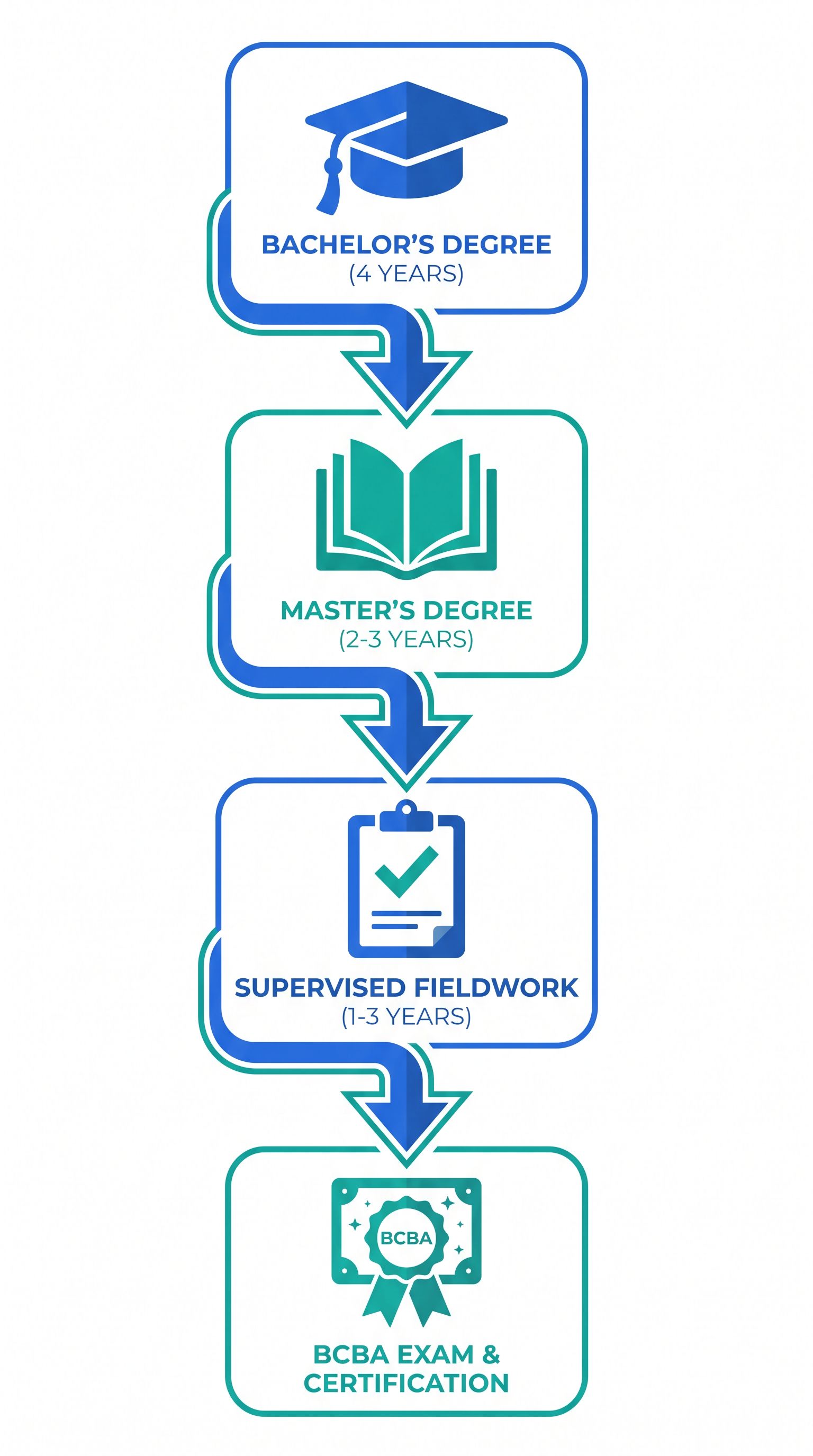
How long does it take to become a BCBA? The short answer: 6 to 10 years from the start of a bachelor's degree. If you already hold a qualifying master's, you can cut that to 2 to 3 years. The timeline depends on your starting point, whether you study full-time or part-time, and how quickly you accumulate fieldwork hours. Below is a detailed breakdown of every step, realistic timelines from three different starting points, and why the lengthy pipeline makes certified BCBAs more in demand than ever.
Step-by-Step BCBA Timeline
The Behavior Analyst Certification Board (BACB) sets the requirements for earning your BCBA credential. Each step has a defined scope, but the time you spend on each one varies based on your pace and circumstances.
Step 1: Earn a Bachelor's Degree (4 Years)
You need a bachelor's degree before enrolling in a BACB-approved master's program. Most aspiring BCBAs major in psychology, education, or a related behavioral science, though the BACB does not require a specific undergraduate major. This step takes a standard four years of full-time study.
Step 2: Complete a Master's Degree (2 to 3 Years)
A master's degree in applied behavior analysis or a related field is required. Your program must include 315 graduate-level instructional hours across six BACB content areas. Full-time students typically finish in two years. Part-time students, many of whom work as RBTs while studying, should plan for 2.5 to 3 years (Research.com, 2026).
Step 3: Complete Supervised Fieldwork (1 to 3 Years)
Fieldwork is where most of the timeline variability occurs. The BACB offers two pathways:
- Supervised fieldwork: 2,000 hours with a minimum of 5% direct supervision
- Concentrated supervised fieldwork: 1,500 hours with a minimum of 10% direct supervision
You can log between 20 and 130 hours per month, and at least 60% of your hours must involve unrestricted activities such as designing interventions, training staff, and conducting assessments. At 25 hours per week, the concentrated pathway takes approximately 18 months (BACB, 2026). At 10 hours per week, expect closer to 36 months.
Many master's programs allow you to begin fieldwork during your second year of coursework. This overlap is the single biggest way to shorten your overall timeline.
Step 4: Pass the BCBA Examination (2 to 6 Months)
The BCBA exam consists of 185 multiple-choice questions (175 scored, 10 pilot) with a four-hour time limit. It is based on the 6th Edition Task List, which covers 104 tasks across nine content domains.
Exam preparation typically takes two to four months of dedicated study. However, the declining pass rate is an important factor for timeline planning. According to BACB annual data, the first-time pass rate has dropped from 66% in 2020 to 51% in 2025. That means nearly half of first-time test-takers need at least one retake, adding three to six months per attempt.
Step 5: Obtain State Licensure (1 to 3 Months)
Most states require behavior analysts to hold a state license in addition to BACB certification. Processing times vary, but most applications are approved within one to three months. Check your state's licensing board for specific requirements.
3 Real-World Timelines for Becoming a BCBA
Your starting point dramatically affects how long it takes to become a BCBA. Here are three common scenarios with realistic timelines.
Scenario 1: Starting from a Bachelor's Degree
Total time: approximately 7 to 8 years
- Bachelor's degree: 4 years
- Master's degree with embedded fieldwork: 2.5 years
- Remaining fieldwork (if not completed during master's): 0 to 6 months
- Exam preparation and testing: 3 to 6 months
- State licensure: 1 to 3 months
This is the most common path. The key to staying closer to seven years rather than ten is choosing a master's program that integrates fieldwork from the start and studying for the exam before your fieldwork ends.
Scenario 2: Already Have a Qualifying Master's Degree
Total time: approximately 2 to 3 years
- Additional BACB coursework (if your degree did not include all 315 required hours): 1 semester to 1 year
- Supervised fieldwork: 1 to 2 years
- Exam preparation and testing: 3 to 6 months
If your master's program was not BACB-approved, you may need to complete supplemental coursework to meet the 315-hour requirement. Several universities offer certificate programs designed specifically for this purpose (ABA Study Guide).
Scenario 3: RBT Looking to Advance
Total time: approximately 4 to 5 years
- Master's degree (part-time while working as RBT): 2.5 to 3 years
- Supervised fieldwork (often concurrent with final year of master's): 1 to 1.5 years
- Exam preparation and testing: 3 to 6 months
Working as an RBT gives you a significant practical advantage. You already understand ABA principles in practice, which helps with both fieldwork and exam preparation. However, your RBT hours do not count toward BCBA fieldwork requirements; you will need to log separate supervised hours under a qualified BCBA supervisor. For a detailed walkthrough, see our RBT to BCBA timeline guide.
What Speeds Up or Slows Down Your BCBA Timeline
Accelerators
- ✓ Full-time enrollment in a program with embedded fieldwork can save 1 to 2 years
- ✓ Concentrated fieldwork pathway requires 1,500 hours instead of 2,000, saving several months
- ✓ Starting fieldwork during your master's overlaps two major phases
- ✓ Studying for the exam early so you can test immediately after fieldwork completion
Common Delays
- Part-time study: Adds 1 to 2 years to the master's degree alone
- Exam retakes: With a 51% first-time pass rate (2025), plan for potential retakes that add 3 to 6 months each
- Fieldwork supervisor availability: Finding a qualified supervisor in rural areas can delay your start by months
- Financial constraints: Taking breaks between degrees or reducing fieldwork hours to maintain employment extends the timeline
2027 Changes That May Affect Your Timeline
The BACB has announced several changes effective January 1, 2027, that future candidates should be aware of (BACB Upcoming Changes):
- Certification Pathways 3 and 4 will be discontinued (all pathways phase out except Pathway 1 by 2032)
- Maximum monthly fieldwork hours increase from 130 to 160, potentially allowing faster fieldwork completion
- Concentrated supervision ratio drops from 10% to 7.5%
- Basic Principles of Behavior and Theory and Philosophy of Behavior Analysis must each be standalone courses
Why the Long Timeline Creates Record BCBA Demand
The 6-to-10-year certification pipeline is one of the main reasons the ABA field faces such a significant workforce shortage. The numbers tell the story clearly.
According to the BACB/Lightcast employment demand report, there were 132,307 BCBA job postings in 2025, a 28% increase from 103,150 in 2024. In 2010, there were just 789. Meanwhile, there are approximately 83,586 active BCBAs as of April 2026 (BACB Certificant Data).
The math is striking: job postings outpace active certificants by roughly 50,000. And with only about 8,000 new BCBAs certifying each year, the supply cannot keep up with demand that is growing by tens of thousands of postings annually.
"In 2010, there were 789 BCBA job postings in the United States. By 2025, that number had reached 132,307. Demand grew 167 times in 15 years while the pipeline to produce new BCBAs remained a multi-year process."
Several factors are driving this gap:
- Rising autism prevalence: The CDC now reports a rate of 1 in 31 among eight-year-olds (3.2%), up from previous estimates
- Insurance mandate expansion: All 50 states now require some level of autism coverage, increasing demand for ABA services
- Geographic scarcity: Roughly half of U.S. counties still have zero practicing BCBAs, and 66% of specialty centers report waitlists of four months or longer
- BLS projections: The Bureau of Labor Statistics projects 17% job growth for behavioral health roles from 2024 to 2034, classified as "much faster than average"
For current and aspiring BCBAs, this shortage translates directly into job security, competitive salaries, and significant career flexibility. To see just how many BCBAs there are relative to demand, the picture is clear: the field needs more certified professionals.
Is the Time Investment Worth It?
Six to ten years is a significant commitment. Here is why the return on that investment is stronger than it has ever been.
Salary: The average BCBA salary is approximately $89,000 nationally (ZipRecruiter, 2026), with entry-level positions starting between $60,000 and $80,000. Clinical directors and experienced BCBAs in high-demand states earn $100,000 or more. For a deeper look, explore our BCBA starting salary guide.
Job security: With 132,307 openings against roughly 83,000 active BCBAs, certified professionals can afford to be selective about where they work. The BLS projects 17% job growth through 2034, well above the national average for all occupations.
Earn while you learn: Many aspiring BCBAs work as Registered Behavior Technicians while completing their master's and fieldwork. RBTs earn between $35,000 and $50,000 annually, reducing the financial burden of the certification journey.
Career flexibility: BCBAs work in clinical settings, schools, hospitals, insurance companies, telehealth platforms, private practices, and consulting roles. The field is diversifying rapidly, and the range of BCBA career paths continues to grow.
The employment gap means that when you complete your certification, employers are actively competing for your attention. On platforms like CertifyndABA, companies send interview requests to you based on your qualifications; you do not need to send out applications.
Start Your BCBA Journey
Becoming a BCBA takes 6 to 10 years of education, fieldwork, and exam preparation. It is a substantial investment of time and effort. But with 132,307 job postings in 2025, only about 8,000 new BCBAs certifying each year, and a first-time exam pass rate of 51%, every professional who earns this credential enters a field where demand far outpaces supply.
The best time to start was years ago. The second-best time is today.
Ready to Put Your BCBA Credential to Work?
Whether you just passed the exam or you are an experienced BCBA exploring new opportunities, CertifyndABA lets you showcase your credentials anonymously and receive interview requests from employers who value your expertise.
Create Your Free Profile